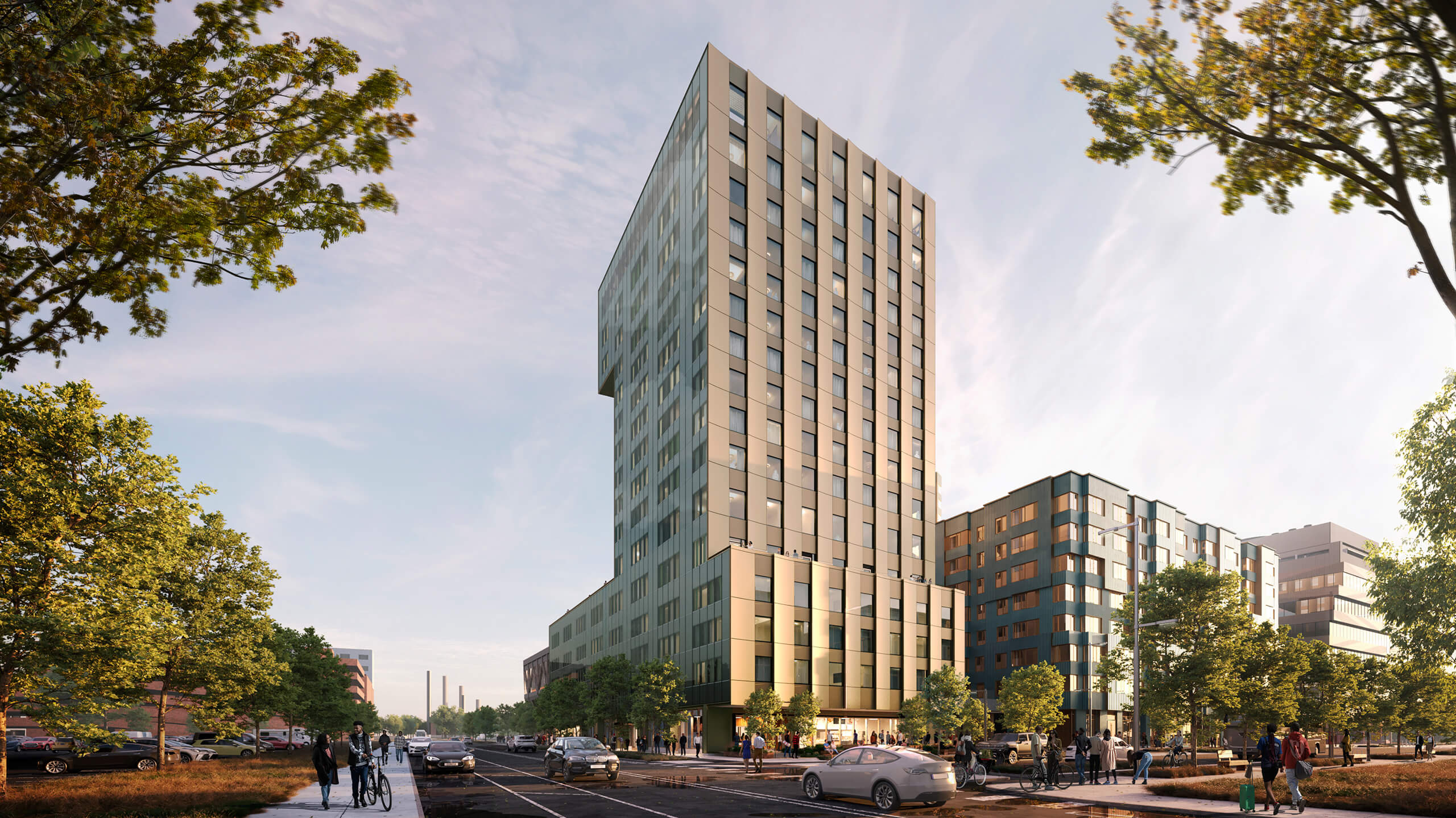
Harvard Enterprise Research Campus | 100 Western Avenue | Allston

MIT is so far ahead of Harvard in what's been built in the last 30 years, it's ridiculous. But then again, MIT had the huge advantage of working with a backdrop of old industrial buildings, rehabbing and repurposing those, and slipping in handsome new buildings to complement the old.
In contrast, Harvard in Allston was working in a vacuum on a large plat of leveled, vacant land, thus producing a sterile suburban office park replete with oddball, mismatched architectural novelties. Aaah Harvard, how could you be so clueless.
 
This looks extraordinarily bad, it’s a bit embarrassing for such a prestigious university.
Yeah, I totally agree. Growing up I had an affinity for Harvard, walking through Harvard yard every day to high school, some of my teachers Harvard grads, and classmates and friends who had parents associated with Harvard. So it is disappointing for me to see Harvard deliberately producing this massive train wreck. They could have developed a really attractive and lively urban community here, with real city blocks, small streets, mixed use, a variety of heights, and buildings that actually visually complemented each other. But instead we get a suburban office park with downright hideous structures seemingly tossed randomly out onto a bleak, sterile prairie. All I can say is, WTF?
 
Gang Studios messed up speccing a very dark glass. With a building like their's - timber and a highly public venue, you would think a highly transparent glass would fit right in.
Yea it looks like theyre using pergo on the facade. Wtf.
 
MIT is so far ahead of Harvard in what's been built in the last 30 years, it's ridiculous. But then again, MIT had the huge advantage of working with a backdrop of old industrial buildings, rehabbing and repurposing those, and slipping in handsome new buildings to complement the old.
In contrast, Harvard in Allston was working in a vacuum on a large plat of leveled, vacant land, thus producing a sterile suburban office park replete with oddball, mismatched architectural novelties. Aaah Harvard, how could you be so clueless.

…..and Northeastern is running rings around both of them.
 
This development is Tishman Speyer's, not Harvard's. Harvard sold Tishman Speyer a ground lease; Having purchased the ground lease, Tishman Speyer proceeded to design and construct buildings on the leased land. Tishman Speyer will own the buildings for up to 95 years. After that, the buildings revert to Harvard ownership. MIT occasionally will use ground leases to develop land it owns in Kendall. More often though, MIT will develop the property as if it were a private sector developer..

The financial arrangement for the Harvard Enterprise campus as detailed by Google AI.

Key financial components
  • Long-term ground lease: Harvard, which owns the underlying land, entered a 95-year ground lease agreement with Tishman Speyer. To fund the significant infrastructure costs associated with developing the formerly industrial land, Harvard received an upfront payment for the full value of the lease, rather than receiving regular payments over time.
  • Major construction loan: For the first phase of the project, which broke ground in 2023, Tishman Speyer secured a $750 million construction loan from Otera Capital. At the time, this was one of the largest such loans for a U.S. development project in 2023.
  • Inclusive equity investment: As part of a partnership with the Harvard Allston Land Company, Tishman Speyer created an inclusive investor initiative. This program raised over $30 million in equity from more than 150 Black and Hispanic individuals and households, making it one of the largest inclusionary investor initiatives in Boston's history.
  • Joint venture for lab space: The life science labs within the ERC are developed and operated by Breakthrough Properties, a joint venture between Tishman Speyer and Bellco Capital.
  • Affordable housing commitment: To secure community approval, the project includes a commitment for 25% of its 343 rental apartments to be designated as affordable housing. These units are reserved for individuals and families earning between 30% and 100% of the area median income (AMI). This is a higher percentage than typically required by Boston housing policy.
  • Community benefits and infrastructure: The project is part of a larger community benefits package. The city of Boston also contributes to the Allston I-90 Multimodal Project, a related infrastructure initiative, through "value capture," where the increase in property values around the new development helps fund the infrastructure.
 
Last edited:
Interesting that the new hotels in Boston (Atlas here and Strider in Boston Landing) are independent and not going with national chain branding. Seems like this is unique to Boston. If you go to Dallas, as an example, there are very few independent hotels.
 
I like the staircase 😮
1761688773533.png
 
Love the way they were able to 'thin out' those stairs with the steel infrastructure.
 
Interesting that the new hotels in Boston (Atlas here and Strider in Boston Landing) are independent and not going with national chain branding. Seems like this is unique to Boston. If you go to Dallas, as an example, there are very few independent hotels.
It's not so uncommon for hotels that position themselves in the luxury space. They still have a management company (Highgate manages several non-branded luxury hotels), they just keep that in the background, resting on amenities, location, what have you, rather than national branding.

What is most interesting to me about both of these, is that they are clearly betting on this area becoming the next Seaport. Otherwise, they probably would go a bit lower on the exclusivity scale.
 
The project is indicative of the institutional rot and lack of ideas at all american institutions. The entire machinery moves automously without vision or oversight--the university has a goal to expand its footprint so they can hire more people, so they purchase land, they pay for buildings, the buildings are built. At no point does anyone ask why or how. The only restraints being the international mechanical code and the institutional masterplan. Neither the architects or the university cares about this project since the check is already in the mail. When this was financed Harvard was still the king of the world--they could have built Hogwarts but instead they built Winnepeg.
This.
 
I see this project as unconnected visually and functionally from the existing adjoining Allston community. This new development doesn't have a meaningful street grid, doesn't have much housing, affordable or otherwise, not much retail, and it doesn't have any kind of architectural unity or cohesiveness. It's just a bunch of misfit buildings thrown randomly like dice onto a giant empty lot next to, and unconnected to, the existing neighborhood. Harvard could have built a finely grained, exciting mixed-use urban environment connected to, and giving life to, the community of Allston. Instead we get an isolated suburban office park.
 
Last edited:
Usually when an interesting or important new building or development is built in Boston, I grab a nice camera and visit to take a small slide show. It's rare, but I'm going to pass on this one.
 

Back
Top