
You are using an out of date browser. It may not display this or other websites correctly.
You should upgrade or use an alternative browser.
You should upgrade or use an alternative browser.
Middlesex County Courthouse Redevelopment | 40 Thorndike St | East Cambridge
- Thread starter timsox6
- Start date

Charlie_mta
Senior Member
- Joined
- Jul 15, 2006
- Messages
- 5,090
- Reaction score
- 7,618
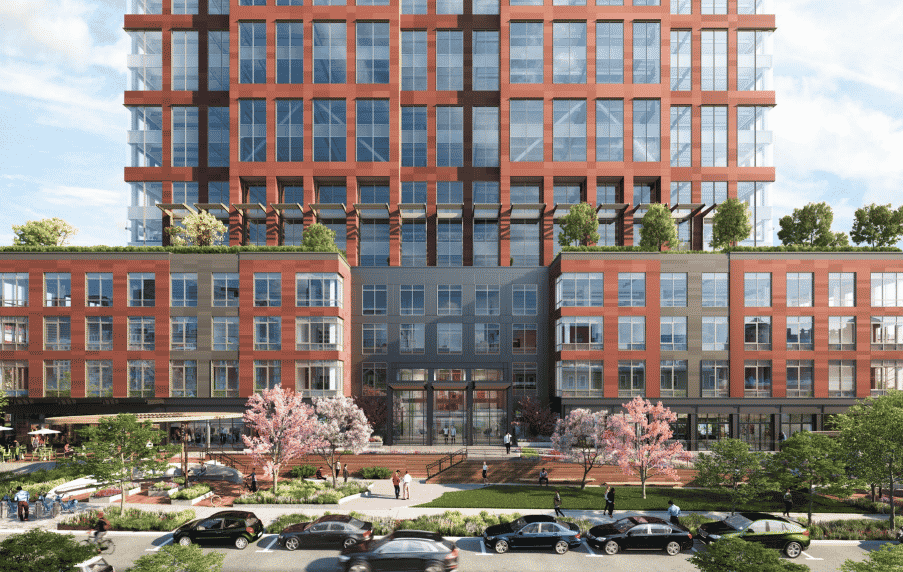
I like it, except for the wire awnings sticking out at the top and around the 5th floor. They look a bit superfluous and cluttery.

stick n move
Superstar
- Joined
- Oct 14, 2009
- Messages
- 13,361
- Reaction score
- 23,947

I drove by this last night and what stood out to me was that all the floors still had the construction lighting. Does anybody know when this is actually supposed to open? I guess I just assumed it was closer to done since it's been externally completed for months.

BACsop
Senior Member
- Joined
- Jun 1, 2019
- Messages
- 1,836
- Reaction score
- 7,630
I drove by this last night and what stood out to me was that all the floors still had the construction lighting. Does anybody know when this is actually supposed to open? I guess I just assumed it was closer to done since it's been externally completed for months.
Pretty sure it is open, there are just no tenants leased in the office portion yet. I believe people have started moving into the small residential portion on the lower floors.
This makes sense for office floors if no tenants have been signed up. The only place where the developer would probably spend money would be the elevator lobbies, if their intent is to demise floor plates into multiple tenants. Otherwise they will leave construction lighting in a "dark shell" until a tenant begins their build-out.I drove by this last night and what stood out to me was that all the floors still had the construction lighting. Does anybody know when this is actually supposed to open? I guess I just assumed it was closer to done since it's been externally completed for months.
RandomWalk
Senior Member
- Joined
- Feb 2, 2014
- Messages
- 3,716
- Reaction score
- 6,506
I had heard that the landlord was hoping to pitch the whole space to Hasbro as a HQ.
bigpicture7
Senior Member
- Joined
- May 5, 2016
- Messages
- 4,043
- Reaction score
- 10,370
Some news on this one:
 bankerandtradesman.com
Glass half-empty news: the extended office vacancy is (as one can imagine) causing serious financial ramifications and the lender seems to be taking over the property
bankerandtradesman.com
Glass half-empty news: the extended office vacancy is (as one can imagine) causing serious financial ramifications and the lender seems to be taking over the property
Glass half-full news: apparently there is a negotiation in-process for a lease on 1/3 of the tower:
Credit to Banker & Tradesman for the story
Lender Takes $72M Charge-Off on Cambridge Courthouse Conversion
Prolific commercial real estate lender Bank OZK is taking a $72 million loss on the construction loan for the 40 Thorndike tower.
bankerandtradesman.com
Glass half-full news: apparently there is a negotiation in-process for a lease on 1/3 of the tower:
“The project continues to be in active competition and negotiations for a potential tenant for approximately one-third of the building, and that process is now expected to continue, likely to mid-year,” the bank’s fourth quarter report states.
Credit to Banker & Tradesman for the story
FormFollowsBudget
Senior Member
- Joined
- Jan 15, 2015
- Messages
- 2,309
- Reaction score
- 4,100
Admittedly, I don't walk in this neighborhood much, but was down there rather recently.
This building is eerily empty. At the time, the leaves all over the place indicated 0 people have been there in weeks, I'm sure the snow is doing the same thing..
It may have worked if this opened at the peak of the building boom, but other than that, it's a bit of a strange location for all this.
This building is eerily empty. At the time, the leaves all over the place indicated 0 people have been there in weeks, I'm sure the snow is doing the same thing..
It may have worked if this opened at the peak of the building boom, but other than that, it's a bit of a strange location for all this.
Charlie_mta
Senior Member
- Joined
- Jul 15, 2006
- Messages
- 5,090
- Reaction score
- 7,618
Hindsight's always 20/20, but too bad they hadn't developed this as all residential with ground floor retail. Functionally, that would have fit into East Cambridge better, IMO.
Justbuildit
Senior Member
- Joined
- Nov 27, 2022
- Messages
- 1,063
- Reaction score
- 3,709
We're watching a number of trends collide here in real time, from once-cheap capital, to Cambridge exuberance, to pandemic effects. Class A is doing better in Boston, but there's still a ton of softness in the market. Someone is going to love this place at the right price, but there's going to be a bloodbath before then.

 www.bostonglobe.com
Today, just a half-mile away, the bank that financed the conversion of the old Sullivan Courthouse into a brand-new 20-story office tower said it has already lost $72.4 million on the project, and will soon force a fire sale if the developers can’t either start filling it or find new investors.
If Bank OZK does end up foreclosing on 40 Thorndike, it could end up selling to a new owner who’d pay far less than the project cost to build, said Andrew Maher, managing partner of real estate firm Anchor Line Properties. He estimated that it cost Leggat McCall and Granite approximately $800 per square foot to develop the 475,000-square-foot property, or around $380 million.
How the sale of a brand-new, empty office building in Cambridge will reshape the real estate market - The Boston Globe
The building could sell for less than half what its developers paid to build it.
www.bostonglobe.com
Today, just a half-mile away, the bank that financed the conversion of the old Sullivan Courthouse into a brand-new 20-story office tower said it has already lost $72.4 million on the project, and will soon force a fire sale if the developers can’t either start filling it or find new investors.
If Bank OZK does end up foreclosing on 40 Thorndike, it could end up selling to a new owner who’d pay far less than the project cost to build, said Andrew Maher, managing partner of real estate firm Anchor Line Properties. He estimated that it cost Leggat McCall and Granite approximately $800 per square foot to develop the 475,000-square-foot property, or around $380 million.
bigpicture7
Senior Member
- Joined
- May 5, 2016
- Messages
- 4,043
- Reaction score
- 10,370
I agree this was a "peak boom" mentality project, but I don't think it's a strange location at all. The strong trend these developers were no doubt aware of preceding this was that the corridor between Kendall and Lechmere was becoming increasingly developed with large workplaces. You had/have the former CarGurus hq, Pegasystems, Flagship Pioneering, and then a wave of large labs, like Alexandria's conversion projects along First street, the Breakthrough lab bldg on 1st, and the massive lab square footage all around Cambridgeside (which itself is facing vacancy challenges). Then on the other side only a couple blocks away you had Lechmere and the redevelopment surrounding it. Yes, it is a (mere) block away from the main corridor itself, but it's in a longtime cluster of government buildings that were always workplaces. My point is that it was not an unreasonable 'skate to where the puck is going' strategy given all the knowledge anyone could have had in 2018 when the current rendition was designed.Admittedly, I don't walk in this neighborhood much, but was down there rather recently.
This building is eerily empty. At the time, the leaves all over the place indicated 0 people have been there in weeks, I'm sure the snow is doing the same thing..
It may have worked if this opened at the peak of the building boom, but other than that, it's a bit of a strange location for all this.
As such, while I am sure there will be some form of serious price correction going on here, I still have some belief that in the long term this will work out fine (including the possibility of further residential conversion).
Yeah, I think that's the way to view it: it'll move at a big discount to someone who's going to end up loving it. Cambridge was so overheated before the pandemic, it was due for a correction and, in all honesty, that's probably better in the long run provided things don't take too long to recover. Unfortunately for a few developers. the once-in-a-blue-moon confluence of factors you mention meant it was about as harsh of an inflection point as one could imagine.We're watching a number of trends collide here in real time, from once-cheap capital, to Cambridge exuberance, to pandemic effects. Class A is doing better in Boston, but there's still a ton of softness in the market. Someone is going to love this place at the right price, but there's going to be a bloodbath before then.
stick n move
Superstar
- Joined
- Oct 14, 2009
- Messages
- 13,361
- Reaction score
- 23,947