Non MBTA buses, School buses, and electrification


Southborough officials wanted to explore the potential for collaboration with other area school districts or Regional Transit Authorities. But they were stymied by a state law that prohibits state funding being used for the purchase or operation of buses when a private school bus operator is available.

[...]

Governor Maura Healey’s Municipal Empowerment Act, which is pending in the Legislature, would repeal the law limiting competition in busing. The law should be repealed, not only because it provides a barrier to districts like Southborough and Northborough but also because it’s unclear what — if anything — it actually accomplishes.

The law says the Commonwealth can’t provide financial assistance for school bus operations that compete with a private operator, as long as the private operator can provide safe service at reasonable rates. The prohibition doesn’t apply if a school system is applying to operate its own school buses.
 
Maybe it's just my head in the sand, but I haven't heard much good lately about private school bus companies in general. Sounds like most are unhappy with price hikes, subpar service, and no competitive bids.
 

GOGO Charters Expands with New England Intercity Bus Service​

GOGO Charters is expanding into New England with new daily routes set to launch in 2026. The expanded service will connect eight cities, including Boston, Hartford, New Haven, Providence and Manchester and more, offering travelers new ways to move easily and affordably across the region.
This rollout introduces three new daily routes connecting major metro areas with nearby cities, communities, and college towns. It marks the next phase of GOGO Charters' regional expansion, following the company's January launch and growing interest sparked by earlier announcements in key markets nationwide.
The cities included in this next phase of service are: Boston, MA; Hartford, CT; Lowell, MA; Manchester, NH; New Haven, CT; Norwich, CT; Providence, RI; Worcester, MA.
bus.jpg
 
Waiting for someone to string together a Cape, South Coast, Providence and Worcester coach bus route that works for two way commuting.
 
P&B ran a Providence-South Coast (well, Taunton/Middleborough)-Cape service about 10 years ago, subsidized by the state. It did not last long. There was a company that did a regular Worcester-Providence run via 146 (Fox?) but that must’ve been 30 years ago. A Wor-Pvd bus seems like something that should be a thing.
 
P&B ran a Providence-South Coast (well, Taunton/Middleborough)-Cape service about 10 years ago, subsidized by the state. It did not last long. There was a company that did a regular Worcester-Providence run via 146 (Fox?) but that must’ve been 30 years ago. A Wor-Pvd bus seems like something that should be a thing.
Amtrak has connector bus service from WOR to PVD 3-4 times per day. Takes 55 minutes.
 
Peter Pan still runs a daily PVD-WOR bus, and you could possibly connect in PVD to their South Coast and/or Cape buses - idk if the timings would work out though.
 
The 146 bus, I believe, made a lot of local stops.
 

Massachusetts is set for another year of statewide municipal budget strain. With high inflation pushing up costs, and Prop 2½ constraining how much cities and towns can raise taxes, this spring will likely lead to tense town hall meetings across the state.

One budgetary strain stands out in particular: the skyrocketing cost of transporting schoolchildren. There are steps the state could take to ease this growing burden, and as more towns renegotiate their bus contracts and face massive jumps in costs, lawmakers should take a closer look at remedying this fiscal land mine.

[...]

One proposed bill, H.513, would establish a state-level Extraordinary Routes Relief Fund to help standalone districts and collaboratives tap into a well of private and donated funds and any public funds appropriated by the Legislature, similar to the Circuit Breaker program that helps fund special education costs including transportation. The measure, sponsored by state Representative Michelle Badger, Democrat of Plymouth, and state Representative Kathleen LaNatra, Democrat of Kingston, is now in the joint Education Committee.

Under the bill, an 11-member committee made up of school district representatives and education department employees would administer a grant program to help districts pay for things like buses, fuel costs, and driver salaries.

Another way to give certain municipalities more options would be to repeal a little-known law that prevents them from starting in-house service, forcing them to rely on private contractors even if operating the buses themselves might be cheaper. Repealing the law, as Governor Maura Healey has proposed, wouldn’t help standalone districts, but it could be beneficial to municipalities that are part of regional districts.

Of course, municipalities should also look for efficiencies themselves — as many are already doing, by studying route consolidation and making sure that they’re not spending money on services that students aren’t actually using. School busing is a necessary expense, but it shouldn’t be a budget-breaker.

Coming from an edu background this has long been a pet issue of mine. I hate that last line in the article, it's become so deeply ingrained that its a school district's responsibility to provide yet another subsidy for sprawl by guaranteeing an inefficient bus transport for far flung homes.


Coming from an edu background this has long been a pet issue of mine. I hate that last line in the article, it's become so deeply ingrained that its a school district's responsibility to provide yet another subsidy for sprawl by guaranteeing an inefficient bus transport for far flung homes.
I think the problem with this argument is that school buses in a sense exist for the same reason that public schools exist. To reduce barriers to receiving an education. Maybe we shouldn't have built the sprawl, but it's there and there's children who need to be educated who live there.

I certainly don't have data on it, but I think it's a pretty safe conclusion that school attendance will likely be sharply worse without school districts providing transportation and that the drop-off will come primarily among the worst-off students in terms of both socieoeconomic status and in terms of those who have less involved parents who care less about their education.

Which is to say: I largely agree with forcing places that encourage sprawl to pay the true costs of that sprawl (such as their busing costs), but I think it's a terrible idea to consider reducing or eliminating their obligations to provide that transportation. That's just subsidizing/encouraging the school drop-off line of private vehicles in a sense.
 
I think the problem with this argument is that school buses in a sense exist for the same reason that public schools exist. To reduce barriers to receiving an education. Maybe we shouldn't have built the sprawl, but it's there and there's children who need to be educated who live there.

I certainly don't have data on it, but I think it's a pretty safe conclusion that school attendance will likely be sharply worse without school districts providing transportation and that the drop-off will come primarily among the worst-off students in terms of both socieoeconomic status and in terms of those who have less involved parents who care less about their education.

Which is to say: I largely agree with forcing places that encourage sprawl to pay the true costs of that sprawl (such as their busing costs), but I think it's a terrible idea to consider reducing or eliminating their obligations to provide that transportation. That's just subsidizing/encouraging the school drop-off line of private vehicles in a sense.
I don't disagree with anything you said. What i take issue with is how the article (and the conversation around school transportation costs in general) looks at that uncritically rather than considering how to reduce these liabilities long term. Its not all that different from other long term maintenance liabilities that we just assume are a natural and unavoidable part of life rather than a choice that we dont have to accept in perpetuity (even if, yes, we need to make sure all students are able to get to school and you cant immediately dump that cost exclusively on parents who bought into a neighborhood with the presumption of having bussing available).
 
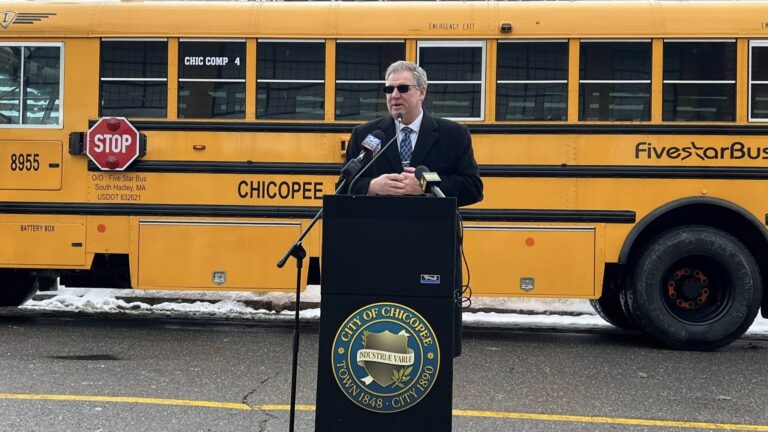
Chicopee has launched a safety system to crack down on drivers who illegally pass stopped school buses.
Working in partnership with BusPatrol, the city unveiled a fleet of security cameras to be installed on the exteriors of Chicopee school buses. Mayor John Vieau held a press conference Wednesday to announce the new program, which is the first of its kind in the state.
“The safety of our children should never be negotiable,” Vieau said in a city statement. “Chicopee is proud to lead the Commonwealth by taking decisive action to protect our students and make our roads safer.”
The safety cameras activate automatically when a school bus’ stop sign arm is extended and red lights are flashing, the Chicopee Police Department said in a statement. If a vehicle fails to stop, the system will capture photographic evidence of the vehicle, and a citation will be issued later.
[...]
Recent pilot programs have found that drivers have been disregarding school bus passing laws at alarming rates. One such program conducted by BusPatrol and Peabody Public Schools recorded more than 3,400 violations on 10 camera-equipped school buses between Sept. 5, 2023, and May 9, 2024.
“This equates to 2.3 illegal passes per bus per day — one of the highest rates recorded nationwide,” BusPatrol said. “This equates to more than 10,000 violations if extrapolated across the entire 30-bus fleet.”
 

Back
Top