Other People's Rail: Amtrak, commuter rail, rapid transit news & views outside New England

Onto some more happier news:

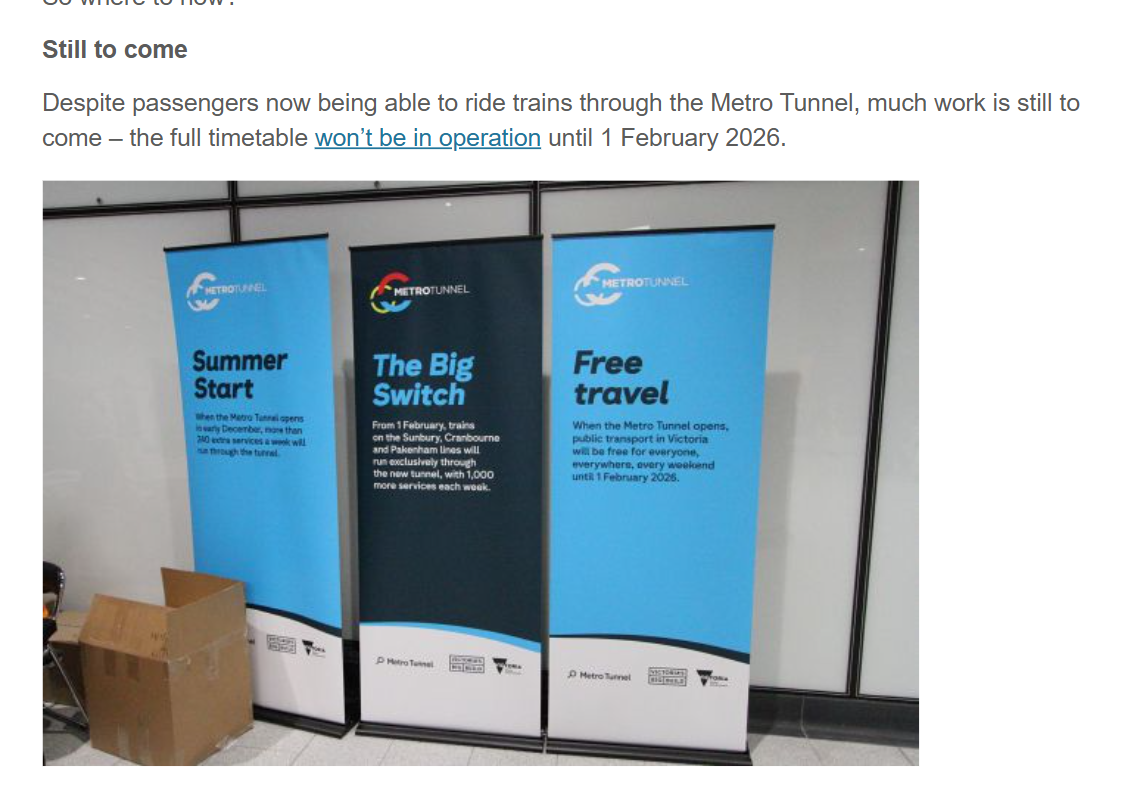
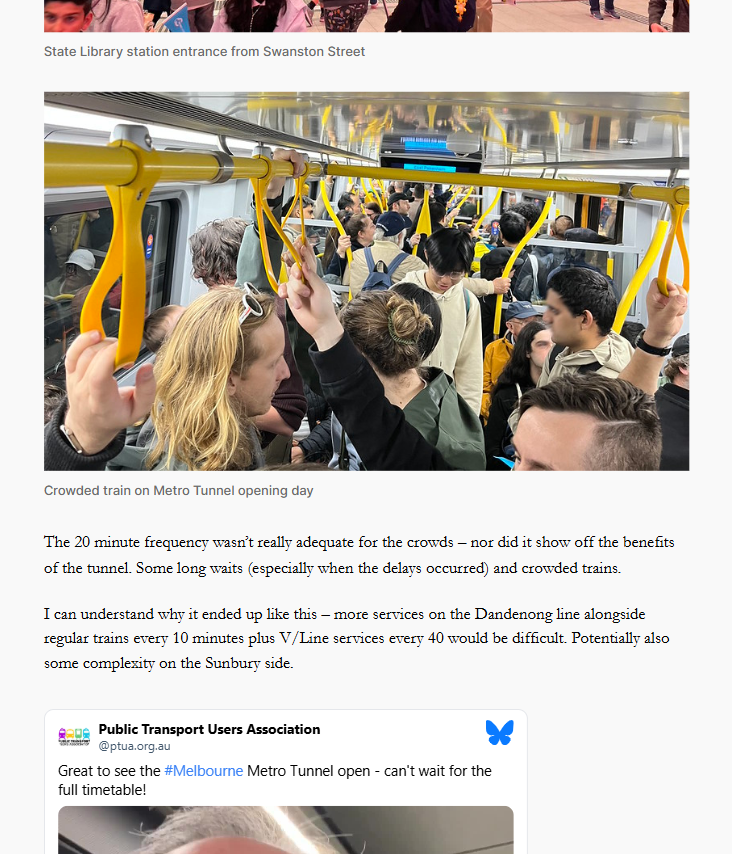
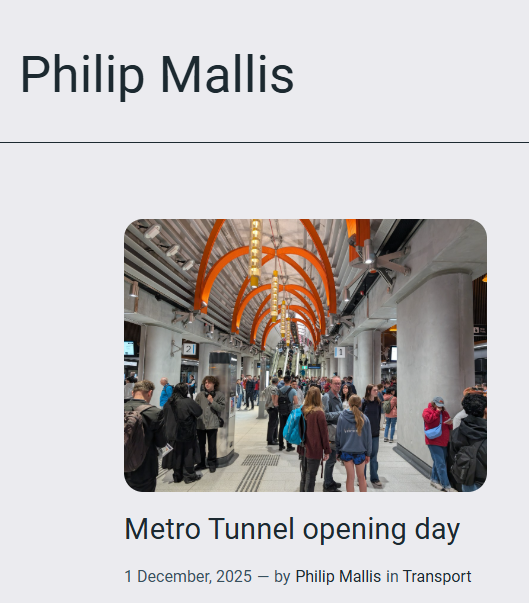
The new Metro Tunnel in Melbourne CBD has opened in November 2025. Trains currently operate on a test schedule with passengers allowed onboard until February 2026; when the full changeover occurs on parts of the Melbourne commuter rail network shift from the City Loop to the Metro Tunnel permanently full time.

Here are various blog posts about the Melbourne Metro tunnel opening.
1764989654961.png
1764989853095.png


1764989762218.png
1764989894698.png
 
Oh this is going to help: Eurostar known for its sudden, significant fare hikes and cycles of financial troubles, with recent issues including major pandemic losses requiring a £290M bailout (2021), intense scrutiny over high prices and poor service amidst record profits (late 2024/2025), and disruptions from infrastructure upgrades causing chaos, especially around Christmas.
 
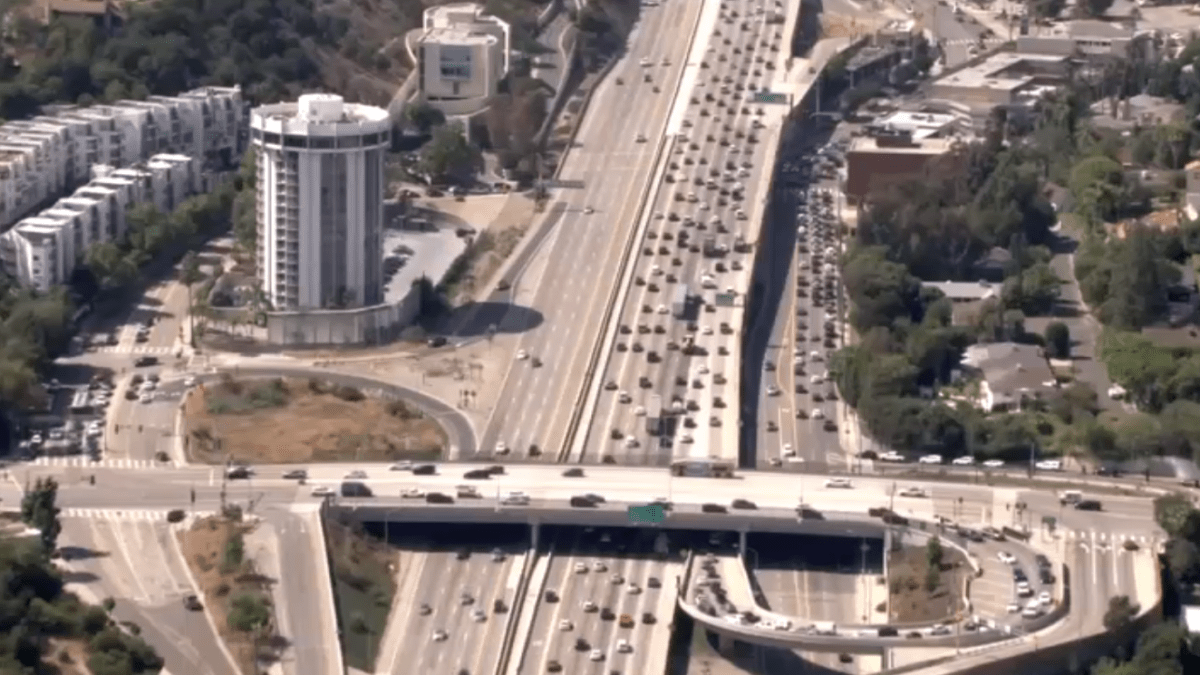
The Sepulveda Transit Corridor Project Locally Preferred Alternatives included options for the project pursued to provide an alternative to navigate on of Los Angeles busiest commutes on the 405 Freeway. The board's Planning and Programming Committee recommended approval of Modified Alternative 5, a heavy rail transit option that would run underground between the Van Nuys Metrolink Station and the E Line Expo/Sepulveda Station.
The proposal would be modified to include a connection to the Metro G Line and the future East San Fernando Valley Light Rail Line at Van Nuys Boulevard. Thursday's vote was unanimous.
Modified Alternative 5 would provide nearly 13 miles of rail with seven stations. At the northern point of the proposed rail system, one station would be located at the Van Nuys Metrolink Station, followed by three unique underground stations at Sherman Way, Metro G Line on Oxnard Street, and Ventura Boulevard.
Four additional underground stations would be proposed at UCLA,(called UCLA Gateway Plaza), at Wilshire Boulevard/Metro D Line, at Santa Monica Boulevard, and a final connection to the Metro E Line Expo/Sepulveda Station.
Metro estimated the cost for the project could be between $20 billion and $25 billion. The transit agency has identified some funding from Measure M, a 2016-voter approved half-cent sales tax to support transit projects, which support the Sepulveda Transit Corridor Transit Project.
sepulveda.png
 

View attachment 70216
This is by far the best of the options that they studied. When this open, it is going to be transformative for people in the Valley. I really love the way Los Angeles is so focused on building cross town routes. The eventual mesh pattern is going to make for a very sophisticated system when full build-out is complete.
 

New York State deep-sixes the plan to extend a Metro-North trip from Poughkeepsie to Albany. Will instead restore all temporarily-reduced Amtrak Empire service trips in March, as well as restoring the Maple Leaf and Adirondack as separate trains (they were temporarily conjoined). I guess that means the East River Tunnels work is progressing enough and/or there are enough loco-to-cab-car conversions now available that the supply of deadhead trains from Sunnyside Yard to the Empire platforms @ Penn is no longer choked off and normal service can resume.

Hochul says the Metro-North issue could resurface, though she sounds pretty uncommitted in the press release.
 
The Second Avenue Subway’s East Harlem extension project will keep chugging away despite the Trump administration’s pause on federal funding for the project — but MTA officials warned they will soon need the money restored in order to award the next contract in the undertaking.
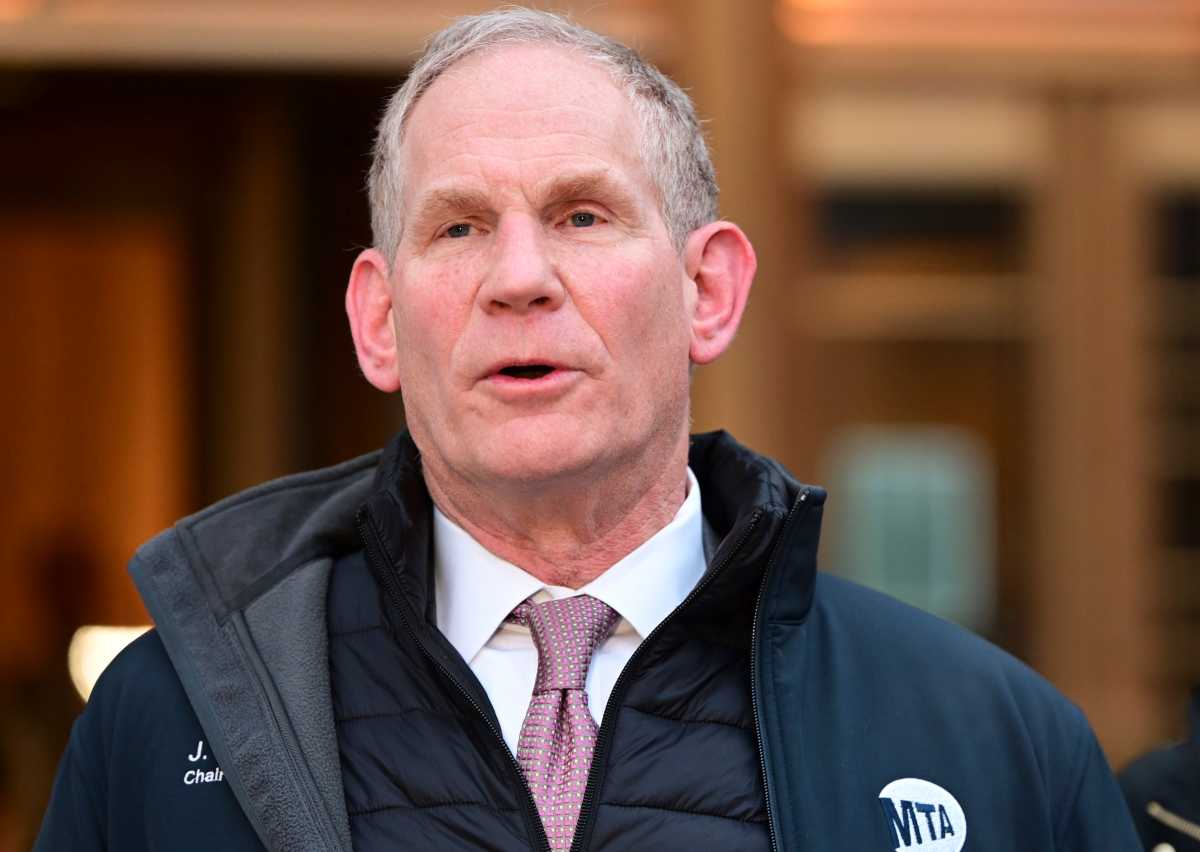
MTA Chair and CEO Janno Lieber, during the agency’s monthly board meeting on Wednesday, insisted that work on Phase 2 of the Second Avenue Subway, which will extend the Q line from 96th to 125th Street, is not in imminent danger of being derailed by Trump’s funding freeze.
[...]
However, MTA Construction and Development head Jamie Torres-Springer said that while work will continue on the Second Avenue Subway, the project will hit roadblocks in the near future if the federal funding remains frozen.
Specifically, he said the MTA will not be able to award its next contract in the effort, to excavate a new station at 106th Street, if the money is not restored within the next couple of months.
“We need a restoration of certainty from the federal government in order to do that,” Torres-Springer said of awarding the contract. “Predictability of funding is what’s key to keeping a big capital program like this afloat. We’re doing everything we can. We need predictability of funding.”
 
Oh, please. A train? In NYC? For Mamdani?

Unless Mamdani can work his magic with an in-person meet with our Dear Leader to charisma those funds out of him--though I do trust he could, the handsome devil--those funds are gone.
 

ConnDOT strongly considering re-dieselizing Shore Line East because of Amtrak's sky-high electric rates on the NEC. :(
This is not the first time a commuter rail line running on the NEC has converted from electric to diesel to avoid paying Amtrak's fees; MARC's Penn Line did the same thing about a decade ago. Two questions come to mind:

1) If Amtrak's electricity rates are high enough to drive agencies back onto diesel, what will it take to reduce the fees? Are the fees calculated in a transparent manner that purely reflects the cost of electricity alone, or is this a situation where things are opaque enough to allow Amtrak to use the fees to "get back" at Connecticut for when Metro-North inconveniences Amtrak on the New Haven Line?

2) Could concern over the high electricity fees be part of the reason the MBTA has so far avoided electrifying the Providence/Stoughton Line?
 
Man, New England really needs to get its act together on grid supply. Inexcusable for us to be paying the highest rates in the country while everyone else is just throwing new capacity around and driving prices to such low levels.
 
Man, New England really needs to get its act together on grid supply. Inexcusable for us to be paying the highest rates in the country while everyone else is just throwing new capacity around and driving prices to such low levels.

Agreed, but there's been a lot of effort that has been outside of our control. Maine fought to block hydro power from Quebec, New York to block natural gas, and the feds to block offshore wind. Reducing nuclear capacity was also obviously a bad move in hindsight.
 
Man, New England really needs to get its act together on grid supply. Inexcusable for us to be paying the highest rates in the country while everyone else is just throwing new capacity around and driving prices to such low levels.

I don't have any details so this is guesswork, but: I don't think that's really the issue here. Power is not so expensive in New England as to make electric trains too expensive to operate for that reason.

I don't think whatever rate Amtrak is charging is really having it's costs being driven by the actual cost of the power supply coming in off the grid.

Amtrak has repeatedly proven elsewhere on the NEC that it seems to have absolutely no idea how to build + maintain overhead catenary at remotely reasonable costs. I would suspect that those blowout costs are making their way down to what they're charging other operators to use it.
 
Agreed, but there's been a lot of effort that has been outside of our control. Maine fought to block hydro power from Quebec, New York to block natural gas, and the feds to block offshore wind. Reducing nuclear capacity was also obviously a bad move in hindsight.
I'd like to see some nuclear power plants built in the parts of the US that need them.
 

Back
Top