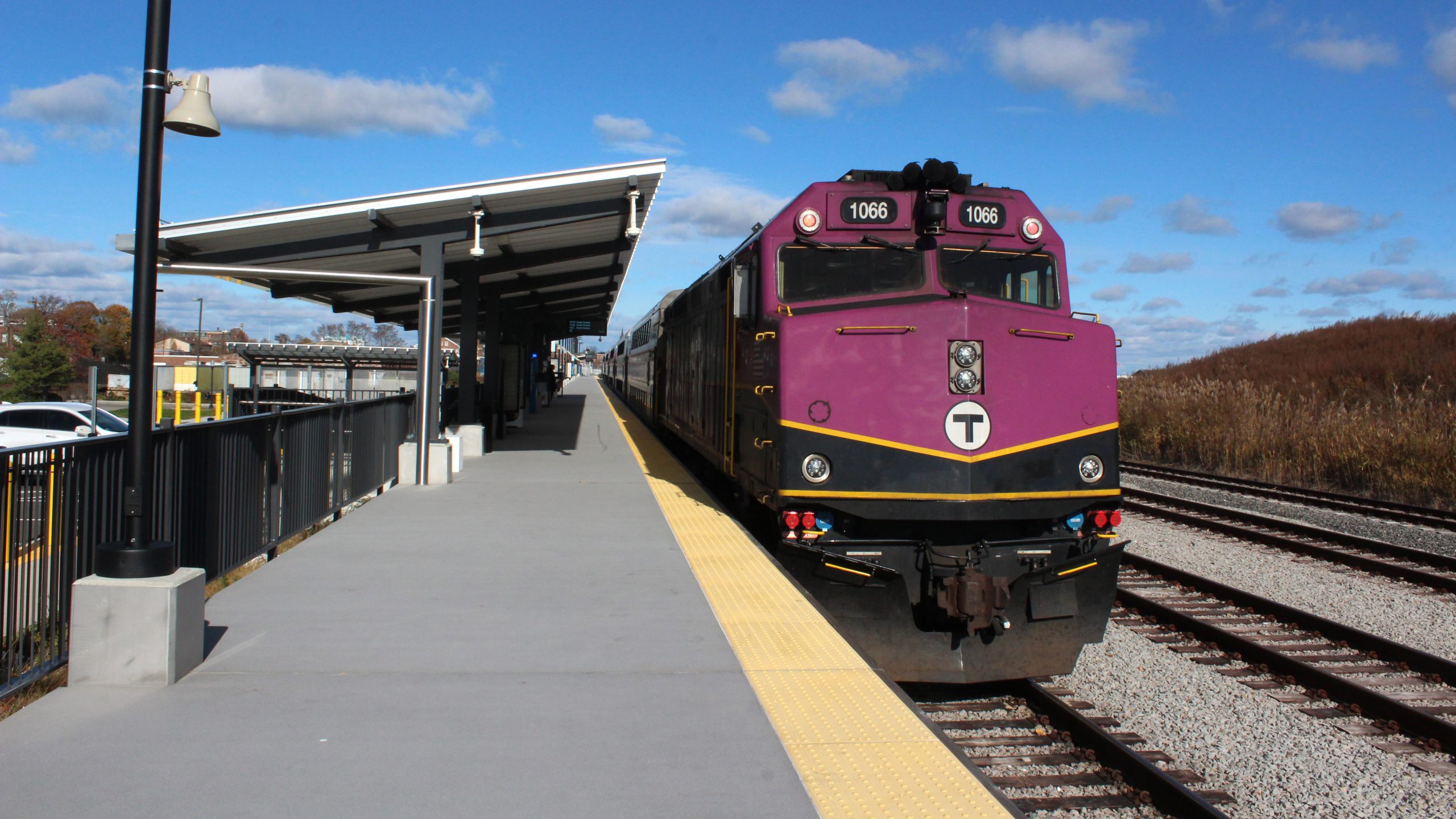
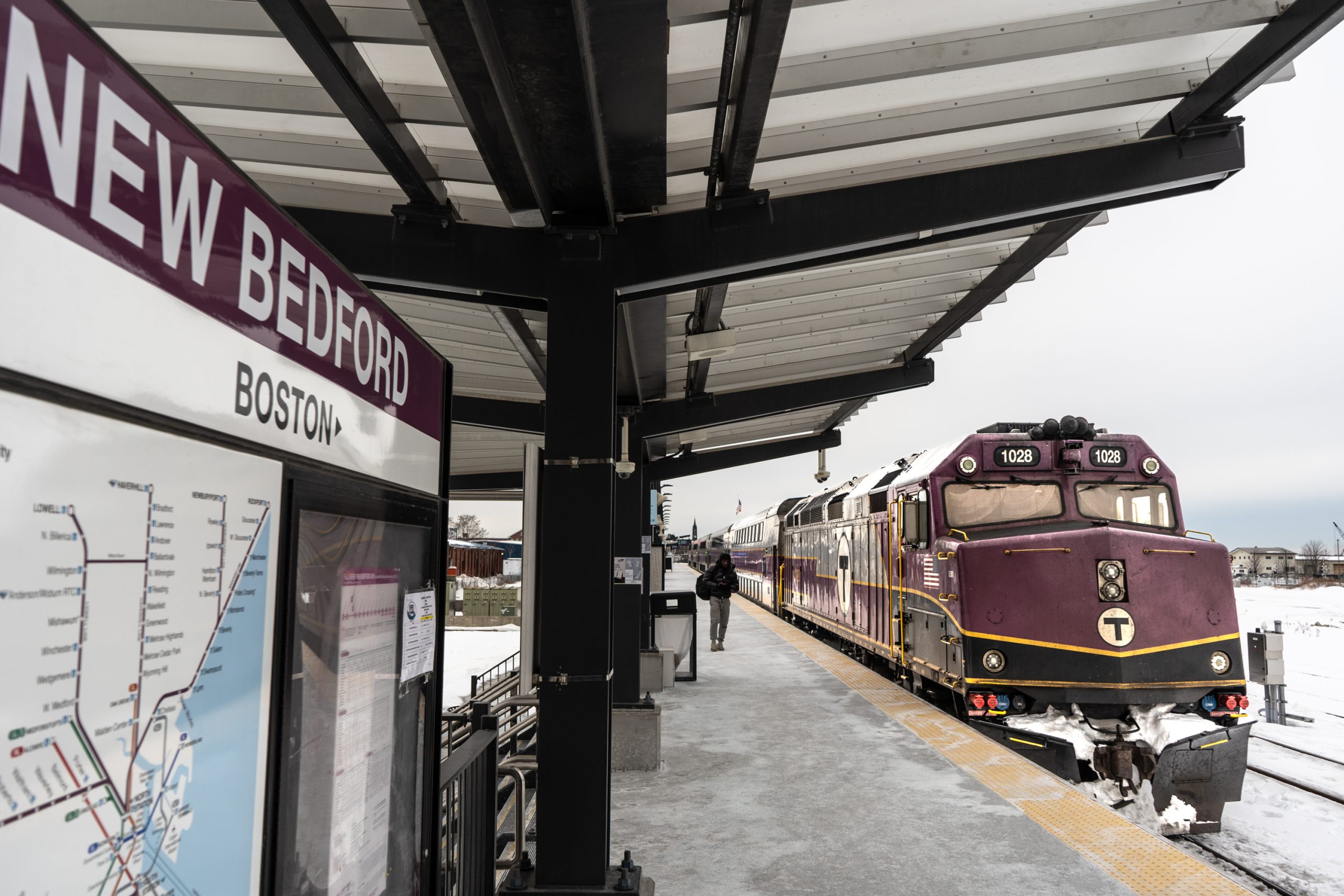
Fall River/New Bedford Commuter Rail (South Coast Rail)

Are MBTA trains tooting 'Jingle Bells'? Residents fed up with noise

The commuter rail crosses Freetown roads in 12 locations, 11 of them public, the most of any community statewide. At each of those crossings, train engineers are required by federal law to sound a safety horn. It doesn’t matter what time of day it is, or if the road is empty, or if the crossings are close together — the horn must blow.
[...]
Coholan said the solution here was easy: email him immediately and he’ll punish the engineer. He said he has access to data onboard every MBTA train’s computer — including horn blasts. “If I see an email from any of you that says at 1:30 at Chace Road a locomotive engineer was blowing ‘Jingle Bells,’ from my living room I’m going to pull up the download from that locomotive. And if locomotive engineer was doing that … they will be held accountable,” Coholan said. “Because I have no tolerance for that. “It’s a rules violation,” added Coholan, a locomotive engineer with 30-plus years of experience. “In our world, you don’t follow the rules, it’s 30 days on the street without pay.”
[...]
An October 2025 study prepared by engineering firm VHB showed the town could potentially create “quiet zones” that would limit train noise. But the solution isn’t perfect, said Town Administrator Deborah Pettey. A quiet zone must be established between the town and the FRA — the MBTA is not involved, nor does the MBTA approve of quiet zones because they're a safety risk. Instituting quiet zones would mean installing up to $18.8 million worth of new safety equipment at the town’s railroad crossings on the town’s dime, and these zones would need to be reinspected every three years.
Pettey added that the town would also assume sole liability in a crash. “I haven’t checked with the insurance. It may not even be something that we can insure,” Pettey said.
 
not attract many riders.
I also think that you're not engaging with the actual argument against the South Coast Rail: it's not worth the benefit - i.e. $1.05 billion for just 2,000 daily riders is pretty costly. And very little in the way of other benefit.
 
I also think that you're not engaging with the actual argument against the South Coast Rail: it's not worth the benefit - i.e. $1.05 billion for just 2,000 daily riders is pretty costly. And very little in the way of other benefit.
In the short term, the BC ratio may not be super impressive, but this project is a key part of the long game, which is to establish a passenger rail network to all areas of the Commonwealth. Thirty, forty, fifty years from now, these rail extensions will be looked back upon as having been absolutely transformative.
 
I also think that you're not engaging with the actual argument against the South Coast Rail: it's not worth the benefit - i.e. $1.05 billion for just 2,000 daily riders is pretty costly. And very little in the way of other benefit.
It shouldn't have cost that much- and in many other states, it wouldn't have. But it was obviously needed.
 
In the short term, the BC ratio may not be super impressive, but this project is a key part of the long game, which is to establish a passenger rail network to all areas of the Commonwealth. Thirty, forty, fifty years from now, these rail extensions will be looked back upon as having been absolutely transformative.
The long game's going to incur another $1B+ in semi-related costs, though, when double-tracking of the Old Colony Boston-Braintree mainline has to go on the table to stabilize the service. Because the service reliability Phase I subsists with is so far off the standard for the rest of Commuter Rail, it shouldn't have been an optional cost in the first place. Baker's people plied a LOT of fuzzy math to get their 'miracle cost savings' for Phase I vs. Phase II, and we'll be paying to bail out that smoke-and-mirrors act for a generation.

I'm not saying establishing a foothold wasn't worth doing. But understand that it's only a foothold, and the cost for achieving only a foothold was extreme. It's sickly service for its schedule length, infrequency, and unreliability until we do another megaproject's worth of finishing work on it. It's overperforming expectations only because ridership projections were so thoroughly and persistently gutted in both the runups to the early-2010's Phase II DEIR and FEIR, and the switcheroo to Phase I. 20 years ago for SCR with a full/not-crippled schedule they were projecting +8700 daily on-mode riders, and +7100 all-new daily riders who weren't taking any form of transit. 2000 daily users is about 23% of that total...just a foothold. That foothold impresses us only because the most recent expectations were so much worse than even that. And if the long game truly involves a goal "to establish a passenger rail network to all areas of the Commonwealth", that work's going to involve yet another mandatory $2B+ on Phase II because the Cape can't participate in that "all areas" network at all with Phase I siphoning all available Old Colony capacity even in a double-tracked mainline universe.

It's something constructive to build on, but I don't think anyone should be taking a victory lap over what tiny % of the original dream has actually been realized for the money.
 

Communities along South Coast Rail explore 'quiet zone' solutions

Taunton has three public rail crossings used by the Fall River/New Bedford rail line that qualify to be quiet zones: Old Colony Avenue, Middleboro Avenue, and County Street. A quiet zone connecting all three qualified crossings in Taunton would span 2.67 miles.
Lakeville has three rail crossings, Berkley has four rail crossings, and Freetown has 12 rail crossings total that are connected to the Fall River/New Bedford line.
All three of Lakeville’s rail crossings, Leonard Street, North Precinct Street, and Malbone Street, are eligible to be quiet zones. This quiet zone would span 1.75 miles.
According to every report written for each municipality, under FRA requirements, “private crossings do not qualify for quiet zones unless they are located between two public highway-rail crossings. A quiet zone must start and end with a public crossing.”
Of Berkley’s four rail crossings, only two qualify for quiet zone designation: Myricks Street and Padelford Street. The other two, Cotley Street and Adams Street are both private roads and not eligible. The qualified crossings would create a quiet zone spanning 2.13 miles.
Of Freetown’s 12 total rail crossings, only 11 qualify to be quiet zones as the 12th is classified as a private crossing that passes through Brightman Lumber. Of the qualified crossings, Freetown would have two separate quiet zones, totaling 7.70 miles, because the Fall River/New Bedford Line splits into the New Bedford Main Line and Fall River Secondary Line once it reaches Freetown.
The reports from engineering firm VHB provide both low and high range cost estimates for the proposed quiet zones.
For Taunton to establish quiet zones across its three qualified crossings, the cost estimate is between $3.37 million and $3.96 million dollars.
For Lakeville to establish quiet zones across its three qualified crossings, the cost estimate is between $2.4 million and $3 million dollars.
For Berkley to establish quiet zones across its two qualified crossings, the cost estimate is between $2.6 million and $3.3 million dollars.
For Freetown to establish quiet zones across its 11 qualified crossings, the cost estimate is between $13.3 million and $18.9 million dollars.
 
Out of curiosity, how much would it cost for a town like Taunton to just grade separate three crossings?
There'd be no way to do the MA 140 one without blowing-up/rebuilding the 24/140 interchange all over again. The rail line doesn't have enough room to change elevation between Cotley Jct. on one side and 24 on the other, the brand-new interchange ramps would have to change elevation and partial placement if 140 were being elevated at the crossing, and there's wetlands all around so nothing's getting depressed below-grade. Easily $100M just for that one. The other two are more minor, but they have snugly-abutting property driveways so cheaper/more self-contained road-over-rail is probably not an option for containing the project areas with steeper road inclines at either. Plus the Middleboro Secondary is on a curve for the Old Colony Ave. crossing, so the project area is going to be way distended for that one to have rail change elevations more gently around the curve.

There's no good cost or common-sense reason for grade separating this far out in the exurbs for this lowish level of train traffic. If the towns want quiet crossings, they've had decades of notice and all the choice in the world to go for it when costs were lower. Hopefully having some hard numbers to chew on now will shut up a lot of the impotent screaming through the media at the unrelated/uninvolved MBTA, but they seem to like doing that way more than they do pondering actual implementable solutions.
 
absolutely transformative
I don't disagree - but - there's other, even more, transformative investments that are even better on the CBR that were foregone so that we could give Mattapoisett, Fairhaven and Somerset the option of avoiding the riff-raff on the Peter Pan or Dattco buses.
 
Now, as phase one nears its first anniversary, state transportation officials are nearly silent on how they plan to finish the job. It’s not clear if they even can.
The Light asked Gov. Maura Healey whether the full build is still a priority at a campaign event in New Bedford on Monday. She answered vaguely. She said that MBTA General Manager and Transportation Secretary Phil Eng is “looking at” it and that more details would be available “soon,” declining to give a specific timeline.
“Everything right now is a balance in terms of which investments we make and where,” Healey said.
The full build has no funding in the MBTA’s current five-year Capital Investment Plan. An MBTA spokesperson referred The Light’s questions to the Massachusetts Department of Transportation; a MassDOT spokesperson referred to comments MBTA officials made about the full build during public meetings in 2024.
“Officials clarified that the MBTA is currently prioritizing available funding toward much-needed maintenance and repairs of existing system infrastructure,” the statement said.
The MassDOT spokesperson declined to make officials available for an interview and didn’t answer a list of questions about the full build’s timeline, funding, or other basics, like the name of the person currently in charge of the project.
New Bedford city officials said they haven’t received any word from the state on the second phase of the project. The conversation appears nonexistent at the Statehouse. “I haven’t heard anything on this,” said Rep. Chris Hendricks, who represents New Bedford and sits on the Legislature’s transportation committee.
With the state facing financial uncertainty from federal funding cuts, and many transportation projects competing for limited funding, lawmakers said they can’t imagine the South Coast Rail full build being a priority right now. One former lawmaker says the full build is probably impossible.
The full build has two main problems, Straus said in an interview this month: It’s infeasibly expensive, and it can no longer get through the environmental permitting process.
Let’s start with the price tag. Initial estimates from 2017 pegged the total cost of the full build at $3.2 billion, including nearly $1 billion for phase one. Adding inflation, higher construction costs, and the necessary land acquisitions, Straus thinks the full build would cost at least $6 billion or $7 billion today. There’s no obvious source for that level of funding, he said.
Then there are the environmental permits. The Stoughton route goes through the protected Hockomock Swamp, along with various other natural areas, triggering a difficult approval process. The state requires an environmental analysis for projects affecting wetlands, and it would have to prove that there is no other viable option but to go through the protected area, Straus said.
 
Last edited:
The long game's going to incur another $1B+ in semi-related costs, though, when double-tracking of the Old Colony Boston-Braintree mainline has to go on the table to stabilize the service. Because the service reliability Phase I subsists with is so far off the standard for the rest of Commuter Rail, it shouldn't have been an optional cost in the first place. Baker's people plied a LOT of fuzzy math to get their 'miracle cost savings' for Phase I vs. Phase II, and we'll be paying to bail out that smoke-and-mirrors act for a generation.

The MBTA failed miserably at futuring when it planned the OL to Oak Grove, and the RL to Braintree extensions in the 1960s. The thinking then was to terminate the commuter rail lines at the ends of these rapid transit line extensions, rather than continue the commuter rail lines all the way into North and South Stations. So, the result was to leave only a one-track rail line (supposedly for freight trains only) alongside these OL and RL extensions. So now we're faced with a massively expensive cost to restore the pre-1970s two-track commuter rail line through Dorchester and Quincy.
In addition to that, the US has an incredibly cumbersome environmental clearance process for wetland takes for transit (and road) projects. Europe and Asia are moving ahead quickly on transit line expansions, but Massachusetts seems stuck. It is time to streamline the environmental clearance process in the US for rail line projects, in recognition of the positive environmental benefits created by rail transit versus automobile commuting.
 
Last edited:
SCR rail advocates absolutely should spike the football on this one. Not because the game is over, but because unlike the Patriots in the SB we put points on the board and have gone into halftime with a lead. But enough of football analogies, let's get down to business.

1) lots of backpedaling here from the doubters. Many of you stated this thing would fail, full stop, not something about oh there was this study done 20 years ago that said blah blah blah. I said repeatedly that it was up to citizens of the area to use it or lose it. They're clearly using it.

2) it's a false argument that this project crowded out more worthwhile ones. That's in the eye of the beholder, but bringing rail to a place it doesn't currently exist is better IMO than Red to Blue which is a convenience project so people don't have to ride the blue or green line for a couple of stops. I'd rather see BLX to Lynn and Salem, but regardless the state has the money and borrowing ability to take those on. It's choosing not to do so I'm speculating because federal funding is iffy, not because SCR is up and running.

3) A big benefit for the state is access to cheaper housing in a region where NIMBY'S aren't dominant. There's no Keep Fall River The Way It Is movement that I'm aware of. There's a lot of housing that can be built in these areas without the usual nonsense.

4) I do agree that the route is somewhat silly although I don't blame the T for how the tracks were laid down 175 years ago. If there is a more direct route to Boston via the swamp I'm all for it. I am very skeptical that rabid NIMBY's won't use environmental regs to delay this until flying cars make the proposal obsolete. Politics aside I don't know if you're ever going to see the feds more willing to blow off environmental concerns that this administration, and they've only got 3 years to go, basically a blink of an eye for a decades long transit project.
 
3) A big benefit for the state is access to cheaper housing in a region where NIMBY'S aren't dominant. There's no Keep Fall River The Way It Is movement that I'm aware of. There's a lot of housing that can be built in these areas without the usual nonsense.
Its perfect timing too because fall river just removed that massive highway and has an enormous of land thats fresh for redevelopment right next to the new stations. The timing couldnt have been any better.
 
The long game's going to incur another $1B+ in semi-related costs, though, when double-tracking of the Old Colony Boston-Braintree mainline has to go on the table to stabilize the service. Because the service reliability Phase I subsists with is so far off the standard for the rest of Commuter Rail, it shouldn't have been an optional cost in the first place. Baker's people plied a LOT of fuzzy math to get their 'miracle cost savings' for Phase I vs. Phase II, and we'll be paying to bail out that smoke-and-mirrors act for a generation.

I'm not saying establishing a foothold wasn't worth doing. But understand that it's only a foothold, and the cost for achieving only a foothold was extreme. It's sickly service for its schedule length, infrequency, and unreliability until we do another megaproject's worth of finishing work on it. It's overperforming expectations only because ridership projections were so thoroughly and persistently gutted in both the runups to the early-2010's Phase II DEIR and FEIR, and the switcheroo to Phase I. 20 years ago for SCR with a full/not-crippled schedule they were projecting +8700 daily on-mode riders, and +7100 all-new daily riders who weren't taking any form of transit. 2000 daily users is about 23% of that total...just a foothold. That foothold impresses us only because the most recent expectations were so much worse than even that. And if the long game truly involves a goal "to establish a passenger rail network to all areas of the Commonwealth", that work's going to involve yet another mandatory $2B+ on Phase II because the Cape can't participate in that "all areas" network at all with Phase I siphoning all available Old Colony capacity even in a double-tracked mainline universe.

It's something constructive to build on, but I don't think anyone should be taking a victory lap over what tiny % of the original dream has actually been realized for the money.
A good part of those operational delays and unreliability has come from the unfinished SR-24 road works keeping the underpass as single track right next to the high traffic East Taunton Station and a long single-tracked section south of Brockton. Once that overpass is finished and the second track is added, plus a couple passing sections in the large expanse between Bridgewater and Middleboro, there will be a lot more operational reliability, and it wouldn't break the bank too crazily.

$1bil may be a large sum of money that all but a handful of humans will never see/have as their own, but we gotta stop acting like that's any really crazy sum of money for the Commonwealth of Massachusetts that we should really be concerned about if it's going towards something good like connecting a huge swath of the state via rail. The annual budget of this state is $61bil. That $1bil is not even 2% of that. That would equate to $140 for each MA resident, which as a one-time payment isn't terrible for the majority of residents, but we have the cool Fare Share Amendment that collected $6bil in its first two years from only a small subset of the state population that have the means for it. If it helps you sleep better to think of the millionaires having covered SCR while your taxes covered fare free RTA service and free community college then have at it. It's not unreasonable since it all comes from the same budget pool anyway. Of course we should be advocating for money not to be wasted on bad deals, but in the current economic climate of America, and with the relative wealth of Massachusetts, getting a 36.1mi rail service extension for $29million/mile isn't terrible. Especially if it paves the way for future better service to the South Coast rather than kicking the can down the road and another decade of no rail being built to the region at all.
 
3) A big benefit for the state is access to cheaper housing in a region where NIMBY'S aren't dominant. There's no Keep Fall River The Way It Is movement that I'm aware of. There's a lot of housing that can be built in these areas without the usual nonsense.
Unfortunately the New Bedford City Council and the residents believe the solution in the housing crisis is to only build a very specific few homes in places that they will never see them, or to magically make new homes appear that are only for the existing residents to instatntly afford and move into.

A quote from city councilor Shane Burgo:
Everyone understands the need and concern for more housing, but nothing that they want to build in a community that has long roots and ties should be done without including those voices...
I do support housing and smart growth in New Bedford. Supporting housing in this case doesn’t mean supporting it in every location.
This is the prevailing view of New Bedford residents. That quote is in reference to a 3-story, 9-unit building on a large empty lot next to a church. Residents claim those 9 units will cause traffic armageddon, impede emergency services, and make it impossible for the church to function. This comes after the developer downsized the building from 4 stories, 15-units, and increased the amount of off-street parking by adding a surface parking lot. Which speaking of, New Bedford only just managed to reduce parking minimums from 2 to 1 space per unit on units under 3beds, to frantic opposition. Residents took on this view to the news:
"I don’t see how you’re solving a problem by saying, ‘Let’s build more units because we have a housing crisis, but let’s ignore the fact that most people are going to be driving."
City planners have said their proposal is based on a data-driven analysis. Census data shows about one quarter of renter households in the city have two cars, half have one car, and one quarter have no car. Some residents are worried about preliminary plans for a three-story apartment building on the site of the abandoned New York Chinese Buffet restaurant on Ashley Boulevard. Neighbors say the development is too large for their suburban neighborhood. No formal plans have been filed with the city yet.
Despite all this, a few city councilors flat out refused to believe the data of reality:
Baptiste, Choquette, and Gomes say the ordinance is unrealistic because they think apartment-dwellers will bring more cars than city planners expect.
And the fun fact to add is that only Choquette actually showed up to hearings about reducing parking minimums over the past couple months.

I'm hopeful that some change can start to come to bring more housing to New Bedford now that rail has arrived, there are plans for a mid-sized apartment building at the station site, but the city unfortunately doesn't have the same blank slate of land for development like Fall River does.
 
SCR rail advocates absolutely should spike the football on this one. Not because the game is over, but because unlike the Patriots in the SB we put points on the board and have gone into halftime with a lead. But enough of football analogies, let's get down to business.

1) lots of backpedaling here from the doubters. Many of you stated this thing would fail, full stop, not something about oh there was this study done 20 years ago that said blah blah blah. I said repeatedly that it was up to citizens of the area to use it or lose it. They're clearly using it.
As a former South Coast resident (lived in Dartmouth as recently as 2019), I'm glad that Fall River, New Bedford, and Taunton finally have rail service to Boston. But it's very disappointing that they don't have fast and reliable rail service to Boston, which Phase 2 would provide. SCR Phase 1 is good for day trips, concerts, and sports games, but it's not very enticing for people who commute to work or school multiple days a week. If anything, a lot of the complaints about Phase 1 were validated the day service started, considering how the unreliability issues began on the very first day of service. Additionally, the lack of a station in Downtown Taunton is a major sore spot that can only be addressed by building Phase 2.

My main issue with the phased approach isn't even the subpar service offered by Phase 1. It's the bait-and-switch tactic that the Baker admin used to quietly kill Phase 2. If there were serious plans to build Phase 2, I'd consider the first phase to be somewhat of a success, albeit a very expensive one. But the state obviously prioritized the phased approach so they could quietly cancel Phase 2. Fall River, New Bedford, and Taunton were basically cheated out of the reliable service they were promised, in exchange for a mediocre service that blocks Cape Cod from getting full-time rail service.
2) it's a false argument that this project crowded out more worthwhile ones. That's in the eye of the beholder, but bringing rail to a place it doesn't currently exist is better IMO than Red to Blue which is a convenience project so people don't have to ride the blue or green line for a couple of stops. I'd rather see BLX to Lynn and Salem, but regardless the state has the money and borrowing ability to take those on. It's choosing not to do so I'm speculating because federal funding is iffy, not because SCR is up and running.
It's not a false argument to say that SCR Phase 1 "crowded out" more worthwhile projects. That's exactly what happened with service to Buzzards Bay/Hyannis. Full-time Commuter Rail service to Cape Cod is completely blocked by South Coast Rail unless Phase 2 gets built. There's not enough track capacity between South Station and Middleborough to run service to Fall River, New Bedford, and Cape Cod without building Phase 2, which isn't happening anytime soon (if ever).

It's also not accurate to dismiss the Red-Blue connector as a "convenience project". Connecting Red-Blue is projected to increase Blue Line ridership by at least 6,500 people a day, for hundreds of millions of dollars less than South Coast Rail Phase 1. The Red-Blue connector is an urgent priority, and it should have been completed decades ago.

 
Last edited:
Fall River, New Bedford, and Taunton alone have more people than the entire year long population of all of the Cape. Now add in the surrounding towns (Fairhaven, Dartmouth, etc) and it's not even close. Furthermore it's unlikely too many people are traveling from Provincetown to Hyannis (the end of the line) to access the train while the stations on SCR are within those 3 cities. No justification for Cape over SCR especially since Cape has seasonal service for tourist season.

That being said, I'm all for the Cape getting regular service and hope they can advocate for and achieve this in less time than the 30 years it took SCR to get done.
 
The MBTA has developed a Residential Noise Mitigation Program for South Coast Commuter Rail. This program provides ways to reduce the impact of noise from trains passing by that affects homes near train tracks. We continue to welcome eligible residents to participate.
[...]
Eligibility is limited to residents who experience severe noise impacts from passing trains. “Severe impact” means that the level of noise from trains at your location is likely to interfere with important activities that occur within a residence, such as sleep. Just being able to hear a train is not considered a severe impact.
The noise mitigation program does not include noise that is caused by the use of horns at railroad crossings. They are considered a safety measure and are regulated by the Federal Railroad Administration.
We will evaluate each property and work with residents to determine the available treatment options, which may include:
  • Sound insulation: acoustically rated products to reduce the interior noise level of rooms in the line of sight of the train tracks
  • Property line noise walls: acoustically rated noise walls to reduce noise and provide visual screening
  • Air-conditioning systems: ductless mini-split systems that enable residents to leave windows and doors closed
  • Visual screening or solid fencing: landscaping or fencing to provide visual screening
 

Back
Top