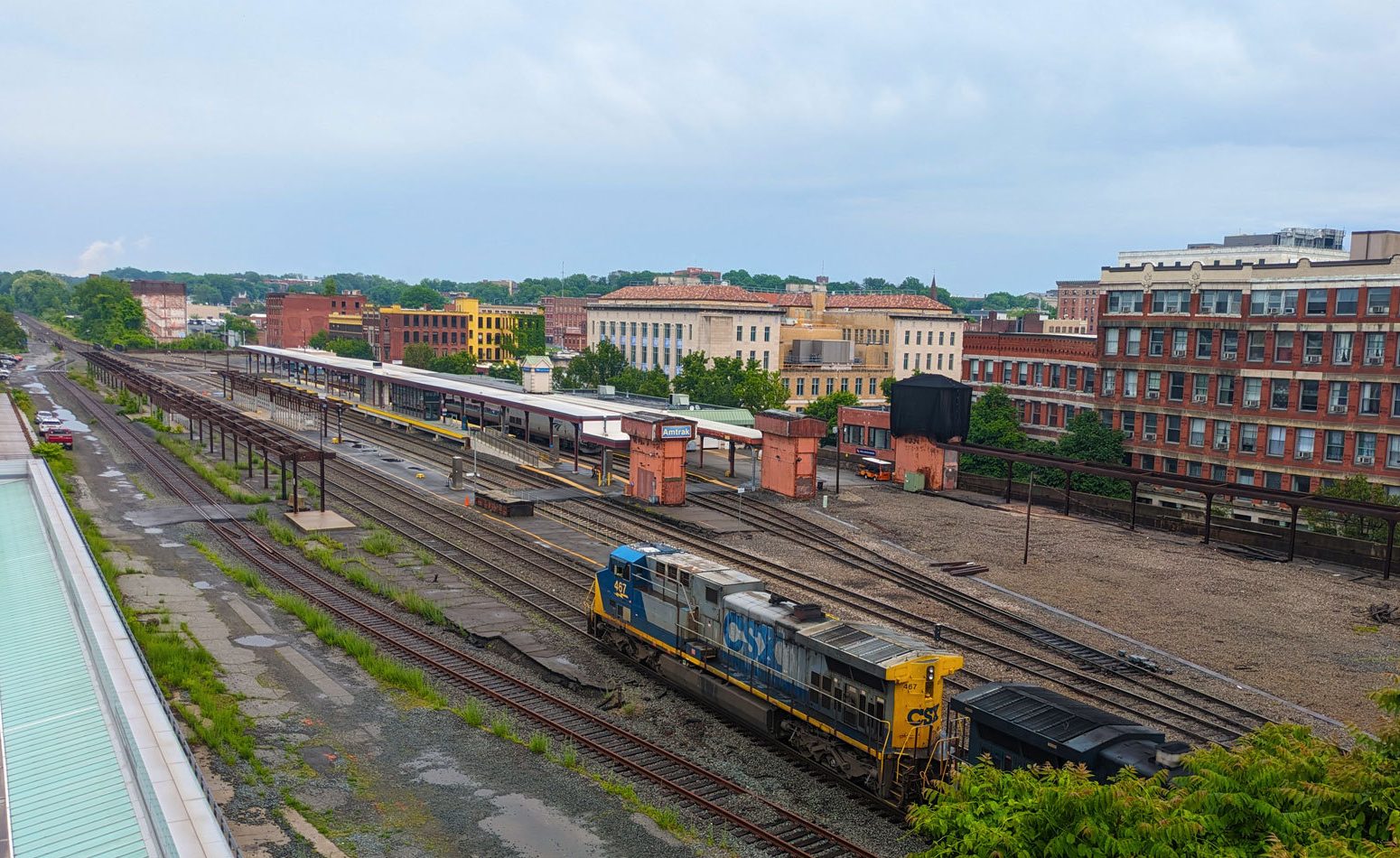
MassDOT Rail: Springfield Hub (East-West, NNERI, Berkshires, CT-Valley-VT-Quebec)

Will Amtrak trains be able to travel faster in MBTA territory when the triple-track project is complete? Most of the Framingham/Worcester line trackage is currently limited to 60 MPH, except for three short stretches of track (in Newton, Westborough, and Grafton) where trains can go a bit faster. What improvements are necessary to allow trains to travel at 79 MPH (or even 90 MPH) through Wellesley, Natick, Ashland, and Southborough?
Curves make that hard. While the B&A doesn't have many sharp curves in MBTA territory it does wave around almost constantly throughout MetroWest meaning even the express trains are going to be in curve restriction recovery time a large percentage of the time. Most of the travel-time savings that the T envisions from the tri-track project are from stripping out copious excess schedule padding (i.e. shorter level-boarding dwells, and way more dispatching precision with the new track layout), not from raw speed increases. Some curves on freight-free Boston-Framingham could *possibly* be treated with more superelevation, but that's unlikely to net more than seconds of cumulative time to an Amtrak or H2H so is unlikely to be worth the cost. More superelevation is definitely not in the cards Framingham-west because of all the freight tonnage that's getting its max speeds increased to 60 MPH per the most recent MassDOT-CSX agreement.

>70 might be doable on more *small* stretches in an electrified (and dual-mode Amtrak under wires) future given vehicles with better curve recovery acceleration, but it's definitely never going to be a 90 MPH railroad by its default geometry.
 
How much trackage is getting upgraded to Class 4/79 MPH (between Worcester and Springfield) as part of the East/West rail project? Will it just be a select few stretches of 79 MPH track? Or will most of Springfield <-> Worcester be 79 MPH, aside from the curves?
 
How much trackage is getting upgraded to Class 4/79 MPH (between Worcester and Springfield) as part of the East/West rail project? Will it just be a select few stretches of 79 MPH track? Or will most of Springfield <-> Worcester be 79 MPH, aside from the curves?
The track class is going to be entirely Class 4 from Worcester to Springfield, but actual speed limits are still limited by the numerous curves. You'll probably see actual 79 on the Palmer-Wilbraham straightaway that was studied in NNEIRI for Class 5/90 MPH, but I doubt you're getting out of the upper-50's and low-60's for much of the trip when the Worcester Hills extract their pound of flesh. Class 4 with rail re-tensioning does mean you'll no longer have heat-related speed restrictions in the summer, which is the bane of the Lake Shore Ltd.'s existence and used to be the bane of Commuter Rail's existence before Framingham-Worcester was similarly class-uprated in the 2010's.

It's projected to be 2:03 Boston-Springfield post-uprate (NNEIRI study projection with a Palmer infill) vs. about 2:32 right now, so it's still a pretty significant difference.
 
The project would add new station tracks and upgrade several passenger boarding platforms in order to accommodate more trains stopping in Springfield on their way to New Haven, Greenfield, Albany, and Boston.
The Springfield station is an interchange point between the north-south railroad along the Connecticut River and the east-west railway that connects to Boston. MassDOT's project would upgrade signal systems and add new switches and crossovers to accommodate more train traffic through the area.
"One of the goals of the Springfield Area Track Reconfiguration Project is to improve train operating fluidity through Springfield and enhance route connections to and from each direction," a MassDOT official told StreetsblogMASS.
The project would also rehabilitate an old rail yard east of the station, near Armory Street, to create a four-track layover facility for passenger trains.
MassDOT officials told StreetsblogMASS that currently, Amtrak stores four trains at Springfield Union Station each night. The new yard would offer modern maintenance and repair facilities, and could potentially be expanded to store one additional train in Springfield overnight.

springfield union station.png


View attachment 70840
There is no world in which service to Springfield will exceed two trains per hour and probably not one where service exceeds one per hour. Four platforms?
 
Convergence of N-S and E-W service, as well as inland route NH to BOS -- sufficient platforms for layovers and timed transfers?
Plus freight traffic. Plus trains like the Vermonter that have to reverse out of the station, which means a bit more time at the platform, maybe....

... And still, four platforms, seven tracks seems high, right? Four Amtraks doing a timed transfer with a Hartford Line train, plus a freight going by, and that's still one track to spare. Besides, E-W Rail is only planned to have single-digit trains per day. None of the other services would be especially frequent.

Some parts like rebuilding the rail yard sound good. New platform sounds odd, but I don't really know.
 
Platform A is going to be needed for the Vermonter and Valley Flyer because they operationally reverse off the north wye to get into the station and you don't want to do too extreme a number of crossover games if you want to keep that from being a schedule drag. "A" will probably also be used by any future Boston-Montreal trains and any future Hartford Line service extension to Greenfield. Platform B is likely to have to remain a low/mini-high platform for freight passage (the crossovers seem to indicate that'll be the thru route), so I doubt that would be used for anything except last resorts. They'd just need to repair it from its current out-of-service status, put in a replacement canopy for the one that was taken down, and slap the mini-high down...which isn't big $$$. If there's any expense I'd quibble with, it's that one because it's so unlikely any on-time trains are going to try to use it. Platforms C and D would likely be the primary Hartford Line, Northeast Regional, and Inland Route platforms...while based on the crossover layout the Lake Shore Ltd. and any future Albany service increases would probably filet to A and C.

It's maybe got a *little* fat, but considering that at least one of the platforms is going to have to be avoided at all costs for being low-level it's pretty right-sized for 25-year growth.
 
I haven't had the pleasure of visiting Springfield too many times, but on one of those times, three platforms were occupied at the same time by a Hartford Shuttle, Vermonter (not sure which direction) and the LSL, all with bonus freight action.
 
There is no world in which service to Springfield will exceed two trains per hour and probably not one where service exceeds one per hour. Four platforms?
You have to consider more than just the total trains, but the timing of when those trains hit the station. When all is said and done, there will be 5-6 service patterns, many of them with timed transfers. That means they will need to handle at times, 4-6 trains in the station, plus passing options. There's also the question of which tracks can send the trains where as they head back out, all of which further complicates the platform arrangement.
 
Aren’t they just restoring platforms that used to exist in the mid 20th century?
 
Aren’t they just restoring platforms that used to exist in the mid 20th century?
Yes. It used to handle 97 trains per day until the late-1950's when the Pike + I-91's opening slashed back the B&A, B&M, and NYNH&H schedules here. And the 4-way directional blender + very divergent-service users at this site (terminating commuter rail and regional intercity, thru multi-directional intercity, and thru long-distance all at close-approaching times) is pretty unusual amongst stations in the U.S. Even Albany, which is a pretty complex facility with all its engine changes and split/combines, doesn't need to accomodate this much complex movement. Also, Springfield's got a very hefty daily freight-passing schedule and slow-moving freights at that because all of them stop at West Springfield Yard right across the river, meaning the meets are a lot longer than just crossovers and good timing alone can accommodate. All told the configuration requires a lot more operational flexibility than the average station, which is why multiple platforms are still in-use even with today's unexpanded schedules.
 
You have to consider more than just the total trains, but the timing of when those trains hit the station. When all is said and done, there will be 5-6 service patterns, many of them with timed transfers. That means they will need to handle at times, 4-6 trains in the station, plus passing options. There's also the question of which tracks can send the trains where as they head back out, all of which further complicates the platform arrangement.
I want some of what you're smoking please. 4-6 trains at once? Don't forget, with time, at least one possible trainset, if not more, is passing through. I don't, for instance, expect Alb-Spr other than as possible Alb-Bos, and any north-south service would not originate or terminate in Spr. So, normally, a NHV train will be either the Boston train or a Greenfield north. More than three trains in station would be a rare event.
The Hartford Line schedule is designed so that service complements, not competes. I would expect the same to continue.
I would rather spend that money on DT another 5-6 miles, or repair/replace a bridge or three.
 
More than three trains in station would be a rare event.
The Hartford Line schedule is designed so that service complements, not competes. I would expect the same to continue.
Yeah, that sounds right. I'd be generous and say they could plan timed transfers between four trains, one going each cardinal direction. Seven tracks/four platforms looks way overbuilt for any of that, to my completely amateur eye.

Put another way, roughly this station setup was apparently good enough to 97 trains per day back in the 1950s. With all the planned Compass Rail expansions, we'll be running... half that? Less? If there were even the vaguest promises to ramp up service in the coming decades, I wouldn't care as much. But the planned schedules are thin and I feel like I've only seen hints of scaling them back further.

This doesn't seem like they're planning the station upgrades with any specific service plan in mind. It kind of looks like they're rebuilding all the tracks and platforms because that sounds good politically. A politician gets a picture taken at a fully rebuilt station, with no ugly, derelict platforms in the background. Or maybe CSX was making some kind of unreasonable demands for the number of tracks guaranteed to always be available through the station. I don't really know what's going on there. But this looks pretty overbuilt.

I would rather spend that money on DT another 5-6 miles, or repair/replace a bridge or three.
Getting into the exact costs is why I'm not sure how much to care. I don't know how much it will cost to fix up the extra platforms. It's not free. But the marginal cost of fixing up those platforms while they're doing other work may not be that much. I agree, they should probably spend that money on track work. But I'm not sure this equates to 5-6 miles of double tracking. I really don't know. Happy to be proven wrong.
 
I want some of what you're smoking please. 4-6 trains at once? Don't forget, with time, at least one possible trainset, if not more, is passing through. I don't, for instance, expect Alb-Spr other than as possible Alb-Bos, and any north-south service would not originate or terminate in Spr. So, normally, a NHV train will be either the Boston train or a Greenfield north. More than three trains in station would be a rare event.
The Hartford Line schedule is designed so that service complements, not competes. I would expect the same to continue.
I would rather spend that money on DT another 5-6 miles, or repair/replace a bridge or three.
I guess I should have more strongly indicated I was talking about time transfers. The service concept only works if several trains arrive within a few minutes of each other, so that somebody can legitimately go Boston to Northampton, for example, not just Boston to Albany. It doesn't take a drug induced haze to see that as the most likely design, which again, could mean 4-6 trains at once, followed by a long gap before the next 4-6 trains at once moment.
 
I guess I should have more strongly indicated I was talking about time transfers. The service concept only works if several trains arrive within a few minutes of each other, so that somebody can legitimately go Boston to Northampton, for example, not just Boston to Albany. It doesn't take a drug induced haze to see that as the most likely design, which again, could mean 4-6 trains at once, followed by a long gap before the next 4-6 trains at once moment.
But when would you ever have a six-way timed transfer? There are only four directions trains can come/go. A four-way timed transfer would give everyone every possible transfer option.

If there were a six-way timed transfer, that would mean multiple trains are coming in from the same direction at essentially the same time, which is wasteful and redundant. Multiple trains would then leave in the same direction, one right after the other, which is wasteful and redundant. With such sparse schedules, it doesn't make sense to have multiple trains clumped together, only a couple minutes apart.
 
But when would you ever have a six-way timed transfer? There are only four directions trains can come/go. A four-way timed transfer would give everyone every possible transfer option.

If there were a six-way timed transfer, that would mean multiple trains are coming in from the same direction at essentially the same time, which is wasteful and redundant. Multiple trains would then leave in the same direction, one right after the other, which is wasteful and redundant. With such sparse schedules, it doesn't make sense to have multiple trains clumped together, only a couple minutes apart.
If you look at the proposed service patterns, some trains change from N-S to E-W at Springfield. It is not pure N-S, E-W service. Inland route New Haven to Boston, for example.

Not saying you get to six trains, but there are complications. Plus freight.
 

Back
Top