I agree. It's sad to see her backslide on this, I thought the overwhelming victory would have been a sign to keep pushing forward.Yes, but the Mayor doesn't seem as interested in bike lanes as she once was. I think the departure of Jascha Franklin-Hodge is likely also a break in prior bike lane momentum. I'm not super confident that we'll see as much success on this issue during term 2.

You are using an out of date browser. It may not display this or other websites correctly.
You should upgrade or use an alternative browser.
You should upgrade or use an alternative browser.
Biking in Boston
- Thread starter statler
- Start date
F-Line to Dudley
Senior Member
- Joined
- Nov 2, 2010
- Messages
- 9,926
- Reaction score
- 12,080
Weapons-grade NIMBY's cosplaying as historical preservationists. Same playbook this time...mealy-mouthed appeals to "we support this...but...not like that." Followed by full-on stonewalling and threats of litigation or (like the sidewalk ADA saga) actual works-gumming litigation. And the Beacon Hill Business Association then tag-teams to call in the F.U.-level money in the neighborhood to pull strings behind the scenes to help make sure nothing ever happens.It’s really weird, who would want three lanes of traffic running through their neighborhood… you’d think they’d be all for it
A disproportionate number of these organizations' clientele still drive 'horseless carriages' around those 18th century streets and double-park them with impunity despite living in one of the most walkable neighborhoods in the city, so it's always going to be a cudgel of "Ooooh, but you're going to hurt our proud local businesses if people can't drive and double-park there." Their own fake "temporary" proposal during the pandemic for more outdoor eating space wasn't even allowed to be vetted by the city because it flagrantly violated the ADA at the sidewalk level (hmm...they do seem to have quite an objection to basic law-abiding accessiblity, no?), and because the emphasis was so transparently on the "temporary" that it wasn't even worth paying attention to. But they're clinging to their hurt fee-fees that "Well, we presented a plan and boo-hoo you wouldn't listen so we're taking our ball and going home...except for the litigation threats!"
I frankly don't blame the City for moving on in this specific instance. These associations are pros at waging a war of attrition over the stupidest things imaginable and deploying enough delay tactics to make it not worth the extra effort to steamroll. The City got wise to them after the whole multi-year sidewalk ADA saga. There are umpteen other neighborhoods that won't rake you over the coals with nuisance litigiousness for deploying bike lanes. It sucks for the people in the neighborhood who actually do bike, but there are other mouths to feed in the City as far as that goes and frankly we're not feeding them fast enough as the Wu Admin. in general has gotten much more reticent over the last year or two to push for bike lanes. This is a probably winnable battle if the City wanted to outlast the Associations' foot-dragging, but I don't get the sense right now that they really want to go against any stiff headwind. Maybe it's not the bravest stance for them, but it's eminently defensible when the money can be spent in other neighborhoods who won't Operation Chaos it.
RandomWalk
Senior Member
- Joined
- Feb 2, 2014
- Messages
- 3,713
- Reaction score
- 6,500
These are a some of the same weapons grade NIMBYs who grouse about the turbines off shore of their summer homes: “I support green energy, but only when it’s generated in someone else’s backyard.”

HenryAlan
Senior Member
- Joined
- Dec 15, 2009
- Messages
- 4,446
- Reaction score
- 5,176
While true, I think the larger need for Charles Street bike lanes lies in the location that is by far the most logical route between Longfellow Bridge users and the Back Bay, South End, Theater District, Chinatown, etc. The existing alternatives add a significant amount of distance for riders coming off the bridge, and/or a lot of hill climbing. A two-way cycle track on Charles Street solves so many bike route challenges, and is a clear example of where we need to think beyond just the neighborhood itself.It sucks for the people in the neighborhood who actually do bike
Last edited:
I've seen so many people use River St northbound + ride on the sidewalk to reach charles circle... shhhhWhile true, I think the larger need for Charles Street bike lanes lies in the location as what is by far the most logical root between Longfellow Bridge users and the Back Bay, South End, Theater District, Chinatown, etc. The existing alternatives add a significant amount of distance for riders coming off the bridge, and/or a lot of hill climbing. A two-way cycle track on Charles Street solves so many bike route challenges, and is a clear example of where we need to think beyond just the neighborhood itself.
HenryAlan
Senior Member
- Joined
- Dec 15, 2009
- Messages
- 4,446
- Reaction score
- 5,176
Yes, I should have included salmoning and sidewalk riding among the less palatable options I listed. The point is that bike riders shouldn't have to pick among dangerous, legally questionable, overly hilly, or trip elongation routes, when there is a perfectly straightforward option that could easily be made available without any meaningful disruption to car traffic.I've seen so many people use River St northbound + ride on the sidewalk to reach charles circle... shhhh
F-Line to Dudley
Senior Member
- Joined
- Nov 2, 2010
- Messages
- 9,926
- Reaction score
- 12,080
How easily, though? Remember...these Associations are very sue-happy. They successfully managed to gum up the installation of something as mundane as ADA sidewalk ramp crossings for several years with lawsuit chaos. Hell, it's taken years to even audit the general (horrible) sidewalk surfacing conditions on Charles St. because they've threatened to sue if anything other than period-accurate wire-cut brick (which is notorious for going uneven and posing accessibility hazards after a few winters' freeze-thaw) is used. It is a virtual certainty that they will try to do the same with bike lanes. If the City really wants this, they have to factor in legal bills as well as the cost inflation potential of a multi-year construction delay while everyone trades nuisance filings in court. Is it still a topmost priority when all of that has to be baked into the calculus? I'm not sure it is. Not every neighborhood has as many high-powered lawyers on the payroll, and time and money to burn as this one. And most other neighborhoods don't have the City's hands partially tied by as many ripe-for-abuse preservation laws and required committee buy-ins (like the Beacon Hill Architectural Commission, which tends to side with the Associations and not the City) as this one. If Wu's already gone politically more gun-shy on bike lanes in general, that chill is definitely going to disproportionately affect the ones that have as much litigious riff-raff to churn through as this one.that could easily be made available
BeansTheCat
Active Member
- Joined
- Aug 14, 2024
- Messages
- 191
- Reaction score
- 598
While I agree with your assessment of the Associations involved here, this discounts the options available to the city. Off the top of my head:How easily, though? Remember...these Associations are very sue-happy. They successfully managed to gum up the installation of something as mundane as ADA sidewalk ramp crossings for several years with lawsuit chaos. Hell, it's taken years to even audit the general (horrible) sidewalk surfacing conditions on Charles St. because they've threatened to sue if anything other than period-accurate wire-cut brick (which is notorious for going uneven and posing accessibility hazards after a few winters' freeze-thaw) is used. It is a virtual certainty that they will try to do the same with bike lanes. If the City really wants this, they have to factor in legal bills as well as the cost inflation potential of a multi-year construction delay while everyone trades nuisance filings in court. Is it still a topmost priority when all of that has to be baked into the calculus? I'm not sure it is. Not every neighborhood has as many high-powered lawyers on the payroll, and time and money to burn as this one. And most other neighborhoods don't have the City's hands partially tied by as many ripe-for-abuse preservation laws and required committee buy-ins (like the Beacon Hill Architectural Commission, which tends to side with the Associations and not the City) as this one. If Wu's already gone politically more gun-shy on bike lanes in general, that chill is definitely going to disproportionately affect the ones that have as much litigious riff-raff to churn through as this one.
- The state could pass legislation explicitly saying historic districts don't cover streets/sidewalks unless otherwise stated. This was already done in isolation for the ADA accessible sidewalks, and could be slipped into much larger piece of legislation. It's also an easy sell when you can point to multiple examples of ridiculous behavior by historic associations.
- Reduce the number of travel lanes for pedestrian-first plazas. These could be vehicle accessible for commercial loading/unloading while peds would have the ROW everywhere by default. This helps quiet much of the parking reduction/elimination criticisms. The city could also choose to not advertise the fact that bikes would be welcome to use the plazas as well.
- Quick-build lanes with paint and flexposts could be installed on a "temporary" or "pilot" basis without notifying the neighborhood. This would be contentious, but it's a lot easier to stop construction with a lawsuit than to revert it. If there's concerns about cars being present, use street cleaning or something similar as an excuse to get them out.
- By the same token, the city could use the next major cycling injury in the area as evidence of dangerous conditions requiring an emergency fix. Unless there is clear precedent for this in state courts, the city is likely to be given the benefit of the doubt. This would be enough to build the lanes, even if there was a ruling against emergency powers in the future
Yes—this is a truly major link and it's a city-level, even region-level, issue. Which makes it all the more absurd that the city can't just squash the NIMBYs.While true, I think the larger need for Charles Street bike lanes lies in the location that is by far the most logical route between Longfellow Bridge users and the Back Bay, South End, Theater District, Chinatown, etc. The existing alternatives add a significant amount of distance for riders coming off the bridge, and/or a lot of hill climbing. A two-way cycle track on Charles Street solves so many bike route challenges, and is a clear example of where we need to think beyond just the neighborhood itself.
I just ride against traffic on Charles St in the easternmost lane. It's not that safe, but it never feels terribly dangerous, and I feel like Im sticking it to the neighborhood when I do it. Also, it really isn't an option for me when Im in a hurry to go all the way to the Esplanade or over the Hill, they are both slower, and more energy consuming.Yes, I should have included salmoning and sidewalk riding among the less palatable options I listed. The point is that bike riders shouldn't have to pick among dangerous, legally questionable, overly hilly, or trip elongation routes, when there is a perfectly straightforward option that could easily be made available without any meaningful disruption to car traffic.
HenryAlan
Senior Member
- Joined
- Dec 15, 2009
- Messages
- 4,446
- Reaction score
- 5,176
In terms of engineering, project scope, and limited impact to traffic. Yes, the political and NIMBY issues you raise are certainly not easy. But my argument is that we shouldn't give any credence to them at all. Unfortunately, our politicians are not the kind of leaders who are willing to take that on.How easily, though?

City councilor proposes banning delivery app drivers from using e-bikes or mopeds - The Boston Globe
Councilor Ed Flynn also wants to keep e-bikes that exceed 20 mph off bike lanes and sidewalks.
 www.bostonglobe.com
This would surely ease the PaRkInG cRiSiS the good councilor is always on about.
Edit: On the other point, a speed limit in the bike lane is perfectly reasonable. Trying to police what types of bikes are allowed in the bike lane is totally impractical.
Been sitting on this one for a bit until the work was done - BlueBikes are coming to Quincy! Really cool to get to help out on something in my own community.
This is the only way to do it.
- Quick-build lanes with paint and flexposts could be installed on a "temporary" or "pilot" basis without notifying the neighborhood. This would be contentious, but it's a lot easier to stop construction with a lawsuit than to revert it. If there's concerns about cars being present, use street cleaning or something similar as an excuse to get them out.

themissinglink
Senior Member
- Joined
- Jan 13, 2018
- Messages
- 1,998
- Reaction score
- 5,512
Bluebikes Station Expansion 2026-2030 | Brookline, MA - Official Website
Details on the proposed Bluebikes Station expansion 2026-2030 project.
 www.brooklinema.gov
The Town will be hosting a virtual public meeting on February 26th from 6 pm - 7:30 pm; we hope to hear feedback and your suggestions as we think about where to locate new stations! Agenda will be posted here when it is available. Anyone is invited and encouraged to attend the public meeting.
Below is the list of prioritized stations. Refer to the February 2026 presentation slides for specific proposed options for each location:
February 2026 Presentation Slides
2026
- Marion Street at Park Street
- Pond Avenue at Leverett Pond
- Harvard Street at Aspinwall Street
- Babcock Street at Dwight Street
- Beaconsfield MBTA Station
- Browne Street at Still Street
- Longwood MBTA Station
2027
- Dudley Street at Lee Street
- Brandon Hall/Fairbanks MBTA Station
- Brookline Avenue at Parkway Road
- Washington Street at Griggs Road (South)
- Dean Road MBTA Station
- Hawes St MBTA Station
- Coolidge Corner Library
2028
- Englewood Avenue MBTA Station
- Babcock Street at Freeman Street
- Larz Anderson Park
- Warren Field
2029
- Clyde Street at Newton Street
- Amory Park
- Putterham Shops
- Aspinwall Avenue at St Paul Street
2030
- Chestnut Hill Commercial Area
- Independence Drive at Gerry Road
- Bournewood Hospital
Last edited:

cubbe8
Active Member
- Joined
- Mar 18, 2022
- Messages
- 408
- Reaction score
- 720
Good news regarding Chestnut Hill Ave bike lanes. Today the Brookline Transportation Board agreed to basically convince the NIMBYS on Chestnut Hill Ave that bike lanes are required and will coordinate with BTD for a full bike accommodation on Chestnut Hill Ave with construction to begin in Spring 2027.
They need 13 months for paint?Good news regarding Chestnut Hill Ave bike lanes. Today the Brookline Transportation Board agreed to basically convince the NIMBYS on Chestnut Hill Ave that bike lanes are required and will coordinate with BTD for a full bike accommodation on Chestnut Hill Ave with construction to begin in Spring 2027.
cubbe8
Active Member
- Joined
- Mar 18, 2022
- Messages
- 408
- Reaction score
- 720
To design the roadway and get public input. Also funding will only be available in the fall when the next Fiscal year starts.They need 13 months for paint?
So I'd like to draw AB's attention towards some the recommendations of MassDOT's micromobility commission, specifically the new classifications and restrictions on where they can be used. A lot of this seems targeted at Class 3 ebikes and the faster standing scooters, which would both need state registration, and be restricted from shared use paths amongst others.
My personal take, is that this sort of regulation will be really hard to enforce - and for the shared use paths, I personally would much rather see a speed limit set than a hard ban on specific devices - I can imagine someone commuting on the minuteman with a class 3 ebike not for the speed, but for the battery size and range.
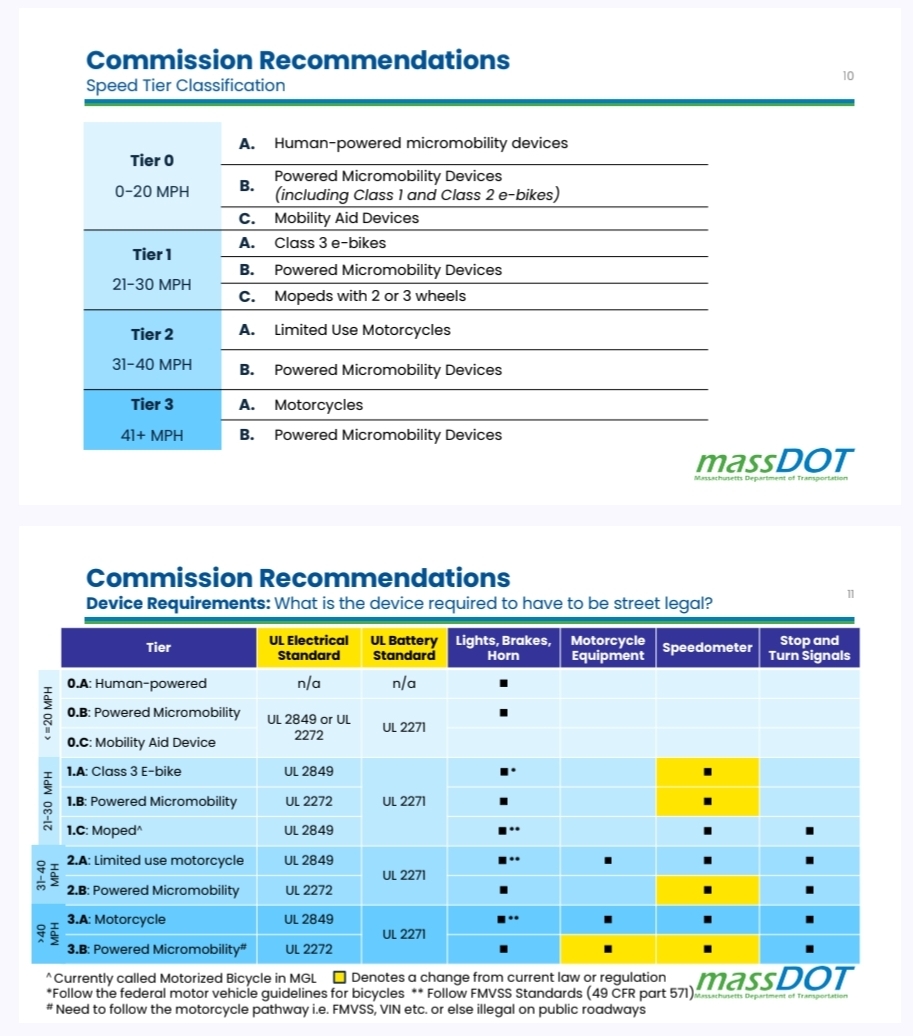
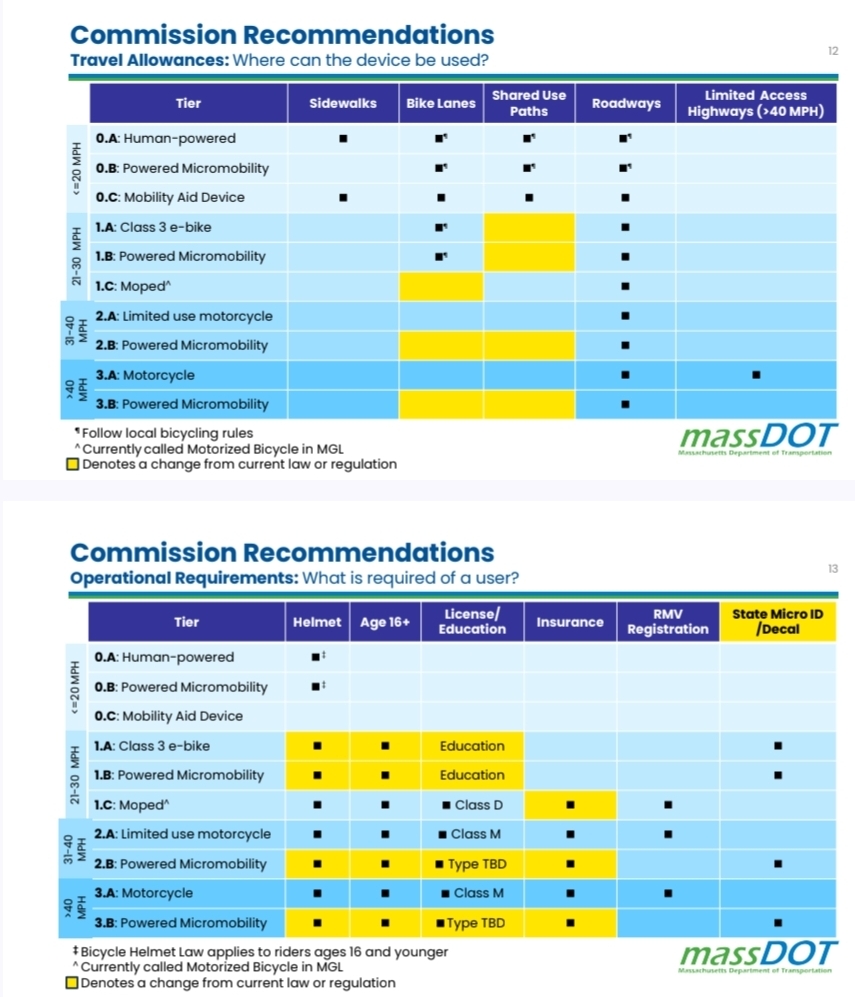
My personal take, is that this sort of regulation will be really hard to enforce - and for the shared use paths, I personally would much rather see a speed limit set than a hard ban on specific devices - I can imagine someone commuting on the minuteman with a class 3 ebike not for the speed, but for the battery size and range.
So I'd like to draw AB's attention towards some the recommendations of MassDOT's micromobility commission, specifically the new classifications and restrictions on where they can be used. A lot of this seems targeted at Class 3 ebikes and the faster standing scooters, which would both need state registration, and be restricted from shared use paths amongst others.
My personal take, is that this sort of regulation will be really hard to enforce - and for the shared use paths, I personally would much rather see a speed limit set than a hard ban on specific devices - I can imagine someone commuting on the minuteman with a class 3 ebike not for the speed, but for the battery size and range.
View attachment 70926View attachment 70927
Yeah I was a little more diplomatic about it when I was questioning them during the presentation but trying to enforce shared used path usage by hardware via "micro ID" rather than on user behavior is nonsense, and their response being that it at least allows accountability after the fact of a crash shows they know it's nonsense too. As Galen put it, we don't ban a Maserati from school zones just because of how fast it CAN go. When a colleague asked what about bikes that are sold as one class but are able to be modified to make them go speeds that would register them as class III, the response was these would be considered class III regardless of whether the those modifications were made. I kind of understand why they would have to go this way, because it really is as easy as dragging a slider in an app for many bikes, but it sure seems to me like the better approach would be prohibiting companies (and these are mainstream companies, not janky jailbroken bikes) from allowing that feature in MA.
EDIT: and to be clear, there is a lot of GREAT recommendations in this report that I hope the state leg moves on with expediency. I just think they're missing the mark here on this, and I know many commission members feel the same. Perhaps it's something that's efficacy can be assessed in a few years and revisited if it's working as we expect.
Last edited: