Biking in Boston

Yeah I was a little more diplomatic about it when I was questioning them during the presentation but trying to enforce shared used path usage by hardware via "micro ID" rather than on user behavior is nonsense, and their response being that it at least allows accountability after the fact of a crash shows they know it's nonsense too. As Galen put it, we don't ban a Maserati from school zones just because of how fast it CAN go. When a colleague asked what about bikes that are sold as one class but are able to be modified to make them go speeds that would register them as class III, the response was these would be considered class III regardless of whether the those modifications were made. I kind of understand why they would have to go this way, because it really is as easy as dragging a slider in an app for many bikes, but it sure seems to me like the better approach would be prohibiting companies (and these are mainstream companies, not janky jailbroken bikes) from allowing that feature in MA.

EDIT: and to be clear, there is a lot of GREAT recommendations in this report that I hope the state leg moves on with expediency. I just think they're missing the mark here on this, and I know many commission members feel the same. Perhaps it's something that's efficacy can be assessed in a few years and revisited if it's working as we expect.
It was a mistake to give so much of our land to automobiles. Just because Maseratis is school zones is normalized doesn’t mean society is better for it.

It would be a mistake to allow the same to happen on multi-use trails, with vehicles that can travel over 40 mph.
 
It was a mistake to give so much of our land to automobiles. Just because Maseratis is school zones is normalized doesn’t mean society is better for it.

It would be a mistake to allow the same to happen on multi-use trails, with vehicles that can travel over 40 mph.
A 15 year old Toyota Corolla can go over 100mph. Saying Maserati is just hyperbole to make a point.

You cannot effectively regulate what types of micromobility are going to access a shared use path. Mopeds, dirtbikes, and motorcycles are visually distinct enough to restrict those. A class III ebike, like the one below, isn't. If the below has been rigged up to go 40mph like you say...well then yeah, it's not an ebike anymore, but you're still not going to know unless the person riding it is speeding.

Screenshot 2026-03-03 093238.png


I agree with you that it would be a mistake to allow shared use paths to become speedways. I believe the speed limit should generally be 15mph, not the 20 the state sets. But trying to regulate hardware instead of behavior is going to both either woefully ineffective (my prediction) or discourage mode shift if it does work.

I quite love my Aventon Abound. It's been life changing for my family. Part of the reason that it works so well for us is because I can travel with the flow of traffic (pedal assist goes to 25mph) on most streets getting around town, making it a safer option to be carrying around our small child than if I was going 20 and dealing with everyone and their cousin trying to pass me so they can reach the next stop light 2 seconds faster (illogical and dangerous behavior, but the reality of how people drive). But I'm also an adult an can abide by a slower speed limit in places where it makes sense. What's at issue isn't "capable of 20" vs "capable of 40" it's "capable of 20" and "capable of somewhere between 20-28".
 
Last edited:
A 15 year old Toyota Corolla can go over 100mph. Saying Maserati is just hyperbole to make a point.

You cannot effectively regulate what types of micromobility are going to access a shared use path. Mopeds, dirtbikes, and motorcycles are visually distinct enough to restrict those. A class III ebike, like the one below, isn't. If the below has been rigged up to go 40mph like you say...well then yeah, it's not an ebike anymore, but you're still not going to know unless the person riding it is speeding.

View attachment 70949

I agree with you that it would be a mistake to allow shared use paths to become speedways. I believe the speed limit should generally be 15mph, not the 20 the state sets. But trying to regulate hardware instead of behavior is going to both either woefully ineffective (my prediction) or discourage mode shift if it does work.

I quite love my Aventon Abound. It's been life changing for my family. Part of the reason that it works so well for us is because I can travel with the flow of traffic (pedal assist goes to 25mph) on most streets getting around town, making it a safer option to be carrying around our small child than if I was going 20 and dealing with everyone and their cousin trying to pass me so they can reach the next stop light 2 seconds faster (illogical and dangerous behavior, but the reality of how people drive). But I'm also an adult an can abide by a slower speed limit in places where it makes sense. What's at issue isn't "capable of 20" vs "capable of 40" it's "capable of 20" and "capable of somewhere between 20-28".

From the sounds of it, we both have similar lived experiences of what micromobility usage is like in mixed traffic with automobiles. We could have a long discussion about mixed use trails and at what speed capability a vehicle becomes inapporpriate to bring onto a multi-use. That would likely not result in us agreeing on a cut-off. It sounds like you think it should be something in the ballpark of "no vehicles with motorized assist above 40mph" and I'm in the ballpark of "no vehicles with motirized assist above 20mph." I don't imagine either of us agreeing to the others' opinion, and that's okay. So, rather than friendly fire, I want to shift the conversation a bit.
  1. We should have spaces where pedestrians can exist in public without vehicles (even bicycles) that travel above 10mph. Thankfully, those are plentiful. The sidewalk on my urban street never has anyone traveling above a jog. I'd love more plazas and spaces like this, but at least they exist and there is a fairly comprehensive network of such space in the Boston urban core.
  2. We should have spaces were pedestrians, cyclists, and lower-speed micromobility users, from the 3 year old on a balance bike to the elderly couple on class I e-bikes staying active and getting fresh air, can exist without vehicles that travel above 20mph. There is a mountain of evidence that shows how important this is. From a safety perspective, the risk of a pedestrian crash fatality is estimated to increase from 5 percent to 45 percent when speed increases from 20 to 30 mph. From a subjective perspective, having spent much time on multi-use trails, paths on which microvehicles are traveling 10-20 mph feel like a relaxing park and paths on which microvehicles are traveling 20-30 mph feel like a much less relaxing parkway. I am not saying parkways should not exist. I am simply saying parks should exist.
  3. We should have more robust infrastructure where people can travel safely in the 15-30 mph range on e-bikes, bicycles, mopeds, etc, without having to contend with the very problem you and I both encounter: illogical and dangerous behavior from operators of multi-ton vehicles. Cycle-tracks, more-than-paint bike lanes, safer slow streets, and other forms of seperated infrastructure that is purpose-built for transportation, not leisure and recreation, not speeding automobiles.
I'd hope you agree that a great city has all three of the above. We are lacking in both #2 and #3. As higher speeds on our multi-use trails have become much more common over the past few years, I've seen a lot of spaces that used to fit into #2 become more appropriately labeled as #3. The bigger problem is that most of our transportation space is fully outside of those three, and rather devoted to higher-speed, larger vehicles.

I empathize with your view that we need to allow higher speed vehicles to use what have been lower-speed park paths because they need the higher speed to battle with high-speed automobiles. I'd rather see a network of infrastructure that protects people from automobiles than turning our parks into parkways suitable for your battle rig against drivers.
 
From the sounds of it, we both have similar lived experiences of what micromobility usage is like in mixed traffic with automobiles. We could have a long discussion about mixed use trails and at what speed capability a vehicle becomes inapporpriate to bring onto a multi-use. That would likely not result in us agreeing on a cut-off. It sounds like you think it should be something in the ballpark of "no vehicles with motorized assist above 40mph" and I'm in the ballpark of "no vehicles with motirized assist above 20mph." I don't imagine either of us agreeing to the others' opinion, and that's okay. So, rather than friendly fire, I want to shift the conversation a bit.
  1. We should have spaces where pedestrians can exist in public without vehicles (even bicycles) that travel above 10mph. Thankfully, those are plentiful. The sidewalk on my urban street never has anyone traveling above a jog. I'd love more plazas and spaces like this, but at least they exist and there is a fairly comprehensive network of such space in the Boston urban core.
  2. We should have spaces were pedestrians, cyclists, and lower-speed micromobility users, from the 3 year old on a balance bike to the elderly couple on class I e-bikes staying active and getting fresh air, can exist without vehicles that travel above 20mph. There is a mountain of evidence that shows how important this is. From a safety perspective, the risk of a pedestrian crash fatality is estimated to increase from 5 percent to 45 percent when speed increases from 20 to 30 mph. From a subjective perspective, having spent much time on multi-use trails, paths on which microvehicles are traveling 10-20 mph feel like a relaxing park and paths on which microvehicles are traveling 20-30 mph feel like a much less relaxing parkway. I am not saying parkways should not exist. I am simply saying parks should exist.
  3. We should have more robust infrastructure where people can travel safely in the 15-30 mph range on e-bikes, bicycles, mopeds, etc, without having to contend with the very problem you and I both encounter: illogical and dangerous behavior from operators of multi-ton vehicles. Cycle-tracks, more-than-paint bike lanes, safer slow streets, and other forms of seperated infrastructure that is purpose-built for transportation, not leisure and recreation, not speeding automobiles.
I'd hope you agree that a great city has all three of the above. We are lacking in both #2 and #3. As higher speeds on our multi-use trails have become much more common over the past few years, I've seen a lot of spaces that used to fit into #2 become more appropriately labeled as #3. The bigger problem is that most of our transportation space is fully outside of those three, and rather devoted to higher-speed, larger vehicles.

I empathize with your view that we need to allow higher speed vehicles to use what have been lower-speed park paths because they need the higher speed to battle with high-speed automobiles. I'd rather see a network of infrastructure that protects people from automobiles than turning our parks into parkways suitable for your battle rig against drivers.
Not to put words in @KCasiglio 's mouth, but if I understand their POV right, it's that we should regulate speed and behavior, not vehicle capability. I generally agree with this.

I agree with your 3-tier categorization in terms of considerations to speed, right-of-way, and noise. But I disagree with the prescriptivity about the exact vehicle specs. If someone wants to carefully ride a bike at 8mph on a sidewalk and is willing to yield to pedestrians as they do so, that's completely fine with me. If someone wants to ride a Class III e-bike at 15mph on the community path and is respectful on how they pass pedestrians and slower cyclists, that's great. I don't even mind electric mopeds in bike lanes as long as they are being safe.

Conversely, I can't stand when oblivious joggers fail to move over on sidewalks and effectively shove oncoming walkers into snowbanks, or when fast manual cyclists pass at 25mph within inches of others on the community path without using their bell. All things that are "allowed" under your classification.

I say this as someone who walks, jogs, and cycles. Please don't ban me from carefully riding on sidewalks sometimes just because of some spandex warriors who don't know common courtesy, and please don't ban parents from respectfully e-biking their kids around on the community path because of some jerks that weave around pedestrians at 30mph.
 
Not to put words in @KCasiglio 's mouth, but if I understand their POV right, it's that we should regulate speed and behavior, not vehicle capability. I generally agree with this.

I agree with your 3-tier categorization in terms of considerations to speed, right-of-way, and noise. But I disagree with the prescriptivity about the exact vehicle specs. If someone wants to carefully ride a bike at 8mph on a sidewalk and is willing to yield to pedestrians as they do so, that's completely fine with me. If someone wants to use ride a Class III e-bike at 15mph on the community path and is respectful on how they pass pedestrians and slower cyclists, that's great. I don't even mind electric mopeds in bike lanes as long as they are being safe.

Conversely, I can't stand when joggers forget move over on sidewalks and effectively shove walkers into snowbanks, or when fast manual cyclists pass at 25mph within inches of others on the community path without using their bell. All things that are "allowed" under your classification.

I say this as someone who walks, jogs, and cycles. Please don't ban me from carefully riding on sidewalks sometimes just because of some spandex warriors who don't know common courtesy, and please don't ban parents from respectfully e-biking their kids around on the community path because of some jerks that weave around pedestrians at 30mph.
I hope you didn’t take my post as an implicit approval of the types of disrespectful behavior you posted, which I’m sure we all agree are not okay and fully outside the purview of this discussion.

Bad actors can be on any mode of transportation. This discussion is about which vehicles should be allowed.

As an aside, I’ll take a jerk on a bicycle (or even a class III e-bike) over a jerk in an automobile any day. One is much more dangerous.
 
I hope you didn’t take my post as an implicit approval of the types of disrespectful behavior you posted, which I’m sure we all agree is not okay and full outside the purview of this discussion.
No not at all! I'm just trying to argue in favor of addressing behavior rather than vehicle specs, generally.
 
No not at all! I'm just trying to argue in favor of addressing behavior rather than vehicle specs, generally.

It's such a tricky space because I don't want to discourage a mode shift away from automobiles, but I recognize that many humans on a class III e-bike will choose to go its max speed even if they aren't "supposed to" and we both know speed enforcement is a joke. If a 20 mph speed limit on a multi-use trail works anything like a speed limit on a road, the average speed will be 25 mph and the 90th percentile speed will be 35 mph. That would be a shame and completely destroy the very peaceful nature of a park path.
 
It's such a tricky space because I don't want to discourage a mode shift away from automobiles, but I recognize that many humans on a class III e-bike will choose to go its max speed even if they aren't "supposed to" and we both know speed enforcement is a joke. If a 20 mph speed limit on a multi-use trail works anything like a speed limit on a road, the average speed will be 25 mph and the 90th percentile speed will be 35 mph. That would be a shame and completely destroy the very peaceful nature of a park path.
I don't know. I think that humans outside of cars tend to behave in a much more socially-conscious way than humans in cars. While the average driver might see it morally fine to drive 25mph in a 20mph zone, I think the average cyclist will actually ride 20mph or less. People are basically respectful and caring by default, but something about putting them in control of a giant metal machine on a wide, smooth roadway seems to uniquely detach them from their sense of responsibility towards others. I'd love if someone with real data were able to support or refute this.
 
We could have a long discussion about mixed use trails and at what speed capability a vehicle becomes inapporpriate to bring onto a multi-use. That would likely not result in us agreeing on a cut-off. It sounds like you think it should be something in the ballpark of "no vehicles with motorized assist above 40mph" and I'm in the ballpark of "no vehicles with motirized assist above 20mph." I don't imagine either of us agreeing to the others' opinion, and that's okay. So, rather than friendly fire, I want to shift the conversation a bit.
I'd say "motorized assist up to 28mph", aligning with the commonly accepted definition of a class III bike and assuming the state adopts such as their definition as well. So not a ton of daylight between our positions there but I think it's important daylight for the reasons above. Happy to let it lie and agree to disagree there.
I'd hope you agree that a great city has all three of the above. We are lacking in both #2 and #3. As higher speeds on our multi-use trails have become much more common over the past few years, I've seen a lot of spaces that used to fit into #2 become more appropriately labeled as #3. The bigger problem is that most of our transportation space is fully outside of those three, and rather devoted to higher-speed, larger vehicles.
Yeah, I think we're exactly on the same page in terms of goals and it really does just boil down to "specs vs behavior" as @ball_square said. I just don't see how the restriction of class III bikes from SUPs could be effectively implemented, and if it somehow can be I don't think it's a net safety benefit to put my daughter and I on Mass Ave instead of the minuteman just because the bike is capable of going 5mph over the speed limit. Behavior on the other hand can be much more effectively enforced with just someone with jurisdiction riding up and down the path on a bike, or even with some design elements. Completely agree that those types of paths should have lower speeds where people of all ages and abilities feel comfortable walking, jogging, or riding.
 
Personally, I have less problem with pedal assist vs pure throttle driven electric. I find the latter should be considered a motor vehicle.
This is a good point, I should mention that the up-to-25mph pedal assist on my bike is still not easy to reach 25mph on unless I'm going downhill or really working, and I'm a fairly athletic man.
 
On a webinar with State Sen. Crighton right now, who just said they expect to introduce a bill soon to adopt the commission's recommendations.

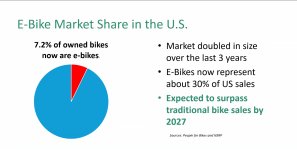
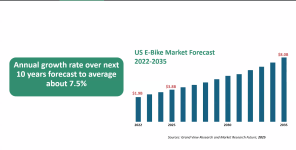
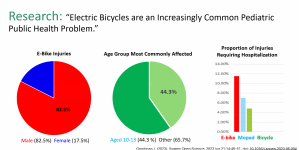
EDIT: Some of the most interesting slides from said webinar. It seems we really have a middle school boys problem. (As a former middle school teacher....yeah that tracks). Also, e-bikes look poised to quickly start overtaking analog bikes over the next few years. Particularly in areas where biking is more transportation than recreation I wouldn't be surprised if this is already the case.
 

Attachments

  • Screenshot 2026-03-04 125046.png
    Screenshot 2026-03-04 125046.png
    219.9 KB · Views: 41
  • Ebike Market Share.png
    Ebike Market Share.png
    177.4 KB · Views: 43
  • Ebike 10Year Growth.png
    Ebike 10Year Growth.png
    114.4 KB · Views: 40
Last edited:
25MPH pedal assist is crazy. Here in NL the limit is 25 km/h (~15MPH) and even that feels dangerously fast at times.
 
So I'd like to draw AB's attention towards some the recommendations of MassDOT's micromobility commission, specifically the new classifications and restrictions on where they can be used. A lot of this seems targeted at Class 3 ebikes and the faster standing scooters, which would both need state registration, and be restricted from shared use paths amongst others.

My personal take, is that this sort of regulation will be really hard to enforce - and for the shared use paths, I personally would much rather see a speed limit set than a hard ban on specific devices - I can imagine someone commuting on the minuteman with a class 3 ebike not for the speed, but for the battery size and range.

View attachment 70926View attachment 70927

To me, these kinds of recommendations are what make things unenforceable. I know other folks have discussed the 3 classes (and apologies that I am late to the discussion) and I think that is where it should stop. There is so much variation within each speed classification of these recommendations that we create a overburdening regulation. Unfortunately there is always going to need to be a certain amount of vagueness within our governance because by creating classes and sub-classes and sub-sub-regulations it is impossible to enforce or even to train to enforce.

The breakdown that Toole Design Group (who I see as a industry leader in the sector) breaks it down very simply.

The semantics comes down to the "pedal assist" for me. So many ebikes nowadays have the pedals, but they are not necessary as the throttle control does not require pedaling. If that is the case, to me it is an emoto no matter the speed capability. If you don't have to actually pedal for the throttle to activate, it's not an ebike. The lone exception in my mind to the pedal activated throttle would be if you pedal and charge up the throttle capability so that you can give yourself a break (think about pedaling as a way to harvest energy). That way it's not like someone just gets on a bike and immediately going 20 or 28 mph.
 
The semantics comes down to the "pedal assist" for me. So many ebikes nowadays have the pedals, but they are not necessary as the throttle control does not require pedaling. If that is the case, to me it is an emoto no matter the speed capability. If you don't have to actually pedal for the throttle to activate, it's not an ebike. The lone exception in my mind to the pedal activated throttle would be if you pedal and charge up the throttle capability so that you can give yourself a break (think about pedaling as a way to harvest energy). That way it's not like someone just gets on a bike and immediately going 20 or 28 mph.
NL laws are very clear on this. If it can go faster than 5km/h without pedaling it's a moped, not a bike.
 
NL laws are very clear on this. If it can go faster than 5km/h without pedaling it's a moped, not a bike.
I like this. I appreciate having the throttle for getting some initial momentum, particularly when I have a load, starting uphill, or in a spot where cars are going to be rapidly accelerating alongside me, but if youre passively sitting and holding a throttle to move I agree we're no longer talking about active transportation
 

Back
Top