
JumboBuc
Senior Member
- Joined
- Jun 26, 2013
- Messages
- 2,789
- Reaction score
- 1,923
It's not about whom they call, it's about who answers their calls.In other news, Commonwealth Beacon apparently has no rolodex whatsoever to book better guests.

It's not about whom they call, it's about who answers their calls.In other news, Commonwealth Beacon apparently has no rolodex whatsoever to book better guests.
Aloisi is very good; him vs. Chieppo is such a not-fair fight the refs should've intervened to stop it after the first round. But damn does Comm Beacon rely on him an awful lot for op-eds and podcast bookings; he's become like a load-bearing wall for them. Their sourcing for transpo coverage and resident opinioneers has gotten painfully thin ever since Bruce Mohl retired from staff and took his contact list with him. Noticeable dropoff in quality and quality control.It's not about whom they call, it's about who answers their calls.


 www.bostonglobe.com

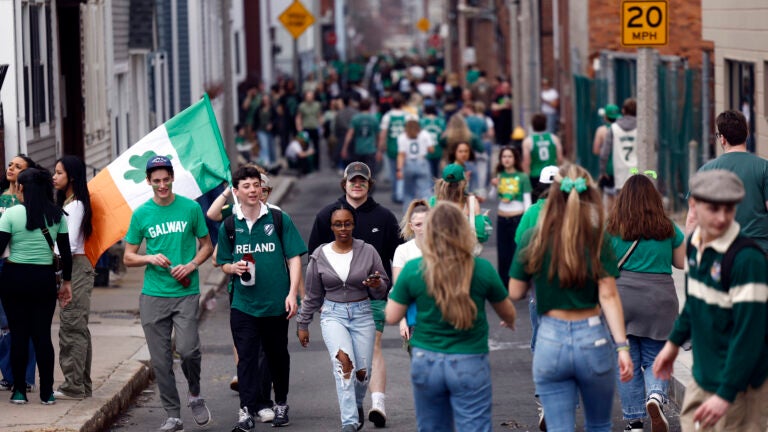
During last year’s parade, the MBTA was so overwhelmed with riders that the Red Line had to bypass Broadway Station. “It was out of control,” state Sen. Nick Collins, who represents South Boston, said last year to Boston.com.
However, this Sunday, the MBTA is initiating schedule changes and deploying large amounts of transit police to mitigate crowding and crime, the agency said in a press release.
On Sunday, the MBTA will run the Red Line on a “rush hour service” schedule from 10 a.m. to 6 p.m. The Red Line may skip the Broadway stop “during certain times due to heavy crowds,” the T said. The MBTA will also offer shuttle buses from South Station to South Boston on parade day, the T said.
On Sunday, the shuttle will pick up riders at Summer Street at Atlantic Ave. and drop them off at East 1st Street at City Point Bus Terminal. The first trip will leave at 9:30 a.m., and service will end at 4:30 p.m., the MBTA said.
For those traveling into Boston, the MBTA is adding extra train cars to Commuter Rail trains to accommodate the masses. The Fairmount, Fall River/New Bedford, Framingham/Worcester, Franklin/Foxboro, Greenbush, Kingston, and Providence/Stoughton Lines will run on special schedules on Sunday, the agency said.
“Additional customer service and management staff will be available at South Station to answer any questions and assist customers,” the T said.
Bus routes 9 and 11 will be temporarily suspended on parade day. Route 9 will end service at 6:45 a.m., with the last inbound and outbound bus leaving at 6:30 a.m. The last bus for Route 11 will be at 6:15. Regular service will resume around 6 p.m., the agency said. Routes 10, 16, 17, and 47 will experience detours throughout the day, the MBTA announced.

 www.wcvb.com
Shuttle buses replaced service between North Quincy and Braintree stations for about an hour.
Riders were also urged to use the Commuter Rail between Braintree and South Station for alternate service.
The cause of the fire remains under investigation.

 www.bostonglobe.com
Massachusetts House Democrats on Tuesday released a $1.8 billion spending bill that would infuse funding into the cash-strapped MBTA, send millions to the state’s elected sheriffs, and pad the state’s World Cup effort with an additional $10 million — addressing a pain point as the state readies to host seven matches this summer at Gillette Stadium.
While the bill, which lawmakers plan to vote on Wednesday, also works to conform the state’s tax law with changes at the federal level, it proposes a raft of new spending during a period of economic uncertainty, according to a summary released by House leaders.
The House’s plan leans heavily on surplus money generated last fiscal year by the state’s so-called millionaires tax, proposing to spend $1.3 billion of it. It also includes roughly $500 million, which House leaders said would come from the state’s general fund.
[...]
It also pitches spending $740 million on the struggling MBTA — a number that exceeds the $560 million budget deficit officials said the agency faces for the fiscal year that begins in July. That amount includes $60 million for physical infrastructure on the subway system, which was strained under this year’s historic winter storm.
The proposed amount exceeds the $645 million that Governor Maura Healey proposed giving the T in surplus surtax revenue.


 www.mbta.com
Spring 2026 Service Changes | Previous Service Changes | MBTA
Official website of the MBTA -- schedules, maps, and fare information for Greater Boston's public transportation system, including subway, commuter rail, bus routes, and boat lines.

They have the map showing the 9 as a FBR already out though not in many places. They have it at South Station in the lobby and on mbtagifts.com.View attachment 71517
Welcome to the map, 9.
Side note, it's going to be interesting to see how the official map handles this change, this is where things may start going really off the rails. The 12, 16, and 47 are going to be the real tests though.
It looks awful.They have the map showing the 9 as a FBR already out though not in many places. They have it at South Station in the lobby and on mbtagifts.com.
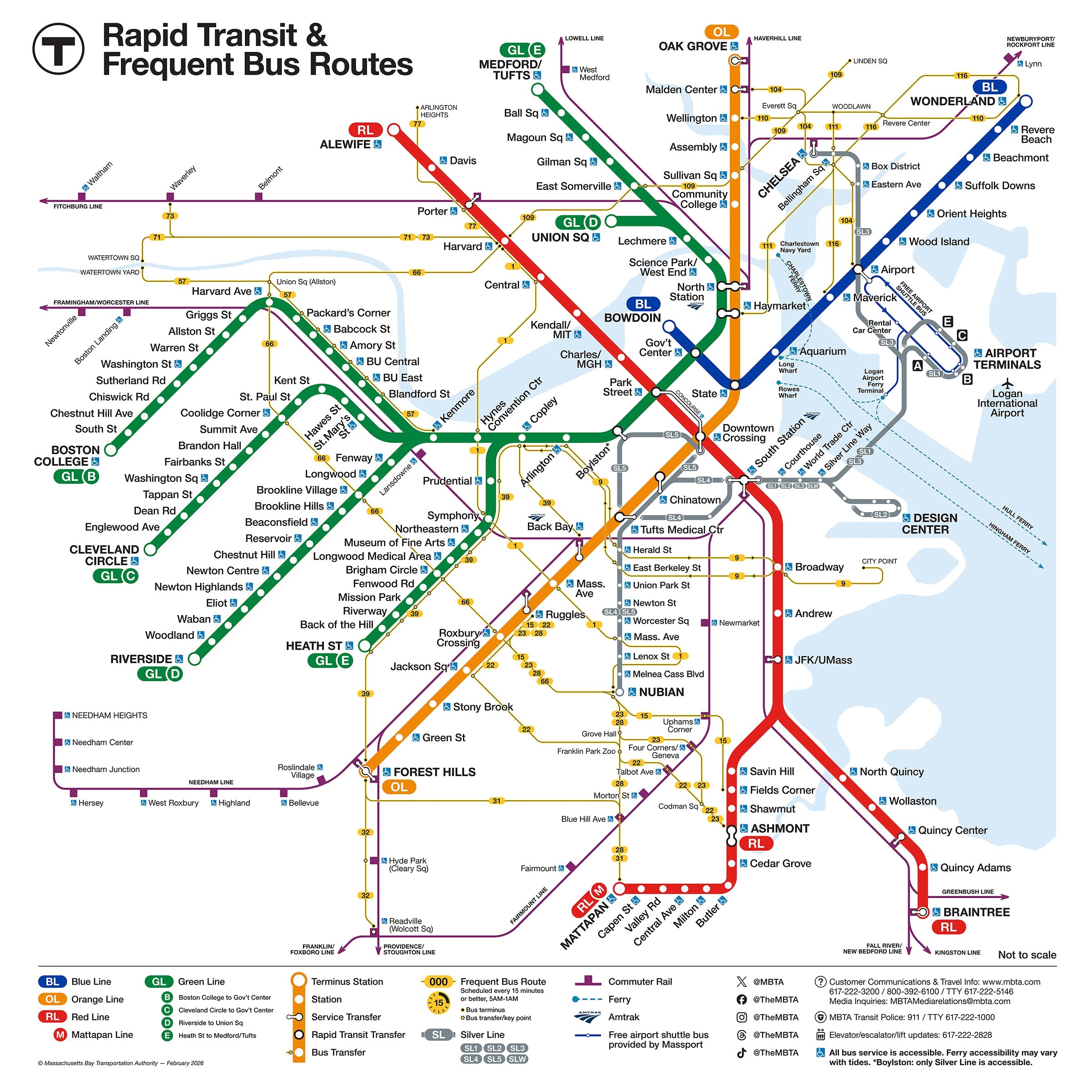
My primary objections to the way it's shown here are that the directional arrows are absolutely tiny and basically invisible, and that the way it's shown as a loop around Copley/Arlington makes the route appear twice as thick (and therefore twice as prominent) as the other routes.I don't see the issue but I have absolutely zero eye for graphic design. Could someone more inclined in such explain?
This is disappointing to hear, hopefully they're just off to a slow start. Unfortunately the funding question is baked in to this process because the T ties it back to the CIP, even though no one knows what the funding picture looks like in 2050. Is there anything in Boston with a more ambitious long-term outlook on infrastructure to support growth, akin to the New York RPA? Some questions that could be tackled are:I was at the Focus 2050 meeting last night. I don't have too many notes but here's what I observed:
- As the name implies, it its a successor to the very Baker-era Focus40 plan from 2019, itself a successor to the 2003 and 2009 PMTs
- If you read each report you notice a very clear trend in ambition trending downwards each time while report quality increases, getting better at being a true visionary document. The 2003 PMT is incredibly dry but features some pretty wild and crazy ideas. Focus40 by contrast is easy to read/understand but the absolute boldest of the "We're imagining" ideas are T under D and a BL extension to Lynn.
- Frankly this was not a good meeting. It was a strange and bizarre way of conducting the least efficient passenger survey possible. Just as an example, we were put in breakout rooms where the moderator asked questions such as "What do you think are some future transport trends in the Commonwealth?" which predictably got conflicting answers like "I think remote work will increase" and "no I think it will decrease."
- The way the project was mentioned makes me nervous. It was explicitly stated that Focus 2050 will not be fiscally constrained, but there was plenty of talk from the MBTA staff there that suggested that this wasn't really being taken to heart. They seemed hesitant to go for really wild and crazy ideas because quote, "They will not be funded." Another attendee corrected them to state, "They may not be funded."
- This was not a heavily attended meeting, it was mostly nerds.
- Said nerds mainly brought up the usual suspects such as Red-Blue, the Urban Ring, and radial rail extensions as things they'd like to see discussed
- There was a brief mention of a survey that they intend to send out in the future.
- Final report is expected in late 2027

The Silver Lines are a mess. The SL 4 and SL 5 routes are shown in a very confusing way north of the Tufts Medical Center stop. The breaks in the lines there and at Downtown Crossing would seem to indicate the lines are just dead-ending at those places, but they're actually looping around. Also, directional arrows are needed on these sections of SL 4 and SL 5 to show how the loops work. The same types of graphic deficiencies are at Logan Airport for SL 1 and at Design Center for SL 2.I don't see the issue but I have absolutely zero eye for graphic design. Could someone more inclined in such explain?
There actually are directional arrows on the SL loops (at the end of each loop at the break point), but they are way too subtle for the average user of the map to identify their purpose. Very poor graphical design. There needs to be much clearer designation of the one-way nature of the loop service.The Silver Lines are a mess. The SL 4 and SL 5 routes are shown in a very confusing way north of the Tufts Medical Center stop. The breaks in the lines there and at Downtown Crossing would seem to indicate the lines are just dead-ending at those places, but they're actually looping around. Also, directional arrows are needed on these sections of SL 4 and SL 5 to show how the loops work. The same types of graphic deficiencies are at Logan Airport for SL 1 and at Design Center for SL 2.
Yes, there are tiny directional arrows at the stub ends on the loops, but I couldn't even see them, and my eyes are pretty good.There actually are directional arrows on the SL loops (at the end of each loop at the break point), but they are way too subtle for the average user of the map to identify their purpose. Very poor graphical design. There needs to be much clearer designation of the one-way nature of the loop service.
The Silver Lines are a mess. The SL 4 and SL 5 routes are shown in a very confusing way north of the Tufts Medical Center stop. The breaks in the lines there and at Downtown Crossing would seem to indicate the lines are just dead-ending at those places, but they're actually looping around. Also, directional arrows are needed on these sections of SL 4 and SL 5 to show how the loops work. The same types of graphic deficiencies are at Logan Airport for SL 1 and at Design Center for SL 2.
I agree with all the points backing this up but think it would still be a massive unforced PR nightmare.Taking this all into consideration, I really think it's time to strip the SL4 and SL5 of their "Silver Line" branding and just bring back the (old) 49 in their place as a Frequent Bus Route. The "Silver Line" concept (with Subway fares) can live on with SL1, SL2, and SL3, which (primarily) run on true grade-separated busways (rather than bus lanes on public streets).
