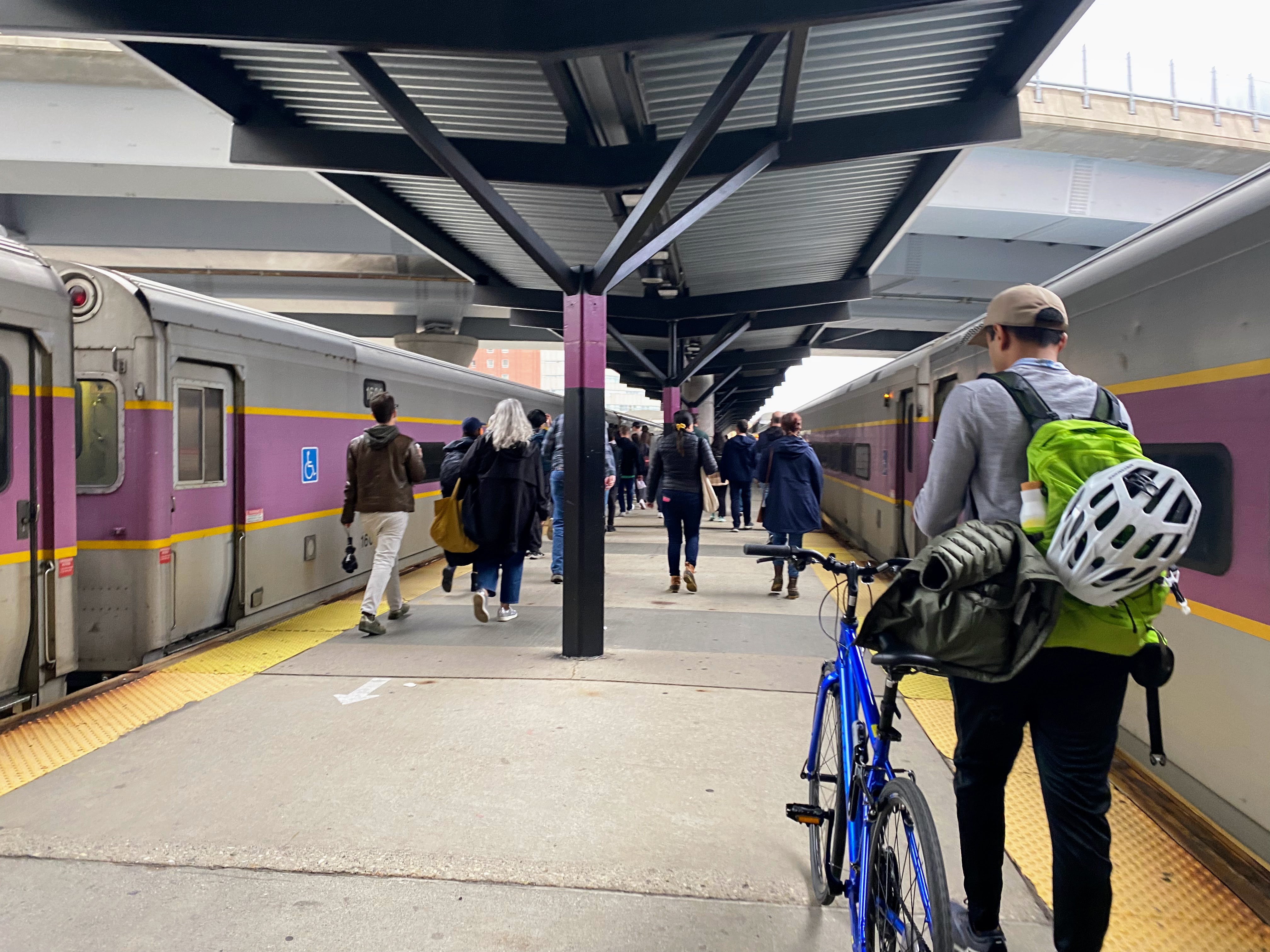
MBTA Commuter Rail (Operations, Keolis, & Short Term)

Other observations - Middleboro layover yard
-Three HSP46's stored here with MBTX reporting marks. These should be the first units headed to WABTEC/Erie for overhaul.
-Two tracks worth of S.I.T. gondolas. They appear to be stored cars for the dirt shipments out of Taunton. They had been storing
them in New Bedford in the freight yard next to the layover. Haven't been by in a spell, so I don't know if they are still there (NB)
MBTA leasing out space in Middleboro to MC?
 
Wollaston is definitely brutal. I don't see how that gets solved without blowing-up/rebuilding the station yet again. They'd either have to swing the Red Line alignment further out on the parking lot side of the station and/or narrow the somewhat curiously over-wide for its passenger load (28 ft.) island platform. Either way it's a total nuke job, and calls directly into question what they were (or weren't) thinking when they planned the most recent station rebuild.

Quincy Center is not that bad. There's lots of earthen fill on the Burgin Pkwy. side of the station, so you could fairly straightforwardly scoop out, pour a concrete shell, do up an island platform, and punch repeated holes in the existing retaining wall for passage between the platform halves. That might even be a lower-reach installment-plan add before the running track outside the station gets doubled-up to increase frequencies a bit by using meets on the would-be island as a timing mechanism for closer bi-directional train spacing. It's honestly not as hard as doubling-up the tracks immediately south of the station under the parking garage. If you did islands at both JFK and QC first you'd be able to add quite a lot of frequencies...maybe still far from Regional Rail-on-3-branches levels, but having all mainline stations doubled-up first is worth pretty substantial gains as well as a lot better resiliency when anything's running late.

Quincy Adams is very snug, but the width of the Commuter Rail ROW through the station is about 31-32 ft. (only about 1-2 feet narrower than what the currently DT'd tracks do when passing the Braintree Red Line station). That should be *just* enough for double-track with no margin for error, though you've still got to blow-up/rebuild the very much single-track flyunder immediately south of the station to extend DT into Braintree and probably have to lane-diet Burgin Pkwy. everywhere between QC and QA to make it contiguous.
By far the biggest killer of frequencies is Quincy Center station, it's an important stop right in the middle of the line. If QC can get an island platform and double-track up to Adams St then it would maybe be possible to just leave the rest of the track between North Quincy and Quincy Adams as single-track. With an average speed of 20MPH that means you can do 6 TPH per direction, or 2 TPH per OC line. Double-tracking from NQ-Wollaston would increase the maximum frequency to around 7-8 per direction, enough for 15 minute service to Brockton/Bridgewater, 30 minutes to Greenbush/Kingston, and hourly to Fall River/New Bedford without shuttling. Full double-track would be nice but when Greenbush and Kingston seem likely to stay pretty sleepy lines for the foreseeable future I think it's probably letting perfect get in the way of good.
 
By far the biggest killer of frequencies is Quincy Center station, it's an important stop right in the middle of the line. If QC can get an island platform and double-track up to Adams St then it would maybe be possible to just leave the rest of the track between North Quincy and Quincy Adams as single-track. With an average speed of 20MPH that means you can do 6 TPH per direction, or 2 TPH per OC line. Double-tracking from NQ-Wollaston would increase the maximum frequency to around 7-8 per direction, enough for 15 minute service to Brockton/Bridgewater, 30 minutes to Greenbush/Kingston, and hourly to Fall River/New Bedford without shuttling. Full double-track would be nice but when Greenbush and Kingston seem likely to stay pretty sleepy lines for the foreseeable future I think it's probably letting perfect get in the way of good.
TransitMatters generally went a little too threadbare for credulity in its Old Colony Modernization report with sheer-perfection timing single-track meets on the OC branches, but even they thought the entire main needed complete double-tracking to pull off effective :30 Regional Rail to all destinations, nevermind :15 to a Gateway city and big bus hub like Brockton. They were, however, all behind the installment plan that treated the stations first to ratchet up the frequencies in stages.
1774193157694.png
 
By far the biggest killer of frequencies is Quincy Center station, it's an important stop right in the middle of the line. If QC can get an island platform and double-track up to Adams St then it would maybe be possible to just leave the rest of the track between North Quincy and Quincy Adams as single-track. With an average speed of 20MPH that means you can do 6 TPH per direction, or 2 TPH per OC line. Double-tracking from NQ-Wollaston would increase the maximum frequency to around 7-8 per direction, enough for 15 minute service to Brockton/Bridgewater, 30 minutes to Greenbush/Kingston, and hourly to Fall River/New Bedford without shuttling. Full double-track would be nice but when Greenbush and Kingston seem likely to stay pretty sleepy lines for the foreseeable future I think it's probably letting perfect get in the way of good.
Given that consensus is that we need to increase capacity on the Old Colony lines and that it will be incredibly expensive to double track through Quincy and JFK, I wanted to bring back up an idea that got thoroughly shut down on this board when it was brought up a while ago - removing the Braintree branch from the Red Line and converting those stations to serve shorter BEMU/EMU trainsets while maintaining longer express platforms at Braintree and Quincy Center.

My main assumption with bringing this up again are that it will cost much less to reconfigure 5 platforms + track integrations compared to redoing a significant amount of 3 stations + widening the ROW underneath Burgin Pkwy and in other spots.

When I look at all the " blowing up" that will have to happen, as well as images like the one below, all I can think is that will be a nightmare in cost and disruption to get through. It makes me start to think that the slightly longer frequencies in Quincy + extra transfer with frequent and relatively easy transfer at JFK to get further than South Station+ better frequencies to Ashmont through Savin Hill is worth it. This way you are triple tracking one line rather than double tracking two separate ones in the same ROW. Each way you are increasing service to Brockton and the South Shore and (I think) will require either SSX or NSRL for additional capacity.
1774215603142.png


I know that there are other unique differences that would add to the cost of converting the entire ROW to regional rail like slopes on flyovers, are those going to be as much as a cost barrier? Addiitonally, from the posts I could find in 2016, the reason why it's a terrible idea were

1- Frequencies will at best be 15 minutes and always inferior to RL (by 1-6 minutes depending on time of day) due to terminal district, FRA rules, and dispatching.
2- Disruptions to commuting destinations by losing 1SR from Quincy to Park St, MGH, and Cambridge.

I'm not knowledgeable enough about the interlocking to try to assert a 10 frequency claim from 2tph on each of the 3 branches, but I don't think the additional transfer for Cambridge and MGH is insurmountable. I'm well aware we don't want to downgrade service at all, but if the goal is giving South Shore and Brockton a major upgrade to service/ realistic transit option, wouldn't this slight downgrade to Quincy be the easiest/most affordable way?

 
Given that consensus is that we need to increase capacity on the Old Colony lines and that it will be incredibly expensive to double track through Quincy and JFK, I wanted to bring back up an idea that got thoroughly shut down on this board when it was brought up a while ago - removing the Braintree branch from the Red Line and converting those stations to serve shorter BEMU/EMU trainsets while maintaining longer express platforms at Braintree and Quincy Center.

My main assumption with bringing this up again are that it will cost much less to reconfigure 5 platforms + track integrations compared to redoing a significant amount of 3 stations + widening the ROW underneath Burgin Pkwy and in other spots.

When I look at all the " blowing up" that will have to happen, as well as images like the one below, all I can think is that will be a nightmare in cost and disruption to get through. It makes me start to think that the slightly longer frequencies in Quincy + extra transfer with frequent and relatively easy transfer at JFK to get deeper than downtown + better frequencies to Ashmont through Savin Hill is worth it. Each way you are increasing service to Brockton and the South Shore, but this way you are triple tracking one line rather than double tracking two separate ones in the same ROW.
View attachment 71536

I know that there are other unique differences that would add to the cost of converting the entire ROW to regional rail like slopes on flyovers. From the posts I could find in 2016, the reason why it's a terrible idea were

1- Frequencies will at best be 15 minutes and always inferior to RL (by 1-6 minutes depending on time of day) due to terminal district, FRA rules, and dispatching.
2- Disruptions to commuting destinations by losing 1SR from Quincy to Park St, MGH, and Cambridge.

I'm not knowledgeable enough about the interlocking to try to assert a 10 frequency claim from 2tph on each of the 3 branches, but I don't think the Cambridge and MGH extra transfer is insurmountable. I'm well aware we don't want to downgrade service at all, but if the goal is getting to an upgraded service and making transit a realistic option for the South Shore, wouldn't this slight downgrade to Quincy be the easiest/most affordable way?
No. I'll give the same exact answer as the last time you brought this up.

Quincy has a 55-year developed commuting affinity for the Downtown transfer stations and Cambridge. You are not politically going to be allowed to wreck all those commutes by forcing extra transfers and fare penalties at South Station and overloading the living crap out of the already overloaded South Station platforms. And you're not going to wreck their frequencies. Red Line Transformation is taking the peak headways on the branches down to 6 minutes. You aren't achieving that on Regional Rail while sucking up all the extra abandoned Red Line stations, especially when the number of extra stations would induce required skip-stopping on the 90-minute Fall River and New Bedford runs to make up time vs. the schedule drag of that many more stops.

You LOSE ridership--lots of it--deleting the Red Line. More than you feasibly gain by bringing Regional Rail service levels to the suburbs, and with deleterious effects to the big Quincy Center bus hub and all routes emanating from it as well if they lose their direct subway transfer. The price tag of widening the OC may be scary, but it's not a bad investment in the slightest. Removing the Red Line just punishes Quincy and Braintree and every trip pair therein for no good reason.
 
TransitMatters generally went a little too threadbare for credulity in its Old Colony Modernization report with sheer-perfection timing single-track meets on the OC branches, but even they thought the entire main needed complete double-tracking to pull off effective :30 Regional Rail to all destinations, nevermind :15 to a Gateway city and big bus hub like Brockton. They were, however, all behind the installment plan that treated the stations first to ratchet up the frequencies in stages.
View attachment 71528
From the report this image is taken from...
"However, the physical constraints in Quincy are such that, until the North-South Rail Link (NSRL) is built, the trunk should only be partially doubled."

Which is the "Phase 1" indicated on the map. In fact their service plan is more conservative, 30 minutes on all branches including Fall River/New Bedford. Like I said and the image shows, you just need double-track at Quincy Center to do that. If you want to start going above that you'll either need to add more double track (Probably NQ-Wollaston) or get the average speed up above 25 MPH. Yes, doubling everything would be operationally better but the saying is operations before concrete for a reason.
 
From the report this image is taken from...
"However, the physical constraints in Quincy are such that, until the North-South Rail Link (NSRL) is built, the trunk should only be partially doubled."

Which is the "Phase 1" indicated on the map. In fact their service plan is more conservative, 30 minutes on all branches including Fall River/New Bedford. Like I said and the image shows, you just need double-track at Quincy Center to do that. If you want to start going above that you'll either need to add more double track (Probably NQ-Wollaston) or get the average speed up above 25 MPH. Yes, doubling everything would be operationally better but the saying is operations before concrete for a reason.
TransitMatters specced 60-80 MPH actuals on the mainline from the terminal district through Braintree, 30 MPH actuals in the terminal district, and 100 MPH actuals on the branches to make those Phase I meets happen with impossible precision. All of their reports were bad on the speed vs. meet precision minus padding front, but the Old Colony Modernization report was perhaps the single worst of them all. Just complete and utter garbage make-believe numbers. You might be able to get up to 30 in the terminal district with common-sense upgrades, but the rest presupposes standee-incompatible intercity-class EMU's that simply are not bought by commuter agencies in most of the Best Practicing™ world and have never been made available for bid here. Things between the doubled-up JFK and QC and Braintree platform timing mechanisms are simply not going to be moving nearly fast enough to slide impeccably-timed meets for :30+:30+:30 bi-directional branch service with that little double-track. You might be able to do it with Quincy Center to Quincy Adams left as malingering single if electrification with (B)EMU's is part of the upgrades, but most of the rest of it is going to have to be backfilled for the slower-by-necessity meets to work. And seeing as the T is running screaming away from any more xMU deployments after Fairmount, you're probably looking at default push-pull ops (though maybe battery) for the next 20+ years on lines like this meaning you can't count on better vehicle acceleration at all to narrow the meet margins.
 
Given that consensus is that we need to increase capacity on the Old Colony lines and that it will be incredibly expensive to double track through Quincy and JFK, I wanted to bring back up an idea that got thoroughly shut down on this board when it was brought up a while ago - removing the Braintree branch from the Red Line and converting those stations to serve shorter BEMU/EMU trainsets while maintaining longer express platforms at Braintree and Quincy Center.

My main assumption with bringing this up again are that it will cost much less to reconfigure 5 platforms + track integrations compared to redoing a significant amount of 3 stations + widening the ROW underneath Burgin Pkwy and in other spots.

When I look at all the " blowing up" that will have to happen, as well as images like the one below, all I can think is that will be a nightmare in cost and disruption to get through. It makes me start to think that the slightly longer frequencies in Quincy + extra transfer with frequent and relatively easy transfer at JFK to get further than South Station+ better frequencies to Ashmont through Savin Hill is worth it. This way you are triple tracking one line rather than double tracking two separate ones in the same ROW. Each way you are increasing service to Brockton and the South Shore and (I think) will require either SSX or NSRL for additional capacity.
View attachment 71536

I know that there are other unique differences that would add to the cost of converting the entire ROW to regional rail like slopes on flyovers, are those going to be as much as a cost barrier? Addiitonally, from the posts I could find in 2016, the reason why it's a terrible idea were

1- Frequencies will at best be 15 minutes and always inferior to RL (by 1-6 minutes depending on time of day) due to terminal district, FRA rules, and dispatching.
2- Disruptions to commuting destinations by losing 1SR from Quincy to Park St, MGH, and Cambridge.

I'm not knowledgeable enough about the interlocking to try to assert a 10 frequency claim from 2tph on each of the 3 branches, but I don't think the additional transfer for Cambridge and MGH is insurmountable. I'm well aware we don't want to downgrade service at all, but if the goal is giving South Shore and Brockton a major upgrade to service/ realistic transit option, wouldn't this slight downgrade to Quincy be the easiest/most affordable way?

My "crazy transit pitch" has been the opposite:

Convert OC lines to some kind of hybrid HRT through-running with the red line.

Procure some funky rolling stock with third-rail + catenary power, 48.5" boarding height compatible with both high-level commuter rail platforms and red line platforms, and more commuter-focused seating like Metrorail in DC. Then you just have to string up catenary and signal infrastructure on the lines and build two flying junctions -- gotta be cheaper than double-tracking commuter rail through Quincy, right?

Now you're left with just Fall River/New Bedford trains running up that single track, which is much more manageable. Plus, it frees up capacity at South Station for more frequency on other routes.

Limitations-wise, all I can think of are:
1. Freight: To my knowledge the only freight operations on the OC lines is the Fore River Railroad, which would be easy to deal with by either 1. stealing a track or 2. triple tracking on the small section of the Greenbush line it uses until it links up with the main line.
2. Red Line over capacity: This would put more riders on the red line, no doubt. But, many (most?) of the OC riders already transfer to the red line anyway, and the red line realistically has capacity to spare for many, many decades if rolling stock and signaling are maxed out.
3. Signaling: Maybe some signaling or scheduling wonkiness, I don't know enough about this area to say.
 
1. There's substantially more freight than that. CSX and Mass Coastal run over much of the Old Colony. I suppose you might be able to time separate it though.
 
My "crazy transit pitch" has been the opposite:

Convert OC lines to some kind of hybrid HRT through-running with the red line.

Procure some funky rolling stock with third-rail + catenary power, 48.5" boarding height compatible with both high-level commuter rail platforms and red line platforms, and more commuter-focused seating like Metrorail in DC. Then you just have to string up catenary and signal infrastructure on the lines and build two flying junctions -- gotta be cheaper than double-tracking commuter rail through Quincy, right?
Can't. Red Line cars are 15-1/2 feet shorter than Commuter Rail cars, and the loss of that much carbody underside cannibalizes all of the space you'd need to mix power inputs for 600V DC third rail and 25 kV AC overhead. Plus you'd never be able to do a uni-car that makes weight for the Red Line tunnels and Longfellow Bridge with FRA buff strength and all the extra electric guts. And if your aim is to keep it all 600V DC including the overhead, you'll be plunking substations every 4 miles instead of every 30 so there goes all your cost savings.
Limitations-wise, all I can think of are:
1. Freight: To my knowledge the only freight operations on the OC lines is the Fore River Railroad, which would be easy to deal with by either 1. stealing a track or 2. triple tracking on the small section of the Greenbush line it uses until it links up with the main line.
CSX runs Taunton-Middleboro-Braintree Yard, and while that's usually an overnight job they will stop and pick back up on the midday off-peak if they run out of crew hours on the overnight. Fore River runs on the inner Greenbush Line and a section of the mainline to Braintree Yard on the midday off-peak, and it switches sides of the Greenbush Line to get there so you can't keep a sealed separate track. Time-separation is not going to be possible.

2. Red Line over capacity: This would put more riders on the red line, no doubt. But, many (most?) of the OC riders already transfer to the red line anyway, and the red line realistically has capacity to spare for many, many decades if rolling stock and signaling are maxed out.

3. Signaling: Maybe some signaling or scheduling wonkiness, I don't know enough about this area to say.
There is no way because of the distance involved on the branches, the numerous grade crossings (especially on the Greenbush and Plymouth Lines), and the slower vehicle acceleration of rolling stock that has to carry FRA buff strength that you'd be able to maintain the same headway as the closed-system Red Line. Chaos factors start to mount that eat into the margins, which is why the best EMU'd Regional Rail can do is still not definitionally rapid transit.


We're just gonna have to eat our peas on this one. The expense and disruption may be scary, but the South Shore is hella dense so the investment will definitely pay for itself over time with increased ridership from increased frequency.
 
Can't. Red Line cars are 15-1/2 feet shorter than Commuter Rail cars, and the loss of that much carbody underside cannibalizes all of the space you'd need to mix power inputs for 600V DC third rail and 25 kV AC overhead. Plus you'd never be able to do a uni-car that makes weight for the Red Line tunnels and Longfellow Bridge with FRA buff strength and all the extra electric guts. And if your aim is to keep it all 600V DC including the overhead, you'll be plunking substations every 4 miles instead of every 30 so there goes all your cost savings.

CSX runs Taunton-Middleboro-Braintree Yard, and while that's usually an overnight job they will stop and pick back up on the midday off-peak if they run out of crew hours on the overnight. Fore River runs on the inner Greenbush Line and a section of the mainline to Braintree Yard on the midday off-peak, and it switches sides of the Greenbush Line to get there so you can't keep a sealed separate track. Time-separation is not going to be possible.


There is no way because of the distance involved on the branches, the numerous grade crossings (especially on the Greenbush and Plymouth Lines), and the slower vehicle acceleration of rolling stock that has to carry FRA buff strength that you'd be able to maintain the same headway as the closed-system Red Line. Chaos factors start to mount that eat into the margins, which is why the best EMU'd Regional Rail can do is still not definitionally rapid transit.


We're just gonna have to eat our peas on this one. The expense and disruption may be scary, but the South Shore is hella dense so the investment will definitely pay for itself over time with increased ridership from increased frequency.

Do you think doing the digging is cheaper than decking over the Expressway from Neponset to the Braintree Split and leaving Greenbush on the single-track Quincy Center alignment?
Or are the grades, curves, NIMBYism in Milton, and flying junction at Neponset the parts that make it a non-starter?
 
Do you think doing the digging is cheaper than decking over the Expressway from Neponset to the Braintree Split and leaving Greenbush on the single-track Quincy Center alignment?
Or are the grades, curves, NIMBYism in Milton, and flying junction at Neponset the parts that make it a non-starter?
What??? Like...a whole new alternate rail alignment along I-93? No...nobody's proposing that. That would cost billions more than just widening the current alignment, plus you'd never divert the Old Colony alignment away from the Quincy Center bus hub and all that 2-seat trip generation. There's not even a lot of property impacts to widening the current alignment. It's just a whole lot of bridges and existing state transportation infrastructure (Wollaston Station, the Red Line around Savin Hill, Burgin Parkway lane-drop) that would need to be rebuilt or modified driving up the overall price tag. I doubt there's even going to be much NIMBY activity with such a project because the ROW conditions are not really changing in how it interacts with its surroundings.
 

Six years after investigators discovered a troubling pattern of thousands of dollars in fare money going missing, the private company that operates the state’s commuter rail system wired $35,000 to the Massachusetts Bay Transportation Authority last August to cover the discrepancy.

The repayment is a tacit acknowledgment that two conductors improperly handled fares totaling tens of thousands of dollars.

The amount barely qualifies as a rounding error for Keolis Commuter Services: The Commonwealth pays the firm nearly $400 million a year to run the rail service under a long-term contract set to expire in June 2027. But the payout could take on larger significance as the T considers a Keolis-led consortium and two other bidders for the contract to run the commuter rail for the next decade or so.
 

Governor announces special summer-month Commuter Rail discounts: Free Fridays, 50% monthly pass discounts, weekend interzone discounts for monthly pass holders, and $1 weekend fares for bringing 1 companion on the train.


Boy, the widespread service cuts for the World Cup days and raiding all those World Cup trainsets from other lines must be pretty damn bad if they're throwing out this many sweeteners for good PR in advance. The press release buries way at the end that "temporary schedule changes" are coming for the WC and that these fare sweeteners are intended as direct offsets.
 
Should we expect the "weekend storm schedule" levels or worse levels to be the service cuts in June and July?

Imagine hypothectically a "Weekend storm schedule", but it's a regular summer day in July.

How many trainsets are even needed to run a "weekend storm schedule" anyways?
1774903626931.png


1774903551903.png
 
Should we expect the "weekend storm schedule" levels or worse levels to be the service cuts in June and July?

Imagine hypothectically a "Weekend storm schedule", but it's a regular summer day in July.

How many trainsets are even needed to run a "weekend storm schedule" anyways? View attachment 71788

View attachment 71787
It's 14 7-car bi-level trainsets + 2 spares reserved for the World Cup, so 16 locos, 16 cab cars, and 96 bi-level trailers needed. I don't know how it compares to the storm schedules, but it's a LOT of disruption considering that other events like Red Sox home games are happening simultaneously. Right now vehicle availability isn't great with 3 HSP-46 locos departed the property for rebuild, and lots of other locos and cab cars out for backlogged winter-related repairs (bent snowplows and the like). If Boston Engine Terminal can't catch up on maintenance in the next 2 months they're probably going to be in a bad place because the spare ratios are not looking too hot right now. See the strings of bi-levels with missed inspections clogging up the dead line at BET, on the Cobble Hill track in Somerville, and now at Beacon Park.

Certainly the southside is going to get heavily dinged by the crunch in South Station capacity staging all these trainsets one after the other, so it's probably a mass bloodletting on all lines. But the amount of equipment they have to vulture is probably going to be enough to ding the northside too: a few canceled slots, and probably shorter rush-hour trains while they hunt for as many bi-levels as they can grab.
 
Should we expect the "weekend storm schedule" levels or worse levels to be the service cuts in June and July?

Imagine hypothectically a "Weekend storm schedule", but it's a regular summer day in July.

How many trainsets are even needed to run a "weekend storm schedule" anyways? View attachment 71788

View attachment 71787
I've parsed all the weekend storm schedules; looks like maybe 11 trainsets on the southside and 7 trainsets on the northside are needed to run a reduced weekend storm schedule? So that's at least 18 trainsets running on a weekend storm schedule on both sides combined, but not including spares. I did go through every single line and try to estimate how many trainsets are needed to run the reduced weekend storm schedule. Those are the numbers I got. How many trainsets run on a normal weekday though? Do we get 18-22 leftover trainsets to run the reduced "weekend storm schedule" in June and July?
 

The bring a friend for a discounted rate thing is something that I think could really help drive ridership. Even for a car-light family or a small group of friends it just doesn't make economic sense most of the time to buy 3 round trip tickets versus just driving in and paying for parking
 

The bring a friend for a discounted rate thing is something that I think could really help drive ridership. Even for a car-light family or a small group of friends it just doesn't make economic sense most of the time to buy 3 round trip tickets versus just driving in and paying for parking
I know we don't think of pricing this way in transit, but we really should be trying to drive fare structures that maximize the use of available seats. (Recognizing that the price is only one issue -- frequency is the other big one.) The trains are running, empty or full.
 

Back
Top