Regional Rail (RUR) & North-South Rail Link (NSRL)

Is having a layover facility at the end of the line only advantageous for peak-oriented service patterns, or am I misunderstanding the above quote? From different plans and reports I’ve read over time, I always had the impression that it was considered ideal to put the layover at the end of the line, because that meant minimal deadhead mileage, which in turn meant better cost efficiency. But is that only true for traditional commuter rail operations? If you ran a perfectly balanced, bidirectional/regional rail service pattern, would it not really matter where along the line you put the layover?
Well, you need it end-of-line for start- and end-of-day for damn sure. Overnight storage needs increase if you're doing :30 frequencies right from 5:00am. But you'll also need it for shift changes between the peak and off-peak, even when frequencies stay at a constant high level all day, because of the changing demand/capacity needs that are never totally going to flatten even with significant changes in when people choose to commute. You need to be able to exchange the minimal 4-car off-peak set and retrieve the 6- or 7-car set for 7:00am-10:00am and 4:00-7:00pm. Running positioning runs through the day from the central layovers with cars closed off can only get you so far before it gets very inefficient, and might be extra-cumbersome if they end up buying (B)EMU sets (like the Stadlers) that are in semi-permanently coupled sets of 3-6 cars instead of just 2+2+2+etc. married-pair tinker toys that can be easily split up and recombined. Balancing capacity by shift gets even more stark if the (B)EMU order ends up single-level instead of bi-level (and, related, 2 x 2 instead of 3 x 2 seating), which it easily could depending on what the market offers for buying choices. You also, even with minimal off-peak sets, have certain runs where staff shift changes and set cleaning need to happen...so there'll be a semi-constant churn throughout the day of skipped runs where an out-of-service set will be rotated down into the yard for at least one headway.

Franklin's in an all-world crunch for this because its layover can only hold 3 full-length sets, and that gets chopped down to 2 when the Double Track Phase 2 claims one of the layover berths for the extra running track. They're going to dance around it with enough crossovers so the cannibalized track can continue to be used on the off-peak for layovers so long as the occupying train on that berth is the very first one emptied in the up-shift to rush hour. But they'll be crunched with a short length of de facto single-track on the off-peak, limiting frequencies. They absolutely need a new yard to be able to implement Regional Rail because what they have is not nearly enough to work. Doing up a layover yard in Foxboro for that branch might buy them a little time as you'd be able to triage some shorter-distance Foxboro-Walpole-Forge Park deadheads on shift changes without unduly taxing line capacity, but it's only a kludgy short-term punt.
 
Well, you need it end-of-line for start- and end-of-day for damn sure. Overnight storage needs increase if you're doing :30 frequencies right from 5:00am. But you'll also need it for shift changes between the peak and off-peak, even when frequencies stay at a constant high level all day, because of the changing demand/capacity needs that are never totally going to flatten even with significant changes in when people choose to commute. You need to be able to exchange the minimal 4-car off-peak set and retrieve the 6- or 7-car set for 7:00am-10:00am and 4:00-7:00pm. Running positioning runs through the day from the central layovers with cars closed off can only get you so far before it gets very inefficient, and might be extra-cumbersome if they end up buying (B)EMU sets (like the Stadlers) that are in semi-permanently coupled sets of 3-6 cars instead of just 2+2+2+etc. married-pair tinker toys that can be easily split up and recombined. Balancing capacity by shift gets even more stark if the (B)EMU order ends up single-level instead of bi-level (and, related, 2 x 2 instead of 3 x 2 seating), which it easily could depending on what the market offers for buying choices. You also, even with minimal off-peak sets, have certain runs where staff shift changes and set cleaning need to happen...so there'll be a semi-constant churn throughout the day of skipped runs where an out-of-service set will be rotated down into the yard for at least one headway.

Franklin's in an all-world crunch for this because its layover can only hold 3 full-length sets, and that gets chopped down to 2 when the Double Track Phase 2 claims one of the layover berths for the extra running track. They're going to dance around it with enough crossovers so the cannibalized track can continue to be used on the off-peak for layovers so long as the occupying train on that berth is the very first one emptied in the up-shift to rush hour. But they'll be crunched with a short length of de facto single-track on the off-peak, limiting frequencies. They absolutely need a new yard to be able to implement Regional Rail because what they have is not nearly enough to work. Doing up a layover yard in Foxboro for that branch might buy them a little time as you'd be able to triage some shorter-distance Foxboro-Walpole-Forge Park deadheads on shift changes without unduly taxing line capacity, but it's only a kludgy short-term punt.
A related Service Planning 101 question that’s maybe better illustrated by the Lowell Line, where there’s no outer layover yard at all and you’re stuck storing the trains close to the terminal: why do the cars need to be closed off during those positioning trips at the beginning/end of day? If you’re stuck in a situation where your layover is at the inner end instead of the outer, why don’t transit agencies “make lemons out of lemonade” and allow riders on board those trips? Even if it’s only a tiny handful of people wanting to travel in the reverse peak direction, if you have to run the trains and incur the operating expense regardless, why wouldn’t you be interested in collecting at least some revenue vs. none at all?
 
A related Service Planning 101 question that’s maybe better illustrated by the Lowell Line, where there’s no outer layover yard at all and you’re stuck storing the trains close to the terminal: why do the cars need to be closed off during those positioning trips at the beginning/end of day? If you’re stuck in a situation where your layover is at the inner end instead of the outer, why don’t transit agencies “make lemons out of lemonade” and allow riders on board those trips? Even if it’s only a tiny handful of people wanting to travel in the reverse peak direction, if you have to run the trains and incur the operating expense regardless, why wouldn’t you be interested in collecting at least some revenue vs. none at all?
They're considered extras on the schedule, so the arrival/departure times are not all that predictable. There's probably internal rules about that, since revenue collection would be pretty unreliable at scattershot schedules. Plus the assistant conductors may be officially off-shift when being ferried to Lowell, so minimum crew (2: engineer + lead conductor) rules may be in effect.

It's not a great way to operate, for sure.
 
Last edited:
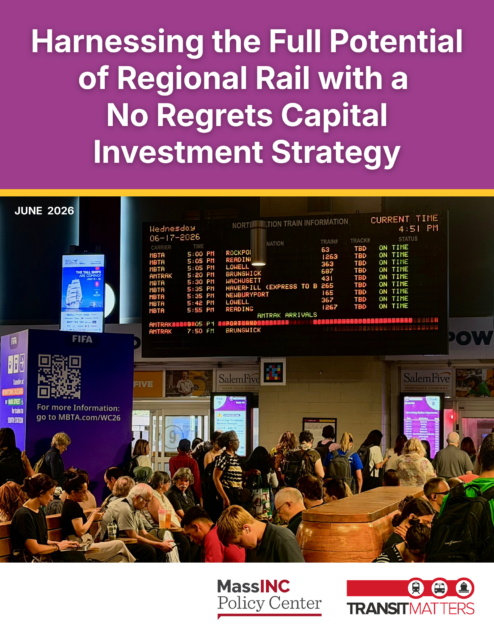
The MBTA’s Capital Improvement Plan, released in March, budgets $373.7 million for the procurement, and the agency says it expects to award the contract this summer. At an MBTA Board meeting on Thursday, TransitMatters Regional Rail lead Janet Cheung said the plan reflects a disconnect between the T’s capital spending and its long-term service goals.
“Our question to the MBTA and to the board today is: Is the Commonwealth committed to delivering Regional Rail or not?” Cheung said. “Our review of the FY27-31 MBTA CIP, and the recent approval of the commuter rail rolling stock procurement, suggest that, at present, the T’s capital investments are not aligned with that goal, pointing to a technology-driven, rather than service-driven, approach.”
In written comments on the MBTA’s five-year Capital Investment Plan, TransitMatters sharpened that critique, warning that “the proposed FY 2027–2031 Capital Investment Plan (CIP) makes costly decisions that prioritize legacy constraints over the established 2019 Rail Vision.” That 2019 plan contemplated the possibility of an entire network run on electricity through overhead wires. The group took aim at the locomotive RFP, urging officials to rethink the mix of equipment being pursued.
“Amend the locomotive RFP to replace 10 planned battery-electric locomotives (BEL) with 10 proven electric locomotives” and “decline the option for 50 additional diesel and battery-electric locomotives to preserve capital for future electric multiple unit (EMU) procurement,” the letter states.
Responding directly to the criticism, General Manager Phil Eng emphasized that the agency is balancing immediate service needs with longer-term decarbonization goals.
“Right now we are running regional rail service and maximizing the equipment we have, maximizing the crews that we have, and taking full advantage of the infrastructure,” Eng said. “And in all cases, we need to continue to improve that, because, long term, just for reliability and to maintain the frequency, all of that needs upgrades.”
Eng noted that while the MBTA ultimately aims to electrify its system, only one corridor — the Providence Line — currently has overhead power infrastructure in place.
“The unfortunate thing is, we don’t have electric power throughout the whole system. We only have it on the Providence corridor where Amtrak runs today,” he said. “So for me to just buy electric without the money to upgrade and electrify all of our territory, does not get us to where we need to be, hence the battery electric.”
 
Is there a middle ground of buying EMUs but pulling them with diesels until the wires are up, or is that just nuts?
 
“The unfortunate thing is, we don’t have electric power throughout the whole system. We only have it on the Providence corridor where Amtrak runs today,” he said. “So for me to just buy electric without the money to upgrade and electrify all of our territory, does not get us to where we need to be, hence the battery electric.”

Dude...you're buying the battery locos to run on the one fully electrified line and, so far, nowhere else. You ain't maximizing shit with pants-on-head spending decisions like that. Gah...his brain and everybody's brains immediately underneath him are absolutely cooked on this battery shit. I hate that this is apparently his kryptonite.


I would agree that there needs to be some large-scale diesel purchase because the majority of the system is nowhere near the readiness to get a mass EMU deployment, and attrition will take its course on the service reliability of the current not-great-condition loco fleet in short order if they don't do something big soon. So I definitely don't think a full reverse on the RFP is called for; TM is taking a very reckless stance calling for a full nuking instead of a de-batterying modification of the RFP. Definitely replace the GP40's as soon as possible, and probably use the options to replace the F40's which will be nearing the end of the line at the tail end of the RFP's (greater-than decade long) contract term. That's not imprudent in the slightest. Siemens Charger straight diesels will have very good midlife resale value if we ever do get our electrification house in order, so this needn't be a fraught framing of sacrificing the future to prop up the past. Yeah, we squandered a lot of time already doing jack squat on decarbonization the last decade-plus and are charting a course in stupidity to waste a whole lot more time. That's absolutely something to get mad about and raise consistent hell about. But that's also not going to be fixed in an instant by a one-time transferring CIP funds out of the cycled renewal bucket to the peril of immediate-term system reliability. That's just going to accelerate the systemic collapse that then self-evidently is used to justify delaying the electrification mandate even further. At least be smart and deal from a position of relative strength: a system at fullish state-of-repair. Cycling the diesel replacements of our 20th-century leftovers will get them there. The Chargers are a long-term asset to future-barter if we ever find ourselves at a diesel surplus because we got our electrification dreams back on-track. It's when the HSP-46 misfits have no end-of-life choice but to be replaced by more diesels that we'll have truly and utterly failed on decarbonization, so work on making sure those things only ever get replaced by EMU's.


But as I noted when the batt loco order was first announced, you could buy 41 cars worth of Caltrain-mod Stadler KISS straight EMU's--the same ones that delivered 25% schedule savings for Caltrain--for the cost of just the 10 Siemens battery locos (at the Metro-North unit price) on the base order. EMU's that can run on the already-electrified line with vastly improved schedules and reinvestment of freed-up equipment from the system's car-hungriest line into Regional Rail-ification of frequencies on other lines rather than buying something 3x as expensive that can't make do with anything more than existing constrained coach capacity and forevermore will be unable to do the schedule any faster than today's diesels. And the Caltrain KISSes were kind of a ripoff as EMU unit pricing goes, so the open market may be able to deliver more bang-for-buck still. Those batt loco unicorns are bar none the stupidest, most wasteful spending decision the T has embarked on in a very long time...and Eng is just "hold my beer"-ing it here trying to bullshit the justifications.
 
Is there a middle ground of buying EMUs but pulling them with diesels until the wires are up, or is that just nuts?
It's just nuts. Providence is already electrified. Stoughton can be electrified for cheap by building out Sharon substation. Fairmount can be electrified cheap if they'd stop making the lamest excuses in the world for not doing any of that. It's only the sparse 8 weekday RT's to Wickford that would have to remain diesel until RIDOT can self-fund some wire-ups of its own. With the equipment tied up in those electric 3 schedules, you'd have a LARGE base of EMU's freeing up a lot of diesels and push-pull coaches to go run :30 service somewhere else. You're talking double-digit locos and cab cars, and several dozen trailer coaches that can usefully be applied elsewhere because we bought EMU's at something resembling a sane world-market rate and did just *little* extra wire-ups with expansion of existing substations.

As it stands the 3x they're spending for replacement battery locos that do not do one iota better on-schedule is resources directly diverted from implementing Regional Rail. Especially since they'd have to start draining even more batt loco unit options to even get Stoughton trains decarbonized (the 10-unit base order is, by the T's own words, only enough for Providence + Wickford). There's no ridership increases whatsoever from improved schedules...something that would actually start to fund more Regional Rail buildouts...because batt locos don't improve the schedules any. There's no capacity increases. When the single-levels are completely retired by the next Rotem order, we'll be staring at an approximately 3000-seat deficit systemwide from current active seating capacity, with no plans to buy more coaches. So right then and there we're spending money on unicorn tech that doesn't do anything except cynically greenwash that SHOULD instead be spent on buying more coach capacity to sustain and grow the system. If you were spending the same pot on EMU's instead of blowing 3x as much on per-unit power you'd be getting not just that keep-up-with-today capacity but also a generous amount of expansion capacity that can be distributed all around for Regional Rail service levels.

A Providence + Stoughton + Fairmount EMU fleet commitment would be large, self-sustaining, and very cost-effective for the revenue gains those improved schedules would bring. Even if we still stayed completely fucked on doing any more wire-ups beyond those. The only justifications they've given for NOT doing any of that are completely irrational, illogical, self-contradictory, and an insult to everyone's basic intelligence. But whooo-boy have they ever tripled-down on those irrational talking points.
 
At Metro-North prices the battery locomotive procurement will be at least $230 million. The T also spent $396 million in 2024 on 80 more Rotem coaches. So $626 million for 10 8-car locomotive-hauled trainsets.

Meanwhile, that same year, New Jersey Transit managed to order Alstom Multilevel III bilevel EMUs for less per car ($4.7 million) than what the MBTA is spending on unpowered Rotem bilevel coaches ($4.95 million per car).
 
Is there a middle ground of buying EMUs but pulling them with diesels until the wires are up, or is that just nuts?
The only reason you'd possibly want to do that is if you expected EMU prices to rise dramatically in the near to medium term, same as buying someone a car before they get their learner's permit. It's a depreciating asset that has upkeep costs, so you don't want to keep it around if you don't need it.
 
I understand it wouldn’t make sense without the infrastructure side being guaranteed. I was figuring it would be part of a plan that involved wiring the whole network. Run them in push-pull mode on the lines that haven’t completed electrification yet.

Otherwise, how do you get from here to there without running diesel under wires for a long stretch of time? Politically, that leaves a gap for an incoming administration to bring in a Shortsleeve and screw up the whole thing.
 
I understand it wouldn’t make sense without the infrastructure side being guaranteed. I was figuring it would be part of a plan that involved wiring the whole network. Run them in push-pull mode on the lines that haven’t completed electrification yet.

Otherwise, how do you get from here to there without running diesel under wires for a long stretch of time? Politically, that leaves a gap for an incoming administration to bring in a Shortsleeve and screw up the whole thing.
We're not going to be replacing the entire loco and coach fleet in one fell swoop like this is the Red Line. Procurements and rebuilds were staggered out enough that end-of-life targets of the current fleets is spread way, way out and require multiple orders to feasibly turn over. Hell, even this cursed batt/diesel loco RFP has a deadline on the option orders spread out ultra-long greater than decade out. The GP40's should reasonably be replaced ASAP because they're worn the hell out today, but the F40's just came back from rebuild and have a solid 10 more years of reliable service left in them. It reasons that the replacement options would be well backloaded into the 2030's to replace that fleet when their time is up. So full EMU'ification of the system would involve multiple orders over multiple decades as more line electrifications come online. It's not one-and-done by a longshot. The only thing that's really critical for the first order is that they choose a make/model/configuration that works so the subsequent re-orders are an academic exercise.

Just wiring up Providence+Stoughton+Fairmount (and not even Wickford) by 2030 without delay using one procured EMU starter pool fleet would provide a large-enough and self-sustaining enough first order that then facilitates generous capacity/frequency expansion from freed-up diesel sets. That's what every sane and rational expert recommends for the first phase, and which the T is fighting tooth and nail with sky-is-pink alternate realities. Subsequent orders can happen based on pace (or lackthereof) of subsequent wire-ups. There's no need to frame it as a "use it or lose it" monolithic order. It's a long multitasking process, not a one-shot deal.
 

Back
Top