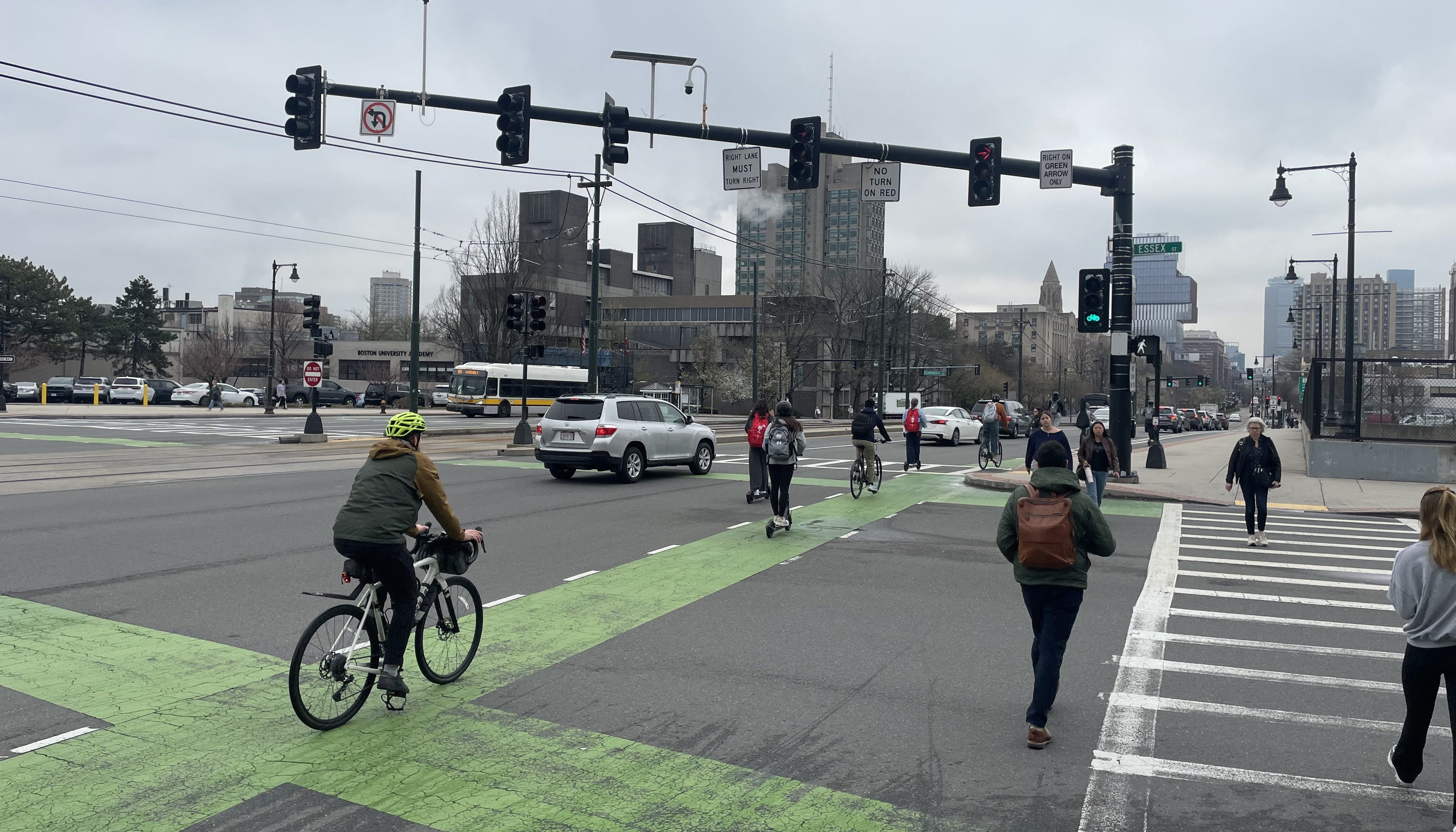
Biking in Boston

The trails don't go everywhere so you wa
No class 2 is up to 20mph with throttle
I can hit 40\45mph with throttle and pedaling but I only go that fast if I'm alone or on the road competing with traffic. You can always get a 2nd or 3rd battery with that speed and travel pretty far. So much better for the environment and safer than cars.
 
The trails don't go everywhere so you wa

I can hit 40\45mph with throttle and pedaling but I only go that fast if I'm alone or on the road competing with traffic. You can always get a 2nd or 3rd battery with that speed and travel pretty far. So much better for the environment and safer than cars.
Your bike won't even be class III it will (and currently does) require a license, registration, and insurance at those speed capabilities.
 
Your bike won't even be class III it will (and currently does) require a license, registration, and insurance at those speed capabilities.
As it should, mine peaks at ~22mph if I go down a hill (or bridge, there aren't many hills here) and I pedal real hard. That's already terrifying if there's anyone else around or anything but a dead straight road with green lights.
 
Yea as someone who currently owns a small selection of 2 wheel electric devices... Anything capable above 30 or so really does need to be classified as a moped/ motorcycle/ e-moto and not a bike. I currently have a class 2/3 hybrid, (pedal up to 28, throttle to 20) and a scooter capable of 25ish and I think that's fine. That said, if you also gave the plated group the legal ability to filter (at or below a defined speed), it'll at least give them another option to beat traffic than bike paths.

I remain skeptical of hardware speed capabilities based limits on paths however, especially since most are not easily distinguished at a glance, and unlike proper motorcycles and mopeds, I can order something fully illegal right now on Amazon, and change in MA law most likely won't change that. Unfortunately, I don't know how you enforce it unless you go full-on "these are vehicles" and require VINs on them to be sold, and even then that has never stopped people from riding not-street legal dirt bikes.
 
I remain skeptical of hardware speed capabilities based limits on paths however, especially since most are not easily distinguished at a glance, and unlike proper motorcycles and mopeds, I can order something fully illegal right now on Amazon, and change in MA law most likely won't change that. Unfortunately, I don't know how you enforce it unless you go full-on "these are vehicles" and require VINs on them to be sold, and even then that has never stopped people from riding not-street legal dirt bikes.
Entirely agreed, and folks from the commission I've spoken with acknowledge it's imperfect and that in practical terms it's almost entirely going to be enforced retroactively on people who are getting in trouble for speeding or other behavior. If you ride a class III on a trail and are riding respectfully/under the speed limit you're almost certainly never going to be bothered.
 
Looks like Beacon Street is next. It’s mentioned under the question regarding vertical separation.
 
Looks like Beacon Street is next. It’s mentioned under the question regarding vertical separation.
I wonder what the outreach process for that project was when you have a total of zero Boston residents abutting the road.
 
The rollout of "better buffers" has been so slow I was worried it was dead, but seeing a lot of anecdotes rolling in of cast-in-place concrete!
Yeah, it's unclear why it took so long when they were touting this in the fall as a quick build but semi-permanent solution. Hopefully this will lead to a lot more of these upgrades over the summer.
 
The official plans for Beacon Street still show no vertical separation between the bike lane and the road, although it does show parking-protected bike lanes where parking exists. If they do add cast-in-place concrete, that would be amazing. Maybe, as with congress street, Boston's given up on releasing plans ahead of time. Which may be a way to get around NIMBY anti-bike lane voices, so I'm not entirely opposed, but it's an interesting shift.
 
Last edited:
Happy grant news! Most, but not all of these, are bike centric. I chose to place this news here but understand if mods want to move.

First, we have the AARP Community Challenge Grant, where MA was very well over-represented:

  • Boston: Action for Boston Community Development — The Tech Treasures program will expand digital literacy training for low-income older adults. Participants will receive hands-on instruction in basic technology use, online safety and digital communication.
  • Boston: Boston Cyclists Union — The project will install temporary pedestrian and bicycle safety treatments at high—injury intersections near housing and services. These changes will help people cross more confidently while informing future permanent safety improvements.
  • Mattapan: WalkMassachusetts — Adults age 50-plus will participate in workshops and walk audits to identify barriers to safe walking in their neighborhoods. The project will support resident-led recommendations for crossings, sidewalks and traffic calming.
  • Mendon: Mendon Council on Aging — This initiative will expand tech access for older residents via a volunteer help desk and shared laptop program. Through hands-on instruction and intergenerational support, participants will develop digital skills, confidence and social ties.
  • Newburyport: City of Newburyport — The city will expand its bikeshare system by adding stations at parks, wildlife areas and the beach. This expansion will help people reach scenic destinations without owning a bike and support comfortable cycling for recreation and daily trips.
  • North Adams: North Adams Partnership — Accessibility upgrades will improve paths, seating and gathering areas in a small neighborhood park. Student-led construction will help create a safer place to rest, walk and meet neighbors close to home.
  • South Hadley: South Hadley Council on Aging — Older volunteers will be trained as peer technology mentors to expand the number of hours for one-on-one tech help. Faster support will help residents use phones, tablets and computers with greater confidence.
  • Statewide: Massachusetts Department of Transportation — Older adults will take part in bikeshare training that includes classroom learning, guided rides and group discussions. The program will increase comfort using shared bikes for short trips, recreation and everyday travel in three Massachusetts cities.
  • Sunderland: South County Senior Center — Household disaster preparedness for older adults will be impved by distributing 300 emergency kits designed for power outages, flooding and extreme cold. The center will also host local workshops with emergency management partners to help residents age 50-plus prepare.
  • Westport: Westport Council on Aging — The program will provide needed home safety repairs such as rails, ramps, lighting and stair fixes for older adults with lower income. These updates will reduce hazards and help residents remain safe and independent in their homes.
  • Worcester: Indian Lake Community Association — High-visibility crosswalks, curb bump-outs, reflective signs and a street mural will be added near a neighborhood garden. These features will slow traffic and make crossings safer for older adults and other pedestrians.

MassTrails was also announced today, since I lack of a concise public source I encourage you to visit Streetsblog. But a few of my favorites:

  • Framingham, Bruce Freeman Rail Trail extension: $200,000 to complete final, shovel-ready design plans for the final segments of the Bruce Freeman Rail Trail into Framingham. The final segment would extend the Bruce Freeman Rail Trail from Sudbury into Framingham Center, near Framingham State University.
  • Swampscott, Swampscott Rail Trail: $100,000 to advance final design of the Swampscott Rail Trail, another segment in the Border to Boston trail network. The project is in line to receive federal funding to go under construction in 2029 or 2030.
  • Sandwich, Cape Cod Canal Path: $500,000 for preliminary design of a new shared-use path that will connect the recently-opened extension of the Service Road shared use path to the Cape Cod Canal shared use path.
 
My primary project right now is a regional gap analysis for the biking and walking networks. This is phase I of what will be a regional active transportation plan for the Boston Metropolitan Region. As we work on the gap analysis one of the deliverables will be a regional and municipal priority gap list, essentially a top 10% for the region and a top 10% for each municipality. Both to help inform the prioritization and to help provide humanizing examples for when we do case studies, we are asking people to identify gaps in the network that they experience and how it impacts their mobility/access in the region. If you have a few minutes, I would greatly appreciate folks here taking the survey: https://survey123.arcgis.com/share/a735fe6de63f41dd8b35d0f434db63e3

I don't want to derail this thread, but am happy to discuss the study in more detail if you DM me or want to shoot me an email.
Hi AB,

KCasiglio put me in contact with the comms team for the MPO, and I was able to publish a piece about this survey:


its quite interesting to see sommerville with better (lower) crash numbers for bikes/peds compared to cambridge. Not surprising to see Boston's numbers still elevated (many parts of the city are still a car sewer). But with cambridge, it's well documented that the number of bike trips has also ballooned by over 50-100%, so decreasing crash rate, not absolute crash numbers is what we really care about.
 
Somerville has some sneaky good neighborhood bike lanes, whereas cambridge has at times been pretty reticent to put them on side streets. For example the bike lanes on Washington St. in Somerville are great and would never be installed in cambridge. They in fact end at the town border.
 
Entirely agreed, and folks from the commission I've spoken with acknowledge it's imperfect and that in practical terms it's almost entirely going to be enforced retroactively on people who are getting in trouble for speeding or other behavior. If you ride a class III on a trail and are riding respectfully/under the speed limit you're almost certainly never going to be bothered.

This seems like the appropriate approach to me. What's the problem with this approach?
 
This seems like the appropriate approach to me. What's the problem with this approach?
I agree that it's the right approach, which is why it's weird to me that they're making it the informal in-practice approach and not the formal on-the-books approach.
 
I agree that it's the right approach, which is why it's weird to me that they're making it the informal in-practice approach and not the formal on-the-books approach.
We might be misunderstanding each other. I'm saying the best approach is to on the books ban Class III e-bikes, so that if one is behaving inappropriately on a Class III e-bike on a multi-use trail, that is a more formal infraction to discourage their usage, but if one is acting in a way that's indistinguishable from a Class I ebike, they won't face repurcussions.
 
We might be misunderstanding each other. I'm saying the best approach is to on the books ban Class III e-bikes, so that if one is behaving inappropriately on a Class III e-bike on a multi-use trail, that is a more formal infraction to discourage their usage, but if one is acting in a way that's indistinguishable from a Class I ebike, they won't face repurcussions.
Gotcha, in that case I was misunderstanding and disagree. Why should there be a higher level of penalty for the same behavior just based on hardware? Is there any example of motor vehicles being treated that way? Why are we leaving the opportunity open for discretion on whom to enforce? Just design for the speeds you want and regulate and enforce based on behavior.

Edit: To be clear, as I've said before, this is still a big improvement on the status quo and I think is going to work fine in practice. Had this been the status quo I wouldn't be pushing to spend limited energy changing it. I just think they missed an opportunity to get it right and its going to inevitably lead to (likely rare, but not 0) some people getting tickets while not being disruptive to the SUP.
 
Last edited:

Back
Top