
You are using an out of date browser. It may not display this or other websites correctly.
You should upgrade or use an alternative browser.
You should upgrade or use an alternative browser.
Copley Square Revamp | Back Bay
- Thread starter FormFollowsBudget
- Start date


MjolnirMan
Active Member
- Joined
- Jan 18, 2016
- Messages
- 317
- Reaction score
- 694
StreetsblogMA post about public bathrooms from a few years ago, but still relevant. Any chance Trinity could make space available? Potties In Lieu Of Taxes...
Re: food trucks, there are some places in major cities like Independence Ave in DC south of the Air and Space Museum that are loaded with food truck parking daily during operational hours. Perhaps the closest lane of Dartmouth could serve as that for Copley (on a smaller scale, of course)?
Re: food trucks, there are some places in major cities like Independence Ave in DC south of the Air and Space Museum that are loaded with food truck parking daily during operational hours. Perhaps the closest lane of Dartmouth could serve as that for Copley (on a smaller scale, of course)?
That's just not Trinity Church's job. Old churches are a terrible place to try to insert lavatories. If the city had wanted to, it could have included public lavatories as part of the redesign. It did not. That doesn't mean Trinity Church has to take on the expense and burden of designing, building, maintaining, and securing them.
Or why not just have the food trucks set up on all this new hardscape? That's precisely the type of usage that it replaced the grass for in the first place.StreetsblogMA post about public bathrooms from a few years ago, but still relevant. Any chance Trinity could make space available? Potties In Lieu Of Taxes...
Re: food trucks, there are some places in major cities like Independence Ave in DC south of the Air and Space Museum that are loaded with food truck parking daily during operational hours. Perhaps the closest lane of Dartmouth could serve as that for Copley (on a smaller scale, of course)?
MjolnirMan
Active Member
- Joined
- Jan 18, 2016
- Messages
- 317
- Reaction score
- 694
Is it? I hadn't seen any renders or statements from the City that the hardscape was designed for frequent food truck usage. From my more cynical view, they based the design entirely around optimizing for infrequent events like the Marathon or NYE, with focus entirely around lowering daily maintenance costs by creating a no-frills space, even if it depresses utilization. Happy to be corrected if they did indeed plan for that, though.
EDIT: In fact, the renders I found show that it's being used as intended: f***in empty.
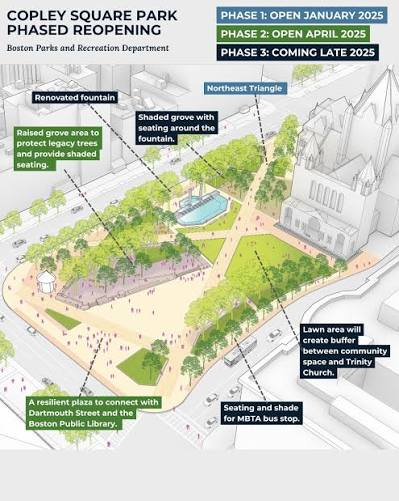
EDIT: In fact, the renders I found show that it's being used as intended: f***in empty.
Last edited:
MjolnirMan
Active Member
- Joined
- Jan 18, 2016
- Messages
- 317
- Reaction score
- 694
I mean, look, clearly I think the City's choice of design here was horrible and I would have done it totally differently. They certainly can't add a bathroom anywhere there now. I'm just spitballing ideas here to polish this turd, since having to cross an active Dartmouth to find a BPL bathroom is probably less desirable for people on Copley Square Plaza than something localized to the plaza itself. Trinity has historically allowed homeless people to set up tents on their property; surely even a single public toilet could work.That's just not Trinity Church's job. Old churches are a terrible place to try to insert lavatories. If the city had wanted to, it could have included public lavatories as part of the redesign. It did not. That doesn't mean Trinity Church has to take on the expense and burden of designing, building, maintaining, and securing them.
sean99090900
Active Member
- Joined
- Jan 18, 2024
- Messages
- 291
- Reaction score
- 1,122
If not designed for heavy food truck usage, why not food carts. In the middle of the med school campus in New Haven everyday during lunch hours they have 20-30 of these tiny food carts lined up year round. Food isn't half bad and not that expensive. If the economics are workable in a small city, why not the heart of Boston?Re: food trucks, there are some places in major cities like Independence Ave in DC south of the Air and Space Museum that are loaded with food truck parking daily during operational hours. Perhaps the closest lane of Dartmouth could serve as that for Copley (on a smaller scale, of course)?
I hear you, but I imagine the church does not wish to deal with the liability of owning a permanent attractive nuisance with regard to street people. It's seems clear to me from the nature of the square's redesign that the City of Boston shares that ... concern, shall we say - the particular problem of the square being that it can be quickly accessed and exited by dealers, and passively incentivizing congregating as a market snowballs.I mean, look, clearly I think the City's choice of design here was horrible and I would have done it totally differently. They certainly can't add a bathroom anywhere there now. I'm just spitballing ideas here to polish this turd, since having to cross an active Dartmouth to find a BPL bathroom is probably less desirable for people on Copley Square Plaza than something localized to the plaza itself. Trinity has historically allowed homeless people to set up tents on their property; surely even a single public toilet could work.
Smuttynose
Active Member
- Joined
- May 26, 2006
- Messages
- 749
- Reaction score
- 4,235
Can't argue with any of that, but the famer's market, marathon activity, and other events weren't sustainable on the previous lawn. We either get those (valuable) activations or a lawn. I'm fine with the trade-off. If you want grass, the Esplanade, Public Garden, Commonwealth Mall, and Common are a short walk away.
I think the problem is that Copley gets much more transient traffic than the big parks. It's not a destination picnic spot in the way The Esplanade or Public Garden is. It's mostly people on their 30 minute lunch breaks, or coffee breaks, or chilling for a few minutes after work making a call or making a quick stop on their way somewhere else. They're not necessarily seeking out a great park, they're seeking a convenient, somewhat pleasant place to chill for a few minutes and Copley is nothing if not convenient. We don't have to give these folks a nice place to do these things - we could say F-you, go to the Esplanade - but I don't know that the options have to be that binary.
I don't doubt the new design is better for the Marathon and Farmers Markets. But the Marathon is what, 12 hours of one day of the year? Is that more valuable than the other 364 days of the year? The Farmers Market is better, but still maybe 14 hours a week at maximum in the Summer. The problem with designing the space specifically for those special events - as is clearly the case for the paver plaza section of the park (which is clearly the most divisive part of the redesign and the area where these comments are focused) - is that it's not hospitable outside of those events. We can interrogate the old design, and definitely there was plenty of room for improvement, but on a nice day, there were plenty of people chilling or hanging out in the grass. Nobody is going to sit or lie down in the new paver plaza now unless they're like actively dying of a heart attack.
And it's not like there weren't Marathons or Farmers Markets before. Copley might not have been ideally designed previously for special events, but we made it work. And the previous design was infinitely more photogenic than the current mini-me Government Center plaza redesign. I'd rather have a park that's nice 315 days of the year where we make it work on the 50 days when there are special events, instead of one that's unpleasant 315 days of the year but really great for the Marathon and other events.
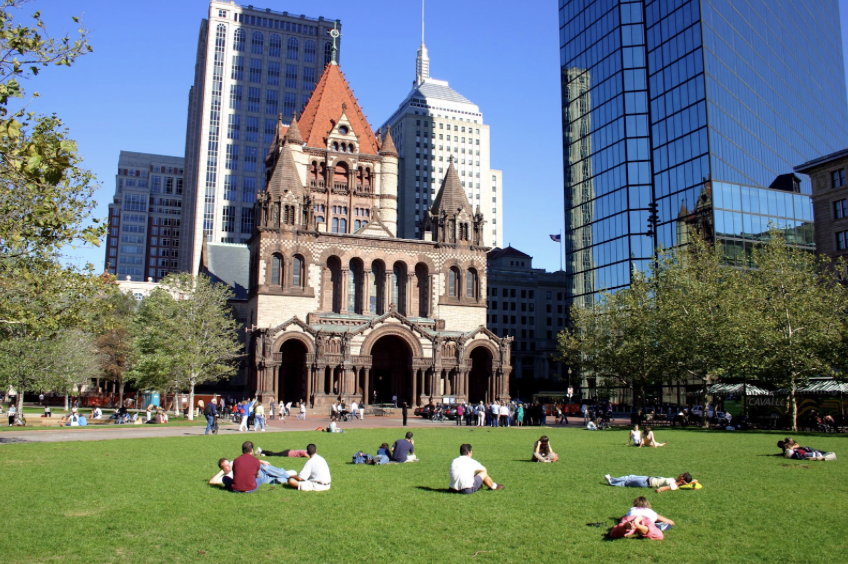

HenryAlan
Senior Member
- Joined
- Dec 15, 2009
- Messages
- 4,527
- Reaction score
- 5,422
Not a bad idea in the abstract, but I can already picture the screaming when the city starts floating the idea of closing Dartmouth --- "they want to take away the space for food trucks!"Re: food trucks, there are some places in major cities like Independence Ave in DC south of the Air and Space Museum that are loaded with food truck parking daily during operational hours. Perhaps the closest lane of Dartmouth could serve as that for Copley (on a smaller scale, of course)?
JeffDowntown
Senior Member
- Joined
- May 28, 2007
- Messages
- 5,099
- Reaction score
- 4,376
Copley Square hosts events on something like 100 days of the year, 80 to 90 farmers market days (2x per week from mid-May to late November) plus about 15 other major events. The beautiful green grass you show was often torn up muddy tracks from vehicles hauling event equipment. It was costing the City a lot of money to try to keep grass there. That was a major driver for the redesign.I think the problem is that Copley gets much more transient traffic than the big parks. It's not a destination picnic spot in the way The Esplanade or Public Garden is. It's mostly people on their 30 minute lunch breaks, or coffee breaks, or chilling for a few minutes after work making a call or making a quick stop on their way somewhere else. They're not necessarily seeking out a great park, they're seeking a convenient, somewhat pleasant place to chill for a few minutes and Copley is nothing if not convenient. We don't have to give these folks a nice place to do these things - we could say F-you, go to the Esplanade - but I don't know that the options have to be that binary.
I don't doubt the new design is better for the Marathon and Farmers Markets. But the Marathon is what, 12 hours of one day of the year? Is that more valuable than the other 364 days of the year? The Farmers Market is better, but still maybe 14 hours a week at maximum in the Summer. The problem with designing the space specifically for those special events - as is clearly the case for the paver plaza section of the park (which is clearly the most divisive part of the redesign and the area where these comments are focused) - is that it's not hospitable outside of those events. We can interrogate the old design, and definitely there was plenty of room for improvement, but on a nice day, there were plenty of people chilling or hanging out in the grass. Nobody is going to sit or lie down in the new paver plaza now unless they're like actively dying of a heart attack.
And it's not like there weren't Marathons or Farmers Markets before. Copley might not have been ideally designed previously for special events, but we made it work. And the previous design was infinitely more photogenic than the current mini-me Government Center plaza redesign. I'd rather have a park that's nice 315 days of the year where we make it work on the 50 days when there are special events, instead of one that's unpleasant 315 days of the year but really great for the Marathon and other events.
That's a nice picture of people enjoying the plaza on a nice day. All it takes is scrolling back through the past few pages to find the new space similarly engaged -- and not just on World Cup days or farmer's markets. I've gone to school and now work in the area and walk through Copley nearly every weekday (and some weekends!) and the old plaza was devoid of human activity exactly as much as it is now. People still go there for lunch or to read. It's true folks have yet to lounge around on the smaller grassy areas (an oddity that was brought up a page or two back), but it's still plenty activated. And, as JeffDowntown noted, that lovely patch of grass in the photo you shared was often a soggy, muddy mess which nobody was sunbathing or reading books on.I think the problem is that Copley gets much more transient traffic than the big parks. It's not a destination picnic spot in the way The Esplanade or Public Garden is. It's mostly people on their 30 minute lunch breaks, or coffee breaks, or chilling for a few minutes after work making a call or making a quick stop on their way somewhere else. They're not necessarily seeking out a great park, they're seeking a convenient, somewhat pleasant place to chill for a few minutes and Copley is nothing if not convenient. We don't have to give these folks a nice place to do these things - we could say F-you, go to the Esplanade - but I don't know that the options have to be that binary.
I don't doubt the new design is better for the Marathon and Farmers Markets. But the Marathon is what, 12 hours of one day of the year? Is that more valuable than the other 364 days of the year? The Farmers Market is better, but still maybe 14 hours a week at maximum in the Summer. The problem with designing the space specifically for those special events - as is clearly the case for the paver plaza section of the park (which is clearly the most divisive part of the redesign and the area where these comments are focused) - is that it's not hospitable outside of those events. We can interrogate the old design, and definitely there was plenty of room for improvement, but on a nice day, there were plenty of people chilling or hanging out in the grass. Nobody is going to sit or lie down in the new paver plaza now unless they're like actively dying of a heart attack.
And it's not like there weren't Marathons or Farmers Markets before. Copley might not have been ideally designed previously for special events, but we made it work. And the previous design was infinitely more photogenic than the current mini-me Government Center plaza redesign. I'd rather have a park that's nice 315 days of the year where we make it work on the 50 days when there are special events, instead of one that's unpleasant 315 days of the year but really great for the Marathon and other events.
Looks like early morning or late afternoon/early evening on a hot summer Monday. I wouldn't expect it to be a hive of humanity.
I wasn’t cvommenting on the lack of people in the pics. I was astonished at how very chaotic and disorganized the schematic is for this long-awaited square.
***And can someone please look at the final photo in Missinglink’s post #375 - - just to the left of the hand railing - the second block (where most of the trash is in front of) how awful is the work there????? It seems crooked and doesn't even level up to the blocks next to it — the whole thing looks shoddy. I’m sorry, but that is an embarrassment for the city.
Last edited:
commuter guy
Active Member
- Joined
- Feb 1, 2007
- Messages
- 959
- Reaction score
- 215
A bit off topic from the thread, but I agree regarding the food truck/cart scene, It was sub par before Covid and has tanked since then, at least from my prospective working Downtown. I'm not sure what the problem is, too much red tape and regulatory expense etc... Given Boston's density and foot traffic we should have way more options.If not designed for heavy food truck usage, why not food carts. In the middle of the med school campus in New Haven everyday during lunch hours they have 20-30 of these tiny food carts lined up year round. Food isn't half bad and not that expensive. If the economics are workable in a small city, why not the heart of Boston?
View attachment 74077
JeffDowntown
Senior Member
- Joined
- May 28, 2007
- Messages
- 5,099
- Reaction score
- 4,376
I think the food trucks are suffering from the same issue that lunch spots in Boston Proper are also being hit by -- lost foot traffic. In office is no longer guaranteed M-F; more likely T, W, Th with W as the heaviest day. The foot traffic, particularly on M and F is noticeable reduced, hence you can support fewer restaurant options.A bit off topic from the thread, but I agree regarding the food truck/cart scene, It was sub par before Covid and has tanked since then, at least from my prospective working Downtown. I'm not sure what the problem is, too much red tape and regulatory expense etc... Given Boston's density and foot traffic we should have way more options.
MjolnirMan
Active Member
- Joined
- Jan 18, 2016
- Messages
- 317
- Reaction score
- 694
I agree with your assessment. Part of the problem with "hostile architecture" (the high-level concept, not just spikes on a wall) is that it makes it worse for everyone in order to dissuade the homeless from using it. If Trinity Church can't open a public bathroom for a farmer's market because it would quickly lead to drug deals, overdoses, violence, etc. - then what exactly are we doing as a city? We can't just accept that normal accommodations like comfy benches and a toilet are now impossible lost technology that it would burden our resources to implement.I hear you, but I imagine the church does not wish to deal with the liability of owning a permanent attractive nuisance with regard to street people. It's seems clear to me from the nature of the square's redesign that the City of Boston shares that ... concern, shall we say - the particular problem of the square being that it can be quickly accessed and exited by dealers, and passively incentivizing congregating as a market snowballs.
Dewey Square still seems to have something regular - food trucks in the day and then the beer garden. It seems like that's been the city's "fix" for under-activated spaces (Dewey, the Common outside Boylston, the Greenway across from the Harbor Hotel). Maybe the Copley Beer Garden could fill the new plaza and provide impetus for turning the ticket kiosk into a toilet.I think the food trucks are suffering from the same issue that lunch spots in Boston Proper are also being hit by -- lost foot traffic. In office is no longer guaranteed M-F; more likely T, W, Th with W as the heaviest day. The foot traffic, particularly on M and F is noticeable reduced, hence you can support fewer restaurant options.
sean99090900
Active Member
- Joined
- Jan 18, 2024
- Messages
- 291
- Reaction score
- 1,122
I think land and labor costs probably force a pretty high floor for prices on traditional lunch options. A new group of lower cost food options would generate its own foot traffic into Copley just for lunch. I suspect the barriers are more regulatory than economic, Longwood is like 5x larger than Yale/YNHH and probably retains almost all pre-WFH foot traffic yet somehow I only ever saw the chicken rice food truck and occasionally a questionably legal fruit stand when I worked in the area.I think the food trucks are suffering from the same issue that lunch spots in Boston Proper are also being hit by -- lost foot traffic. In office is no longer guaranteed M-F; more likely T, W, Th with W as the heaviest day. The foot traffic, particularly on M and F is noticeable reduced, hence you can support fewer restaurant options.
Ehh. The library is literally across the street, and while obviously only open during its operating hours, I'd say that's plenty proximate for public bathroom access... Where they also happen to have a "community support team" designated to conduct outreach and provide services to the homeless population. As for benches, that's why I think people aren't using the grass - there's a ton more programmed seating than there used to be. But In terms of permanent amenities...I agree with your assessment. Part of the problem with "hostile architecture" (the high-level concept, not just spikes on a wall) is that it makes it worse for everyone in order to dissuade the homeless from using it. If Trinity Church can't open a public bathroom for a farmer's market because it would quickly lead to drug deals, overdoses, violence, etc. - then what exactly are we doing as a city? We can't just accept that normal accommodations like comfy benches and a toilet are now impossible lost technology that it would burden our resources to implement.
Does anyone know if the BosTix kiosk is actually back in operation? One of the things they did when they dug everything up was to "install a water pipe to the BosTix kiosk, in case that location hosts a cafe in the future." If they follow through with that, it'd be very helpful in place making - some permanent activations wouldn't have been amiss.
Last edited: