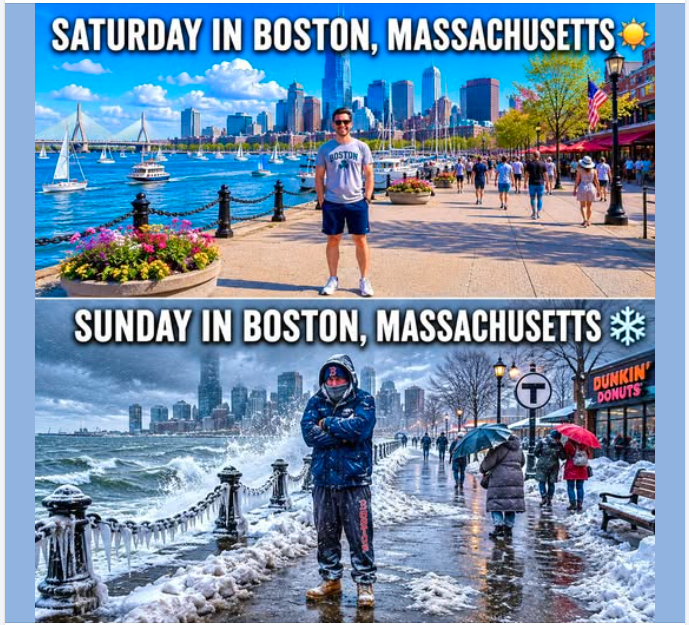
Here's one (two?) that the Facebook algorithm served me that is not accurate (nor consistent!) at all, but I do like the Baltimore Inner Harbor vibes it gives off. Whatever the prompts were the environment changed quite a bit between each run.

You are using an out of date browser. It may not display this or other websites correctly.
You should upgrade or use an alternative browser.
You should upgrade or use an alternative browser.
AI Redraws Boston
- Thread starter DZH22
- Start date

Charlie_mta
Senior Member
- Joined
- Jul 15, 2006
- Messages
- 5,150
- Reaction score
- 7,774
Eliminate Storrow Drive between Charlesgate and Arlington St, replace the roadway with retail and community gathering places, and the new Esplanade could very well look like the first depiction.Here's one (two?) that the Facebook algorithm served me that is not accurate (nor consistent!) at all, but I do like the Baltimore Inner Harbor vibes it gives off. Whatever the prompts were the environment changed quite a bit between each run.View attachment 72911
I get how Storrow's an important and much-used artery and that it'd be considerably more difficult to eliminate it than to, say, get rid of the tiny stretch of Dartmouth St. in front of the BPL, but it'd be so nice to not have the Esplanade cut off from Back Bay by that ugly mini-highway.Eliminate Storrow Drive between Charlesgate and Arlington St, replace the roadway with retail and community gathering places, and the new Esplanade could very well look like the first depiction.
I'd replace "Saturday" with "Monday - Friday"Here's one (two?) that the Facebook algorithm served me that is not accurate (nor consistent!) at all, but I do like the Baltimore Inner Harbor vibes it gives off. Whatever the prompts were the environment changed quite a bit between each run.View attachment 72911

Charlie_mta
Senior Member
- Joined
- Jul 15, 2006
- Messages
- 5,150
- Reaction score
- 7,774
Storrow Drive is important, but if a new set of on and off ramps (aimed towards I-93) were to be added to the Mass Pike at Charlesgate and maybe another set east of there, I think the section of Storrow Drive from Charlesgate to Arlington Street could be eliminated. Add in a BLX line to Kenmore with stations at Hatch Memorial Shell and at Mass Ave (using half the width of the abandoned Storrow Drive footprint), and then you'd really have something. Also, some 1 story retail fronting the Esplanade could be built on the old roadway footprint. These additions would provide a vibrant riverfront. I don't think the BLX tracks and stations, and the new retail buildings would violate 4F regulations, as they would be replacing a road (Storrow Drive), with no net taking of park land.I get how Storrow's an important and much-used artery and that it'd be considerably more difficult to eliminate it than to, say, get rid of the tiny stretch of Dartmouth St. in front of the BPL, but it'd be so nice to not have the Esplanade cut off from Back Bay by that ugly mini-highway.
BronsonShore
Active Member
- Joined
- Feb 13, 2014
- Messages
- 520
- Reaction score
- 1,645
I'm trying and failing to figure out what the point of any of these fake pictures is. Real pictures exist.
Charlie_mta
Senior Member
- Joined
- Jul 15, 2006
- Messages
- 5,150
- Reaction score
- 7,774
I find them amusing. I've laughed out loud at many shown on here. They also get the imagination going, about what could be vs. what is there.I'm trying and failing to figure out what the point of any of these fake pictures is. Real pictures exist.

TheRatmeister
Senior Member
- Joined
- Sep 23, 2023
- Messages
- 1,566
- Reaction score
- 3,171
My opinion is that yes it's important but...I get how Storrow's an important and much-used artery and that it'd be considerably more difficult to eliminate it than to, say, get rid of the tiny stretch of Dartmouth St. in front of the BPL, but it'd be so nice to not have the Esplanade cut off from Back Bay by that ugly mini-highway.
- The effects to the recreational and public waterfront are so dramatic that costs/some amount of congestion is justified.
- The land taken by Storrow or otherwise made borderline useless by it and its ramps is immensely valuable and may be able to be used to cover some costs.
- Storrow isn't free and with things like the Hatch Shell underpass rapidly deteriorating, removal should be evaluated alongside the costly proposed replacements.
- There are mitigation options available. They are costly but likely worth it. This would likely include a Blue Line extension, improvements to the Framingham/Worcester Line, a new I-90 exit connecting to a reduced Bowker overpass, a better interchange with Soldiers Field Rd to keep traffic flow smooth onto I-90, and possibly even a suspension of tolling between Soldiers Field Rd and the Ted Williams tunnel.
The only reasonable argument I've come across is in cases where copyright is actually a concern - You'd either need to pay shutterstock for a licence (and be aware of the categories and limitations therein) or an artist for the rights to reproduce their art. AI produced content can't currently be copyrighted, so many smaller publishers or players can prefer AI produced imagery rather than deal with a mess of rights. Remember a couple years ago there were those sites that scrape art sites for T Shirts and how folks were trying to get them to produce Disney stuff to get them in legal hot water? Yea.I'm trying and failing to figure out what the point of any of these fake pictures is. Real pictures exist.
Memes... idk why you'd bother.
Last edited:
This is definitely the reason. If you're doing a poster or something for an event in Boston and you don't want to pay for a copyrighted photo, and you don't have access to your own, then you're going to resort to AI. I'm seeing it a bunch with a lot of small time racing promoters and local short tracks, they all use AI to cheaply and quickly create posters and ads now, and they ALL have the same ugly aesthetic with the same uncanny valley-looking images. The memes, too, I understand - it used to take a functional knowledge of Photoshop or similar to make them, but now you can just prompt your funny idea into existence.The only reasonable argument I've come across is in cases where copyright is actually a concern - You'd either need to pay shutterstock for a licence (and be aware of the categories and limitations therein) or an artist for the rights to reproduce their art. AI produced content can't currently be copyrighted, so many smaller publishers or players can prefer AI produced imagery rather than deal with a mess of rights. Remember a couple years ago there were those sites that scrape art sites for T Shirts and how folks were trying to get them to produce Disney stuff to get them in legal hot water? Yea.
Memes... idk why you'd bother.
This discussion actually makes me want to feed (well, makes me want to see someone else feed) some data about Boston and some maps into a model and see what it spits out for a future state of transit and infrastructure. I wonder if it would be completely bat$&% insane or if it would actually be feasible (my money's on the former).Storrow Drive is important, but if a new set of on and off ramps (aimed towards I-93) were to be added to the Mass Pike at Charlesgate and maybe another set east of there, I think the section of Storrow Drive from Charlesgate to Arlington Street could be eliminated. Add in a BLX line to Kenmore with stations at Hatch Memorial Shell and at Mass Ave (using half the width of the abandoned Storrow Drive footprint), and then you'd really have something. Also, some 1 story retail fronting the Esplanade could be built on the old roadway footprint. These additions would provide a vibrant riverfront. I don't think the BLX tracks and stations, and the new retail buildings would violate 4F regulations, as they would be replacing a road (Storrow Drive), with no net taking of park land.
Charlie_mta
Senior Member
- Joined
- Jul 15, 2006
- Messages
- 5,150
- Reaction score
- 7,774
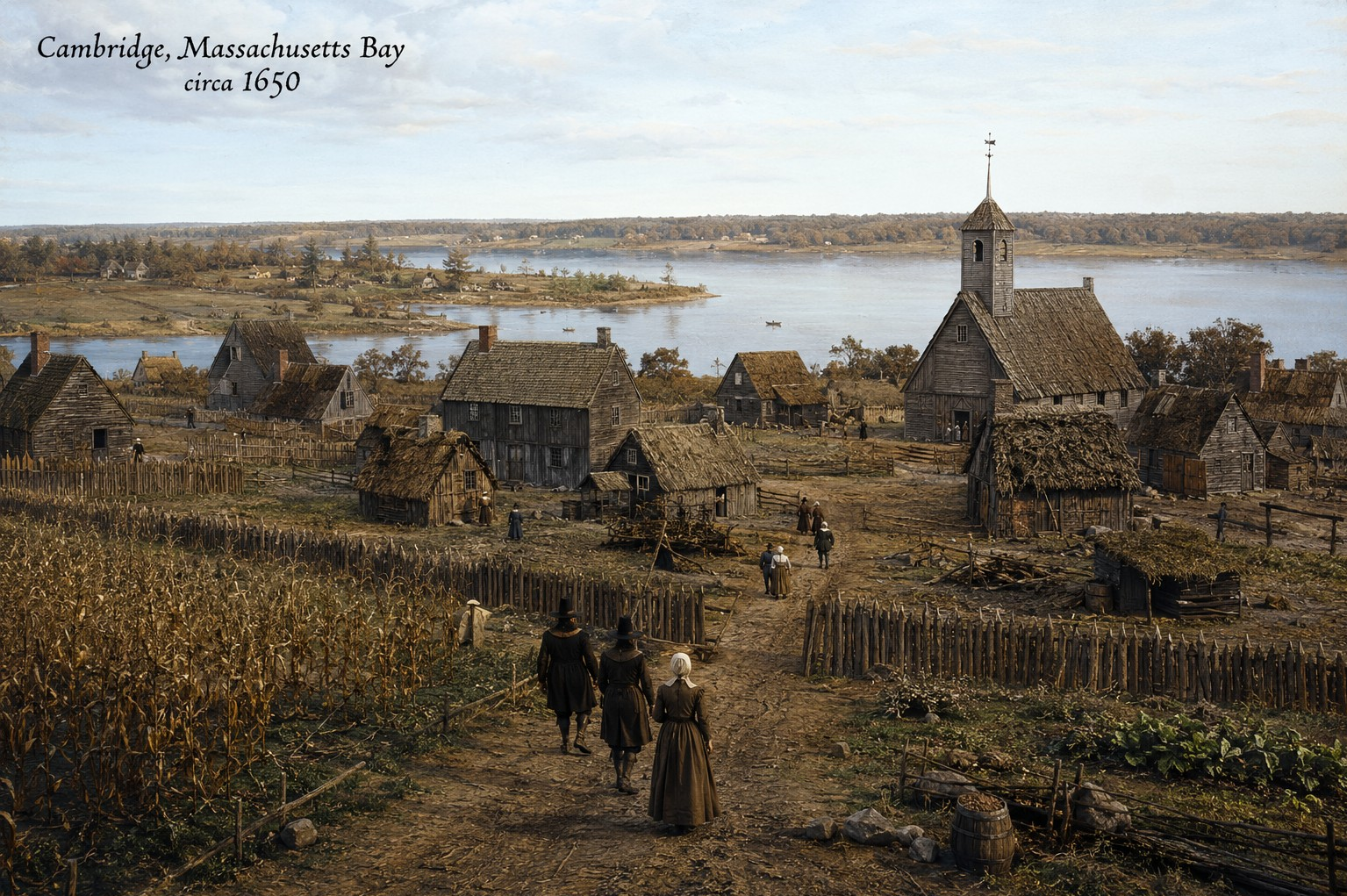
I typed in "Cambridge Massachusetts 1650" into Chatgpt, and the image below is what it produced. I did it because my ancestor (on my dad's side of the family) immigrated to Cambridge from England in 1640, and I was curious what the town may have looked like back then. The image looks plausible. My ancestor is actually buried in the Old Burial Ground next to the Cambridge Common. So, AI is entertaining that way, and a bit informative.
Last edited:
I sort of did; I fed it the prompt "using existing data and maps of Boston, generate a map that depicts a future state of transit and infrastructure." I then told it to justify itself. It has a somewhat tenuous grasp on geography still, but based on what it's scraped, it's basically gotten to Focus 40.This discussion actually makes me want to feed (well, makes me want to see someone else feed) some data about Boston and some maps into a model and see what it spits out for a future state of transit and infrastructure. I wonder if it would be completely bat$&% insane or if it would actually be feasible (my money's on the former).
Proposed map: “Boston 2040: Transit, Growth, and Resilience Network”
Core idea: make it a layered, semi-schematic map showing not just MBTA lines, but the infrastructure Boston is actually reorganizing around: regional rail, bus-priority corridors, climate resilience, bike/ped links, and major redevelopment nodes.
Map layers to include
Existing rapid transit backbone Show Red, Orange, Blue, Green, Silver Line, and ferry terminals as the base network.
Near-future rail upgrades Highlight:
Red–Blue Connector from Bowdoin to Charles/MGH as a proposed missing link.
Regional Rail modernization corridors, especially Fairmount, Worcester/Framingham, Newburyport/Rockport, Providence/Stoughton, Lowell, Fitchburg, and Haverhill.
South Coast Rail as now part of the regional rail network after opening in March 2025.
Major rail capacity/infrastructure nodes
Widett Circle as a future regional rail layover/operations hub.
North Station Draw One Bridge replacement.
South Station / Tower 1 interlocking modernization. MBTA’s FY2027–2031 capital plan is centered on maintenance, modernization, improved service, regional rail rolling stock replacement, Widett, and North Station bridge work.
Bus-priority and high-frequency corridors Draw thick red/orange bus corridors on:
Blue Hill Ave / Warren / Nubian / Ruggles axis
Washington Street / Silver Line corridor
Forest Hills–Roslindale
Brighton Ave / Commonwealth / Oak Square
Chelsea–Everett–Sullivan corridor
Boston is already installing transit-priority interventions on busy corridors, while the MBTA’s bus redesign is intended to increase bus service and expand high-frequency access.
Allston / West Station megaproject Use a large “future multimodal district” symbol around Beacon Park Yard / West Station. The Allston I-90 project is planned around replacing the viaduct, adding West Station, new streets, bike/ped links, parkland, and better Charles River connectivity.
Climate-resilience overlay Add translucent flood/heat-risk bands at:
Downtown tunnels
Blue Line waterfront sections
Silver Line tunnel / Seaport
Charlestown, East Boston, South Boston waterfront
MBTA’s 2026 Resilience Roadmap identifies tunnels and power systems as especially vulnerable and calls for flood protection, heat mitigation, drainage, pump-room, power, signal, and communications upgrades.
Bike/ped “green mobility spine” Show:
Emerald Necklace / Southwest Corridor
Charles River paths
Northern Strand connections
Seaport–South Boston waterfront resilience paths
Allston river path improvements
Visual hierarchy
Use solid lines for existing service, dashed lines for planned/proposed projects, glowing nodes for capacity investments, and transparent blue/amber overlays for climate-risk/resilience zones. The map should feel like a future service diagram plus infrastructure risk map, not a tourist map.
Justification
Boston’s future mobility story is not simply “new subway lines.” The stronger pattern is: fix the core system, modernize regional rail, make buses faster where rail does not reach, harden vulnerable tunnels and waterfront assets, and use megaprojects like Allston to reconnect neighborhoods. MBTA’s new Focus 2050 planning effort explicitly frames transit as tied to housing, economic development, sustainability, resilience, and mobility, so the map should show those systems together rather than as separate silos.
These are the sources it scraped to each it's conclusions.
I also gave it the prompt to ignore all previous proposals and use only statistical data and existing infrastructure - this is what it then generated.
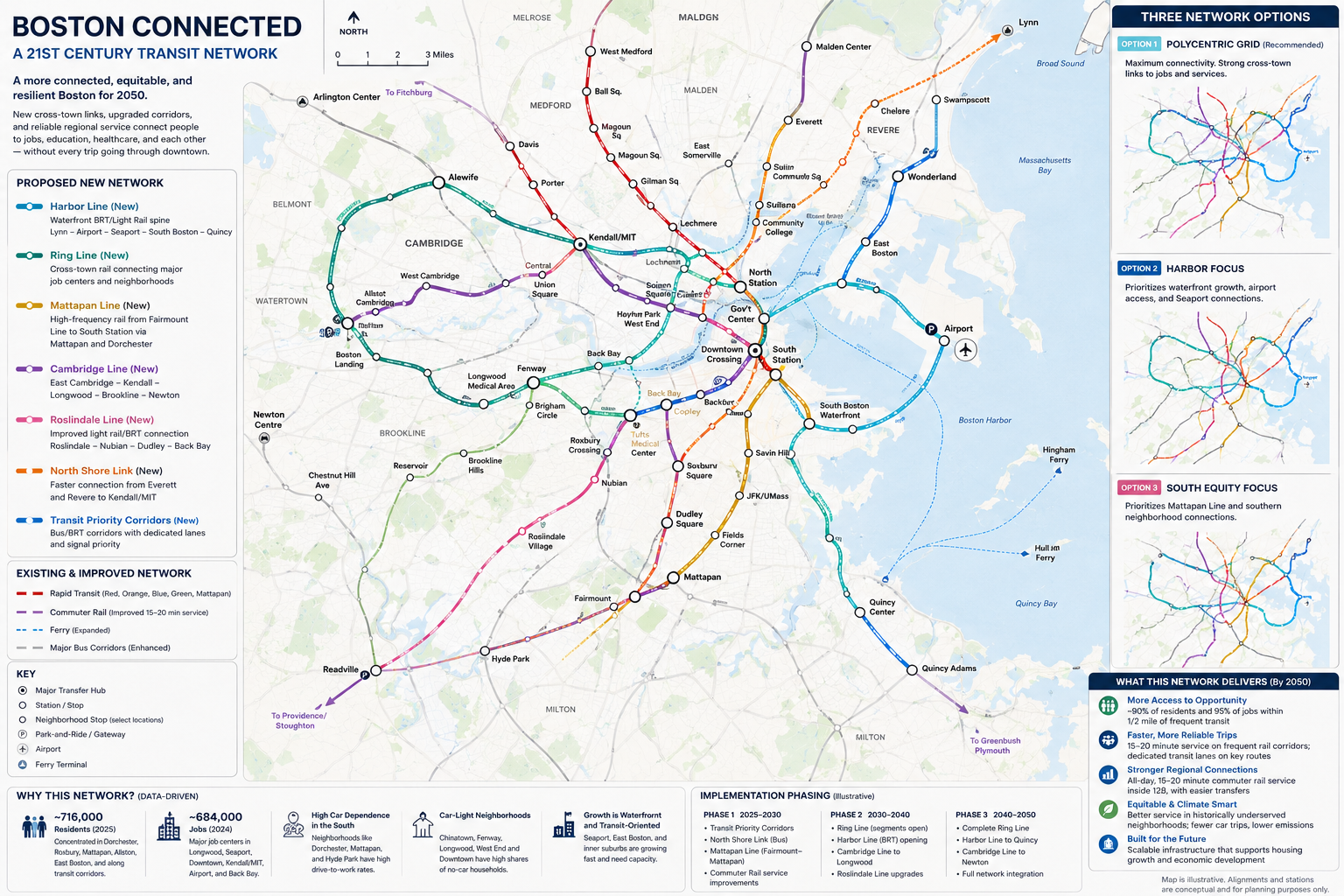
Below is a data-driven “Boston 2040 transit + infrastructure map concept” that uses existing MBTA geography as the base, but does not copy existing expansion proposals. The guiding idea is: Boston should stop treating downtown as the only useful transfer point and build a network that connects the highest-density residential corridors to the highest-density job corridors directly.
Data basis
I would build the map from four layers:
1. Population density and growth: Boston Planning Department’s 2025 population estimates and neighborhood/census-tract data, especially Dorchester, Roxbury, Mattapan, East Boston, Allston-Brighton, South Boston, and Jamaica Plain. Boston’s Planning Department says its 2025 demographic work uses tract-level and neighborhood-level estimates, and explicitly notes that Census estimates undercount Boston’s population.
2. Employment density: Boston Planning Department’s Employment Map, which maps payroll job locations at census-block level using Census LEHD/LODES data.
3. Regional job structure: the Boston-Cambridge-Newton metro area had about 2.79 million nonfarm jobs in June 2025; education/health services and professional/business services are the largest employment sectors, with Boston and Cambridge-Newton-Framingham each holding about 46% of metro employment.
4. Existing transit geometry: MBTA subway, bus, commuter rail, ferry, and paratransit form the existing network; MassGIS also maintains MBTA bus route/stop layers and train layers for route/station geography.
The major weaknesses the map fixes:
Longwood is one of the region’s biggest job centers but lacks a true rapid-transit spine.
Seaport, Logan, Chelsea, Everett, and Sullivan are job-growth areas but are poorly linked east-west.
Roxbury, Dorchester, Mattapan, and Hyde Park have population density and transit dependence but mostly radial service.
Cambridge/Somerville/Allston/Brighton form a major western job-housing arc, but cross-river and circumferential transit is weak.
North Station, Downtown Crossing/Park, South Station, Kenmore, Copley, and Government Center are overburdened transfer chokepoints.
Visual schematic
This is the proposed map structure, not to exact scale:
REVERE / WONDERLAND
│
BLUE LINE │
│
CHELSEA ─── EVERETT ─── LOGAN ─── SEAPORT
│ │ │ │
│ │ │ │
ORBITAL EAST / HARBOR LINE ───── SOUTH BOSTON
│ │
SULLIVAN ── UNION SQ ── KENDALL ── LMA / LONGWOOD
│ │ │ │
│ │ │ │
MALDEN CENTRAL MIT ROXBURY
│ │ │ │
ORANGE RED LINE ALLSTON NUBIAN
│ │ │
│ │ │
FOREST HILLS ── JP ── BROOKLINE ── JFK / UMASS
│ │ │
│ │ │
ROSLINDALE ── WEST ROXBURY DORCHESTER
│ │
HYDE PARK ───── MATTAPAN ───── FIELDS CORNER
Proposed lines and infrastructure
1. Gold Line: Chelsea–Everett–Sullivan–Kendall–Longwood–Roxbury–JFK
Type: Mostly surface light metro / urban rail, using reserved lanes, short tunnels only where needed
Color: Gold
Purpose: The missing circumferential line
Route:
Chelsea → Everett → Sullivan Square → Union Square → Kendall/MIT → Central/Mass Ave → BU/Fenway → Longwood Medical Area → Nubian → Uphams Corner → JFK/UMass
Why it belongs on the map:
This is the single most important new line. It directly connects:
north-side working-class population centers,
Kendall/MIT jobs,
Longwood medical/education jobs,
Roxbury and Dorchester residential density,
Red Line and Fairmount corridors.
It avoids forcing people through Downtown Boston just to go from Everett or Chelsea to Kendall, Longwood, Nubian, or Dorchester. That matters because Boston’s job geography is no longer only Financial District–Back Bay; education/health services and professional services are dominant sectors, and those are concentrated in places like Longwood, Kendall/Cambridge, Downtown, and the Seaport.
Key transfer stations:
Chelsea: Silver/urban rail/future regional rail
Sullivan: Orange Line
Union: Green Line
Kendall/Central: Red Line
Longwood: Green Line branches
Nubian: bus hub
JFK/UMass: Red Line + Old Colony/Fairmount connections
2. Fairmount Urban Rail: Readville–Hyde Park–Mattapan edge–Dorchester–South Station–Seaport
Type: Electrified urban rail, rapid-transit fare, 6–10 minute peak service
Color: Indigo or deep purple
Purpose: Convert the Fairmount corridor into Boston’s south-side rapid-transit spine
Route:
Readville → Hyde Park → Mattapan/Blue Hill Ave connector → Morton Street → Four Corners/Geneva → Uphams Corner → Newmarket → South Station → Seaport
Why it belongs on the map:
The Fairmount corridor already cuts through Dorchester, Mattapan-adjacent neighborhoods, Hyde Park, and dense residential areas that are relatively underserved by subway. The right-of-way exists, so the map should use it as a spine instead of treating it like a low-frequency commuter service.
This line would also create a direct south-side path to Seaport jobs without routing everyone through Park Street, Downtown Crossing, or the Red Line core.
3. Blue Line West: Logan–Seaport–South Station–Back Bay–Longwood
Type: Heavy rail extension or subway-compatible light metro
Color: Blue
Purpose: Make the Blue Line a real cross-harbor regional connector
Route:
Wonderland/Revere → Airport → Logan terminals → Seaport → South Station → Back Bay → Longwood Medical Area
Why it belongs on the map:
The Blue Line currently serves East Boston and Revere well, but it stops short of the region’s biggest job clusters west and south of downtown. Extending the Blue Line across the harbor into Seaport, South Station, Back Bay, and Longwood would tie together:
East Boston residential growth,
Logan Airport employment and travel,
Seaport jobs,
South Station intercity/regional rail,
Back Bay office/hotel jobs,
Longwood medical jobs.
This is a natural geography-based line: airport → waterfront jobs → regional rail hub → hotel/office district → medical district.
4. Red Line Relief Branch: Alewife–Porter–Harvard–Allston–Longwood–Roxbury
Type: New branch or parallel relief corridor
Color: Red dashed / crimson
Purpose: Reduce dependence on the Kendall–Park–South Station Red Line core
Route:
Alewife/Porter → Harvard → Lower Allston → BU West → Longwood → Nubian/Roxbury
Why it belongs on the map:
The Red Line connects dense residential areas and huge job centers, but its core is fragile: Alewife, Davis, Porter, Harvard, Central, Kendall, Park, Downtown, South Station, and JFK are all doing too much. A western-southern Red relief corridor would connect Cambridge/Allston/Longwood/Roxbury without forcing trips through Park Street or Downtown Crossing.
This is especially valuable because Cambridge-Newton-Framingham and Boston each account for roughly 46% of metro nonfarm employment, meaning the region has a two-sided job geography rather than a single downtown job pole.
5. Mattapan–Blue Hill–Nubian Line
Type: Modern light rail or center-running bus rapid transit convertible to rail
Color: Brown / bronze
Purpose: Give Mattapan and Blue Hill Avenue a direct high-capacity spine
Route:
Mattapan → Blue Hill Ave → Grove Hall → Nubian → Ruggles → Longwood
Why it belongs on the map:
Mattapan and the Blue Hill Avenue corridor have enough population and transit demand to justify a high-capacity, legible route. The existing Mattapan trolley should remain, but it should not be the only rail identity for the area. This new line makes Mattapan a through-running part of the urban network rather than a terminal appendage.
6. Green Line simplification + surface priority
Type: Existing light rail, reorganized operationally
Color: Existing Green
Purpose: Keep the Green Line, but make it less fragile
Map changes:
Keep branches to Boston College, Cleveland Circle, Riverside, and Medford/Union.
Add strong transfer nodes at Longwood, Kenmore, BU, Union, and Lechmere.
Show “surface priority zones” on Commonwealth Ave, Beacon Street, Huntington Ave, and the E branch.
Why it belongs on the map:
The Green Line is valuable because it already reaches dense neighborhoods and job centers, but it is operationally complex. The map should show the Green Line as a local distributor, while the new Gold/Blue/Fairmount routes handle longer cross-city trips.
Recent network-resilience research also identifies central Green Line nodes like North Station, Government Center, Haymarket, Copley, and Kenmore as critical points, which supports building alternatives that reduce single-node dependency.
7. Harbor Ferry Grid
Type: All-day urban ferry network
Color: Teal
Purpose: Use Boston Harbor as infrastructure, not a barrier
Routes:
Charlestown Navy Yard → North Station/Long Wharf → Seaport
East Boston → Seaport → South Boston
Logan → Seaport → Downtown
Chelsea Creek/Everett waterfront → Seaport/Long Wharf
Why it belongs on the map:
For waterfront districts, ferries can provide useful redundancy and short cross-harbor trips without needing every trip to pass through the subway core. This should be shown as a supporting layer, not the backbone.
Boston already has a strong radial transit skeleton. The future map should add the missing ribs
RandomWalk
Senior Member
- Joined
- Feb 2, 2014
- Messages
- 3,790
- Reaction score
- 6,803
I love the double Magoun Square stops and Chelere (apparently Chelsea has Cholera).


FormFollowsBudget
Senior Member
- Joined
- Jan 15, 2015
- Messages
- 2,318
- Reaction score
- 4,106
Swampscott is closer than I remember these days...
That Alewife Ring Proposal is fantastic! My completely ridiculous version that ignores actual demand and engineering constraints would be:
- Alewife to Watertown Square via cut-and-cover on Watertown branch, with a curve + tunnel to get to W-branch from Alewife
- Cut and cover Galen & Washingtons streets to Brighton Center
- Tunnel to Riverside and join GL D Branch to Kenmore
- Tunnel to Grand Junction w/station near Mass Ave and follow to Brickbottom Area
- Join GL E Branch towards Tufts
- Cut and Cover under Somerville community path to Davis and continue to Alewife
If you hook it up with GIS and specify costs and constraints you will get better outcomes. The more useful context you can feed into these tools the better the results.
I have unlimited access to state of the art models but dont really have the time to fiddle right now but maybe some rainy Sunday.
I have unlimited access to state of the art models but dont really have the time to fiddle right now but maybe some rainy Sunday.
Saturday in Chicago-ston - Sunday in Baltim-ston.Here's one (two?) that the Facebook algorithm served me that is not accurate (nor consistent!) at all, but I do like the Baltimore Inner Harbor vibes it gives off. Whatever the prompts were the environment changed quite a bit between each run.View attachment 72911
I think this isn't unexpected - it's going to find Focus 40 and the documents that link to or call on it.it's basically gotten to Focus 40.