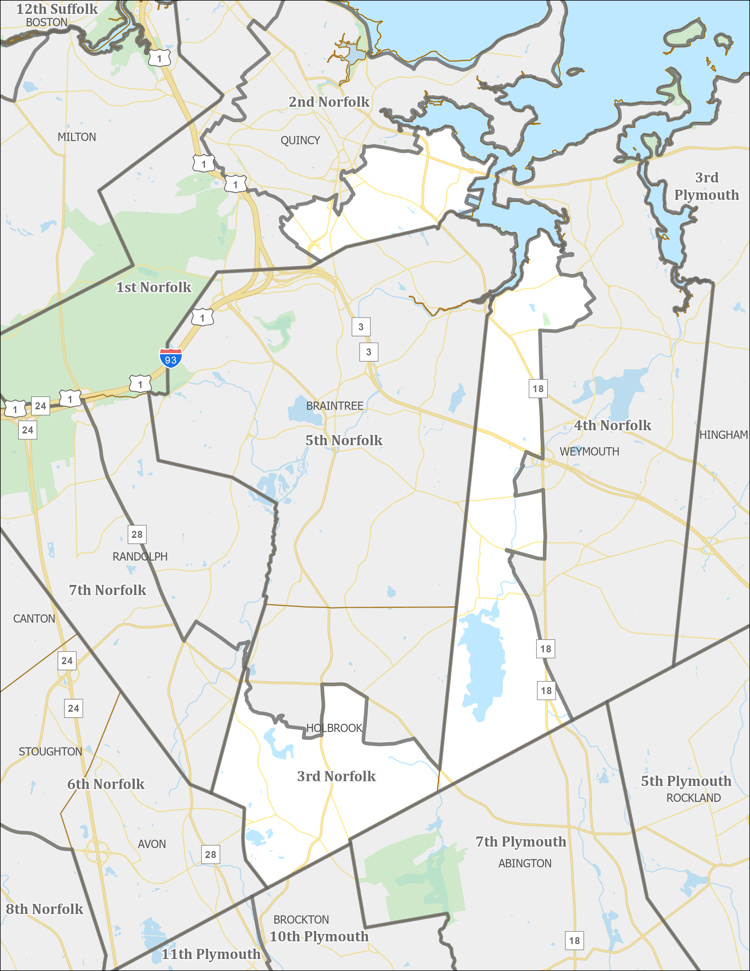
Shame on me for not knowing the hilarious shape of the district I live in. Obviously, I have more common concerns with the good folks of southern Holbrook than I do with those a quarter mile up the road. What a joke.The occupant of this gerrymandered abomination of a district probably doesn't care much about Quincy overall, and certainly not much about real transportation issues near and dear to the city as a whole.

You are using an out of date browser. It may not display this or other websites correctly.
You should upgrade or use an alternative browser.
You should upgrade or use an alternative browser.
Local Politics Thread
- Thread starter statler
- Start date

Campaign roundup: Josh Kraft HAS TOO voted in Boston elections; looks like we'll have a September preliminary for mayor
Yes, Josh Kraft issued a statement to clear that up, or as the statement puts it, answer more lies by the lying liar he says he's running against. Read more.
Does anyone know what At-Large candidates support bicycle infrastructure? I've poked around on some of their websites, but there's not a lot to go off of.

themissinglink
Senior Member
- Joined
- Jan 13, 2018
- Messages
- 2,180
- Reaction score
- 6,189

State adds tax to most cable boxes - The Boston Globe
Cable boxes had been exempt from 6.25 percent state sales tax. But no more.
 www.bostonglobe.com

stick n move
Superstar
- Joined
- Oct 14, 2009
- Messages
- 13,823
- Reaction score
- 25,995
Ironically gerrymandering was invented in massachusetts, for the detriment of everyone.Shame on me for not knowing the hilarious shape of the district I live in. Obviously, I have more common concerns with the good folks of southern Holbrook than I do with those a quarter mile up the road. What a joke.

In race to replace Fernandes Anderson, District 7 candidates debate housing affordability, reparations during forum - The Boston Globe
Eleven candidates are running in the only open seat on this year’s ballot, and would represent a district that encompasses parts of Roxbury, Dorchester, Fenway and part of the South End.
 www.bostonglobe.com
In particular, the candidates, speaking during a forum hosted by the civic engagement group Speak Boston, revealed differences in how they would tackle Boston’s housing affordability crisis. Housing affordability and stability are top issues for voters, especially in Roxbury and Dorchester, parts of District 7 that comprise the highest share of Boston’s poor, according to city reports. All four of the candidates said during an earlier event that they support rent control.
“I like rent control,” Said Ahmed, a nonprofit executive said at Monday’s event. “I grew up in a Mission Hill project on Annunciation Road. Because of Annunciation Road, I got this far.”
Said Ahmed, a nonprofit executive, said if elected he would push to make the lottery systems that distribute affordable units in private developments more transparent. Miniard Culpepper, a lawyer who previously worked for the US Department of Housing and Urban Development (HUD), supported giving tenants in public housing more ownership rights.
Community activist WaWa Bell supported the idea of creating a more localized area median income that would better reflect the demographics of District 7. Area median income is the standard used for determining income eligibility for affordable housing projects. Such a change would require the state Legislature’s approval.
Mavrick Afonso, who works for the state’s executive office of housing and livable communities, also supported the idea of a localized area median income for the district, noting that areas like Waltham are included in the region for which HUD calculated the area median income.
“Locally in Roxbury, that median income is a lot lower,” Afonso said, “we’re not making housing for Waltham in Roxbury.”
[...]
When asked by an audience member about how he would make sure that Black people from Roxbury could afford to stay in the neighborhood, Bell said reparations were the solution. Community organizations like Roxbury Rising envision reparations in the form of restoring property to Black people who were forced out during urban renewal, as opposed to just cash payments. Bell, who is a co-founder of the nonprofit Nubian Square Foundation, said that if elected to the city council, he would support a policy not based on race, that is targeted towards the descendants of slaves in Boston, not all Black people. Bell, who was formerly incarcerated, also said he would set up an American Freeman affairs office for reparations.
[...]
On reparations, Culpepper said that Black students at Madison Park vocational high school should be able to attend nearby Northeastern University tuition free if they are admitted.
[...]
Afonso, who previously worked for the city’s parks and recreation department, said a public discussion about past injustices like redlining was needed before deciding on how reparations may be implemented.
“The first step for me is to really do the work to try to understand the damages that happened at the time, a model that was set forth in South Africa with the Truth and Reconciliation trial,” Afonso said, " I can’t tell you I have a solution for all of that right now, because we don’t know how deep it’s gone and how much it’s infected and hurt families over generations."
Ahmed did not directly voice his opinion on reparations, but said he supported efforts to keep Roxbury residents in the neighborhood.

8/10 of the Boston at-large city council candidates filled out surveys on some policy issues.

 dotnews.com
Direct link that has the surveys
Survey offers new insights on council at-large field; candidates outlined priorities | Dorchester Reporter
8 (of 10) at-large Council candidates lay out policies Eight candidates for the Boston City Council’s four at-large seats explained their positions on a range of policies in responses to a questionnaire prepared by The Reporter in partnership with the Boston Municipal Research Bureau (BMRB) last...
Direct link that has the surveys

Louijeune again tops council at-large field; Baker in 5th, behind Santana
City Council President Ruthzee Louijeune was the top vote-getter in Tuesday's at-large councilor race, followed by fellow incumbents Julia Mejia, Erin Murphy and Henry Santana. Former district Councilor Frank Baker finished fifth, close on Santana's heels.
 www.wbur.org
About one-fifth of Boston’s registered voters chose eight finalists on Tuesday to compete for four at-large city council seats in November. The current Council president, Ruthzee Louijeune, was once again the top vote-getter in the citywide field, followed by fellow incumbents Julia Mejia and Erin Murphy respectively.
Henry Santana, a first-term councillor at-large with close ties to Mayor Michelle Wu finished fourth with Frank Baker, a former district councillor from Dorchester, some 3,700 votes behind him.
Incumbents cleaned up in the city council elections.
Please listen to this audio clip, I cannot believe even an ardent catholic like Koch would say this publicly
F-Line to Dudley
Superstar
- Joined
- Nov 2, 2010
- Messages
- 10,092
- Reaction score
- 12,804

Seth Moulton believed to be weighing 2026 primary challenge to Ed Markey - The Boston Globe
The Salem Democrat has not made a final decision but is seriously looking at challenging the two-term Democratic senator, several sources told the Globe.
 www.bostonglobe.com
Seth Moulton strongly considering a primary of Ed Markey for '26. Can't see that going any better for him than it did for Joe Kennedy in 2020. Markey's a fairly popular progressive who's shown some backbone against this Administration's overreach, while Moulton is a thinnish-resuméd triangulating centrist who's not real popular in his own caucus because of past flights-of-fancy challenging party leaders with doomed bids for Speaker and President. If the midterms are going to be primarily a referendum on Trump, I can't see a squishier-and-to-the-right version of Markey appealing to MA voters who are concerned about getting targeted by the Administration. All he's really got going for him are the age concerns about Markey, although at 79 Markey's hardly one of the Senate's biggest going geriatric concerns.
F-Line to Dudley
Superstar
- Joined
- Nov 2, 2010
- Messages
- 10,092
- Reaction score
- 12,804
Considering the Rev. Robert Gale case during the big Boston diocese scandals included incidents at a Quincy parish (St. Joseph's)...yeah, some of his constituents might have just a little bit of a problem with that.
Please listen to this audio clip, I cannot believe even an ardent catholic like Koch would say this publicly
Seth Moulton believed to be weighing 2026 primary challenge to Ed Markey - The Boston Globe
The Salem Democrat has not made a final decision but is seriously looking at challenging the two-term Democratic senator, several sources told the Globe.
Seth Moulton strongly considering a primary of Ed Markey for '26. Can't see that going any better for him than it did for Joe Kennedy in 2020. Markey's a fairly popular progressive who's shown some backbone against this Administration's overreach, while Moulton is a thinnish-resuméd triangulating centrist who's not real popular in his own caucus because of past flights-of-fancy challenging party leaders with doomed bids for Speaker and President. If the midterms are going to be primarily a referendum on Trump, I can't see a squishier-and-to-the-right version of Markey appealing to MA voters who are concerned about getting targeted by the Administration. All he's really got going for him are the age concerns about Markey, although at 79 Markey's hardly one of the Senate's biggest going geriatric concerns.
I'm absolutely begging for someone to give me an opportunity to vote against Markey but this ain't it.
F-Line to Dudley
Superstar
- Joined
- Nov 2, 2010
- Messages
- 10,092
- Reaction score
- 12,804
Moulton's already drawn a primary challenger for next year in the 6th district over some of his more infamous punching-down/lurching-right comments, so he's definitely not shored up his local cred enough lately to be favored in a statewide race as a challenger himself. Especially with a primary electorate that figures to be energized further to the left in '26.I'm absolutely begging for someone to give me an opportunity to vote against Markey but this ain't it.
Oh well...at least the 6th will have a fully competitive open race to liven things up.

BACsop
Senior Member
- Joined
- Jun 1, 2019
- Messages
- 1,910
- Reaction score
- 8,071
I generally find the Crimson's coverage of local politics in Cambridge to be solid. I think this profile of the current city manager is well worth a read:

 www.thecrimson.com
The Man in the Middle | Magazine | The Harvard Crimson
Yi-An Huang ’05 is Cambridge’s eleventh city manager, and he sits atop a bureaucratic machine that employs nearly 4,000 staff. Every pothole that gets fixed, every police call that is made, and nearly every city dollar that gets spent — all of it, eventually, can be traced to the man who sits in...
Longfellow
Active Member
- Joined
- Dec 12, 2023
- Messages
- 448
- Reaction score
- 1,087
A great critique of the liberal habit of holding up process as an end rather than a means. He withholds the name of this officer - a man who literally killed another person - affording him a level of privacy not afforded to the smallest time criminal in Cambridge. He puts himself through all these protests etc. and he cannot even explain to himself why he does it. He’s just like, well, we didn’t have a policy. Kind of this aw shucks mentality about something he likely actually has an opinion on. He mentions being frustrated since he was previously in their shoes as an activist. Well, you went to HBS. You are now part of the machine. All in all kind of interesting.I generally find the Crimson's coverage of local politics in Cambridge to be solid. I think this profile of the current city manager is well worth a read:
The Man in the Middle | Magazine | The Harvard Crimson
Yi-An Huang ’05 is Cambridge’s eleventh city manager, and he sits atop a bureaucratic machine that employs nearly 4,000 staff. Every pothole that gets fixed, every police call that is made, and nearly every city dollar that gets spent — all of it, eventually, can be traced to the man who sits in...

Salary Petition Falls Short Of Required Signatures; Will Not Be Placed On Nov. 4th Ballot - The Quincy Sun
By ROBERT BOSWORTH A citizens initiative petition that aimed at eliminating a 2028 annual mayoral salary of $285,000 and instead set the salary at $183,000 beginning Jan. 1, 2026 and stipulate an annual raise of two percent will not be placed on the Nov. 4th ballot due to insufficient valid...
 thequincysun.com
A citizens initiative petition that aimed at eliminating a 2028 annual mayoral salary of $285,000 and instead set the salary at $183,000 beginning Jan. 1, 2026 and stipulate an annual raise of two percent will not be placed on the Nov. 4th ballot due to insufficient valid signatures, the city clerk said Friday afternoon.
City Clerk Nicole Crispo said 7,163 signatures were submitted by the group Quincy Citizens for Fair Raises on the day of the signature deadline Tuesday, Sept. 24. However, after Election Department workers examined all of the signatures it was determined only 4,545 signatures were actually valid –828 short of the minimum required. A total of 5,373 certified signatures were required to place the petition on the Nov. 4th ballot.
and in other Quincy news...Koch is doubling down on the radio comments

Quincy mayor under fire for linking clergy sex abuse crisis to ‘homosexual issues’ - The Boston Globe
When Dan Rea of WBZ News Radio criticized the Catholic church over its response to the abuse crisis, Mayor Thomas Koch said: “That was mostly homosexual issues, not pedophilia.”
www.bostonglobe.com
Koch told the Quincy-based Patriot Ledger that he was “inartful” in his comments, while also citing studies that he said showed most abuse victims were teenage boys.
“Having said that, I don’t believe that homosexual abuse is higher than heterosexual,” Koch said, adding that “if I offended anybody, I apologize. That was never the intent. ... I have gay friends and relatives and all. I treat everybody the same.”
[...]
“The church was not very popular with the secular media,” Koch told Rea. “They took a beating. ... You don’t read about it every day when it happens around the country in other circumstances.”
leading to the Herald of all outlets to be the first to call for his resignation:
I can't find a resource, and I was hoping someone here just knows where to find it.
Some local org put together a simple chart for the upcoming Cambridge election. It was just a user-friendly chart showing how each incumbent voted on the major bike lane and housing votes of the past few years. Plus I think it had what the new challengers said about the bills. Has anyone else seen this? Know where I can find it? Did I dream this?
Some local org put together a simple chart for the upcoming Cambridge election. It was just a user-friendly chart showing how each incumbent voted on the major bike lane and housing votes of the past few years. Plus I think it had what the new challengers said about the bills. Has anyone else seen this? Know where I can find it? Did I dream this?
P
pfd12
Guest
I think the closest thing to your description that I'm aware of is this informational website for the 2023 election: https://www.cambridgecouncilcandidates.com
For example, here's the housing issue page which has a summary table of votes/stances. And you can click through to individual candidate pages, which are super detailed, compiling news articles, questionnaire answers, endorsements, past public comments at city council meetings, etc. It's great. Even though it's for 2023, it's still fairly informative for evaluating incumbents/repeat challengers. There does seem to be a 2025 update at https://www.cambridge.vote/, but still in progress (the people behind the site haven't officially posted about/shared it yet, and there's still a few broken elements on the site).
The only other thing that comes to mind for this year's election specifically is this post from one guy's civics newsletter, which has an overview of the various interest groups active in Cambridge that put out slates/endorsements, as well as a summary table of endorsements each candidate has received.
And not directly related to your question, but some additional info/visualization of campaign finances here: https://cambridgereview.org/elections/city-council/
For example, here's the housing issue page which has a summary table of votes/stances. And you can click through to individual candidate pages, which are super detailed, compiling news articles, questionnaire answers, endorsements, past public comments at city council meetings, etc. It's great. Even though it's for 2023, it's still fairly informative for evaluating incumbents/repeat challengers. There does seem to be a 2025 update at https://www.cambridge.vote/, but still in progress (the people behind the site haven't officially posted about/shared it yet, and there's still a few broken elements on the site).
The only other thing that comes to mind for this year's election specifically is this post from one guy's civics newsletter, which has an overview of the various interest groups active in Cambridge that put out slates/endorsements, as well as a summary table of endorsements each candidate has received.
And not directly related to your question, but some additional info/visualization of campaign finances here: https://cambridgereview.org/elections/city-council/
BACsop
Senior Member
- Joined
- Jun 1, 2019
- Messages
- 1,910
- Reaction score
- 8,071
Leaders at Cambridge Super Pacs say candidates for City Council overstate organizations' impact - Cambridge Day
Super Pacs were fingered as having outsized influence on Cambridge’s City Council in a recent candidates’ forum. “It’d be nice to think we could have that impact,” one group member said. “But it’s not true.”
 www.cambridgeday.com