MassDOT Rail: Springfield Hub (East-West, NNERI, Berkshires, CT-Valley-VT-Quebec)

So upgrade the line to 80mph , route it via the Harlem Line which is faster, and you could bring that down to 4hrs... CT is currently dumping a half of billion into the Waterbury Branch so I see no reason why they couldn't do a Brewster - New Milford , Danbury - Pittsfield line upgrade for a billion+. Combining the projects would say money and time and you would be able to Justify upgrading all the way to Pittsfield... Isn't the Branch to North Adams gone?
You CAN'T upgrade it to 80 MPH. The Berkshire Line is a neverending series of curves because of the river valleys. Track class exceeded achievable curve speed even in the Penn Central days 54 years ago, so the best you're going to get is the nearly 5 hours it took the last time there was service here. Throwing even more good money after bad to route via Brewster-Danbury is only going to save you maybe 20-25 minutes, which is still not nearly good enough when the "wonky" route that currently isn't drawing flies for ridership can do it in well under 4 hours. And Connecticut didn't want anything to do with it the last time it was proposed; ConnDOT was outright insulted that Massachusetts proposed it over their heads. Nothing past a Metro North extension to downtown New Milford is going to draw, and the roads are not congested north of there to North Caanan so people are going to continue to drive to the Harlem Line where the trip to New York is extremely faster than the best the Berkshire Line would ever be able to do. Not every contiguous line out there is crying for world-class passenger service. Danbury-Pittsfield was outright bad transit compared to the alternatives the last time it existed, and that's not something we need to aspire to bring back when there are so many other workable proposals out there.

Yes, the branch to North Adams is a trail. But my point stands: you'd be better off directing the money and political capital to de-landbank that line and target some actual population centers with a Berkshire Flyer extension to North Adams than you would throwing money down a deep dark pit tarting up the Berkshire Line to run way too slow for credulity for way too little population catchment. And believe me: I don't think de-landbanking the Pittsfield & North Adams is anyone's idea of a high priority.
 
"Wonky" routing or not, at 3:50 (probably 3:30 if the B&A gets uprated from Class 3 to Class 4 for better BOS-ALB service) it's over an hour faster than the Berkshire Line would be on good track.
500px-PCRR_Pittsfield_19710201.png

People drive all the way to the Upper Harlem stops because that in itself is about an hour faster than this train would be, and the roads aren't congested enough up there to ever make that a question. And the stop catchments north of downtown New Milford are absolutely microscopic. There's a reason why Connecticut wanted absolutely nothing to do with Patrick's folly the first time around, and why there's been virtually zero advocacy for it in Berkshire County since he left office.

I've said it before: if we've got a jones to spend an absolutely stupid amount of money on one-seat Berkshire rail projects, spending less than half as much to de-landbank the Pittsfield & North Adams branch to run the same Berkshire Flyer to Adams and North Adams ends up netting more total ridership than touching anything on the Berkshire Line because it would actually go where the bulk of the county's population is. Pittsfield, North Adams, and Adams alone have as much population as the next 36 municipalities in the county. That...and/or spending some MTA money to re-extend the Harlem Line from Wassaic to Millerton so the park-and-ride is that much easier for North Caanan and Great Barrington, the only population pockets of any consequence between New Milford and Pittsfield. The Berkshire Line is objectively bad transit with its corkscrewing-curve river valley ROW going dog-slow at even expensively upgraded track, and avoids actual population like the plague. Get the line up to tolerable-enough condition for Berkshire Scenic to resume operating on it, and look into getting an excursion carrier for New Milford-North Caanan like Housatonic used to operate back in the 80's. But that's about all the passenger value you're ever going to wring out of this corridor: 10 MPH scenic rides by museum operators.
Reviving the line to N Adams also would provide most of the same benefit that the Northern Tier proposal would at significantly lower cost.
 
You CAN'T upgrade it to 80 MPH. The Berkshire Line is a neverending series of curves because of the river valleys. Track class exceeded achievable curve speed even in the Penn Central days 54 years ago, so the best you're going to get is the nearly 5 hours it took the last time there was service here...

Spot checking a handful of New Haven Railroad employee timetables from the 1940s into the mid 1950s, it becomes obvious the top speed on the Berkshire line was 50 m.p.h. back in the "good old days." That, with 41 to 42 permanent speed restrictions along the route between S.S. 44 in South Norwalk and Pittsfield. Scheduled transit time was generally 4 hours 10 minutes to 4 hours 30 minutes between Grand Central Terminal and Pittsfield.
 
Even if the timetables worked out for the Berkshire Line, why would anyone ride it to any of the destinations between New Milford and Great Barrington? I have a deep affection for the Litchfield Hills...but the historic railroad villages are utterly isolated without access to a car and will keep you occupied for an hour or two at most. There just aren't destinations on the line.
 
Even if the timetables worked out for the Berkshire Line, why would anyone ride it to any of the destinations between New Milford and Great Barrington? I have a deep affection for the Litchfield Hills...but the historic railroad villages are utterly isolated without access to a car and will keep you occupied for an hour or two at most. There just aren't destinations on the line.
If the town is walkable then it could quickly become a popular gateway destination like most Hudson Valley towns , or Vermont , or Eastern Long Island or Eastern CT.. Kent is near some State parks , some paths connecting the town / station to said parks could turn it into a Cold Spring,NY . North Canaan , Great Barrington , Lee are sizable towns... They remind me of the Ethan Allen Towns in Vermont... The Hudson River towns were dumps in the early 2000s before they started targeting rail travelers from nyc , I can foresee the same thing happening to this line and a few others.
 
Last edited:
If the town is walkable then it could quickly become a popular gateway destination like most Hudson Valley towns , or Vermont , or Eastern Long Island or Eastern CT..
There are definitely some good railway towns along the line. Great Barrington, Lee, Stockbridge, Cheshire, and Adams, plus the larger towns of Pittsfield and North Adams. Could some of those places be somewhat compelling weekend getaways from Boston or Albany? Maybe. There's a good amount of nature accessible near the railway, especially with a bicycle, not that it's world class. But is that going to be the main driver of passengers to a new Housatonic line? Probably not. If you want to revive the line, a North Adams-Great Barrington service seems like a good place to start. Get people between the main towns in the area and provide a stimulus for railway-oriented development like a new state college or university in Pittsfield or something.
 
Last edited:
$3.5 million federal dollars to “develop a service development plan examining the feasibility of a Boston-to-Albany intercity passenger rail route, and [ ] detail the necessary steps to implement the service”.

 
$3.5 million federal dollars to “develop a service development plan examining the feasibility of a Boston-to-Albany intercity passenger rail route, and [ ] detail the necessary steps to implement the service”.

Happy to see we're finally doing the right study. I've always felt west of Springfield is absolutely absurd to be contemplating if your end destination isn't going to be Albany.

Only studying the idea of trains to Pittsfield, getting to within 50 miles of a metro area of 1m people, not to mention the 20+ connecting trains a day that connect to millions more and....and then just going....nah, we're only going to study dead-end trains to a town of 40k, was ridiculous.
 
Happy to see we're finally doing the right study. I've always felt west of Springfield is absolutely absurd to be contemplating if your end destination isn't going to be Albany.

Only studying the idea of trains to Pittsfield, getting to within 50 miles of a metro area of 1m people, not to mention the 20+ connecting trains a day that connect to millions more and....and then just going....nah, we're only going to study dead-end trains to a town of 40k, was ridiculous.
Bit by bit we're finally unwinding the great Baker/Pollack tank job on East-West. The costs are coming down, the ridership is projecting up, the right destination pairs are being pivoted to, connections are being emphasized instead of shunned, actual phased implementations are being worked up. Shame we had to deal with that intentional fuckery in the first place, as the Patrick-era NNEIRI study would've been an easier starting point to glom an add-on Albany service leg to. But it'll cost some money to put an eraser to the more egregious sabotage in the E-W study.
 
Would the funding/operation for this be like the setup for Amtrak state supported routes?

Really hope the study explores the value of this vs. non Albany alternatives like just running to Springfield with the MBTA (and expanding facilities there for other services), or supporting Amtrak run NEC inland routes.

Is Albany a real ridership driver, or just a good enough terminus that adds some extra support for East-West rail?
 
Would the funding/operation for this be like the setup for Amtrak state supported routes?

Really hope the study explores the value of this vs. non Albany alternatives like just running to Springfield with the MBTA (and expanding facilities there for other services), or supporting Amtrak run NEC inland routes.

Is Albany a real ridership driver, or just a good enough terminus that adds some extra support for East-West rail?
Can't legally run the MBTA to Springfield under the current agency charter unless there's an underwriting agency (see: CCRTA with Cape Flyer) reimbursing them for all out-of-district running miles. Springfield is far out-of-district, and you'd need to either amend the charter or individually vote in a whole slew of municipalities to make it happen. Anything west of Worcester is going to be Amtrak under the state-supported PRIIA rules.

Albany has pretty decent coach bus schedules out of South Station. It's not as big a bus market as Boston-Hartford just like East-West isn't as big a train market as the Inland Route (which is why Compass Rail is kick-starting the Inlands first), but Albany is definitely profitable for the bus operators. The train's relative schedule certainty compared to Pike traffic should make it a pretty well-utilized route if it gets some decent frequencies and a speed/track class uprate from 59 MPH to 79 MPH (already planned and funded Springfield-Worcester for the Inland service starts, badly needed Springfield-Schodack, NY for more Albany action). And the train would obviously serve Pittsfield to some beneficial if not earth-shattering ridership bump while nearly all of the Albany buses skip Pittsfield for it being pretty far off the Pike.
 

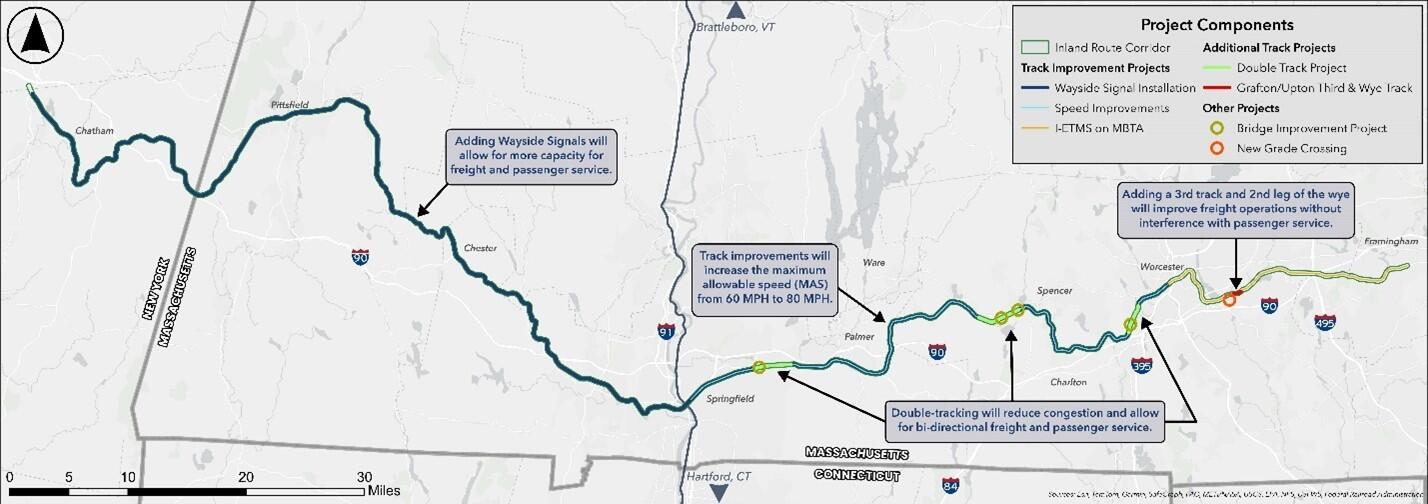
dot-inland-route-projects-082925.jpg

MassDOT with an Inland Route early action items update.
  • $108M in federal grants have been executed. They took the check during the last week of the Biden Administration in January, so there's no risk of Trump clawing it back.
  • They're installing CSX's Positive Train Control system (called I-ETMS) from Worcester to Framingham on top of the T's and Amtrak's ACSES system. This will allow road freights to Framingham to travel up to 60 MPH now instead of the 40 MPH that ACSES caps the freights at, helping ease congestion when freights and passengers run in concurrent slots. And also means CSX won't have to swap out ACSES-equipped leader locomotives in Worcester anymore to keep them bottled up for T territory (that can now happen in much smaller numbers at Framingham Yards for just the Readville and Attleboro locals). This satisfies a request from CSX, which does not stock many ACSES-equipped leaders and can't run here at all when one of them craps out. The same PTC co-installation is also in negotiation to future-occur on the segments of the Fitchburg and Haverhill Lines that CSX traverses en route to Portland (that's separate from this deal, though).
  • 1.6 miles of B&A tri-track is going in at North Grafton for the Grafton & Upton interchange, and G&U is getting a brand new westbound wye leg at its junction. This will keep the daily midday Framingham-Westborough-Grafton yard-stocker job from blocking the inbound mainline track at North Grafton for an hour or more while they're interchanging with G&U's cramped North Grafton Yard.
  • Cab signals are being removed from Worcester to Selkirk on the B&A in favor of new intermediate wayside signals, excepting some of the passenger-only interlockings at Springfield Union Station. This was a sub-ideal concession to CSX, which like with its small ACSES PTC pool of locomotive leaders only maintains a limited number of cab signal-equipped locomotives for its New York City and New England operations. They'll still have to always stock cab signal leaders for thru-Portland and thru-Framingham jobs that pass through parts of MBTA territory, but all of the Worcester- and West Springfield-terminating intermodal trains, all of the East Brookfield-terminating autorack trains, and all of the Palmer yard-stocker jobs will now be able to run on any old locomotive from CSX's national pool...and that's a majority of their B&A schedules. By redeploying their scarce cab signal and ACSES leaders to other jobs, CSX hopes to expand local service elsewhere in New England to drive business increases. Means the MBTA...which already had jurisdictional hurdles for ever expanding its service area west of Worcester...now really can't physically run west of Worcester, either. Doesn't affect Amtrak in any way/shape/form.
  • Work will start on upgrading speed limits between Worcester and Springfield from Class 3 (59 MPH passenger, 40 MPH freight) to Class 4 (79 MPH passenger, 60 MPH freight). Most of that involves re-tensioning the rail, but the state is also paying for some cycled maintenance like select rail/tie replacement where replacement is coming due. Some curves will get superelevation work for the higher speed limits, and some signals will be re-timed. This will reduce Lake Shore Ltd. Boston-Springfield travel times from 2:35 to 2:03 (that's 2:03 with a future Palmer infill stop...probably 1-2 minutes faster without).
  • 3 new segments of double track Worcester-Springfield: 2.4 miles Worcester-Auburn, 3.7 miles west of East Brookfield (still no word on whether they're doing any tri-track @ East Brookfield so the autorack trains don't tie up a mainline track while interchanging with the auto yard), 3.1 miles east of Springfield.
  • All of the above elements are currently undergoing design, with construction starts expected for 2027 and completion for 2029.
 
Cab signals are being removed from Worcester to Selkirk on the B&A in favor of new intermediate wayside signals, excepting some of the passenger-only interlockings at Springfield Union Station. This was a sub-ideal concession to CSX, which like with its small ACSES PTC pool of locomotive leaders only maintains a limited number of cab signal-equipped locomotives for its New York City and New England operations. They'll still have to always stock cab signal leaders for thru-Portland and thru-Framingham jobs that pass through parts of MBTA territory, but all of the Worcester- and West Springfield-terminating intermodal trains, all of the East Brookfield-terminating autorack trains, and all of the Palmer yard-stocker jobs will now be able to run on any old locomotive from CSX's national pool...and that's a majority of their B&A schedules. By redeploying their scarce cab signal and ACSES leaders to other jobs, CSX hopes to expand local service elsewhere in New England to drive business increases. Means the MBTA...which already had jurisdictional hurdles for ever expanding its service area west of Worcester...now really can't physically run west of Worcester, either. Doesn't affect Amtrak in any way/shape/form.
The removal of cab signals wouldn't have any bearing on the feasibility of the MBTA running west of Worcester—they already can't because none of their equipment has I-ETMS PTC. As you mention, the jurisdictional hurdles are the much bigger issue anyway.

The cab signal decommissioning and I-ETMS overlay from Worcester to Framingham are, however, pretty blatant handouts to CSX that don't really have any bearing on passenger service. (With or without these changes, trains between running between Boston and points west of Worcester will still need to be equipped for cab signals, ACSES, and I-ETMS.) Yes, the signal system will need some changes to accommodate the new double track and sidings, but that doesn't necessitate major signal system work on the whole line, including the portion west of Springfield. It's still probably worth it if that's what it takes to get the service off the ground, but I'm just tired of the Class 1s holding passenger rail expansion projects hostage unless they get public funds for their own pet projects.
 
The removal of cab signals wouldn't have any bearing on the feasibility of the MBTA running west of Worcester—they already can't because none of their equipment has I-ETMS PTC. As you mention, the jurisdictional hurdles are the much bigger issue anyway.
ACSES and I-ETMS can coexist, though. That, of course, is exactly what they just agreed to for Worcester-Framingham. So up till now a putative co-install of ACSES on the western B&A would've allowed the MBTA to theoretically roam further than Worcester. ACSES, however, does require a cab signal layer underneath to run airtight enough to meet the requirements of the Positive Train Control federal mandate (reason why the FRA reversed course midway through on the PTC mandate and required the T to belatedly install cabs across the formerly cabless northside). Removing the cabs on the western B&A means you close the loophole on ever having ACSES there, and thus ever having the MBTA there. Which again, doesn't impact Amtrak one iota because every current and future diesel and future dual-mode on their national roster will have both ACSES and I-ETMS installed...because theirs is a national pool and I-ETMS has way bigger installed mileage nationally. So, yeah...it does affect some Purple Line Crazy Transit Pitches we talk about from time to time here, though in the real world we just get all that service expansion under the Amtrak banner instead (up to and including any future Springfield Shuttles/Valley Flyer analogue on the B&A with more local stops and subsidized commuter fares).
The cab signal decommissioning and I-ETMS overlay from Worcester to Framingham are, however, pretty blatant handouts to CSX that don't really have any bearing on passenger service. (With or without these changes, trains between running between Boston and points west of Worcester will still need to be equipped for cab signals, ACSES, and I-ETMS.) Yes, the signal system will need some changes to accommodate the new double track and sidings, but that doesn't necessitate major signal system work on the whole line, including the portion west of Springfield. It's still probably worth it if that's what it takes to get the service off the ground, but I'm just tired of the Class 1s holding passenger rail expansion projects hostage unless they get public funds for their own pet projects.
It's CSX's line. $108M + $27M more in MassDOT and Amtrak offsets isn't nearly enough to purchase the B&A outright it's such an extremely valuable property. And even if it were enough, all that money would be blown on the title deed alone with nothing left to spare for the actual passenger-supporting construction work. So, yes...of course there has to be something in it for CSX's selfish benefit to agree. That's how negotiations work. MassDOT happens to be very good negotiating with this particular Class I with the haul of assets and passenger flex they've managed to procure from them over the last 20 years. Sunsetting the cab signals so CSX can portion their loco fleet more efficiently is an extremely small price to pay for getting them to agree to all the other work on their property. We now have everything we need locked-and-loaded for 2 Inland Route RT's 4 years from now, and a basic framework for incrementally adding more from there.
 
What’s the cost and likelihood of the T converting to I-ETMS on their territory?
 
What’s the cost and likelihood of the T converting to I-ETMS on their territory?
I'll defer to F Line, but I'd say zero chance given they only just finished installing the current ACSES system like 7 months ago, which cost just shy of a billion dollars. Given the NEC and how that will always be ACSES, for interoperability there's no good reason for the T to switch.

Besides... if the T ever wanted to operate over I-ETMS territory, my understanding is that its really a rules issue - but there's no real reason you can't have different operating rules over the two territories, and is how Amtrak LD operates. I-ETMS just doesn't support cab signaling, but there's nothing intrinsic to it that says you can't run CR service under its control, as I believe thats what Caltrain and Metra deploy. You could do the inverse of what CSX currently needs to do, (operate with ACSES equipped locomotives in MBTA/Amtrak territory), and equip a subfleet of MassDOT locomotives with both ACSES and I-ETMS for operation over the B&A and operating rules that apply wayside vs cab signals West of Worcester.
 
What’s the cost and likelihood of the T converting to I-ETMS on their territory?
Zero likelihood. ACSES serves them more ideally than I-ETMS. There are two major differences between I-ETMS and ACSES:
  • I-ETMS can factor train length, which is useful for traffic-managing very long freight trains which may span multiple signal blocks. It can tell the difference between a moving 10-car train and a moving 150-car train and everything in-between. It does not require cab signals, and can even govern signal-less lines because it's almost entirely GPS and radio-based. All of the Class I freights have adopted it as their system of choice, as have most of the non-Northeastern commuter rail agencies (because virtually all of them are on Class I host trackage). It's particularly scalable to long distances because it's radio-based and doesn't have to care much about the underlying signal system.
  • ACSES doesn't factor train lengths since it's mainly used by passenger agencies which don't run more than 4-12 cars, and it works with a cab signal system (cab signals = electromagnetic pulses through the running rails which convey signal codes and speed limits to a reader on the train). Being agnostic to train lengths is why freights are capped at 40 MPH in ACSES territory even when the track class allows much higher speed, and why CSX is co-installing I-ETMS on the Worcester Line to uprate its speeds. ACSES requires much less radio spectrum than I-ETMS because the cab signal layer does the majority of the work with only the above-and-beyonds handled by the PTC layer, and as byproduct it is more robust from radio dropouts (which would cause the train to go into immediate restricting speed under I-ETMS as a fail-safe). Amtrak adopted it for the NEC and branches, and all NEC-member Commuter Rail agencies in the Northeast use it.
The T wouldn't ever drop ACSES for I-ETMS because the radio spectrum acquisition in the Northeastern megalopolis is more expensive and complicated than it is in flyover country, and because the possibility of radio signal dropouts are much more harmful to train schedules as dense as we have in the Northeast. You pretty much would never chance running a line as complex as the NEC on radio-and-GPS only tech, because one hiccup (say: a solar storm that majorly disrupts radio communications) could paralyze the works. As it stands if ACSES were to ever fail you'd just fall back to running on the normal cab signals at scant loss of speed and only a little bit more cushion between trains, instead of everything grinding to a near-halt. That's a major advantage for an agency that runs the service levels of a typical Northeastern commuter rail system.

Besides... if the T ever wanted to operate over I-ETMS territory, my understanding is that its really a rules issue - but there's no real reason you can't have different operating rules over the two territories, and is how Amtrak LD operates. I-ETMS just doesn't support cab signaling, but there's nothing intrinsic to it that says you can't run CR service under its control, as I believe thats what Caltrain and Metra deploy. You could do the inverse of what CSX currently needs to do, (operate with ACSES equipped locomotives in MBTA/Amtrak territory), and equip a subfleet of MassDOT locomotives with both ACSES and I-ETMS for operation over the B&A and operating rules that apply wayside vs cab signals West of Worcester.
Having a pool of dual I-ETMS equipped locos like Amtrak is possible, but that's awkward fleet fragmentation they'd be loathe to try. It sucked for them before in the pre-PTC days when they had fragmentation in the loco and cab car fleets between cab signal-equipped and cabless equipment which had to be segregated north vs. south putting a big strain on the overall fleet flexibility. And there's really no place except Springfield on our fantasy crayon maps where that would ever have to come into play. All other studied expansion proposals including on CSX trackage to Nashua-Manchester-Concord would be cab signaled with ACSES because traversing some cab signal+ACSES territory is required to get any train--pax or freight--to there in the first place. The problem with Springfield is that if the T has to dispatch any I-ETMS territory they'd incur an onerous and expensive back-office installations of the broadcasting tech, and they definitely don't want to incur those expenses for an edge case. So as long as this CSX arrangement lasts on the B&A, they are likely to keep CSX as the dispatcher even if the state someday ends up buying the property. But it really doesn't constrain us for Springfield, because if we ever wanted to run a more commuter-flavored service with more local stops we can just take the Springfield Shuttles/ConnDOT template and subsidize some commuter fares under the Amtrak banner and get pretty much the same thing as if it were 'real' Purple Line.
 
What are the major cost drivers of PTC systems like ACSES, and how do they scale in terms of implementation? I know it’s come up a couple times in the context of increasing frequencies on the Vermonter corridor, for example, that once you pass the 6 round trips per day threshold, you trigger the need for PTC, and there’s a big expense that comes with it. But what drives that cost? Is it retrofitting the rolling stock with transmitters? Does it scale with fleet size, route length, something else?
 
What are the major cost drivers of PTC systems like ACSES, and how do they scale in terms of implementation? I know it’s come up a couple times in the context of increasing frequencies on the Vermonter corridor, for example, that once you pass the 6 round trips per day threshold, you trigger the need for PTC, and there’s a big expense that comes with it. But what drives that cost? Is it retrofitting the rolling stock with transmitters? Does it scale with fleet size, route length, something else?
It's largely the back-office installation. Huge amount of computer infrastructure is required at the dispatching center to implement a PTC system, and a large amount of employee training. Radio spectrum acquisition is the other big cost, as PTC (I-ETMS much much moreso than ACSES) is spectrum-hungry and there's a lot of interference mitigation required in built-up areas. And if the underlying signal system isn't up-to-spec for a PTC overlay there's additional upgrade costs there (like when the whole northside needed to have cab signals installed). Once it's down to actually putting the transponders on the trains and installing the transmitters in the field, though, it scales pretty efficiently. Most of the cost-and-implementation drama is in the design and back-office.

MassDOT does plan to install PTC on the Conn River Line to support Valley Flyer frequency increases. Probably ACSES + cab signals, since all of Pan Am Southern's/Berkshire & Eastern's locomotives and dispatch can natively handle that for traveling on the Fitchburg Line in MBTA territory and on the Amtrak Springfield Line to Connecticut. If PTC ever comes to the NECR portion of the corridor up in Vermont, it would probably be the same (NECR doesn't currently run in any PTC territory, but their existing locos all have cab signals for crossing the B&A diamond in Palmer).
 
It's largely the back-office installation. Huge amount of computer infrastructure is required at the dispatching center to implement a PTC system, and a large amount of employee training. Radio spectrum acquisition is the other big cost, as PTC (I-ETMS much much moreso than ACSES) is spectrum-hungry and there's a lot of interference mitigation required in built-up areas. And if the underlying signal system isn't up-to-spec for a PTC overlay there's additional upgrade costs there (like when the whole northside needed to have cab signals installed). Once it's down to actually putting the transponders on the trains and installing the transmitters in the field, though, it scales pretty efficiently. Most of the cost-and-implementation drama is in the design and back-office.

MassDOT does plan to install PTC on the Conn River Line to support Valley Flyer frequency increases. Probably ACSES + cab signals, since all of Pan Am Southern's/Berkshire & Eastern's locomotives and dispatch can natively handle that for traveling on the Fitchburg Line in MBTA territory and on the Amtrak Springfield Line to Connecticut. If PTC ever comes to the NECR portion of the corridor up in Vermont, it would probably be the same (NECR doesn't currently run in any PTC territory, but their existing locos all have cab signals for crossing the B&A diamond in Palmer).
Actually, that reminds me. I believe that Downeaster service had been capped at 6RT trips, due to the limits of FRA PTC waivers which went away when CSX bought Pan Am. I know that any additional service is beholden to the current lack of equipment availability, but I believe they opted for I-ETMS, despite connecting to the ACSES Haverhill Line, probably thanks to centralized CSX dispatch. Also, the press release seems to indicate that Amtrak is funding all of the signal work. Any clue on how Amtrak ended up with the bill when its an FRA mandate for all Class Is?


Back
Top