MBTA Commuter Rail (Operations, Keolis, & Short Term)

I don't know for sure, but I'm assuming it's related to the proposed 30-minute headways on the line. The T hasn't published much information on it, but here's some CIP info:

The announcement also mentions that "crews will also perform culvert upgrade work near Westborough", so you have that too.

Not sure what 30 minute headways would mean in this context. After all, they were sending 4 tph in the Peak.
 
On an unrelated note, could someone provide a brief description on how modern diesel locomotives (like the ones the T plans to order) compare to the oldest locos in the CR fleet? I know we should expect better fuel efficiency, improved acceleration, lower NO2 and particulate pollution, and reduced failures, but have a poor feel on just how much improvement could come. This is not meant as a defense of the decision to keep buying diesel equipment, but instead just trying to understand the full benefits of getting new locos.
 
On an unrelated note, could someone provide a brief description on how modern diesel locomotives (like the ones the T plans to order) compare to the oldest locos in the CR fleet? I know we should expect better fuel efficiency, improved acceleration, lower NO2 and particulate pollution, and reduced failures, but have a poor feel on just how much improvement could come. This is not meant as a defense of the decision to keep buying diesel equipment, but instead just trying to understand the full benefits of getting new locos.
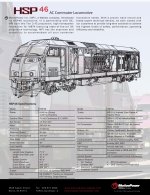
The below link is to a spec sheet for the Siemens SC-44, which is the probable candidate for new diesels - I'd assume their marketed 95% reductions particulate and 89% for NOx compared to Tier 0 is largely accurate, despite the T's F40s and GP40s being Tier 0+.Beyond that, they are 4400hp locomotives, compared to 3000hp, which partially goes to acceleration, and are rated for much higher top speeds.

(I believe the F40s and GPs max out at 103mph, but are limited in service to 79mph. this shouldn't really matter - most of the system is a 79mph max due to track and coach speeds. Afaik, even on the NEC, the bilevels aren't rated to more than 90mph.)

Fuel efficiency numbers aren't published anywhere I can find, but reliability wise, they're all on their second rebuild... the oldest GPs are from the 70s so are 50 years old. The youngest F40s are all 30+. Theres only so much rebuilding they can do before its better to buy something new, as the latest F40 rebuilds were only supposed to buy 10 years, 20 with additional major component overhauls. The early ones are already halfway though that window. The GPs didn't get full second rebuilds, just "heavy maintenance" done in house, so they're probably even more so running on borrowed time.

Worth keeping in mind too that overhauls aren't cheap - in 2019, the T paid 79M to overhaul the 37 F40s, 2M each. The HSP46s cost 6M each to buy in 2013, though they too are up for overhaul. Leaving aside the basis year problem, new chargers would probably run 10-15M, depending on the number of option units included/exercised.

 

Attachments

  • Screenshot_20251102_201839_Chrome.jpg
    Screenshot_20251102_201839_Chrome.jpg
    777.2 KB · Views: 71
Last edited:
The below is a spec sheet for the Siemens SC-44, which is the probable candidate for new diesels - I'd assume the 95% reductions particulate and 89% for NOx compared to Tier 0 is largely accurate, despite the T's F40s and GP40s being Tier 0+.Beyond that, they are 4400hp locomotives, compared to 3000hp, which partially goes to acceleration, and are rated for much higher top speeds.

(I believe the F40s and GPs max out at 103mph, but are limited in service to 79mph. this shouldn't really matter - most of the system is a 79mph max due to track and coach speeds. Afaik, even on the NEC, the bilevels aren't rated to more than 90mph.)

Fuel efficiency numbers aren't published anywhere I can find, but reliability wise, they're all on their second rebuild... the oldest GPs are from the 70s so are 50 years old. The youngest F40s are all 30+. Theres only so much rebuilding they can do before its better to buy something new, as the latest F40 rebuilds were only supposed to buy 10 years, 20 with additional major component overhauls. The early ones are already halfway though that window. The GPs didn't get full rebuilds, just "heavy maintenance" done in house, so they're probably even more so running on borrowed time.

Worth keeping in mind too that overhauls aren't cheap - in 2019, the T paid 79M to overhaul the 37 F40s, 2M each. The HSP46s cost 6M each to buy in 2013, though they too are up for overhaul. Leaving aside the basis year problem, new chargers would probably run 10-15M, depending on the number of option units included/exercised.

Thanks for the information. I figured hard numbers would be difficult to come by, but this paints a clear enough picture.

From this information and everything the T has said, it does seem like the new locos will result in a meaningful service improvement across the CR network. Better reliability and acceleration means better schedule adherence, infrastructure improvements notwithstanding. Reductions in both NOx and particulate should make lots of station environments nicer, even if diesel is still being burned. And even modest efficiency gains represent significant cost savings, given just how much the trains are run. I think it's a shame electrification is so far behind that we're still spending hundreds of millions on diesel equipment, but given the state of the CR network and fleet, the new locos feel much more understandable.
 
Continuing on the modern diesel locomotive, er, train: Are there any measurements surrounding noise pollution improvements for these newer-gen diesel locomotives?

I tried to do some very-quick searching but only see vague references to "less noise".

I assume if the T's locos are "Tier 0+", and those Siemens being Tier 4 (?), what are the "gains" in the noise-pollution world? Is it mostly at idle? Mostly at speed/under load?

I ask (a bit selfishly) because I have mostly tuned out the low rumble of idling diesel locomotives that I can hear from North Station, but every now and then (certain weather conditions) the low frequency hum gets me. If there are good reductions around low-speed/idle, then proposed turn-backs and layover yards may be able to lessen the grasp of some clutched pearls--though they'll find something else to complain about (and the loco replacements won't happen overnight)
 
It means 2 tph at every station, both directions, all day. There would additionally be 4 tph at Framingham and the Boston stations.

That can't be it. They need room for Amtrak and Freight outside of peak.
 
That can't be it. They need room for Amtrak and Freight outside of peak.
I'm just telling you the little bit that's been shared with the public. As far as I'm aware, no proposed timetables have been released.

That said, one Amtrak round trip isn't exactly a ton to schedule around. And freight movements on half the line that only sees 2 TPH shouldn't be too bad as well (especially if more get bumped to overnight). It wouldn't surprise me if it ends up being like the original 30-minute Fairmount schedules, where there's 1 or 2 gaps midday of around 45 minutes to an hour.
 
The below link is to a spec sheet for the Siemens SC-44, which is the probable candidate for new diesels - I'd assume their marketed 95% reductions particulate and 89% for NOx compared to Tier 0 is largely accurate, despite the T's F40s and GP40s being Tier 0+.Beyond that, they are 4400hp locomotives, compared to 3000hp, which partially goes to acceleration, and are rated for much higher top speeds.

(I believe the F40s and GPs max out at 103mph, but are limited in service to 79mph. this shouldn't really matter - most of the system is a 79mph max due to track and coach speeds. Afaik, even on the NEC, the bilevels aren't rated to more than 90mph.)

Fuel efficiency numbers aren't published anywhere I can find, but reliability wise, they're all on their second rebuild... the oldest GPs are from the 70s so are 50 years old. The youngest F40s are all 30+. Theres only so much rebuilding they can do before its better to buy something new, as the latest F40 rebuilds were only supposed to buy 10 years, 20 with additional major component overhauls. The early ones are already halfway though that window. The GPs didn't get full second rebuilds, just "heavy maintenance" done in house, so they're probably even more so running on borrowed time.

Worth keeping in mind too that overhauls aren't cheap - in 2019, the T paid 79M to overhaul the 37 F40s, 2M each. The HSP46s cost 6M each to buy in 2013, though they too are up for overhaul. Leaving aside the basis year problem, new chargers would probably run 10-15M, depending on the number of option units included/exercised.

The GP40's aren't Tier 0+, excepting a very few units that got recently rehabbed out of the Rochester dead line. There's also some fuel and emissions savings from the Chargers (and the Tier 3 HSP-46's) using alternators off the prime mover for the coach HEP power instead of a second diesel generator that's always going no matter the load. All Tier 4 passenger locos so far on the market ditch the generator for the alternator to aid in achieving the emissions compliance. Alternators comes with the downside that if you have a crapped-out engine, your coaches are all in the dark as well...but it's a fair tradeoff if the vehicle is going to be overall more reliable than previous generations.

Another thing new engines have going for them are AC traction motors, which are a technological upgrade to the older-style DC traction on the F40's and GP40's. AC motors are a lot less complicated than DC motors and much easier to service, so other than some freight makes catered to legacy DC fleets most rolling stock manufacturers have long since switched over to AC. Newer makes also have the latest in regenerative braking tech, which helps quite a bit with the emissions and fuel. The F40 rebuilds did not get any of that in their overhauls because their overall tech wasn't suited to it.

For a solid 25 years or so it was cheaper to rebuild older power vs. buying new, but that's flipped on its head now that Tier 0+ emissions control packages required by major rebuilds are pretty pricey and DC traction is becoming more scarce. Even the Class I freight carriers are largely buying new and slowing/narrowing their once prodigious in-house rebuild programs. The T would never be able to rebuild the GP40's again as at a half-century old there's enough accrued frame fatigue that you just can't roll back anymore. That's the make this next order must replace ASAP because they're truly at the end of the line. The F40's have a decent amount of time left in them, but for future planning it's better to lock in a price now for the option orders that'll replace them some years after the GP40-replacing first batch. At least if we buy Chargers then get our electrification house more in order, those Chargers will have good resale value over their lifetime because of the likelihood that they'll be rebuilt many times over. So when we no longer need them because we've started displacing with EMU's, we can recoup the investment to a good degree by selling the fleet to another agency to rebuild. It's why if they buy anything, it's overwhelmingly likely to be Chargers and not the EMD F125 or MPI MP54AC because the Charger's market penetration (and thus future resale value) absolutely dwarfs everything else out there.
 
I am so thankful that we have ejected the Pioneer crowd from T management. They probably would have chosen a low-ball F125 order just to screw the pooch.
No...they would've done absolutely nothing until the GP40's were failing at such an astronomical rate that they had to start cutting service from the lack of serviceable bodies. That's the governance-by-Pioneer way.

It was Deval Patrick's people who decided to order the HSP-46 unicorns the last time out rather than buy something proven and ubiquitous like more MP36PH's (which did top out at Tier 3-compliant like the HSP's).
 
I'm just telling you the little bit that's been shared with the public. As far as I'm aware, no proposed timetables have been released.

That said, one Amtrak round trip isn't exactly a ton to schedule around. And freight movements on half the line that only sees 2 TPH shouldn't be too bad as well (especially if more get bumped to overnight). It wouldn't surprise me if it ends up being like the original 30-minute Fairmount schedules, where there's 1 or 2 gaps midday of around 45 minutes to an hour.

That would be a pretty substantial increase in service. They haven't even brought back 2+2 at peak yet.
 
That would be a pretty substantial increase in service. They haven't even brought back 2+2 at peak yet.
That's true, but the schedule has been shifted to prioritize all-day service over peak service. And it's not like peak service is that far off from 2 locals and 2 local expresses hourly. There's currently 7 trains that arrive at South Station between 7:10 & 9:11 AM and 7 that leave between 4 & 6:15. If the T was running a "true" 2+2 schedule, those numbers should be right around 10. It is a meaningful difference, but a reasonable trade-off for hourly off-peak service.
 
“The showing in this room was the best thing that could have happened,” said Haley, referring to the estimated 300-or-so citizens who turned up at the special Select Board meeting in RMHS’ performing arts center. “Hopefully, [the MBTA] does take this seriously. This is the not the regular crowd [we’re accustomed to seeing at our meetings…I really think the MBTA has to go back to the drawing board on this.”
“This project is not appropriate for our town,” Murphy stated earlier in the evening. “If they’re going to push forward, we as a town need to push back even harder.”
[...]
This fall, the MBTA reintroduced the plans and argued that a series of alternatives proposed by opponents - such as calls to situate the turnback track in a more industrialized section of the town on land that runs behind the Market Basket and Newcrossing Road office buildings - simply won’t work.
However, area abutters and members of the citizen advocacy group insist that the existing turnaround site will result in heavy diesel fuel and nitric oxide and other NoX emissions, cause serious traffic issues in the center of town due to an increased number of train gain stoppings, potentially increase police and fire response times, and create noise disruptions in the middle of a residential neighborhood that sits nearby a local middle school and a senior housing facility.
 
Isn’t this ever more reason to move Reading Station east of Ash Street away from the NIMBYs? It was really shortsighted for the T to put a mini-high at North Wilmington when they could have just relocated to the old Salem Street stop on the Wildcat Branch and routed outer Haverhill trains via the Lowell Line permanently. Then the grade crossing concerns wouldn’t be yet another thing for the Reading folks to pick at on top of the turnback track.
 
Isn’t this ever more reason to move Reading Station east of Ash Street away from the NIMBYs? It was really shortsighted for the T to put a mini-high at North Wilmington when they could have just relocated to the old Salem Street stop on the Wildcat Branch and routed outer Haverhill trains via the Lowell Line permanently. Then the grade crossing concerns wouldn’t be yet another thing for the Reading folks to pick at on top of the turnback track.

Yeah, that's been my thinking too.
- You avoid a lot of grade crossings through town if you eventually shift Haverhill traffic to Wildcat
- It might be even closer to the town center on rt28
- There's a lot more TODable parcels close by in the long run, with parking lots and an old factory?/spirit halloween
- It would even be convenient to 95 for Park and Ride if they thought they needed it

North Wilmington always struck me as a weird place to prioritize investment. But I guess it had to be redone, and they were able to do it for relatively cheap by reusing part of an old bridge, which is cool.
 
Yeah I mean just perusing the Haverhill Line boarding and alighting data: https://mbta-massdot.opendata.arcgis.com/search?tags=commuter%20rail

Dataset

MBTA Commuter Rail Ridership by Trip, Season, Route Line, and Stop.​


There isn’t a great deal of affinity between the “outer” Haverhill Line stations (north of Reading) and the “inner” Haverhill stations (Reading-Malden Center). Meaning very few people who board inbound at an outer Haverhill station alight at an inner Haverhill station (or vice versa outbound). Almost all outer Haverhill passengers are going to North Station. Malden Center is the only major job center stop on the inner Haverhill part of the line and even that only receives a handful of outer Haverhill passengers (presumably some to transfer to OL too for Assembly job/retail or Sullivan Square buses).

And pushing the outer Haverhill stops to the Lowell Line via Wildcat would achieve two other objectives:
1. Achieving regional rail-like frequencies on the Lowell Line inside 128 (Woburn to North Station - the Wilmington station layout with the Wildcat junction is a little convoluted and only the outbound platform connects to Wildcat). Presumably some outer Haverhill trains would still run express from Ballardville-NS like one rush hour train morning and evening does now. But you could get ~20 min Woburn-NS frequencies at rush hour which would make Woburn much more attractive as a park and ride reliever for 93 traffic than today with 35 min frequencies during rush. Plus better frequencies on this stretch off-peak and weekends.
2. Presumably a much better rider experience for outer Haverhill passengers given the fewer stops to NS via Wildcat/Lowell Line (only four stops on Lowell between Ballardville and NS leaving out Wilmington vs. inner Haverhill now with nine stops including Oak Grove and North Wilmington). Plus all the single track through Melrose that puts a damper on on-time performance.

One caveat discussed here is that the outer Haverhill would need some double tracking to make this compatible but again that seems a lot easier than dealing with the public animosity over a little track siding in Reading.

The other caveat is this proposal is self-serving given that I use West Medford Station quite a bit 😉.
 
The T should seek from the legislature a single action that requires cities to furnish permits within 90 days, no longer, for all permits they request to accomplish the regional rail vision. Get the NIMBYs to take many many seats.
 
I just noticed a bunch of wooden utility poles arrayed alongside the Lowell Line awaiting installation. I thought they just moved all the signaling to buried fiber optics. Why are they installing new poles?
 
I just noticed a bunch of wooden utility poles arrayed alongside the Lowell Line awaiting installation. I thought they just moved all the signaling to buried fiber optics. Why are they installing new poles?
My informed guess would be a lease of the RoW to a telco - the MBTA FOR project installed either 96/288F and 3 conduits for the MBTA's own use, and optionally 3 to be leased to commercial operators. My understanding is that due to construction costs, the 3 commercial ducts were omitted from the scope of the project - which means that commercial fiber will still be aerial. Even if they're leasing one of those ducts, if it was sized for 288... the major fiber operators I'm aware of are currently installing 864F and up. Telecom leases account for the vast majority of MassDOT/MBTA real estate revenue.
Screenshot_20251109_223024_Chrome.jpg
Fiber-Map-1536x1187.jpg
 

Back
Top