
You are using an out of date browser. It may not display this or other websites correctly.
You should upgrade or use an alternative browser.
You should upgrade or use an alternative browser.
Housing (Supply Crisis & Public Policy)
- Thread starter Jouhou
- Start date


themissinglink
Senior Member
- Joined
- Jan 13, 2018
- Messages
- 2,201
- Reaction score
- 6,280
Governor Healey Launches New Campaign to Make It Easier and Cheaper to Build ADUs Across Massachusetts
Governor Maura Healey today announced a new campaign to make it easier and cheaper for people across Massachusetts to build accessory dwelling units (ADUs). ADUs, also known as granny flats or in-law apartments, are small residential living spaces that are located on the same lot as another home. Governor Healey’s Affordable Homes Act allowed ADUs to be built-by-right in single-family zoning districts statewide, giving communities an effective tool to increase housing production and lower costs.
- Design: The Executive Office of Housing and Livable Communities (HLC) will launch its ADU Design Challenge on December 15, offering prize funding through sponsorship partners to generate a set of publicly available, replicable designs that homeowners and communities can use at no cost.
- Support: Backed by $10 million from the Governor’s fiscal 2026-2030 Capital Investment Plan, Massachusetts Housing Partnership (MHP) will offer a program to help more homeowners build ADUs.
- Finance: Following its recent authorization of $20 million for mission-oriented homeownership activities, MassHousing plans utilize a portion of those funds to introduce affordable, accessible construction financing for low and moderate-income homeowners beginning in 2026.
Why does it feel like almost every new initiative in this state to increase housing boils down to a new, roundabout way to throw money at the problem...

Trump administration says it will investigate Boston’s housing policies for anti-white bias - The Boston Globe
The Trump administration said Boston may have discriminated against white people by prioritizing people of color, rather than all low-income residents, in its efforts to support homeownership.
 www.bostonglobe.com
Finally the real housing crisis is being taken head-on

stick n move
Superstar
- Joined
- Oct 14, 2009
- Messages
- 13,923
- Reaction score
- 26,458
The American century of humiliation is fully underway.

Johnnyrocket891
Active Member
- Joined
- Jul 1, 2019
- Messages
- 248
- Reaction score
- 152
38 trillion dollar National Debt. And our US cities are deteriorating across the country. Records number of US homelessness across the country.
I guess those bank bailouts, free healthcare all worked out back 2008-2012. Our leaders doing a great job enriching themselves while destroying our country to get rich.
"The U.S. reached a record high for homelessness in 2024, with 771,480 people experiencing homelessness on a single night, an 18% increase from 2023, driven primarily by the severe lack of affordable housing, inflation, and stagnant wages, though veteran homelessness continued to decline. This data comes from the Department of Housing and Urban Development's (HUD) (HUD) Annual Homelessness Assessment Report (AHAR) based on the Point-in-Time (PIT) count"
I guess those bank bailouts, free healthcare all worked out back 2008-2012. Our leaders doing a great job enriching themselves while destroying our country to get rich.
"The U.S. reached a record high for homelessness in 2024, with 771,480 people experiencing homelessness on a single night, an 18% increase from 2023, driven primarily by the severe lack of affordable housing, inflation, and stagnant wages, though veteran homelessness continued to decline. This data comes from the Department of Housing and Urban Development's (HUD) (HUD) Annual Homelessness Assessment Report (AHAR) based on the Point-in-Time (PIT) count"
38 trillion dollar National Debt. And our US cities are deteriorating across the country. Records number of US homelessness across the country.
I guess those bank bailouts, free healthcare all worked out back 2008-2012. Our leaders doing a great job enriching themselves while destroying our country to get rich.
"The U.S. reached a record high for homelessness in 2024, with 771,480 people experiencing homelessness on a single night, an 18% increase from 2023, driven primarily by the severe lack of affordable housing, inflation, and stagnant wages, though veteran homelessness continued to decline. This data comes from the Department of Housing and Urban Development's (HUD) (HUD) Annual Homelessness Assessment Report (AHAR) based on the Point-in-Time (PIT) count"
Sir, this is a Wendy's.
AFAICT, this has, in fact, been a major problem in our urban markets, everywhere. People in areas already served by transit claim that any new development is gentrification, and so demand is met in places that are car-centric by design.Does anyone else worry about the amount of apartment-style housing built as car-oriented development? Stuff like NOBO in Saugus, etc. Not just from a "we need more TOD" perspective, but also because there are only so many people who are in the market for an apartment, whether rented or owned, and if too much of the apartment demand is built with cars in mind, there won't be enough demand for something like Suffolk Downs that's more transit-oriented.
I'm approaching this from the perspective that, while a lot of policy is focused on allowing denser housing options just about anywhere (see stuff like HB631 in NH), is there any consideration that this might hurt demand for apartments in areas where people might actually use something other than a car to get around? Would love to see some more robust research on this, but I haven't had any luck so far.
Certainly, I have to say that seems to be a major cause of poor public transit utilization in Metro Portland, Oregon, where I now live. There's a decent-ish light rail service that covers most of the metro (and usable bus services), and yet so many stations--including those very close to even the very-narrow local definition of Downtown--have little more than SFHs all around.
People talk about Portland's TOD like it's bog-standard for all the MAX stations, but really, there's extraordinarily little of it, and most of the region is built very New American-West Coast car-sprawl--and there's nearly no bike infrastructure, aside from painted bike gutters, on the west side of the metro which has absorbed a lot of the region's growth--so even though there are a lot of small-plot suburban homes and genuine multi-story apartment/condo developments, most people just drive everywhere and traffic WITH 50mph stroads are ubiquitous.
It's really a worst of both worlds situation, and I don't know how they got here, but they did.
Agreed.AFAICT, this has, in fact, been a major problem in our urban markets, everywhere. People in areas already served by transit claim that any new development is gentrification, and so demand is met in places that are car-centric by design.
Certainly, I have to say that seems to be a major cause of poor public transit utilization in Metro Portland, Oregon, where I now live. There's a decent-ish light rail service that covers most of the metro (and usable bus services), and yet so many stations--including those very close to even the very-narrow local definition of Downtown--have little more than SFHs all around.
People talk about Portland's TOD like it's bog-standard for all the MAX stations, but really, there's extraordinarily little of it, and most of the region is built very New American-West Coast car-sprawl--and there's nearly no bike infrastructure, aside from painted bike gutters, on the west side of the metro which has absorbed a lot of the region's growth--so even though there are a lot of small-plot suburban homes and genuine multi-story apartment/condo developments, most people just drive everywhere and traffic WITH 50mph stroads are ubiquitous.
It's really a worst of both worlds situation, and I don't know how they got here, but they did.
Outside of an exhaustive, state-wide zoning/development plan (which, while politically untenable, seems like the most comprehensive way to solve this), what policies do you think could combat this trend?
Only ones I can think of off the top of my head are:
- Eliminate parking minimums state-wide (-> cheaper construction in transit-rich areas)
- Some kind of incentive system for TOD (lower IZ reqs, tax credits, streamlined permitting like 40B, etc.)
- More onerous requirements for greenfield/industrial redevelopment far from transit (higher IZ reqs, add. taxes, more stringent justification for development, comprehensive alternative mobility plans)
stick n move
Superstar
- Joined
- Oct 14, 2009
- Messages
- 13,923
- Reaction score
- 26,458
It's really a worst of both worlds situation, and I don't know how they got here, but they did.
Yup, its also a worst of both worlds situation where due to strict zoning and bad land use cities have become extremely expensive places to live (especially the cities with good transit), so the very people that need public transit the most are not the ones who live near it, and the people who do live near transit dont use it as much because theyre wealthy and drive.

HenryAlan
Senior Member
- Joined
- Dec 15, 2009
- Messages
- 4,534
- Reaction score
- 5,453
Thanks for pointing this out. Let's dig into this a bit. $38 trillion is approximately 125% of US GDP. Since a lot of simplistic types like to talk about the government needing to operate like a household (they're wrong, but let's go with that), this would be similar to a household with $50,000 annual income holding a $62,300 mortgage. Nobody would credibly argue that such a mortgage is too high. There's a reason why people respond by telling you this isn't a Wendy's -- your argumentation in this and every other thread is alarmist and completely lacking in any relevance or analytical foundation. Would you like fries with that order?38 trillion dollar National Debt.
Why does it feel like almost every new initiative in this state to increase housing boils down to a new, roundabout way to throw money at the problem...
Because short of an economic crash, there is nothing that would fix the problem here. So pols just do whatever they think will sound good to people who aren't paying attention.
It's not as black and white as "fix" or "not fix". There are absolutely policies that would make the crisis less severe, even if it doesn't mean housing prices get cut in half or something. Incremental improvements still move the needle, and politicians should be pursuing them.Because short of an economic crash, there is nothing that would fix the problem here. So pols just do whatever they think will sound good to people who aren't paying attention.
Since a lot of simplistic types like to talk about the government needing to operate like a household (they're wrong, but let's go with that), this would be similar to a household with $50,000 annual income holding a $62,300 mortgage. Nobody would credibly argue that such a mortgage is too high....
Let's stay simplistic. If this so called household was paying a real mortgage (and not the variable rate version that crashed the market back in 2009) then they would owe a little bit less at the end of every year. However, that is not the case here. The balance continues to get larger, not smaller. In your analogy, the people would lose their house to the bank. Now apply "losing the house" to the United States and... then what happens?
It's not as black and white as "fix" or "not fix". There are absolutely policies that would make the crisis less severe, even if it doesn't mean housing prices get cut in half or something. Incremental improvements still move the needle, and politicians should be pursuing them.
Probally more like a drop in the bucket. Like they could ban AirBnB and in theory free up some units... but I think the main reason people who do AirBnB instead of renting it out do it because they are afraid of getting a bad tenant who will trash the place and be impossible to get rid of.
but I think the main reason people who do AirBnB instead of renting it out do it because they are afraid of getting a bad tenant who will trash the place and be impossible to get rid of.
I think the main reason people who do AirBnB instead of renting it out do it because of money
commuter guy
Active Member
- Joined
- Feb 1, 2007
- Messages
- 959
- Reaction score
- 216

The rarest of birds in the Boston skyline: the construction crane - The Boston Globe
Two years ago, there were 20 tower cranes active in Boston. Now are there are just five.
 www.bostonglobe.com
"Between high interest rates and the high cost of materials, construction is slow all over the country right now. But it’s particularly slow in Boston, where massive projects have ground to a near-halt with the smallest number of cranes since construction consulting firm RLB launched the index in 2016."
"There’s a debate among developers whether it’s economic conditions or the policies of Boston Mayor Michelle Wu that have reduced the number of big real estate projects in Boston."
"Some contend the Commonwealth isn’t creating jobs fast enough to justify new development, and the cost of construction and interest rates are simply too high. But others blame Wu for creating new affordable housing and green energy requirements that advance her political agenda but make it financially unfeasible to build."
commuter guy
Active Member
- Joined
- Feb 1, 2007
- Messages
- 959
- Reaction score
- 216
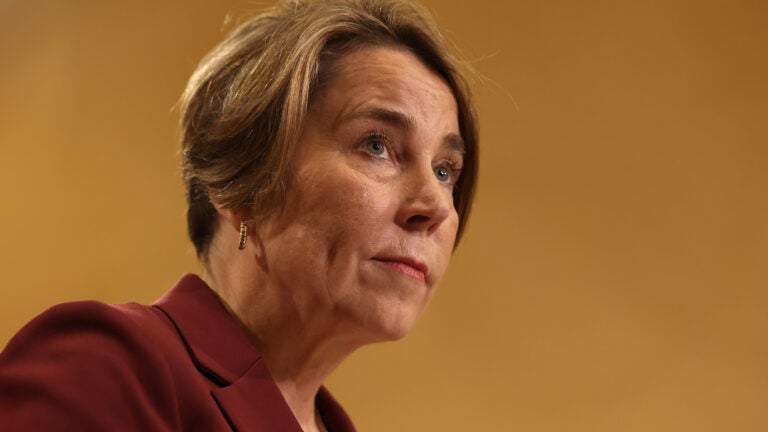
Healey opposes proposed rent control ballot question
A proposal to enact statewide rent control could be in front of voters next year. Gov. Maura Healey is concerned that this could slow housing production.
www.boston.com
"Healey says she opposes rent control ballot question, warning it could 'effectively halt' housing production"
“Rent control is not going to be the solution to how we get through this crisis,” Healey said Tuesday. “We need to build more homes.”
"The proposed ballot question appears to have early support among voters. Nearly 63 percent of voters surveyed for a Suffolk University/Boston Globe poll last month said they’d support the initiative."
"The proposed ballot question appears to have early support among voters. Nearly 63 percent of voters surveyed for a Suffolk University/Boston Globe poll last month said they’d support the initiative."
See that's what I'm talking about when I say people don't want more housing. They want their rent to go down.

ball_square
Active Member
- Joined
- Nov 14, 2023
- Messages
- 286
- Reaction score
- 853
I mean, duh? I also want to have my cake and eat it too.See that's what I'm talking about when I say people don't want more housing. They want their rent to go down.