
You are using an out of date browser. It may not display this or other websites correctly.
You should upgrade or use an alternative browser.
You should upgrade or use an alternative browser.
"Dirty Old Boston"
- Thread starter theSil
- Start date
My best recollection is the original building (in your pic) opened in 1941 (replacing a previous building), and was amended/expanded with a stylistically similar addition in 1967 to create the brute force, full-block, kinda Art Deco-ish massing it is today.View attachment 69877
When was the new england mutual life insurance building expanded to its present form? Cant seem to find much about the addition
I have some photos of the transition of the site on an old laptop, but my charger died and I need to visit the Apple Store. Oy.
Just to add, it is clear when touring the current building, the differences between the original northern mid-rise versus the later addition over Boylston are stark. Both, in terms of construction materials as well as means/methods and efficiency in the use of plenum space.View attachment 69877
When was the new england mutual life insurance building expanded to its present form? Cant seem to find much about the addition

stick n move
Superstar
- Joined
- Oct 14, 2009
- Messages
- 13,823
- Reaction score
- 25,995
It would be cool if they restored it back to its original form.
Bananarama
Active Member
- Joined
- Mar 18, 2020
- Messages
- 615
- Reaction score
- 1,290
So like... demolish the entire addition that wraps the center structure and probably accounts for the majority of the building's SF?It would be cool if they restored it back to its original form.
The original was pretty, I just don't see how they would ever go about "restoring" something so heavily added onto. It's pretty nice as is imo
stick n move
Superstar
- Joined
- Oct 14, 2009
- Messages
- 13,823
- Reaction score
- 25,995
dirtywater
Active Member
- Joined
- Nov 16, 2006
- Messages
- 688
- Reaction score
- 374
I used to love going to Lechmere Sales on First Street. I would go there to get record albums at a reasonable price. Aging myself, I remember buying Rubber Soul by the Beatles there when it first came out, among many other records. The store had a feel for the local market, which was destroyed when Montgomery Ward bought them out. They ran the chain into the ground which led to the bankruptcy and closure of the First Street store as well as the rest of the chain.
Last edited:
stick n move
Superstar
- Joined
- Oct 14, 2009
- Messages
- 13,823
- Reaction score
- 25,995
I wish we had kept the fort point channel in this state and built the southeast expressway on an elevated viaduct over the tracks.

Charlie_mta
Senior Member
- Joined
- Jul 15, 2006
- Messages
- 5,261
- Reaction score
- 8,027
I agree. Even today the Central Artery presents a barrier between the South End/South Cove and the Fort Point Channel. The highway was located in the 1950s when the powers-that-be didn't give a rip about expressways dividing a city.I wish we had kept the fort point channel in this state and built the southeast expressway on an elevated viaduct over the tracks.
Charlie_mta
Senior Member
- Joined
- Jul 15, 2006
- Messages
- 5,261
- Reaction score
- 8,027
Love the density. When I see that photo, I imagine how Boston could have turned out without the 1950/60s urban renewal projects, without the Central Artery, and without Storrow Drive. Such a present-day Boston would have looked much like the above photo, except that it would include many talls and super-talls scattered along the high spine, supported by a more robust transit and commuter rail system. Maybe someday we can still reach that.
RandomWalk
Senior Member
- Joined
- Feb 2, 2014
- Messages
- 3,951
- Reaction score
- 7,451
The location of Logan would still affect the maximum height of large swaths of the city.
Charlie_mta
Senior Member
- Joined
- Jul 15, 2006
- Messages
- 5,261
- Reaction score
- 8,027
True, but even with the Logan height restrictions, it would have been one hell of a city without the large urban renewal projects and highways decimating large sections of it.The location of Logan would still affect the maximum height of large swaths of the city.
One of my personal favorite skyscrapers under construction.
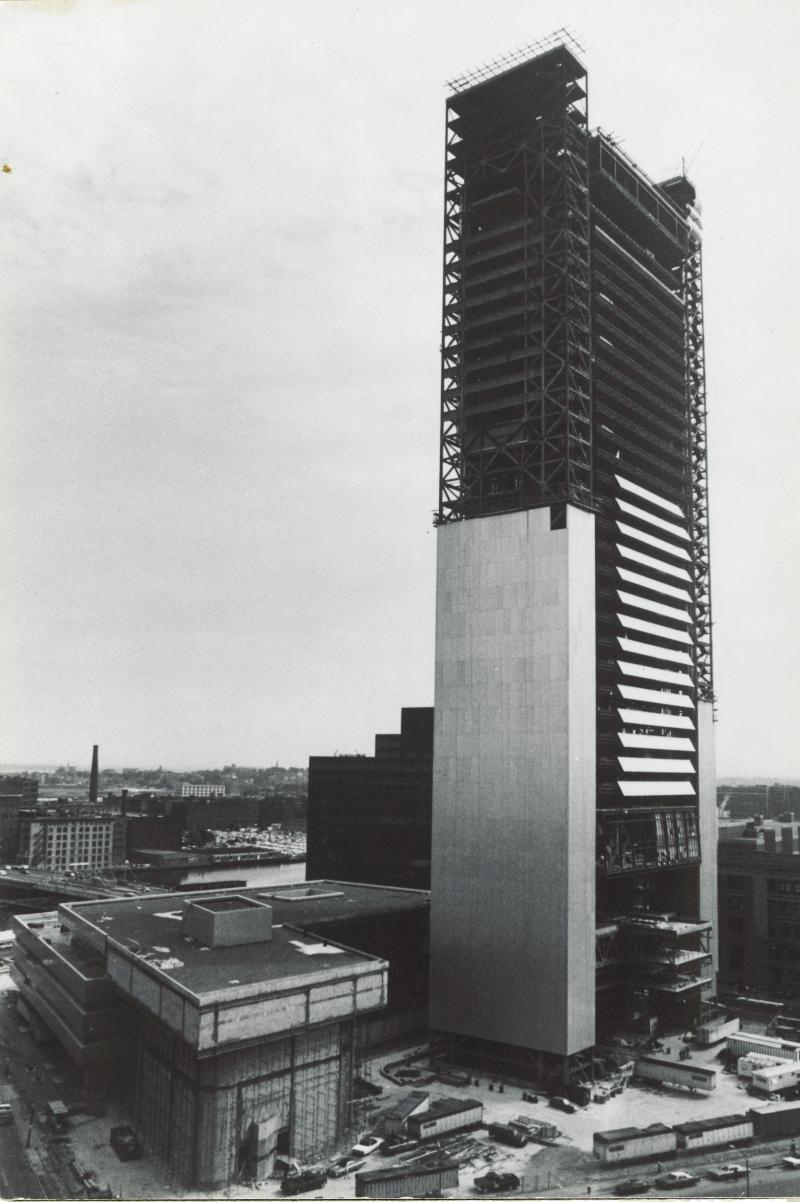
absolutely love that building. one of my faves, as well (and Stubbins' favorite of his implemented designs fwiw).

Charlie_mta
Senior Member
- Joined
- Jul 15, 2006
- Messages
- 5,261
- Reaction score
- 8,027
Wow, such an industrial cityscape. Love it!
Charlie_mta
Senior Member
- Joined
- Jul 15, 2006
- Messages
- 5,261
- Reaction score
- 8,027
Good shot of the Analex Building in that first photoHotel Manger, then Hotel Madison, then Hotel Demolished. Honestly scrolling through this is painful but I stumbled onto one pic and jumped down a quick rabbit hole.
View attachment 70597
www.facebook.com