JohnAKeith
Senior Member
- Joined
- Dec 24, 2008
- Messages
- 4,372
- Reaction score
- 117
I've never liked the idea of the government holding housing developers hostage. Is it illegal? I've always thought so.


Every regulation ever written falls somewhere on a slippery slope, and what we as a society must do is draw the line of when laws or regulations go "too far" and when they don't.“There are an infinite number of ways in which the government restricts the use of property,” Nikolas Bowie, a professor of constitutional law at Harvard Law School, said in an interview. “It’s hard to find a regulation that you can’t describe as a seizure.” If affordable housing requirements are unconstitutional, what about open space requirements, or public access easements? What about the Americans With Disabilities Act, which generally requires that 5 percent of any new housing development be set aside as accessible?
Are there legally enforceable price controls in Massachusetts as simple as these? I don't know of any.Also very much not a lawyer, so following how this plays out is fascinating. My view is it's not really any different than rent control or price fixing which, while I agree they're bad policy are legal. If you put a price cap on bread, that means anyone building a bakery has to sell their product, the bread, at that rate. Similarly, this is saying that the developer's product (housing) has to be sold at a set rate.
Are there legally enforceable price controls in Massachusetts as simple as these? I don't know of any.
The reason that many housing authorities are below Faircloth limits is that they cannot pull together sufficient funding to replace/rehabilitate those units without also going over the faircloth. Bidens HUD tried to come up with some new models, but BHA was not seemingly positioned to meet the opportunity.Boston is about 3,000 units below its Faircloth Limit (12,086 units). With about 25% of that cap still "on the table," Faircloth really isn't relevant to the current market.
I don't have any clear answer for you, but I think your question is really interesting. I've got some scattered thoughts.View attachment 70629
Braintree, MA - 11 mi from downtown Boston - Station opened 1980
Vs.
View attachment 70630
Wheaton-Glenmont, MD - 11 mi from downtown DC - Station opened 1990 (it's underneath the intersection)
This is one example of two particularly analogous situations, but almost everywhere you look DC completely gaps Boston in all measures of development, whether you're talking architectural quality, quantity of housing, height, complete street grids, park-and-ride garage sizes, etc.
Does anyone understand what specific mechanisms/policies/economic realities are under the hood that power outcomes like this? How exactly does DC do so much better with TOD than Boston?
I don't have any clear answer for you, but I think your question is really interesting. I've got some scattered thoughts.
First, DC really has been a lot better about TOD than maybe any other region in the country. I've seen planning documents from the early days of their subway system (1970's-ish) where TOD was a really explicit goal. I couldn't say why they latched onto that idea before a lot of other places did, but they did, and they kept at it. Poking around, I found this really interesting planning document for how DC area stations should be designed, and it really focuses on place-making and pedestrian access (mostly). WMATA builds that into the land they control and really push local governments to expand that around the station. I'm curious what leverage WMATA has to actually get that done.
Massachusetts was doing TOD before that was even a term, from the advent of railroads through the mid-20th century. So many of our towns and neighborhoods sprung up around rail stops and streetcars. Since you're looking at Braintree station, that was sadly from a period where the mindset was more about building park-and-rides. Once the garages and access roads are built, it's hard to then change that into a pedestrian-friendly area. The state has tried some things to get more built around stations, like the MBTA Communities Act. The results of that law are... messy. There is broad compliance with the law, but some high-profile objectors. Some towns are complying with the letter of the law while still blocking housing, but many towns are actually allowing new development. It will create new homes, but not a ton. It's a decent first step, but a long way to go.
Second, if you want to know why there aren't taller apartment buildings around Braintree, it's because that's illegal. (Sorry, I know this is obvious, but bears repeating.) The area around the station is mostly zoned for single-family detached housing.
There's some land zoned for commercial space, but there are height limits, thus box stores and strip malls. I don't know if they changed some of this recently, but that's been the law for decades.
Third, it's worth remembering that developing a new area like that can happen over decades. Wheaton station you point to is 35 years old. and bunch of the new development you're pointing to didn't exist even 10 years ago. The area still has a giant suburban-style mall with vast parking lots. Now there might be a critical mass of density that new developments spring up faster. Who knows? And looking at that kind of time scale, the Boston area is absolutely filling in decent development around a bunch of stations. To varying degrees there's: Lechmere, Jackson Square, Alewife, North Quincy, Assembly(!!). It's happening here, but maybe hard to notice at times.
And last, again, I think you're right that DC often does TOD better. But also, I think you're a little selective in the stations you're looking at. DC also has built kind of crap stations, and the Boston region has made a few really good ones. Assembly is probably the best around here. And, just as an example, here's Cheverly Park, MD compared to Alewife (both about 5 miles from downtown)
View attachment 70642
View attachment 70643
 www.mapc.org

 www.bostonglobe.com
As state leaders grapple with the state’s seemingly intractable housing and affordability crisis, Governor Maura Healey is losing yet another Cabinet member in Housing Secretary Edward M. Augustus Jr., who is leaving for a job in banking, state officials said Thursday.
In his place, Healey said she is appointing Juana Matias, a former Democratic state representative, congressional candidate, and regional administrator for the US Department of Housing and Urban Development under the Biden administration.
[...]
Matias’s appointment marks a shift at the top of the state housing office. During his time in Worcester, Augustus oversaw a period of redevelopment in the city’s downtown, including the transformation of the Worcester County Courthouse into 117 mixed-use apartments, as well as a number of mixed-use developments around the Polar Park baseball field. He brought that same pro-growth philosophy to the top housing job in the state.
Matias, meanwhile, has focused more on affordable housing for low- and middle-income residents, overseeing the distribution of housing assistance vouchers and public housing programs in her role as HUD’s regional administrator for New England.

I’m glad you added the row house bit at the end because as I was reading your post I was going to reply with the same thing. Not only does dc do TOD better than boston, but what gets built is much higher quality as well. You mentioned the row houses, dc puts them up by the thousands. Alexandria has brand new neighborhoods that look like the south end. On top of that sure you get the normal crappy fiber cement panel 5 over 1’s here and there, but theyre also throwing up neo art deco mid rises and everything in between at random TOD stops well outside downtown.Thanks for linking that planning doc, pretty interesting read.
Cheverly station is just about as bad as it gets, though. 2nd lowest ridership station in the whole WMATA system, and it's basically just a convenient station location on the way to a more important terminus at New Carrollton. Not really fair to compare it to Alewife, a terminus handpicked for TOD.
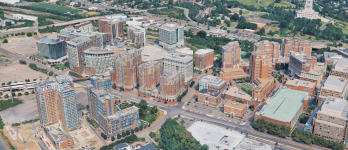
And if you're going to cite TOD like Assembly or Lechmere (Jackson Sq. and North Quincy are laughable), its only fair to compare to equivalents in DC, all further from downtown:
Ballston
View attachment 70646
Courthouse
View attachment 70647
Crystal City
View attachment 70648
Carlyle
View attachment 70649
^ all areas surrounded by single family homes and sprawl that would suggest tough battles against NIMBYs, and yet high rise clusters prevail
And even if we go with the excuse that Braintree was developed as a park-and-ride, it STILL doesn't hold a candle to DC park-and-rides like:
Huntington
View attachment 70651
Franconia-Springfield
View attachment 70652
Herndon
View attachment 70653
Quincy Adams is maybe the ONLY park-and-ride in the whole system that can compare to these behemoths.
There's more to this story than just having open land. Even when we have had opportunities for greenfield development like in South Weymouth, the quality of outcomes just doesn't compare:
View attachment 70655View attachment 70654
NoVa has this great historically-styled rowhouse form that has maxed out asethetic and density value while still appealing to the suburban home buyer and I wish we copied it more here. The grey boxes have gotten old.
I would personally love to see a study on how much IZ requirements affect development. It's hard to get accurate numbers because things vary municipality-to-municipality, but it seems like DC and other high-development, density-focused metros like Minneapolis and Seattle all have MUCH lower IZ reqs than Boston. It would actually be a relief to know that those policies in particular are the main culprit for our development woes, because its such a simple policy fix. n
This is why I'm going to vote yes on this ballot question. The 1/2, 1, or 2 acre zoning requirements in cities around Boston should not exist. I'm looking at the zoning map for Newton right now, and their single family lot area requirements are in the 10,000 to 25,000 SF range. This includes parcels very close to Green Line stops. Ideally the YIMBY bill passes to, and allows for a lot more density, but I'll take any improvement to our zoning codes that I can get.Idk, is traffic even real? I grew up in Dover and I’m there all the time. It’s gotten significantly more denser with that typology you describe. People complain about the traffic but I’ve literally never had an issue. The population density or politics don’t support transit but you can technically build to the sky without building a single bus or train, it just sucks mentally and makes people who are more discerning eventually move to Boston. And yes if we were centrally planning we would build up city centers and let suburbs die on the vine, but we can’t do that, so fuck it, densify the suburbs for those who want them.
Yeah, I have some thoughts. Primarily, I think it's great and I want it to pass. This is overwhelmingly the right thing to do. But you do point to a general problem I've been thinking about. In no particular order:Anyone have thoughts on the Legalize Starter Homes ballot initiative?
As much as I'd like to be in favor of more open zoning policy, it feels like this will not lead to conscious development. 5000sqft lots (~8 units/acre) are pretty much right in that sweet spot for maximizing pain: not dense enough to support quality transit but dense enough to cause lots of traffic. If you think about what kind of parcels might get subdivided and redeveloped as these starter homes, it would most likely be those larger 0.5 acre / 1 acre parcels in exurban sprawl like Bedford or Dover (i.e. places with no downtown core or commuter rail station with zero hope of enough density to ever become walkable/bikeable for local trips...). The only positive thing it could do is absorb demand and bring down prices, but at the cost of leaving underutilized parcels in the urban core undeveloped and increasing per capita car usage.
So even though I'm super pro-housing, part of me feels compelled to vote against such poorly thought-out policy.
The ONLY way I could see it working out is if it could synergize with the YIMBY bill going through the Senate. Combined, that could then make it possible to build 4 units on 5000sqft lots everywhere in the state. That would be powerful, but is just so unlikely to come to fruition.