Are one-way streets the reason for 20th-century urban decay and why

JohnAKeith

Senior Member
Joined
Dec 24, 2008
Messages
4,378
Reaction score
123
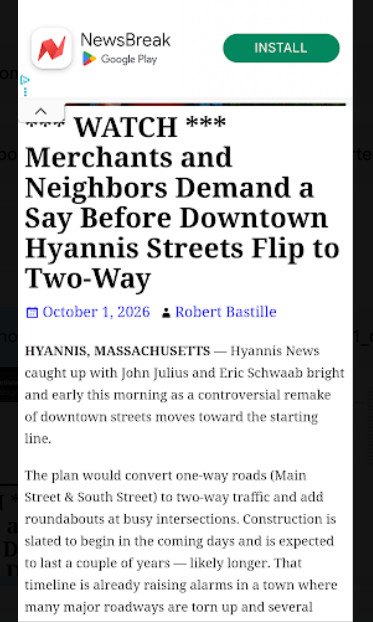
I'm reading that Hyannis is going to return to two-way traffic on Main Street and another one of the major streets going through the neighborhood (which is, actually, in Barnstable). I think I read somewhere that turning two-way streets into one-way streets was a major reason that cities suffered in the mid-to-late 20th-century. I'm thinking Lynn, maybe Concord NH, probably a lot of other cities that thought it was a good way to increase traffic flows but ended up worsening the situation.

1790875044213.png
 
Urban sprawl emptying out the downtown tax bases was the biggest reason for urban decline. Look at st louis as an example its city population went from 850,000 in 1950 to 280,000 today. Most of the population emptied out into the separate st louis county suburbs which went from 400,000 people in 1950 to 990,000 people today. So the total metro area population barely grew going from 1,250,000 people to 1,270,000, yet the county still had to double in size while the city population dropped by about a third. So now you end up with basically the same amount of people but theyre spread across a muuuuch larger amount of land. So for 70 years theyve been building new infrastructure to support the spreading suburbs, new highways, electrical, water, sewer…etc yet the population isnt actually growing, meaning the tax base isnt growing either, its just spreading out over a much larger area. That same population is now responsible for so much more infrastructure than before.

It makes absolutely no sense and is completely asinine fiscally, but this was repeated to different degrees across almost every city in the country. Even the cities that are doing good today like boston still havent recovered yet to their previous peak population in the mid 20th century, yet the cities and towns in the metro area are the biggest theyve ever been. Boston is nowhere near st louis with this problem, but its touched every city.

If you look at detroit from satellite view its grown like 4x in size even though the downtown population has completely collapsed. Its starting to make a comeback right now, but it has a long hill to climb. The best thing we can do is invest in transit and transit oriented development and try to make use of all of this existing infrastructure which was built to sustain much larger populations instead of just adding more and more unsustainable sprawl to the edges of cities. Also the way the roads are laid out in suburban sprawl makes them super inefficient for walking and the lack of connections makes it very hard to grow over time like youd see with a street grid. Basically once theyre laid down its very hard to change and retrofit in the future so you cant even fix the mistakes even if you want to.

 
I'm reading that Hyannis is going to return to two-way traffic on Main Street and another one of the major streets going through the neighborhood (which is, actually, in Barnstable). I think I read somewhere that turning two-way streets into one-way streets was a major reason that cities suffered in the mid-to-late 20th-century. I'm thinking Lynn, maybe Concord NH, probably a lot of other cities that thought it was a good way to increase traffic flows but ended up worsening the situation.

View attachment 76040
Converting a one-way into a two-way street is a traffic calming measure, slowing traffic down and thus increasing safety for all modes. Also, such a conversion makes a street look less like a suburban highway, and more like a pedestrian and bicycle friendly urban street, providing a visual sense that cars are not king, encouraging sidewalk cafes, outdoor dining in front of restaurants and bars, and just generally a more eclectic urban feel for a street. I've personally seen a lot of downtowns convert their streets to two-way, which has helped reinvigorate the downtowns.
 
slowing traffic down and thus increasing safety for all modes.
That's not true in every case - though - a lot of one-way street systems were built as highways for travel from white-flight suburbs to the amenities and opportunities of historic downtowns. That windshield perspective seems to be a bigger problem than anything else.

A good counterpoint would be all of the British Isles and continent's one-way systems which are notably safer and slower than many US one-way streets converted to two-way operation.
 

Back
Top