General MBTA Topics (Multi Modal, Budget, MassDOT)

An Act to allow municipalities to finance expanded transit options​

“194th Legislature (2025-2026)Introduced by Michelle Ciccolo

Allows Massachusetts municipalities to independently finance expanded public transit through local revenue mechanisms, enabling faster service improvements but risking unequal access across communities.

Legislative bill overview​

HD 1510 authorizes Massachusetts municipalities to establish financing mechanisms for expanded public transit services beyond what state and federal funding currently supports. The bill grants local governments additional tools to independently fund transit infrastructure and service expansion through local revenue sources. This enables cities and towns to pursue transit improvements without waiting for state or federal appropriations.

Why is this important​

Many Massachusetts communities lack adequate public transportation, creating barriers to employment, education, and healthcare access—particularly in lower-income areas. By enabling local financing authority, the bill could accelerate transit improvements in underserved regions, reduce traffic congestion, and support environmental goals. However, it also places financial responsibility on municipalities with varying fiscal capacities, potentially widening service disparities between wealthy and struggling communities.”


An Act to allow municipalities to finance expanded transit options​

“194th Legislature (2025-2026)Introduced by Michelle Ciccolo

Allows Massachusetts municipalities to independently finance expanded public transit through local revenue mechanisms, enabling faster service improvements but risking unequal access across communities.


The bill you posted reminded me of S.2009 (An Act relative to regional transportation ballot initiatives), another way to let a municipality fund some transit improvements. It seems like both bills haven't really progressed.


According to an announcement from the governor's office on Friday, the FTA issued a letter formally closing the final special directive, returning safety oversight of the MBTA to the DPU, on Sept. 11.
The FTA found in 2022 that the DPU was under-resourced and unable to provide safety oversight. Subsequently, the DPU created a Rail Transit Safety Division that now employs investigators, engineers, data analysts and lawyers. State officials said the division now conducts independent inspections of MBTA trains and facilities.
"As we take this moment to celebrate this achievement, we are grateful to showcase how important investing in our workforce, tracks, vehicles, and infrastructure is to ensuring the MBTA is the world-class system our region can be proud of," Interim Secretary of Transportation and MBTA General Manager Phillip Eng said in a statement.
"Today, the T is safer, more reliable, and more affordable for the riders who use it every day," Gov. Maura Healey said in a statement.
 

Globe article highlighting how the new Green Line C branch stations will not be future-proofed for 14 inch high/225ft long platforms, likely requiring significant amounts of the current construction to be demolished and rebuilt in 10-15 years.
 

Globe article highlighting how the new Green Line C branch stations will not be future-proofed for 14 inch high/225ft long platforms, likely requiring significant amounts of the current construction to be demolished and rebuilt in 10-15 years.
Quite the interesting mischaracterization of the T the Globe went with here. This initial platform height raising does serve to make boarding accessible with the built-in ramps on the trains. They can't raise them to the full level boarding height because of the way the existing trains' doors open. The stations being rebuilt to the 8" height are completely inaccessible by wheelchairs today, and doing this work would make them all capable of being accessible with both the old and new fleets during the next half decade of transition period. After which they will still be fully accessible via the ramps just not completely level so as to not require deploying the ramps which adds ~30sec to the stop. Pretty egregious of the Globe to mislead riders into thinking the work the T is doing needs to be "undone" and wont be accessible by literally calling the new platforms "incompatible" with the new trains when they will in fact be fully compatible for accessible boarding. Calling it "poor planning" when its making all but 2 of the 70 Green Line stations fully ADA accessibly in less than 5 years. The C branch itself is aggressively pursuing a 12month timeline for 7 stations, which was the decision of Brookline to accomplish as fast as possible even if requiring extended shut downs.
This is some pretty bad reporting that can genuinely harm the livelihood of people, because like the person featured in the article, someone could completely move their life around thinking that they wont be able to access the T with their various assisted mobility devices over the next 10-15 years when the new trains arrive but the opposite is the case.
 

Globe article highlighting how the new Green Line C branch stations will not be future-proofed for 14 inch high/225ft long platforms, likely requiring significant amounts of the current construction to be demolished and rebuilt in 10-15 years.
It’s also not going to be a full demo - the current designs are 100% designed with the future condition in mind. They’ll basically lengthen the platform on one side, pour an extra 6” of concrete on the whole thing, and call it a day. Not trivial, but not a complete reconstruction.
Also, the T is only doing this intermediate step instead of waiting until the final condition is buildable because they did work at these platforms that accidentally un-grandfathered them from their ADA exemption, and the FTA is both mandating and funding the bulk of this work. If they were paying for this and choosing to do this themselves, it would be a bit of a waste - but they’re not.
 
It’s also not going to be a full demo - the current designs are 100% designed with the future condition in mind. They’ll basically lengthen the platform on one side, pour an extra 6” of concrete on the whole thing, and call it a day. Not trivial, but not a complete reconstruction.
I can tell you firsthand that they're not, although it's mainly the Town of Brookline's fault and not the MBTA's. Some of the station access ramps will need to be rebuilt because they won't be ADA compliant with 14 inch high platforms, and in some cases electrical equipment is being placed where those ramp rebuilds would need to happen because Brookline was stingy with its grants of location.
 
I can tell you firsthand that they're not, although it's mainly the Town of Brookline's fault and not the MBTA's. Some of the station access ramps will need to be rebuilt because they won't be ADA compliant with 14 inch high platforms, and in some cases electrical equipment is being placed where those ramp rebuilds would need to happen because Brookline was stingy with its grants of location.
This is crazy. Do you have some (publicly available) sources for this? It shouldn't be that hard to design the platforms so they can be raised a few inches later, right?

The GLX stations were built with this kind of future proofing, right?
 
This is crazy. Do you have some (publicly available) sources for this? It shouldn't be that hard to design the platforms so they can be raised a few inches later, right?
I've seen the design plans, that's my source and unfortunately I can't elaborate further. You would be correct that it's not hard to design the platforms that way, they were originally designed that way and then changed to the current design to have a smaller footprint. I believe this happened at a similar time as the change to 140' platforms instead of 225'.
 
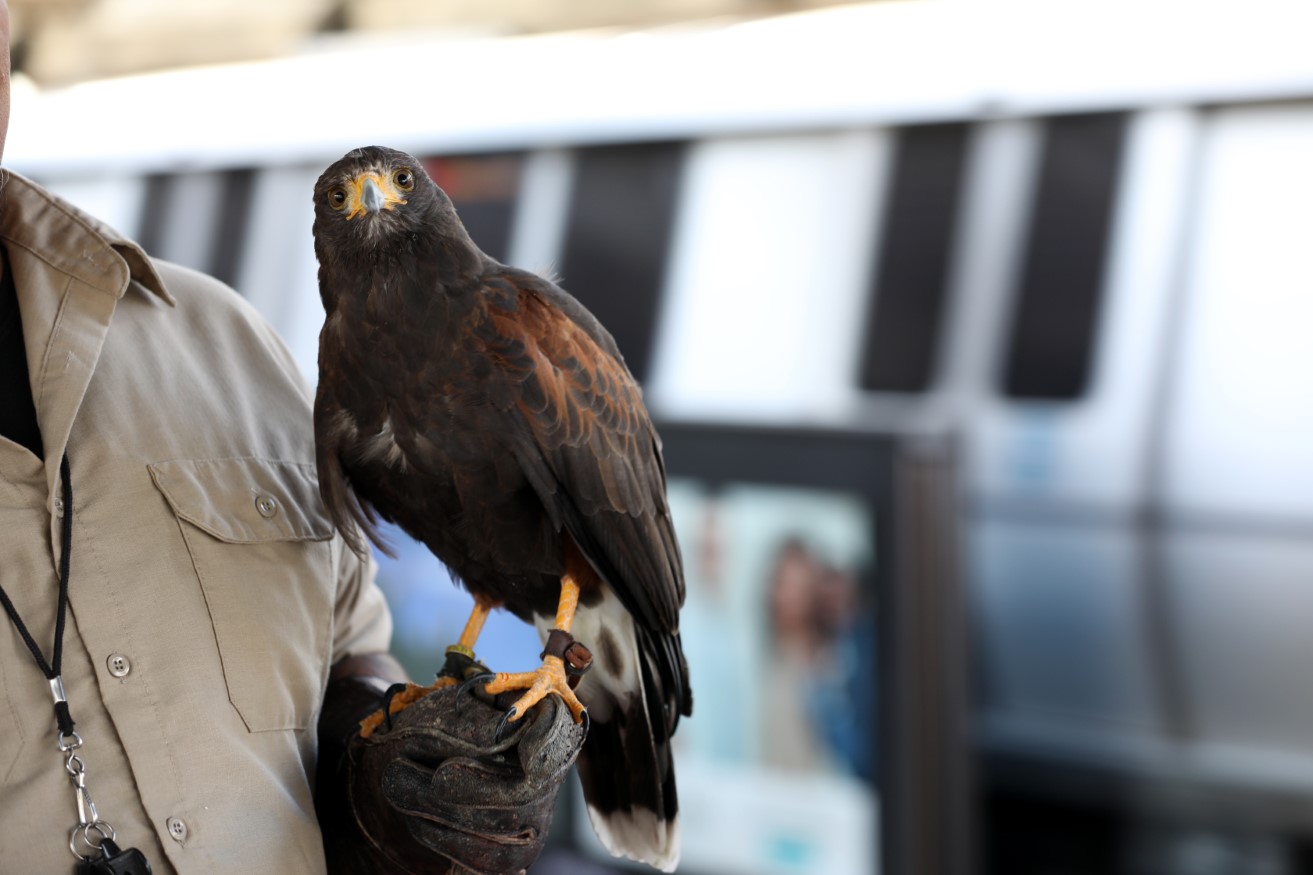
The MBTA is shopping for falconry professionals that could help the agency scare away “nuisance birds” that roost in its stations, feast on commuters’ garbage, and spatter platforms with their excreta. In August, the T issued a “request for information” from falconry experts who could provide pest control services in its stations and maintenance facilities.
“Pigeons, seagulls, starlings, and other invasive and nuisance birds are drawn to MBTA stations and facilities in search of food and shelter,” according to the MBTA’s solicitation. “Bird droppings can carry diseases, corrode critical infrastructure, and create unsanitary conditions for the public and MBTA employees.”
[...]
A T spokesperson told StreetsblogMASS that using trained birds of prey to scare away other birds is a common form of pigeon control. They noted that the Bay Area Rapid Transit (BART) system in California has been using raptors to deter pigeons from nesting in its stations since 2022. A BART webpage about the program claims that it’s a bloodless intervention.
[...]
The T is also piloting a program to capture live pigeons in its stations for removal. A T spokesperson told StreetsblogMASS that the trapping program had captured 218 birds as of September 4. The T hands off trapped pigeons to the federal USDA Wildlife Service.
Responses to the MBTA’s birds of prey solicitation were due earlier this month. A T spokesperson confirmed that there has been interest, and based on the responses, the T will next consider issuing a formal “request for proposals” for a pilot program.
 
Story time. The new lechmere station has bird netting under the huge I-beams to prevent birds nesting there. A year later, the contractor put up the timer signs for the bus loop. Pretty good, right? In order to do it they cut the netting away where they had to put up the signs and just let it hang open.

The birds got in pretty much instantly... there was even a period where a bird clearly got stuck and panicked as it was for a while completely littered with feathers on the top half of the netting. Poor bird :(
 
The Green Line will have another mass shutdown covering nearly most of the period in between after Thanksgiving and before Christmas Eve for the 3rd or 4th consecutive year in a row! Every single year recently the post-Thanksgiving holiday shopping season pre-Christmas Eve, the Green Line has been unavailable for service!

Source: zombie site

1791227299825.png
 
Lotta work to finally replace a signal system from 1946 with one from the 2020s as well as a tunnel from the 1890s-1920s fit a 2020s train along with its weight, power, and accessibility requirements. And the damn labor laws mean the days are gone where you can just send a bunch of Italians and Irish down there to do it nonstop over a week, whatever happens, happens.
 
But why not just do 1 ultra long 6 month shutdown instead of the nonsense the T does right now? This hybrid “shutdown week” then “10 days of train service” then “shutdown week” again then “10 more days of train service” then “shutdown week” again; is far far more disruptive. It would be much less disruptive to do 1 single ultra long 4-6 month shutdown then forget about shutdowns for the next 19 months - 2 years.

You would just know the subway is “closed for the entire semester”; that’s much easier; way easier to plan for. Versus: “random weeklong shutdown then 10 days train service then another weeklong shutdown then 10 more days of train service then weeklong shutdown again”. Now you have to carefully time your doctor appointments; social hangouts, around random non-shutdown weeks.

Planning for “the subway is closed for the entire semester” would be much much easier and much less disruptive then the nonsense the T does right now.
 
I noticed that the wrap up PR for the latest shutdown included a tiny bit more detail than prior ones. They said things like “20 miles of cable” and 40 miles between the two shutdowns out of 72 total. That’s enough detail to do the math on two more shutdowns to cover the cable pulling.

If someone from the T is reading this: Good work. Now please put together a Gantt chart with some of the dependencies.
My current unconfirmed unverified guesstimate is that the T is gonna do another GL shutdown Nov. 7th through Nov. 15th; then another GL shutdown Dec. 5th through Dec 13th.

While the T has no announcement; I'm just planning around the possibility idea that the Green Line might be closed altogether on those days.

The T refuses to tell us early (only 2-3 weeks notice, too little time to plan ahead).
 

Back
Top