We have an order for 65 New Flyer "Enhanced Electric Hybrid Bus" incoming, from slides for the MBTA Audit and Finance Subcommittee meeting tomorrow (October 15th):

You are using an out of date browser. It may not display this or other websites correctly.
You should upgrade or use an alternative browser.
You should upgrade or use an alternative browser.
MBTA Buses & Infrastructure
- Thread starter Arlington
- Start date

BosMaineiac
Active Member
- Joined
- Nov 25, 2020
- Messages
- 258
- Reaction score
- 465
Ribbon-cutting next TuesdayQuincy
View attachment 76278

MBTA Open Discussion | I walk by the new Quincy bus garage maybe once a week and woah it’s looking so much more complete each time . | Facebook
I walk by the new Quincy bus garage maybe once a week and woah it’s looking so much more complete each time .www.facebook.com

Looking further into the slides these are probably just regular hybrid buses, as the previous 2022-2023 XDE40s are described in slide 2 as "Enhanced Electric Hybrid buses" as well.
Also curious about why they want to replace the recently-rebuilt 2014-2015 XDE40s so quickly when there's no replacements slated for the even older 2010 DE60LFR fleet.
Edit: on one hand this seems to be a backtrack from doing full electrification despite the state 2040 zero-emission bus mandate; on the other hand, in late 2025 the MBTA won a $78.6 million federal grant to buy hybrid buses, and the Trump administration seems to have shifted all federal grants away from battery-electric buses.
Last edited:
Realistically, the Ts bus facilities aren't keeping up with their electrification hopes. Until they have the facilities to do so, I don't see that they have many options but to buy new hybrid buses to stock their legacy bus garages. And to be clear, I think diesel hybrid buses stick around for a while yet - newer hybrid buses will just be continually displaced to older garages as new garages equipped for BEBs and those buses come online. Arborway is next and that isn't supposed to open until 2031, so something will need to be bought to run out of Cabot, Charlestown, Albany etc.Looking further into the slides these are probably just regular hybrid buses, as the previous 2022-2023 XDE40s are described in slide 2 as "Enhanced Electric Hybrid buses" as well.
Also curious about why they want to replace the recently-rebuilt 2014-2015 XDE40s so quickly when there's no replacements slated for the even older 2010 DE60LFR fleet.
Edit: on one hand this seems to be a backtrack from doing full electrification despite the state 2040 zero-emission bus mandate; on the other hand, in late 2025 the MBTA won a $78.6 million federal grant to buy hybrid buses, and the Trump administration seems to have shifted all federal grants away from battery-electric buses.
From what I can tell, those 2014/15 buses, despite their rebuilds in 2022, weren't in great shape at rebuild time; that was already "early" for rebuilds at an agency that usually pushes buses closer to year 10 before even contracting for their rebuilds, rebuilding them after closer to 11-12 years in service, which is more consistent with the FTAs guidance for rebuilds. Rebuilds at 8 years old, which would be about 3-4 years early isn't a great sign for their condition at the time, which were apparently necessary to get them to the FTA grant funding minimum useful life benchmark of 12 years. In 2025, the T described it as a "challenging" overhaul with lots of hidden damage when they optioned the rebuild of the 2016/17 fleet. Per NETransit, despite their rebuild contract being awarded 4 years ago and which was supposed to be complete in 2023, there's still a bus out at Midwest with issues. I wouldn't be surprised if the T decided that fleet was due for replacement, even if they're relatively young, simply because that particular configuration is apparently an earlier hybrid configuration which is just problematic, especially since they'll still be at an appropriate replacement age by the time this order is slated for delivery in 2028.
My understanding is that the 2010 DE60 fleet is also freshly back from (apparently) a more successful rebuild program that only wrapped up like, 3-4 years ago. If they lasted the full 12 years before their rebuilds that probably bought them an extra 7-8 years, their replacement order probably wouldn't be for a couple more years yet, since I believe replacement more typically happens closer to the 20 year mark.
Last edited:

alewife
New member
- Joined
- Dec 19, 2023
- Messages
- 67
- Reaction score
- 234
It's definitely true that the facilities aren't keeping up with electrification hopes—as I recall, the plan is to replace the current "yellow" 60-footer fleet for the 28 and 39 with new BEB artics out of the new Arborway garage, plus some expansion to convert the 32 to artics as well. (I don't know if the plan is to have Southampton just serve the Silver Line at that point or to use the freed-up capacity to convert additional routes to 60-footers.) The other major problem is that New Flyer, which is basically remaining Buy America-compliant builder of 60-foot buses since NovaBus left the US market a few years ago, has discontinued the XDE60 hybrid model due to a "lack of certified engine and hybrid drive combinations." If the T wants new artics, their options are either to get BEBs, which they don't yet have facilities to support, or buy straight diesel or CNG buses. I believe they've formally committed to no longer buy straight diesel buses, and they've been moving away from CNG for a while now.
What's weirder to me about this order is that there's seemingly no plan for full replacement of the 155-bus 2008 D40LF fleet. The bulk of that fleet is at Quincy (93 buses) and is set to be replaced by the 88 4300-series BEBs once the new garage opens, but there are still 21 at Albany, 19 at Lynn, and 18 in "contingency fleet" service at Southampton, plus 2 currently on loan to Paul Revere for the Winthrop routes while the 2017 hybrids normally assigned there go through the current overhaul program and 2 out of service. These buses got overhauled in 2017-2020 but that's nearly a decade ago at this point, plus they're the last remaining straight diesels on the roster.
I'm also not so sure about the success of the overhaul program for the 2010 DE60LFRs, since I frequently see both the "contingency fleet" D40LFs and the 1300-series "extended range" hybrids intended for the Silver Line tunnel pinch hitting on the 39. But it could also be declining reliability of the 2016-2017 XDE60 fleet, which is now a decade old and hasn't been overhauled. Either way, the situation isn't looking great for the 60-footer fleet for the next few years until the new Arborway garage can come on line.
F-Line to Dudley
Superstar
- Joined
- Nov 2, 2010
- Messages
- 10,160
- Reaction score
- 13,106
New Flyer has had an absolutely abysmal run on reliability of their product for the last 10 years. There's a reason why Reddit has such a vocal contingent of D40LF fanboys; the fit-and-finish quality on the XDE40's is subpar and they're breaking down too often compared to the older stuff. I don't know what changed with New Flyer management over the last 15 years, but they went from an impeccably high-quality operation to total slopfest in no time flat and that's why their much better-regarded older product keeps sticking around while their newer stuff has degenerated into a band-aid fest. Not just at the T; many other agencies have gotten lousy results with them too. If there weren't such scandalously few Buy America-qualified builders left with any kind of manufacturing scale, the T probably would've entertained switching vendors by now.
RandomWalk
Senior Member
- Joined
- Feb 2, 2014
- Messages
- 4,063
- Reaction score
- 7,886
Were the 1400s originally an option on a CTDOT order?
F-Line to Dudley
Superstar
- Joined
- Nov 2, 2010
- Messages
- 10,160
- Reaction score
- 13,106
From a T employee on Reddit (from a CRRC Red Line cars thread, which is what the first paragraph in the post was about...bus-specific content highlighted):
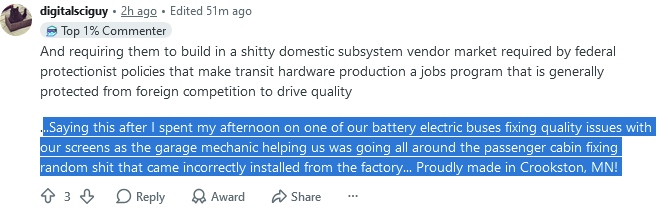
Yeah...New Flyer product is garbage nowadays.
Yeah...New Flyer product is garbage nowadays.

themissinglink
Senior Member
- Joined
- Jan 13, 2018
- Messages
- 2,245
- Reaction score
- 6,465

In rare move, Boston City Council votes to subpoena MBTA leader Phil Eng over Blue Hill Avenue project - The Boston Globe
The Boston City Council voted Thursday to subpoena MBTA general manager Phil Eng to testify in a council hearing about the proposed $164 million redesign of Blue Hill Avenue.
 www.bostonglobe.com
The Boston City Council voted Wednesday to subpoena MBTA general manager Phil Eng to testify in a council hearing about the proposed $164 million redesign of Blue Hill Avenue, exercising a rarely used power in a bid to press Eng publicly about the controversial plan.
City Councilor Miniard Culpepper filed the subpoena order after he charged that Eng and other transportation officials skirted opponents’ questions at four September public hearings about the project, which is being led by the T and Boston Mayor Michelle Wu’s administration. The Dorchester Democrat said Eng then did not show up to a Oct. 14 field hearing he organized.
Culpepper and fellow councilor Brian Worrell have pushed T officials to consider replacing the project with a plan to extend the Orange Line. Eng has said repeatedly that the Blue Hill Avenue redesign does not preclude future discussions about rail expansion, which would likely take several years and millions of dollars to study a new route before shovels ever hit the ground. Eng also previously met with Culpepper and Worrell in June.

Justbuildit
Senior Member
- Joined
- Nov 27, 2022
- Messages
- 1,149
- Reaction score
- 4,031
I wonder if the subpoena was generated by ChatGPT too? These guys are rapidly approaching clown status.
F-Line to Dudley
Superstar
- Joined
- Nov 2, 2010
- Messages
- 10,160
- Reaction score
- 13,106
It's fully in-character for Culpepper, who has been a real fish-out-of-water since joining the Council last year and seems to know fuckall about how government actually works. He's pretty much proven himself to be a reckless idiot, and that might be enough to get him bounced in his first reelection campaign since he didn't exactly win by a lot the first time around. But Worrell's behavior is surprising. He's been around the Council a lot longer, was a bona fide candidate for the most recent Council Prez. election before getting upset in the final voting, and seemed to have career aims at a higher office. Laying waste to a major improvement for his constituents to prop up a bunch of car owners who are largely driving through the district and not actually living there seems like political suicide. He at least used to be smarter than that.Culpepper and Worrell's antics are infuriating. They are not advocating for ideas that benefit the communities that they serve.
themissinglink
Senior Member
- Joined
- Jan 13, 2018
- Messages
- 2,245
- Reaction score
- 6,465
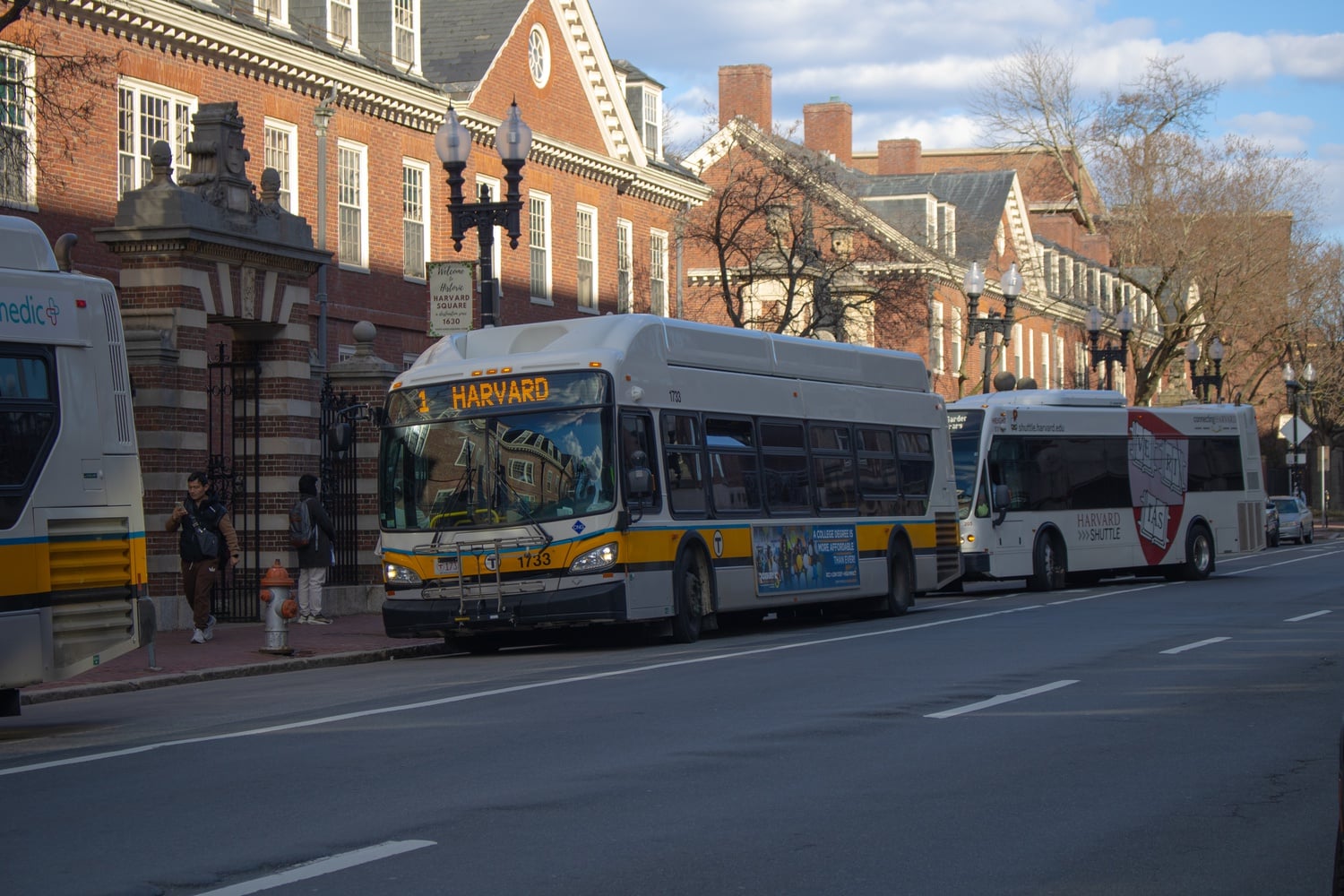
City Council Renews Push to Make Route 1 Bus Fare-Free | The Harvard Crimson
The Cambridge City Council is again pushing to make the Route 1 bus free for riders, unanimously backing an order directing city staff to work with Boston to assess the feasibility of the plan.
The Cambridge City Council is again pushing to make the Route 1 bus free for riders, unanimously backing an order directing city staff to work with Boston to assess the feasibility of the plan.
The Council championed a proposal to make the 1 bus free in 2024, but the MBTA cited budgetary issues and former Assistant City Manager Iram Farooq wrote in a memo to the Council at the time that the proposal was likely unfeasible until fiscal year 2026.
Tuesday’s order — co-sponsored by Councilors Ayah A. Al-Zubi ’23, Jivan G. Sobrinho-Wheeler, Marc C. McGovern, and Vice Mayor Burhan Azeem — tasked City Manager Yi-An Huang ’05 with working with Boston and the MBTA to assess the cost of making Route 1 free, standalone or as a part of Boston’s existing fare-free program.
The policy order asks Huang to request current MBTA ridership data, update the 2024 implementation cost estimate, check federal fare equity rules, and assess the capacity of Boston and the MBTA’s capacity to make Route 1 fare-free. The order also asks Huang to assess whether it may be possible to pilot fare-free rides on Routes 47 and 66 as the city tracks “ridership, speed and cost” for those routes.

Koopzilla24
Active Member
- Joined
- Dec 20, 2022
- Messages
- 471
- Reaction score
- 1,417
I think if they're gonna make the 1 and 66 fare free they gotta increase the bus capacity on a per-trip basis first, which means bendys, which means MBTA garage space for them, which means a different Harvard Sq circulation plan, etc. Based on Transitmatters bus route ridership data the 66 has long surpassed the 28 post-pandemic and the 1 is sitting level with the 28. From personal experience every single trip on the 66 is completely packed thorough almost the entire journey end to end, and the 1 only had brief respite approaching/departing each of the termini. The math on the average 66 weekday works out to over 100 riders per trip, more than justifying trams let alone a 60' bus. The anticipated effect of going fare free, especially on the 1, would be a further increase in riders, so something should most certainly done to address that crowding lest the buses actually experience longer dwell times with only the one additional door for boarding.City Council Renews Push to Make Route 1 Bus Fare-Free | The Harvard Crimson
The Cambridge City Council is again pushing to make the Route 1 bus free for riders, unanimously backing an order directing city staff to work with Boston to assess the feasibility of the plan.www.thecrimson.com
Real problem lies with Harvard Sq turning. I've done that turn onto Dunster and Mt Auburn hundreds of times in a 40' bus no way a bendy is making that. Same with Elliot on JFK without pushing the stop line way back not that drivers follow it. Sending the 1 as a bendy up to loop Flagstaff and come down Brattle Sq to that slip lane onto Mt Auburn should work and give more layover space for the longer buses, but with the 66 I've got no idea and that's the one that needs that capacity far more.
The 1 Bus ridership is wildly strong despite issues with bunching, traffic, and averaging 6mph (about half the speed of a bike). Like how many current uber trips could be replaced by a more efficient corridor. Since there's not enough width to really implement useful bus lanes along with separated bike lanes, I do wonder how feasible it would be to remove general car traffic in one direction (i.e. two-way transitway, one way-only for cars). Maybe southbound only in cambridge (from central square to the bridge), north-bound only in boston, to funnel cars onto storrow/memorial drive and away from the dense surface streets.
Maybe their goals are different than what I would be looking at this for, but if limited dollars are going towards making certain routes fare free (which I'm already iffy on in general) wouldn't it make more sense to focus on the worst performing routes in order to induce more ridership? As people have already stated, the 1 and 66 are both incredibly high ridership as is. Are the minor operational benefits worth it?
JeffDowntown
Senior Member
- Joined
- May 28, 2007
- Messages
- 5,145
- Reaction score
- 4,477
I am not sure the operational benefits of all door boarding on the 1 (my personal experience) would be minor. Dwell time at major transit access stops (and MIT) on the 1 is HUGE.Maybe their goals are different than what I would be looking at this for, but if limited dollars are going towards making certain routes fare free (which I'm already iffy on in general) wouldn't it make more sense to focus on the worst performing routes in order to induce more ridership? As people have already stated, the 1 and 66 are both incredibly high ridership as is. Are the minor operational benefits worth it?
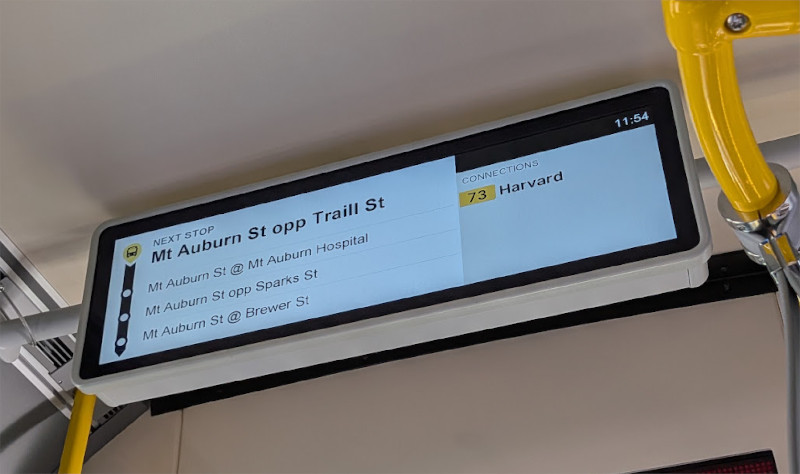
I rode on new electric buses a couple of times in and out of Harvard this morning. They were nice, and they had this really nice wayfinding screen up front. Do any other T buses have this? I don't think I've ever see them on my usual routes.