
You are using an out of date browser. It may not display this or other websites correctly.
You should upgrade or use an alternative browser.
You should upgrade or use an alternative browser.
Boston Alt History
- Thread starter cats10000
- Start date

So, Teddie would have been president?1966:
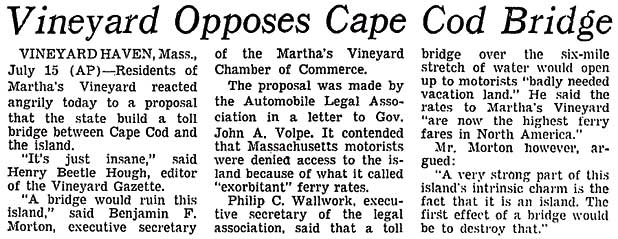
Prolly would've all-blowed-up the west side of Downtown Falmouth to extend the MA 28 expressway to Woods Hole for this thing, too. And widened the everloving shit out of Edgartown-Vineyard Haven Rd. across the island to make it a turnpike-grade extension of the mainline. Then built a wide-ass bridge onto Chappaquiddick and done the same add-a-lane destructing to Chappaquiddick Rd. to make it a state highway all the way to East Beach.


Equilibria
Senior Member
- Joined
- May 6, 2007
- Messages
- 7,244
- Reaction score
- 8,799
Not endorsing that this should have happened (and definitely not that it should happen now), but what if the Commonwealth had pushed for a new airport at the South Weymouth NAS...
Based on AUS - both runways are a bit over 10,000'. The biggest difference from AUS, of course, is that Bergstrom AFB had enough land to accommodate the whole planned airport, while the additional land acquisition required at South Weymouth would have been... extensive.
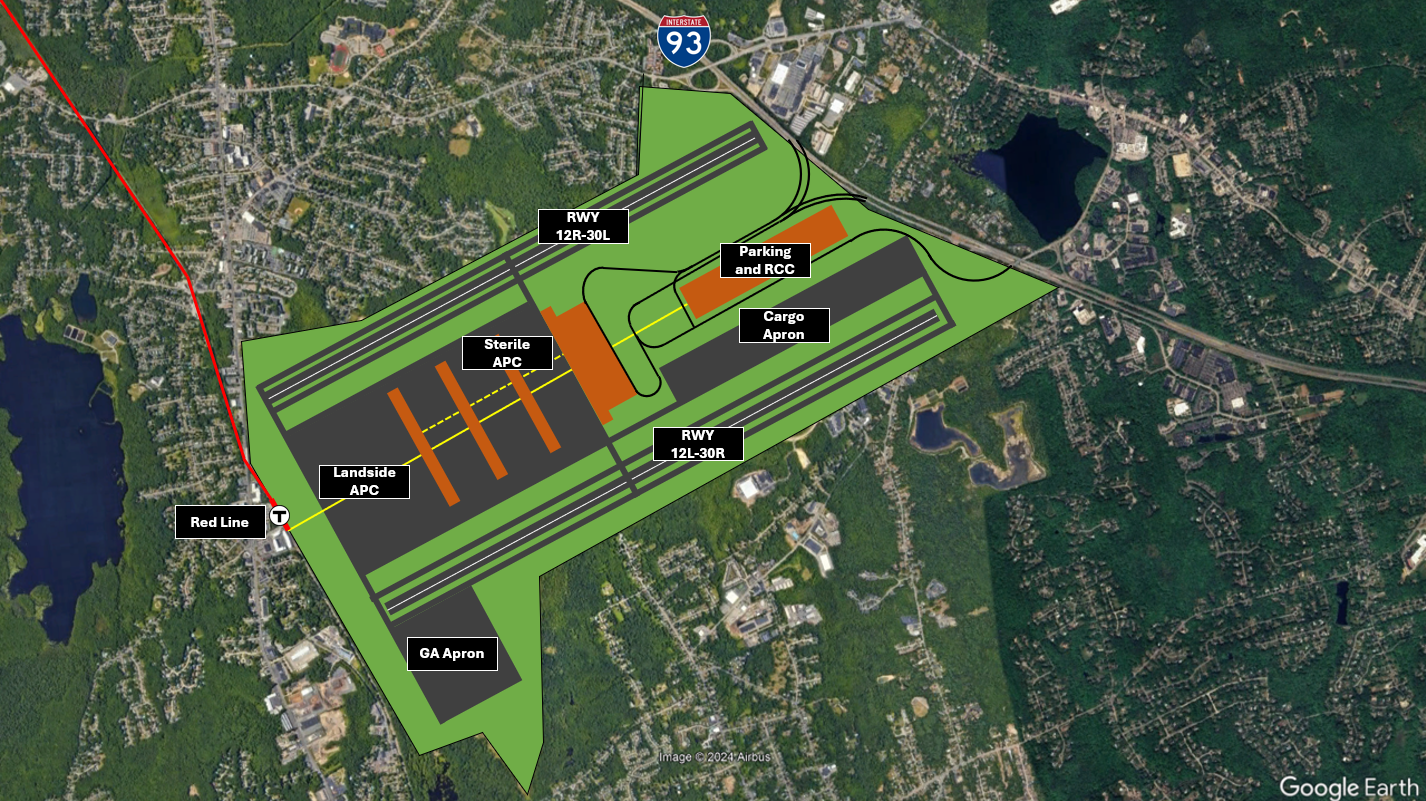
Based on AUS - both runways are a bit over 10,000'. The biggest difference from AUS, of course, is that Bergstrom AFB had enough land to accommodate the whole planned airport, while the additional land acquisition required at South Weymouth would have been... extensive.
JeffDowntown
Senior Member
- Joined
- May 28, 2007
- Messages
- 5,108
- Reaction score
- 4,399
You would likely never have gotten this built as indicated (and not because of NIMBYs, because of the FAA and aircraft safety).Not endorsing that this should have happened (and definitely not that it should happen now), but what if the Commonwealth had pushed for a new airport at the South Weymouth NAS...
Based on AUS - both runways are a bit over 10,000'. The biggest difference from AUS, of course, is that Bergstrom AFB had enough land to accommodate the whole planned airport, while the additional land acquisition required at South Weymouth would have been... extensive.
View attachment 49444
Runway alignments are not selected to fit the land area available. They are selected to align with prevailing wind directions to minimize cross-wind takeoff and landing (dangerous, particularly at the high average wind speeds around Boston). Your runways are moderately close to the secondary wind alignment at Logan (33/15), but you are missing the dominant alignment 22/04.
Equilibria
Senior Member
- Joined
- May 6, 2007
- Messages
- 7,244
- Reaction score
- 8,799
I know that and I thought about looking that up, but it's worth noting that primary wind alignments at Logan might not be the same as inland.You would likely never have gotten this built as indicated (and not because of NIMBYs, because of the FAA and aircraft safety).
Runway alignments are not selected to fit the land area available. They are selected to align with prevailing wind directions to minimize cross-wind takeoff and landing (dangerous, particularly at the high average wind speeds around Boston). Your runways are moderately close to the secondary wind alignment at Logan (33/15), but you are missing the dominant alignment 22/04.
The runway alignment I used perfectly aligns with one of the primary runways at the old NAS. Presumably they chose the prevailing direction at the time. Norwood also has a runway at 10-28.

TheRatmeister
Senior Member
- Joined
- Sep 23, 2023
- Messages
- 1,632
- Reaction score
- 3,341
Wouldn't it make more sense to build the RL in the median of Rt 3? Any airport like this would presumably have been built before RL to Quincy, so it's not like Braintree station needs to be the starting point of the extension.Not endorsing that this should have happened (and definitely not that it should happen now), but what if the Commonwealth had pushed for a new airport at the South Weymouth NAS...
Based on AUS - both runways are a bit over 10,000'. The biggest difference from AUS, of course, is that Bergstrom AFB had enough land to accommodate the whole planned airport, while the additional land acquisition required at South Weymouth would have been... extensive.
View attachment 49444
Equilibria
Senior Member
- Joined
- May 6, 2007
- Messages
- 7,244
- Reaction score
- 8,799
I'd think you'd want the stop in South Weymouth more than a stop along the highway. Generally I think you want to follow rail lines that hit town centers.Wouldn't it make more sense to build the RL in the median of Rt 3? Any airport like this would presumably have been built before RL to Quincy, so it's not like Braintree station needs to be the starting point of the extension.
JeffDowntown
Senior Member
- Joined
- May 28, 2007
- Messages
- 5,108
- Reaction score
- 4,399
Good point, dominant direction could be a bit different inland (although Weymouth is not very far inland!).I know that and I thought about looking that up, but it's worth noting that primary wind alignments at Logan might not be the same as inland.
The runway alignment I used perfectly aligns with one of the primary runways at the old NAS. Presumably they chose the prevailing direction at the time. Norwood also has a runway at 10-28.
So here's a new one from UHub: MIT originally planned to stay in Boston by purchasing the Allston Golf Club, which was situated just to the west of Nickerson Field and right by the train yard. An alumnus who lived in the area wrote to the school to reconsider as he was so fed up with the noise and smoke from the trains, and the school took his advice by moving to Cambridge. Imagine how different things would be if MIT had instead gone forward with the original plan...would they have expanded north across the tracks into what is now Harvard territory, or is there a chance BU and MIT might have combined into one entity?
JeffDowntown
Senior Member
- Joined
- May 28, 2007
- Messages
- 5,108
- Reaction score
- 4,399
At the time there were pretty serious discussions of MIT and Harvard merging.So here's a new one from UHub: MIT originally planned to stay in Boston by purchasing the Allston Golf Club, which was situated just to the west of Nickerson Field and right by the train yard. An alumnus who lived in the area wrote to the school to reconsider as he was so fed up with the noise and smoke from the trains, and the school took his advice by moving to Cambridge. Imagine how different things would be if MIT had instead gone forward with the original plan...would they have expanded north across the tracks into what is now Harvard territory, or is there a chance BU and MIT might have combined into one entity?

Charlie_mta
Senior Member
- Joined
- Jul 15, 2006
- Messages
- 5,297
- Reaction score
- 8,112
Wow, I'm grateful MIT decided to relocate to Cambridge. As a teen in high school in Cambridge, several of my classmates were children of MIT professors, and I really benefitted from knowing them. Also, what would the Kendall Square area be like today without MIT's presence and influence? Most of the vast infusion of money, new construction, businesses, and the excellent rehabbing of old factory buildings would never have happened. History certainly turned out right in this case.So here's a new one from UHub: MIT originally planned to stay in Boston by purchasing the Allston Golf Club, which was situated just to the west of Nickerson Field and right by the train yard. An alumnus who lived in the area wrote to the school to reconsider as he was so fed up with the noise and smoke from the trains, and the school took his advice by moving to Cambridge. Imagine how different things would be if MIT had instead gone forward with the original plan...would they have expanded north across the tracks into what is now Harvard territory, or is there a chance BU and MIT might have combined into one entity?
There weren't just "serious talks" about a merger between Harvard & MIT - there was an agreement, which agreement was undone by litigation undertaken by MIT alumni; as part of the settlement, MIT's board includes alumni to this day.
Charlie_mta
Senior Member
- Joined
- Jul 15, 2006
- Messages
- 5,297
- Reaction score
- 8,112
I'm happy they didn't merge. Harvard and MIT each have such unique personas, histories and missions, and a merger would have diluted and ruined that.There weren't just "serious talks" about a merger between Harvard & MIT - there was an agreement, which agreement was undone by litigation undertaken by MIT alumni; as part of the settlement, MIT's board includes alumni to this day.
Longfellow
Active Member
- Joined
- Dec 12, 2023
- Messages
- 456
- Reaction score
- 1,109
I was being silly and reading the old northpoint thread (since 10 years ago I was less focused on these things) and this render while relatively accurate to the content of CX, seems to be totally nonsense when it comes to the OBrien highway, apparently converting it to a neighborhood street, also including european style masonry streets and these cool pavement markings leading up to the CX entrance? What am I missing here? This would have done a lot to make the area more relaxd but probably would make for a hectic rush hour. The landscaped park along the El is nice too. I was pretty young when this render was made so it's interesting to see how things evolved.
Charlie_mta
Senior Member
- Joined
- Jul 15, 2006
- Messages
- 5,297
- Reaction score
- 8,112
I'm thinking the green area rendered on the left side of O'Brien Hwy could represent a wide median strip, with the other (eastbound) direction of the highway laying just outside the limits of the rendering.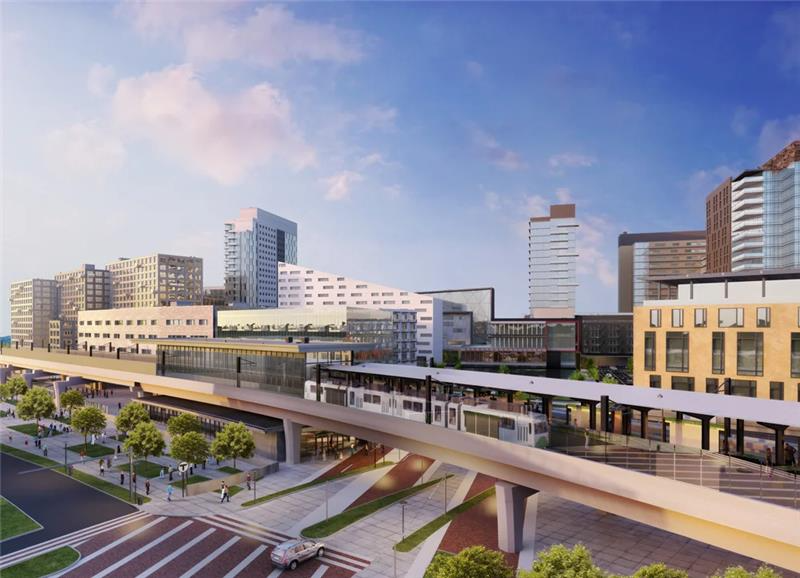
I was being silly and reading the old northpoint thread (since 10 years ago I was less focused on these things) and this render while relatively accurate to the content of CX, seems to be totally nonsense when it comes to the OBrien highway, apparently converting it to a neighborhood street, also including european style masonry streets and these cool pavement markings leading up to the CX entrance? What am I missing here? This would have done a lot to make the area more relaxd but probably would make for a hectic rush hour. The landscaped park along the El is nice too. I was pretty young when this render was made so it's interesting to see how things evolved.
I like the way it all looks, though.
TheRatmeister
Senior Member
- Joined
- Sep 23, 2023
- Messages
- 1,632
- Reaction score
- 3,341
Fun prompt I've wonder about for a while, would transport in Boston look different if MA had a local rolling stock manufacturer in the 1900s? Say the St Louis Car Company (the largest PCC streetcar manufacturer along with most NYC subway cars until the 1970s) was based in Springfield instead, for example. My personal head-canon is that Boston would look a lot more like Philadelphia, and a few streetcar lines and possibly even some interurbans would have survived along with the routes feeding into the subway. Perhaps demand shifts towards rail just enough that the SW Corridor is never even partially built, and the Orange Line never gets rerouted from Washington Street.
F-Line to Dudley
Superstar
- Joined
- Nov 2, 2010
- Messages
- 10,112
- Reaction score
- 12,904
They did: Osgood Bradley of Worcester. Which later became a Pullman-Standard factory after Pullman bought them out in the 1930's. Railcars were manufactured at the Worcester factory until Pullman closed it in 1960. A relatively small order of Type 4A trolleys happened to be the only direct purchase BERy made from them (other streetcar systems including Worcester's did buy lots from them, though). And they were a huge supplier of commuter rail coaches with their standardized "American Flyer" make (which later inspired the HO-scale model railroad line of the same name), selling hundreds of them to the NYNH&H and B&M amongst others. The ex-New Haven fleet lasted well into the Penn Central era with the T acquiring 18 of them that were assigned to the Boston region when they bought out the southside assets from PC in 1973. They last ran here in 1979, while the ex-B&M fleet ran secondhand on LIRR until the early-80's in revenue service and mid-90's in work service.Fun prompt I've wonder about for a while, would transport in Boston look different if MA had a local rolling stock manufacturer in the 1900s? Say the St Louis Car Company (the largest PCC streetcar manufacturer along with most NYC subway cars until the 1970s) was based in Springfield instead, for example. My personal head-canon is that Boston would look a lot more like Philadelphia, and a few streetcar lines and possibly even some interurbans would have survived along with the routes feeding into the subway. Perhaps demand shifts towards rail just enough that the SW Corridor is never even partially built, and the Orange Line never gets rerouted from Washington Street.
I don't think it would've made much of a difference. Hyper-consolidation of the industry was already underway by the Depression which was why the likes of Pullman swallowed so many smaller works and culled a lot of the smaller manufacturing bases like Worcester, and the postwar collapse of the domestic rolling stock market happened regardless.