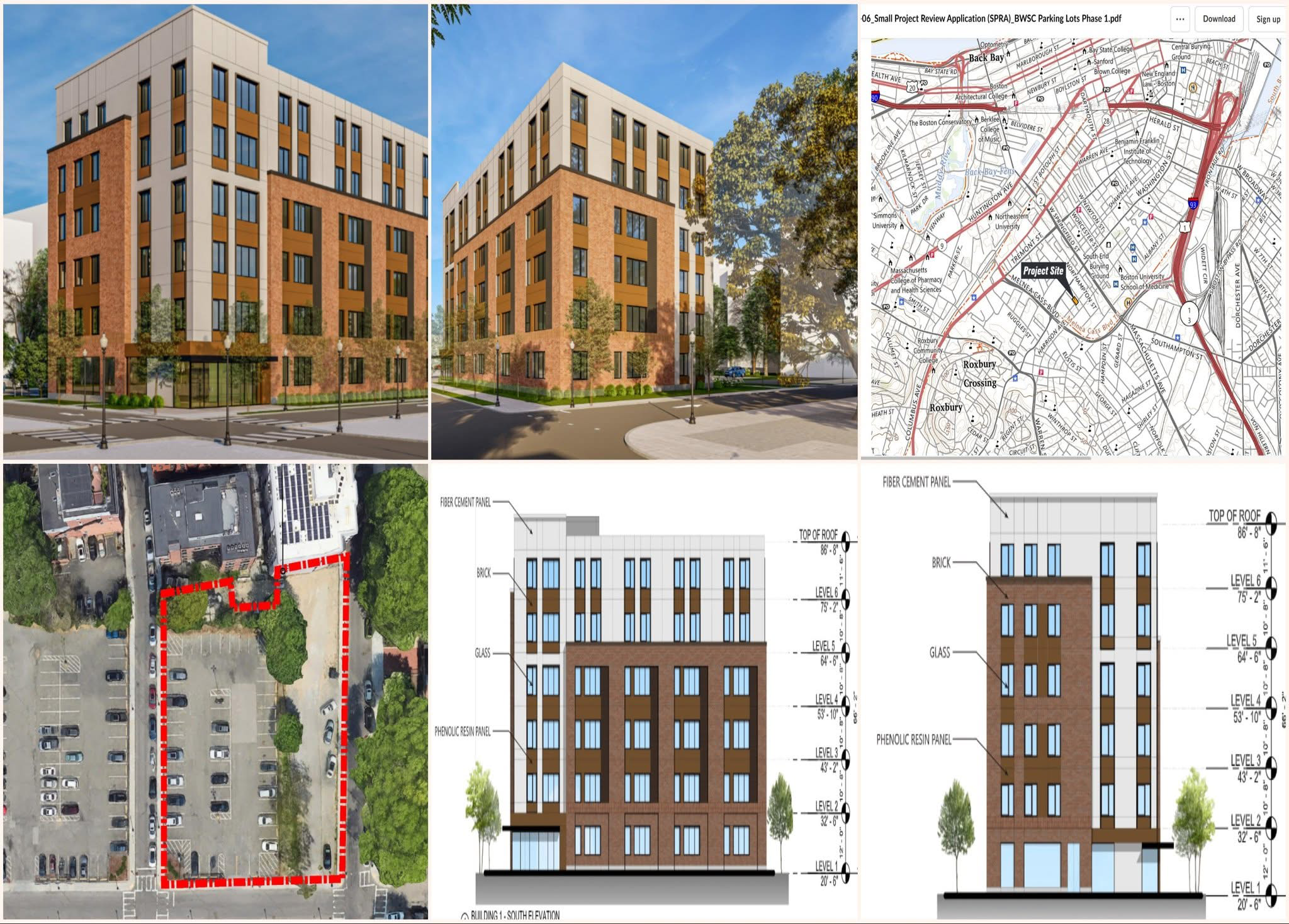
Looking at the most recent presentation, there is a lot of mismatch between the plans and slides, but I think there's some consensus between them that the parking lot is a placeholder for a 6-story Phase 5 building.Very sad that the majority of the site is going toward private automobile parking.

You are using an out of date browser. It may not display this or other websites correctly.
You should upgrade or use an alternative browser.
You should upgrade or use an alternative browser.
Boston Water and Sewer Commission development | 923-925 Harrison ave| Roxbury
- Thread starter stick n move
- Start date
So the whole thing is a mess --- they carved out phase 1 to do small project review on it in the hope of getting ARPA funds. In so doing they basically threw the entire masterplan up for grabs and said they're going to do a new review of it. So who know. The surface parking lot is an utter travesty though.

HenryAlan
Senior Member
- Joined
- Dec 15, 2009
- Messages
- 4,534
- Reaction score
- 5,453
Hopefully phase 5 will happen, which eliminates that surface lot. But that can't happen soon enough.Very sad that the majority of the site is going toward private automobile parking.

stick n move
Superstar
- Joined
- Oct 14, 2009
- Messages
- 13,923
- Reaction score
- 26,458
Welp this has died. Yet another attempt at a single developer masterplan community shitting the bed. It would be nice if they could go to the beacon, jge, and madison proposal if they were still interested but thats not going to happen.
“BOSTON WATER & SEWER COMMISSION DESIGNATION FOR PARCEL REDEVELOPMENT EXPIRES
This is a summary version. To read the full article please visit: https://www.southbostonbeat.com/#bwscparcels
The redevelopment initiative for the Boston Water and Sewer Commission (BWSC) parking lots in Roxbury has officially ended, following the expiration of the tentative designation awarded to Harrison Lenox LLC on October 31, 2025.
The project, a joint venture comprised of DREAM Development, Related Beal, John Barros, and Conan Harris & Associates (CHA) was initially selected by the Planning Department - City of Boston (BPDA) in April 2024 to transform the underutilized parcels at the intersection of Roxbury and the South End into a vibrant, mixed-use community hub. The proposal included a six-story residential building comprising 45 affordable homeownership units and was designed to leverage American Rescue Plan Act (ARPA) funds to deliver deep affordability, workforce housing, and a restorative justice model for the neighborhood.
The development plan was notable for its ambitious social equity goals, which were managed by strategic partner Conan Harris & Associates. The proposal aimed to align with the Roxbury Strategic Master Plan by implementing a unique wealth-building program that included rent-to-own pathways for residents and strict diversity and inclusion mandates for minority- and women-owned business participation. However, the project faced significant headwinds, including rising interest rates, escalated construction costs, and the complexity of financing deep affordability and senior housing. These economic challenges were compounded by the strict federal deadlines associated with ARPA funding, which required funds to be obligated by the end of 2024. Delays in the community review process and infrastructure planning caused the project to miss these critical funding windows, rendering the high level of income-restricted housing financially unfeasible.
Beyond the economic and timeline hurdles, the project ultimately collapsed due to an internal breakdown within the development partnership. One significant negative impact was the complexity and cost associated with the workforce and "rent-to-own" programs championed by Conan Harris. CHA’s plan required an unprecedented level of administrative oversight and financial subsidy to ensure that the 402 units reached the lowest levels of Area Median Income (AMI) while simultaneously funding a robust local contractor incubator. As the Boston real estate market faced a downturn in 2025, the high "social cost" of the CHA-led initiatives made the project increasingly unfeasible for the developers to finance without additional city or federal gap funding, which the city was hesitant to provide given the shifting economic climate.
Furthermore, the community engagement process led by Harris, created a "policy deadlock" by promising specific outcomes that clashed with citywide zoning reforms. For example, while Harris worked to secure community support through promises of high-density affordable housing, the project faced intense pushback from neighboring groups in the South End. The firm's focus on Roxbury-specific restorative justice sometimes struggled to bridge the gap with these neighboring South End stakeholders, leading to protracted delays in the Article 80 review process.
Despite the BPDA Board approving Phase 1 of the project in October 2024, the partners involved—DREAM Development, Related Beal, John Barros, and Conan Harris—could not reach a consensus on how to execute the project collaboratively. The failure to align on a structural path forward forced the team to abandon the venture.
This internal dissolution was formalized in a letter sent by DREAM Development to Rebecca Tomasovic, Director of Real Estate at the City of Boston Planning Department, on October 14, 2025. In the correspondence, DREAM Development Managing Principal Greg Minott stated:
Throughout this period, DREAM Development had actively engaged all parties—including Related Beal, John Barros, and Conan Harris—in an attempt to reach a consensus on the path forward. "We have put forward multiple proposals reflecting a range of possible structures, including both limited and passive roles for certain parties, and have been willing to accept terms that would preserve continuity and minimize delay for the City of Boston."
Despite these efforts, the parties were unable to reach alignment on a structure that would allow the project to proceed collaboratively.
In the official correspondence from DREAM Development, Managing Principal - Greg Minott to Rebecca Tomasovic, Director of Real Estate at the City of Boston Planning Department:
"I regret to report that our efforts to find common ground have not been successful. Accordingly, DREAM is formally acknowledging the end of the joint venture."
Link to the Dream Development correspondence: https://drive.google.com/file/d/1hWs8pOP76u5GBeaau4DYwE-sSmh4YC_5/view
Facebook
 www.facebook.com
“BOSTON WATER & SEWER COMMISSION DESIGNATION FOR PARCEL REDEVELOPMENT EXPIRES
This is a summary version. To read the full article please visit: https://www.southbostonbeat.com/#bwscparcels
The redevelopment initiative for the Boston Water and Sewer Commission (BWSC) parking lots in Roxbury has officially ended, following the expiration of the tentative designation awarded to Harrison Lenox LLC on October 31, 2025.
The project, a joint venture comprised of DREAM Development, Related Beal, John Barros, and Conan Harris & Associates (CHA) was initially selected by the Planning Department - City of Boston (BPDA) in April 2024 to transform the underutilized parcels at the intersection of Roxbury and the South End into a vibrant, mixed-use community hub. The proposal included a six-story residential building comprising 45 affordable homeownership units and was designed to leverage American Rescue Plan Act (ARPA) funds to deliver deep affordability, workforce housing, and a restorative justice model for the neighborhood.
The development plan was notable for its ambitious social equity goals, which were managed by strategic partner Conan Harris & Associates. The proposal aimed to align with the Roxbury Strategic Master Plan by implementing a unique wealth-building program that included rent-to-own pathways for residents and strict diversity and inclusion mandates for minority- and women-owned business participation. However, the project faced significant headwinds, including rising interest rates, escalated construction costs, and the complexity of financing deep affordability and senior housing. These economic challenges were compounded by the strict federal deadlines associated with ARPA funding, which required funds to be obligated by the end of 2024. Delays in the community review process and infrastructure planning caused the project to miss these critical funding windows, rendering the high level of income-restricted housing financially unfeasible.
Beyond the economic and timeline hurdles, the project ultimately collapsed due to an internal breakdown within the development partnership. One significant negative impact was the complexity and cost associated with the workforce and "rent-to-own" programs championed by Conan Harris. CHA’s plan required an unprecedented level of administrative oversight and financial subsidy to ensure that the 402 units reached the lowest levels of Area Median Income (AMI) while simultaneously funding a robust local contractor incubator. As the Boston real estate market faced a downturn in 2025, the high "social cost" of the CHA-led initiatives made the project increasingly unfeasible for the developers to finance without additional city or federal gap funding, which the city was hesitant to provide given the shifting economic climate.
Furthermore, the community engagement process led by Harris, created a "policy deadlock" by promising specific outcomes that clashed with citywide zoning reforms. For example, while Harris worked to secure community support through promises of high-density affordable housing, the project faced intense pushback from neighboring groups in the South End. The firm's focus on Roxbury-specific restorative justice sometimes struggled to bridge the gap with these neighboring South End stakeholders, leading to protracted delays in the Article 80 review process.
Despite the BPDA Board approving Phase 1 of the project in October 2024, the partners involved—DREAM Development, Related Beal, John Barros, and Conan Harris—could not reach a consensus on how to execute the project collaboratively. The failure to align on a structural path forward forced the team to abandon the venture.
This internal dissolution was formalized in a letter sent by DREAM Development to Rebecca Tomasovic, Director of Real Estate at the City of Boston Planning Department, on October 14, 2025. In the correspondence, DREAM Development Managing Principal Greg Minott stated:
Throughout this period, DREAM Development had actively engaged all parties—including Related Beal, John Barros, and Conan Harris—in an attempt to reach a consensus on the path forward. "We have put forward multiple proposals reflecting a range of possible structures, including both limited and passive roles for certain parties, and have been willing to accept terms that would preserve continuity and minimize delay for the City of Boston."
Despite these efforts, the parties were unable to reach alignment on a structure that would allow the project to proceed collaboratively.
In the official correspondence from DREAM Development, Managing Principal - Greg Minott to Rebecca Tomasovic, Director of Real Estate at the City of Boston Planning Department:
"I regret to report that our efforts to find common ground have not been successful. Accordingly, DREAM is formally acknowledging the end of the joint venture."
Link to the Dream Development correspondence: https://drive.google.com/file/d/1hWs8pOP76u5GBeaau4DYwE-sSmh4YC_5/view
www.facebook.com
Idiotic proposals, held together by Rube Goldberg machine levels of subsidy combination are bound to fail. This is a no brainer at market rate that could help fix the city budget. But they're too ideological and hidebound to accept that.