Housing (Supply Crisis & Public Policy)

At the federal level, the Faircloth Amendment hamstrings growth of public housing by limiting the unit count to the number in existence on October 1, 1999. Without the means to increase the number of publicly funded units, we are stuck with the private sector. Yanking IZ removes one of the few tools available to get the private sector to fill the gap.
Boston is about 3,000 units below its Faircloth Limit (12,086 units). With about 25% of that cap still "on the table," Faircloth really isn't relevant to the current market.

And Faircloth only caps federally-subsidized units, not all publicly funded units from state or local sources (or private via PPPs).
 
Screenshot 2026-01-07 131209.png
 
Everything for the SFH owners! Give up whatever that law is, the mortgage interest tax deduction, 30-year fixed mortages, fannie and freddie, and then we'll talk about losing rent control.
 
At a certain point cost of living is going to become a massive impediment towards "talent" wanting to live here.

People will stay as long as the jobs are here.
The jobs are here because the people employers want, want to live in the Inner Core and can afford to do so as long as they are willing to live with Roommates. Multiple incomes goes a long way.

I think the roommates thing is one of the biggest reasons why rents are so high here. Undoubtedly a lot would prefer to live alone... but yeah not happening.
 
People will stay as long as the jobs are here.
The jobs are here because the people employers want, want to live in the Inner Core and can afford to do so as long as they are willing to live with Roommates. Multiple incomes goes a long way.

I think the roommates thing is one of the biggest reasons why rents are so high here. Undoubtedly a lot would prefer to live alone... but yeah not happening.
Keeping in mind that the vast majority of jobs in the area are not in the inner core, so that only pertains to that fraction of our much larger market. I think that another part of the problem is that our generation insists on bigger, fancier housing. People used to raise families in apartments that now house one or two people.
 
Keeping in mind that the vast majority of jobs in the area are not in the inner core, so that only pertains to that fraction of our much larger market. I think that another part of the problem is that our generation insists on bigger, fancier housing. People used to raise families in apartments that now house one or two people.
Starter homes just aren't built anymore, and young people arent buying lots and doing new builds its even more expensive. Land is so costly that developers try to max out square footage on lots. And of course we all know how hard it is to get apartments and even triple deckers built. And double stairway requirements make all the apartments that do get built 1 bdrm and studio only. So you end up with unaffordable mcmansions on all the lots and nothing for young, first time buyers.
 
Keeping in mind that the vast majority of jobs in the area are not in the inner core, so that only pertains to that fraction of our much larger market. I think that another part of the problem is that our generation insists on bigger, fancier housing. People used to raise families in apartments that now house one or two people.
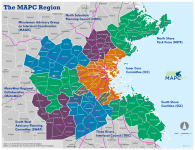
Going by the MAPC official definition of Inner Core (orange in the map below), most of the jobs are there, are they not?
 

Attachments

  • MAPC_Subregions_2017_letter_nonames-2.png
    MAPC_Subregions_2017_letter_nonames-2.png
    368.2 KB · Views: 37
There's a proposal that is likely to end up on the ballot next year about lot sizes. They got their ~100k signatures, and I think it's just a few more minor steps to go.

Basically, it would prevent municipalities from requiring residential lot sizes larger then 5,000 square feet (with some caveats). I think this might be one of the most consequential short term changes for encouraging more housing. Lots of homeowners who were required to have, say, a full acre, could split up that land into smaller lots if they want. Glad it's moving forward.

 
There's a proposal that is likely to end up on the ballot next year about lot sizes. They got their ~100k signatures, and I think it's just a few more minor steps to go.

Basically, it would prevent municipalities from requiring residential lot sizes larger then 5,000 square feet (with some caveats). I think this might be one of the most consequential short term changes for encouraging more housing. Lots of homeowners who were required to have, say, a full acre, could split up that land into smaller lots if they want. Glad it's moving forward.

I think that's too small. You'd want some buffer (plus aparently enough room to put up a fence for the doggo to run around)
 
For some comparison, here are some neighborhoods that seem to be mostly homes on ~5000sqft lots. This is Arlington, Milton, and Newton, picked from about a minute of eyeballing on google maps


These places look nice. These places look so stereotypical New England, it's hard to believe we've mostly banned these kinds of neighborhoods from ever happening again. Nobody will be forced to live in a place like this. Anyone can still get a bigger plot if they want and can afford it. But if a person wants to build a smaller house on smaller plot that they own, I don't think the government should stop them.
 
To extend this a bit further, I also think we should incentivize zero lot lines again, through allowing that increased square footage/coverage in exchange for higher construction standards (in fireproofing or other) - I want to incentivize row houses in the back bay / south end sense, and places like Eastie are density manifest.
 
There's a proposal that is likely to end up on the ballot next year about lot sizes. They got their ~100k signatures, and I think it's just a few more minor steps to go.

Basically, it would prevent municipalities from requiring residential lot sizes larger then 5,000 square feet (with some caveats). I think this might be one of the most consequential short term changes for encouraging more housing. Lots of homeowners who were required to have, say, a full acre, could split up that land into smaller lots if they want. Glad it's moving forward.

Why not just remove minimum lot sizes altogether?
 
Why not just remove minimum lot sizes altogether?
Personally, I think that'd probably be fine (without studying it that much). Certainly better than what we've got now.

But it does seem like the people behind this campaign have been extremely thoughtful and careful about what they think will actually succeed at the polls. Getting rid of minimum lot sizes all together might sound too radical to some, just because it's not what they're used to. Or there could be the weird edge cases that opponents would trot out--scaring people that someone might build a 10X10ft shack in their neighborhood as a nuisance to something-something-I-don't-know. The 5,0000 square foot limit seems specifically picked to have a real impact while not scaring people. And it looks like the reasonable position when municipalities pull crap like requiring 80,000 square foot plots(!).
 
Me too. The controversy was always about East Milton and now that isn't an issue. But now Boston that needs to come up with a similar development plan for the area because there are far more large developable lots on the other side of the river right near the same trolley stations.
 

Back
Top