Other People's Rail: Amtrak, commuter rail, rapid transit news & views outside New England


SEPTA caps off a wild week in having its doomsday service cuts dramatically reversed by a judge's order, then a one-time funding lifeline from the state government. Punitive fare increases still in effect, and they kick the can for all of two years before this sick game of chicken inevitably repeats itself. Be interesting to see how much a whole summer of threatening their own customers ends up depressing ridership more than it already has. SEPTA is still the undisputed most clownshoes-run transit agency in North America.
 
1758934790502.png

1758934808495.jpeg


These new locos are also able to run the full length of third-rail electric territory to Poughkeepsie, Southeast, and Pelham unlike the old Genesis P32AC-DM units which had to fire up the diesel right at the Park Ave. Tunnel portal because their E-mode was only designed to operate in-motion for a max of about 10 minutes at a time. So it's significant fuel and emissions savings, as well as being more miserly in E-mode than their predecessors because of the regenerative braking. MNRR has 26 more option orders of these it can exercise for service increases to Grand Central from diesel territory. LIRR has also ordered 44 of them, with 22 un-exercised options, to replace its unreliable EMD DM30AC's, which likewise can't operate for more than 10 or so minutes in E-mode without overheating.

(Note that these are a batch are regular old third-rail dual-modes, and not the supplemental order of 16 convoluted battery-augmented Chargers that MNRR is very inexplicably buying for Penn Station Access instead of procuring more M8 EMU's.)
 
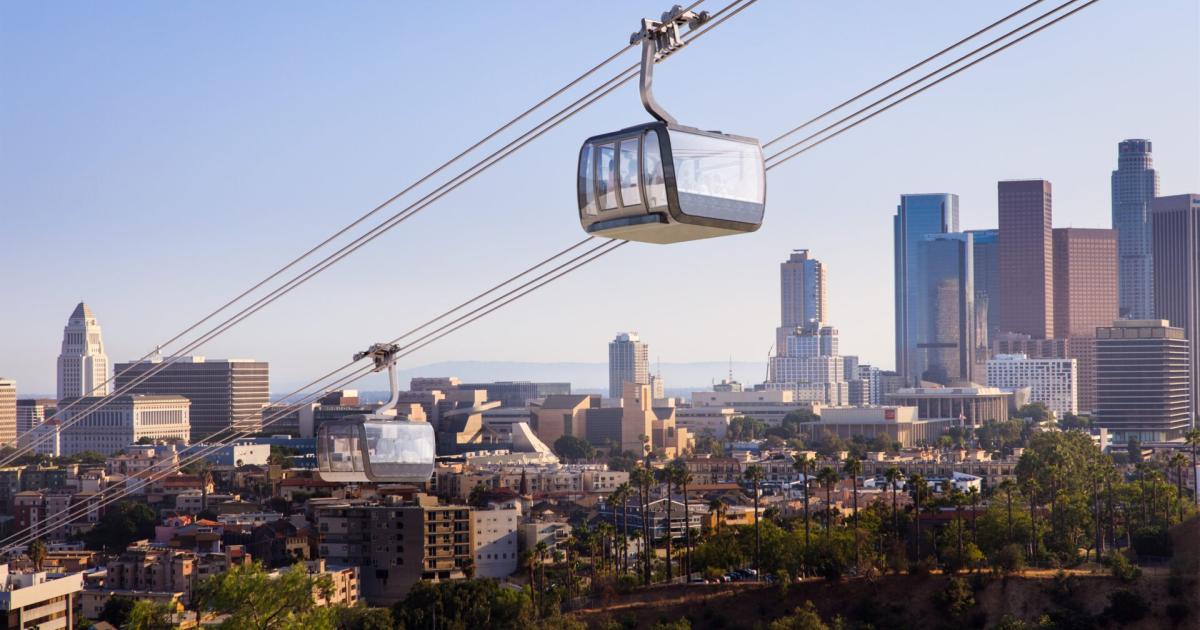
I'm generally skeptical of gondolas, but I think this one is a good idea.
The terrain certainly makes one not an unreasonable choice but a gondola can only move around 15% of Dodger Stadium's capacity in an hour. Lines seem like an inevitability before and especially after events.
 
The terrain certainly makes one not an unreasonable choice but a gondola can only move around 15% of Dodger Stadium's capacity in an hour. Lines seem like an inevitability before and especially after events.

The Green Line* can only move around 15% of Fenway Park's capacity in an hour.

*Using the stated capacity of a two-car Type 7+8 Green Line train and three minute headways.
 
The Green Line* can only move around 15% of Fenway Park's capacity in an hour.

*Using the stated capacity of a two-car Type 7+8 Green Line train and three minute headways.
At 540 people per train, and 20 trains per hour, that's nearly 30% of Fenway Park's capacity per hour.
 
At 540 people per train, and 20 trains per hour, that's nearly 30% of Fenway Park's capacity per hour.
Normal "crowded" capacity is about 100 person per LRV (200 per train); crush load is about twice that. At the lower number, 25 TPH (current rush hour service through Kenmore) gives 5000 pax/hr (13% of Fenway's capacity). But the Green Line is bidirectional - you're running 25 TPH towards the branches and 25 TPH toward downtown - so you can actually move twice that at normal capacity. At crush load, you can theoretically move half of Fenway's capacity per hour. The Type 10s will approximately double the capacity of current LRVs, so 2-car trains of those will have even more crowd-swallowing ability.

The bigger difference, in my opinion, is that Fenway is porous. You walk out the gates and you're in the street grid, able to go any direction. You can go to a bar or restaurant, you can walk back to your dorm at BU or Northeastern, you can walk home to Mission Hill or Cambridgeport, you can get on the Worcester Line, you can walk to the Orange Line, you can walk to approximately 20 different bus lines. All in 20 minutes or less.

Dodgers Stadium is not. There are only 5 total sidewalks on which you can legally leave the stadium, of which only the pair on Vin Scully lead to civilization. There's only a single bus route plus the stadium shuttle bus* within a 20-minute walk. No bars or restaurants save for a handful on Sunset Boulevard. The only thing to do is get in your car and sit in traffic.

*At 8 buses per hour, total capacity is much less than 1000 pax/hr.

Here are the two ballparks at the same scale (images approximately 1.5 miles across):
1759373796946.png
1759373850519.png
 
The terrain certainly makes one not an unreasonable choice but a gondola can only move around 15% of Dodger Stadium's capacity in an hour. Lines seem like an inevitability before and especially after events.
Yeah, it's not perfect, people would need to get to the game early, but it would still be an upgrade over the current shuttle bus system. The buses get badly stuck in traffic, especially post game. Last time I was at Dodger Stadium, I waited well over an hour for a bus, which then took 45 minutes to reach Union Station, and after the last train to where I needed to go :confused:
 
This reminds me, the LA Metro put out this unintentionally hilarious video last year. It's directions for how to take the train after a Dodgers game, and it's very upbeat in a "So Simple!" and "You Can Do It!" kind of way.


It's supposed to be a 25 minute walk. The directions are obviously complicated, and even in Metro's video the walk looks miserable. People have tried the walk and at least one section has no sidewalks at all. You have cross busy intersections with no lighted crosswalks, and the freeway on a narrow pedestrian bridge. The walk looks super dangerous even without game day traffic, and the route isn't anything close to ADA accessible.

 
Stuff like that is just proof positive that you cannot build a city like LA. It’s more or less continuous urban sprawl around supersized office parks, which happen to be tall buildings because at even at LA’s average densities, it makes more sense to build up.

It’s a metropolis built almost exclusively of and around outdated, 1940-60’s ideas of what a city looks like.
 
This reminds me, the LA Metro put out this unintentionally hilarious video last year. It's directions for how to take the train after a Dodgers game, and it's very upbeat in a "So Simple!" and "You Can Do It!" kind of way.


It's supposed to be a 25 minute walk. The directions are obviously complicated, and even in Metro's video the walk looks miserable. People have tried the walk and at least one section has no sidewalks at all. You have cross busy intersections with no lighted crosswalks, and the freeway on a narrow pedestrian bridge. The walk looks super dangerous even without game day traffic, and the route isn't anything close to ADA accessible.

Remarkable in a certain sense that if you have $500m to spend on a gondola, that you can't spend 1/100th of that or less on making the walk more tolerable and clearly marked/easy to follow.
 
Remarkable in a certain sense that if you have $500m to spend on a gondola, that you can't spend 1/100th of that or less on making the walk more tolerable and clearly marked/easy to follow.
Even the most convenient and enjoyable walk will still take a substantial amount of time and physical effort, though, given the sheer distance. That 15-min walk (just guesstimating optimistically) can be the deal breaker for someone deciding between transit and driving.
 

Back
Top