Other People's Rail: Amtrak, commuter rail, rapid transit news & views outside New England

Which section of Amtrak trackage is most likely to get electrified next? DC to Richmond? NYC to Albany? New Haven to Springfield? The Michigan Line? Chicago to St. Louis? Richmond to Raleigh (S-Line reactivation)? Capitol Corridor?

I know there are no current plans for more Amtrak electrification, but I've been wondering which corridor is most likely to be electrified when the time eventually comes.
 
Which section of Amtrak trackage is most likely to get electrified next? DC to Richmond? NYC to Albany? New Haven to Springfield? The Michigan Line? Chicago to St. Louis? Richmond to Raleigh (S-Line reactivation)? Capitol Corridor?

I know there are no current plans for more Amtrak electrification, but I've been wondering which corridor is most likely to be electrified when the time eventually comes.
DC to Richmond probably has the most absolute demand for it, but that's a bigtime double-stack freight corridor (and the track-sharing agreement they signed with CSX is slightly porous so they can't guarantee at any given meet which track might be used by a freight) so it's going to take awhile to wad up the costs. Springfield Line is probably easiest in the absolute, easiest for ops, and ConnDOT definitely wants it. Although the last state-level cost study blew every projection out to boondoggle levels (call it "Caltrain poisoning the well" because so many of the metrics were based on that mismanagement boondoggle)...so I wouldn't be holding my breath on it anytime soon.
 
Do you know why the track-sharing agreement with CSX for the former RF&P doesn't require that freights use a particular track?
 
DC to richmond plus electrification would be awesome to see the northeast corridor get extended south.
 
Do you know why the track-sharing agreement with CSX for the former RF&P doesn't require that freights use a particular track?
It's a large freight schedule because that's CSX's one big lane from the Southeast to the Mid-Atlantic and Northeast regions, so they can't be squashed down to only one track all the time because of meets. Most of the time passenger and freight traffic will be segregated on the to-be tri-track railroad, but the complex agreement allows for each to have flex slots on each other's track when congestion is high.
 
It's a large freight schedule because that's CSX's one big lane from the Southeast to the Mid-Atlantic and Northeast regions, so they can't be squashed down to only one track all the time because of meets. Most of the time passenger and freight traffic will be segregated on the to-be tri-track railroad, but the complex agreement allows for each to have flex slots on each other's track when congestion is high.
When DC to Richmond gets electrified someday, is it anticipated that the Acela will eventually be extended to Richmond? Or would CSX have issues with high-speed trains operating on one of their busiest freight corridors?
 
When DC to Richmond gets electrified someday, is it anticipated that the Acela will eventually be extended to Richmond? Or would CSX have issues with high-speed trains operating on one of their busiest freight corridors?
Probably not. There's grade crossings on the RF&P (not a lot, but a decent number nonetheless) that cap speeds at Class 6/110 MPH so you wouldn't be able to take advantage of the equipment until the crossings were all eliminated. And Richmond really isn't enough of a first-class market to really sell a lot compared to the D.C-Philly-NYC-Boston market, so there'd be sort of a loss-leader issue of the trains running kinda empty south of D.C.
 
Thanks for the answers. Here I thought all M-N territory was electrified.
 
The MTA plans to extend Metro-North Railroad service north to the Albany area, offering a once-a-day round trip between Grand Central Terminal and the Capital Region.
Hochul on Monday announced the northward expansion will launch in the early spring, partially filling in for reduced Amtrak service as the national railway repairs the East River rail tunnels heading into Manhattan. The new trip will serve as an alternative to Amtrak trains that run between Penn Station and the Capital Region.
The expanded service area means Metro-North’s Hudson Line will extend roughly 80 miles beyond its current northernmost point of Poughkeepsie. The roundtrip train will depart Grand Central for the Albany-Rensselaer station mid-morning and return to Grand Central in the afternoon, according to the governor’s office.
The route will follow the existing Hudson Line stops from Grand Central to Poughkeepsie before making stops in Rhinecliff, Hudson and Albany-Rensselaer, according to the MTA. The transit agency hasn’t yet set an exact cost for the trip, but expects it to be similar to the lower end of Amtrak’s one-way tickets from New York City to Albany — which are $38.
 
While Metro-North to Albany is grabbing all the headlines, other notable things in the announcement is that Amtrak is also adding (restoring, really) an additional round-trip starting in December and capping one-way fares between NYC and Albany at $99.
 
What isn't said is how Metro-North is being reimbursed for running this. The MTA is captive to a 12-county district, which only extends as far north as Dutchess County. Their native service area is only inclusive north-of-Poughkeepsie of the Rhinecliff Amtrak station. Anywhere north of there needs to be underwritten by another agency, much like the Cape Flyer is underwritten by CCRTA for the outside- MBTA district running miles. I assume NYSDOT is going to be that underwriting agency?

I also don't know if I'd want to sit on a Shoreliner commuter coach that long. Poughkeepsie-Grand Central locals take about 1:45, and that's skipping all electric-territory stops between Croton-Harmon and 125th Street. About the limit you'd want to sit in a 3 x 2 seating CR coach. Poughkeepsie-Albany on Amtrak takes another 1:00-1:10, and that's with a 110 MPH speed limit north of MNRR territory. The MNRR commuter trains are all capped at 90 MPH top operating speed. Maybe this is just a testing ground to see if the Grand Central terminus attracts any unique ridership so NYSDOT can build a case to bring some Amtrak supplementals back there after 34 years, because Amtrak is clearly much better-suited to such a long run than the commuter equipment.
 
Maybe this is just a testing ground to see if the Grand Central terminus attracts any unique ridership so NYSDOT can build a case to bring some Amtrak supplementals back there after 34 years, because Amtrak is clearly much better-suited to such a long run than the commuter equipment.
I'm wondering why Amtrak isn't already offering this service if the tunnel project is limiting how many trains they can run out of NYP.
 
I'm wondering why Amtrak isn't already offering this service if the tunnel project is limiting how many trains they can run out of NYP.
The Empire Connection isn't affected by the East River Tunnel work. It runs push-pull with cab cars these days to avoid having to deadhead through the East River bores to Sunnyside yard, which takes some of the stress off. I think it's more that Amtrak is so stretched for coaches right now and the NYP-ALB runs are so frequently sold out that there's a screaming need for something, anything interim to plug the gap. And given that this isn't an additional train for MNRR, just a super-extension, it was low-hanging fruit.
 
In addition to Amtrak being extremely short on coaches right now due to the Horizons being pulled from service earlier this year, there apparently are capacity limitations into GCT right now due to the Park Ave. Viaduct rehab project. This service will probably use existing slots for Poughkeepsie trains to fit things in, plus it's only 1 daily RT at the moment.

Also, I'm not sure how much of a consideration it was in the Metro-North vs. Amtrak calculus, but I also wouldn't underestimate the appeal of the Metro-North service having a fixed walk-up fare (not yet officially announced, but reports are saying roughly $40 one-way). It'll be interesting to see how it shakes out.
 
1761156387311.png


“The first Airo trainset has officially departed Pueblo, Colorado, heading east to the Northeast Corridor for additional testing, and then onto the Pacific Northwest to enter service on Amtrak Cascades routes. This moment marks a major milestone in our journey with Amtrak to redefine passenger rail in the U.S.

Built in Sacramento by 2,500 skilled team members, and with more than 2,000 suppliers across the country, the Airo trainset is a symbol of American innovation, comfort, and what’s next in rail.

From Sacramento to Pueblo and now onward to the NEC, this trainset has already traveled thousands of miles and undergone rigorous testing. The excitement is real, and the future of rail is rolling forward.”

 
View attachment 67962

“The first Airo trainset has officially departed Pueblo, Colorado, heading east to the Northeast Corridor for additional testing, and then onto the Pacific Northwest to enter service on Amtrak Cascades routes. This moment marks a major milestone in our journey with Amtrak to redefine passenger rail in the U.S.

Built in Sacramento by 2,500 skilled team members, and with more than 2,000 suppliers across the country, the Airo trainset is a symbol of American innovation, comfort, and what’s next in rail.

From Sacramento to Pueblo and now onward to the NEC, this trainset has already traveled thousands of miles and undergone rigorous testing. The excitement is real, and the future of rail is rolling forward.”

Err, I kinda doubt that this set will be particularly representative of what we should expect in NEC service, if they're bringing this up here for performance benchmarks? The Cascades sets are pure diesels, without the pantograph or aux power cars. What could they accomplish with it, other than a little marketing for "this is whats coming"?

That said... the electrified Airos are meant to go with a diesel Charger to basically create a dual mode set. Whats the possibility of Amtrak matching "plain" non-APV Airo sets (from future options) with the ACS64, which had no future in a pure Airo environment?
 
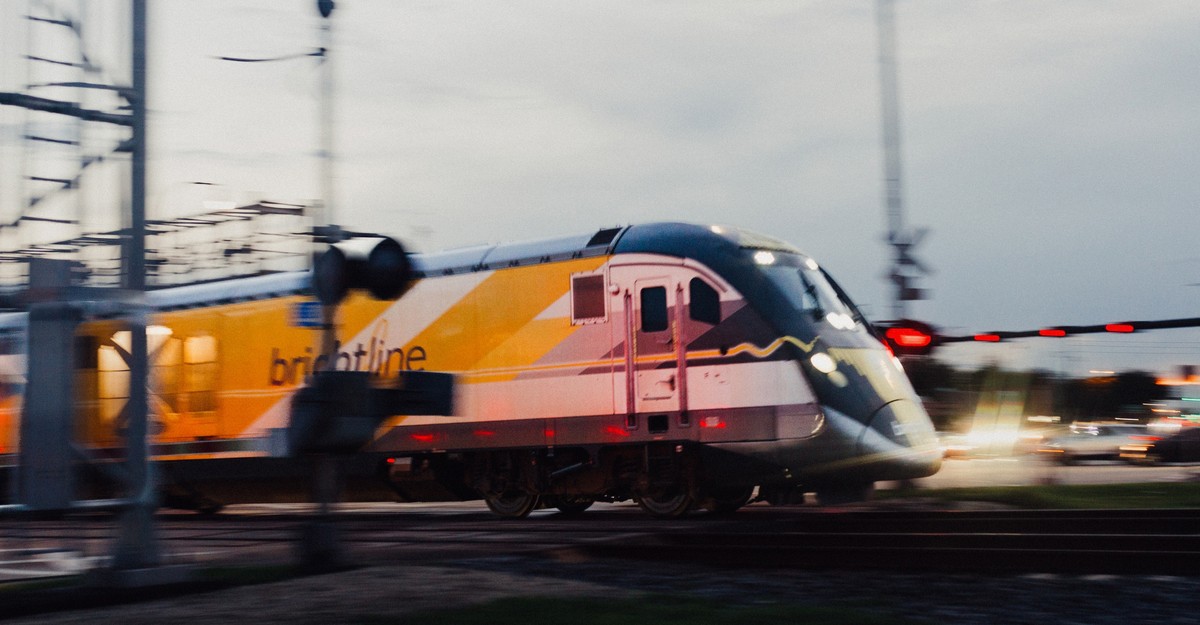
Excellent article about the Brightline death train in Florida.

Well written, although I mostly come away from it with about what I'd guessed for causes: A bit of everything and as such - no simple or cheap solution that's going to just fix it, and a good chunk of it is probably intractable short of major grade crossing eliminations + sealing off more of the corridor - which is going to have it's own problems and probably still get people climbing or cutting fences if you're not building ped crossings at those natural crossings.

Still, at least a few of those seem to point at obvious enough issues that are primarily bureaucratic/coordination - like the traffic light not being sync'd to the grade crossing. Shouldn't have it turning green to send traffic towards the crossing when the train is coming at that short a distance, even if there are gates/lights at the crossing itself.
 

Brightline West eyes 2026 for California construction of high-speed rail project​

A Brightline West official told the Daily Press that construction is expected to begin “early next year” on the Southern California side of its high-speed rail project between Las Vegas and Rancho Cucamonga.
Brightline West spokesperson Antonio Castelan on Monday provided some information about construction in Las Vegas, but no details about the California side of the project.
[...]
Castelan reported Monday that crews will begin infrastructure improvements along Las Vegas Boulevard between Eldorado Lane and Robindale Road. The work east of the project includes removing the existing center median, installing a box culvert, and realigning a sewer line to support future station and roadway enhancements.
Activities will begin on Oct. 23, with one night of median removal, followed by a lane reduction starting Oct. 27 and lasting approximately three weeks. The improvements are essential to preparing the area for future station construction and long-term roadway functionality, according to Brightline officials.
 

Back
Top