Other People's Rail: Amtrak, commuter rail, rapid transit news & views outside New England

The MTA plans to move forward with a $1.1 billion contract to start digging and building a new train station at East 106th Street for the Second Avenue subway — despite a pending lawsuit the transit agency filed against the Trump administration over an order to halt funding for the megaproject.
MTA officials said Friday they plan to bring the contract to the agency’s board for approval next week. It comes days after the authority claimed in its lawsuit that work on the subway extension “will eventually have to come to a screeching halt” if the federal government continues to withhold funding.
Officials say they want to ensure no time is lost on the long-sought subway line while they wait for the lawsuit to play out in court. The agency plans to wait until a judge rules before finalizing the contract, but doesn’t want to have to go back to the MTA board for approval after the order comes down.
[...]
The contract is the third of four contracts for the project. The MTA has already inked deals to relocate utilities and dig out the tunnel for the extension. The authority has one last contract for the project, which it hopes to put out for bid next year, and is still completing the designs for that work.
The MTA plans for trains to begin running on the new line by 2032.
 
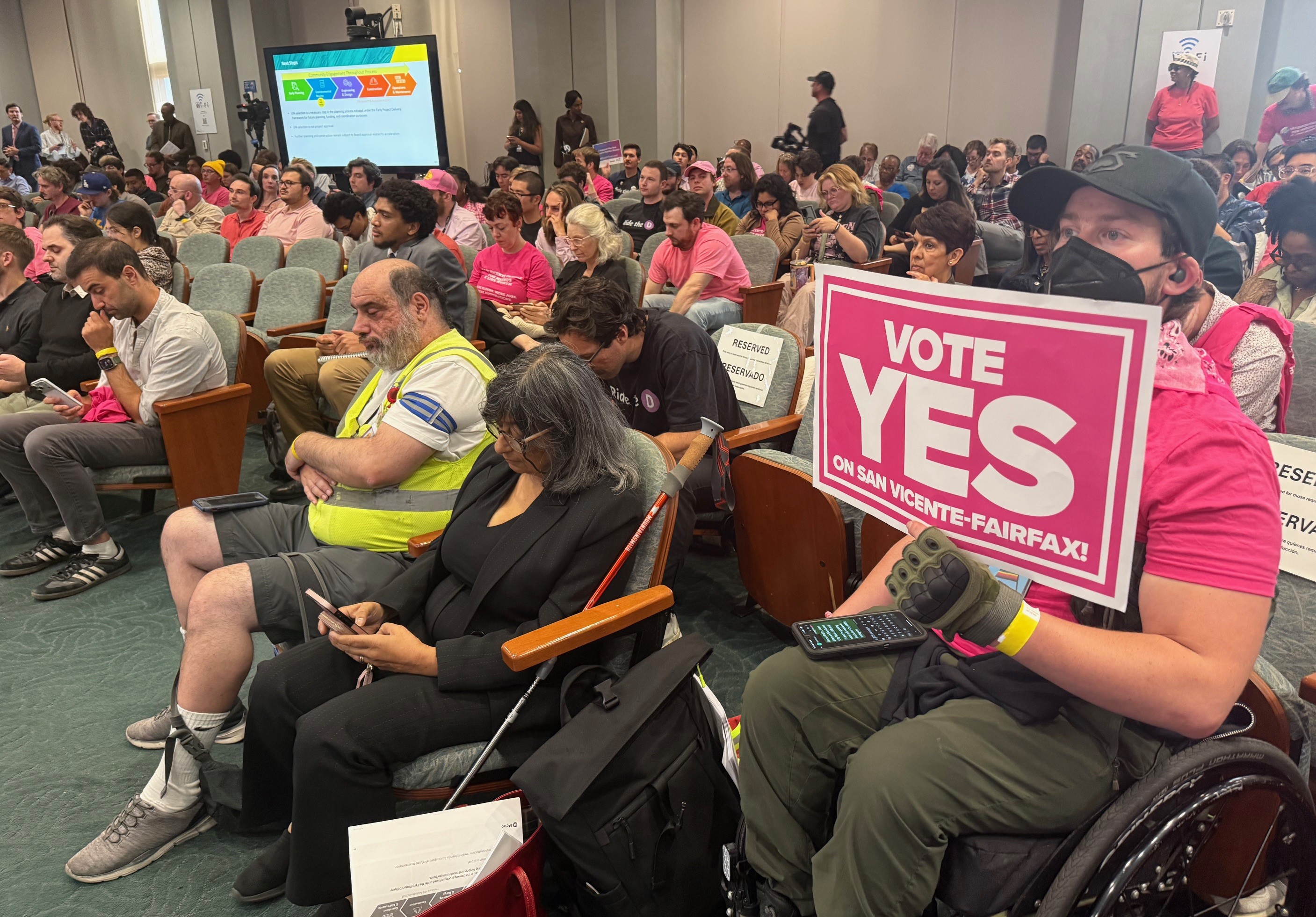
This afternoon, the Metro board unanimously approved most of the route to extend K Line light rail northward. The approval came as the result of a compromise in which L.A. Mayor Karen Bass backed off of her push for indefinite delays requested by some mid-city residents opposed to tunneling under their homes. Today’s winners were K Line champions: Supervisor Lindsey Horvath, the city of West Hollywood, and transit advocates.
Overall the K Line Northern Extension (KNE) will be a key north-south light rail subway that will greatly increases Southern California rail network usefulness by tying together the Metro B, D, and E Lines. The extension will serve relatively population dense central neighborhoods, with plentiful job, retail, and entertainment destinations.
The board selected the San Vicente-Fairfax alignment as the “Locally Preferred Alternative” (LPA). Metro is currently considering three alignments in the project’s environmental studies (Environmental Impact Report – EIR). The alignment selected is the one championed by West Hollywood.
The preferred alignment is roughly ten miles long with nine stations. It extends from the current K Line terminus at Exposition/Crenshaw, connecting to the D Line at Wilshire/Fairfax, and to the B Line at Hollywood/Highland. The project includes six stations in the city of Los Angeles – in Mid-City, Fairfax and Hollywood – and three stations in the city of West Hollywood. (Extending the line to a tenth station – at the Hollywood Bowl – was also approved, but may not be included in early project phases.) The first phase (the initial operating segment – IOS) of the K Line North extension is expected to extend about four miles from the E Line to the D Line.
The extension has just over $2 billion dollars worth of Metro Measure M sales tax funding, but those construction funds are not scheduled until 2041. West Hollywood is pushing to accelerate the project, including paying for a quarter of the capital costs. West Hollywood plans to contribute $2.5 billion to the project via an Enhanced Infrastructure Financing District (EIFD). Many cities (including the city of Los Angeles portion of the D Line) have balked at Metro’s 3 percent local match requirement.
 
A landlord is fighting to keep the MTA from accessing his apartment building as part of a project to complete the transit agency’s Second Avenue Subway extension for fear that an inspection would expose deficiencies that will be costly to repair.
The MTA took the landlord to court this week, arguing that if a judge doesn’t grant it emergency access to the building to assess its structural integrity and carry out reinforcement work, it can’t move forward with the nearly $7 billion public works project that’s nearly a century in the making.
The latest phase of the planned extension for the Second Avenue subway line will bring it into East Harlem and over to Lexington Avenue — adding three new stations at 106th, 116th and 125th Streets. Once complete, some 110,000 daily riders in East Harlem, who currently have few transit options, will have better access to the Q train.
But the MTA says that the structural shells for the planned new station at 106th Street Station and tunnels to its north and south can’t be built until it can repair foundational walls and reinforce the foundation of the building at 2049 Second Ave., which is owned by East Harlem landlord Edgardo Kramer.
[...]
Kramer initially agreed to allow the MTA to enter his building and carry out the necessary work in 2023, according to a signed contract between him and the MTA.
However, a few months ago, Kramer backtracked on the agreement; emails between the parties show the landlord told the agency that, while he doesn’t oppose the MTA carrying out its work, he wouldn’t agree to let it onto his property unless it committed to pay for any and all repairs its structural integrity assessments revealed were necessary. The MTA said in court papers that it considers Kramer’s terms unreasonable.
 

Oklahoma could cut financial ties with Heartland Flyer

While talking budget on the House floor Thursday, lawmakers said that they can’t subsidize the Heartland Flyer anymore. Texas had not put aside funding for the passenger rail, so Oklahoma more than likely won’t be footing part of the bill.
“The state of Texas is saying they don’t want to fund it, so I don’t think it should be on the state of Oklahoma to subsidize it and keep it alive,” said Rep. Trey Caldwell (R-Appropriations Chair).
Lawmakers have discussed cutting ties with funding for the Heartland Flyer before. It has been a back-and-forth conversation over the years.
“I do not think it should be on the Oklahoma taxpayers to continue to subsidize the shopping and the lifestyle of people in North Texas,” said Caldwell.
[...]
Numbers from the last couple of years show that ridership has continued to increase. Last year, the North Central Texas Council provided $3.5 million in emergency funding to keep the train on route.
Without last year’s funding, the service would have shut down at the end of September.
 
Amtrak has officially issued an RFP for its long-distance fleet replacement, which will replace all Amfleet II and Superliner cars with a unified single-level fleet. The supplier will be selected by the end of 2027, with Siemens the likely frontrunner given their recent dominance of the North American intercity rolling stock market with the Venture platform.
It’s official! We’ve started the procurement process for Amtrak’s largest-ever Long Distance train order.

Our customers deserve the best, and this new fleet will move us full speed ahead into a new era of American train travel.

We’ve issued a formal request for suppliers to bid on the new Long Distance fleet replacement contract.

Interested carbuilders are now preparing their proposals for submission. Following an extensive evaluation, we plan to announce our selected supplier by the end of 2027.

This once-in-a-generation fleet replacement program was developed in close coordination with the Federal Railroad Administration, with the goal of modernizing overnight and cross-country travel for a fleet that includes many cars today approaching nearly 50 years of operations.

The program calls for more than 800 new railcars across 14 routes.

Long Distance routes are a critical part of America’s national transportation system, linking major cities, smaller towns, and rural communities while supporting economic growth across regions.

Amtrak’s new and improved Long Distance fleet replacement strategy prioritizes fleet standardization, broadens competition among potential carbuilders, reduces program risk, and accelerates the replacement of aging passenger cars that today approach nearly half-a-century of service. Under this plan, all long-distance routes will transition to a universal single-level fleet, replacing today’s mix of bi-level and single-level equipment.

Procurement of new long-distance passenger cars represents one piece of Amtrak’s broader systemwide fleet modernization program. Amtrak continues to receive new high-powered ALC-42 locomotives for long-distance service, with 79 of 125 units delivered to date. New NextGen Acela trains launched last fall on America’s only high-speed rail corridor, and the new Airo fleet will begin service on Amtrak Cascades in 2026, followed by the Northeast Regional and other short- and mid-distance routes in the coming years.

Amtrak also released a promotional video showing interior design concepts for coach, sleeper, diner, and lounge cars, though the actual final product could differ significantly.
 
Would be so nice if this was “replaced” with a longer route that goes further south following the route of the Texas Eagle. Not ideal for full passenger service yet, but there absolutely is demand for Austin-San Antonio
I agree that extending the Heartland Flyer to San Antonio is a good idea, in addition to a northward extension to Newton, KS, or Kansas City. But all of this depends on state funding, which Texas (and now Oklahoma) won't even provide for the existing route. I wouldn't be surprised if funding dries up completely and the Heartland Flyer ceases to exist in the near future.
 
The business model of paying down the operating deficit with ultra-long term real estate development around the stations, while soundly reasoned, really isn't compatible with the short attention span of private equity and short-term debt-shifting games therein. This end was pretty much inevitable given who held the financing, because debt-pushing is a game to them. It takes a lot of patience to try to pull off Brightline's business strategy, and their owners just don't institutionally have that kind of patience.


I suspect, though, that the glibertarian conceit that all passenger rail should operate like Brightline because MOAR PRIVATIZATION is going to continue being sprouted unabated in spite of the fact that Brightline's crisis shows that private capital in this country is structurally woefully unwilling/unable to execute on such a patience-tested business plan. Oh well...logic was never those people's strong suit. 🤷‍♂️
 
Why the heck isn’t Brian Shortsleeve the CEO of Brightline? The gig seems right up his alley.
 
Last edited:
Why the heck isn’t Brian Shortsleeve the CEO of Brighline? The gig seems right up his alley.
Brightline is actually consistently building new things, instead of just deferring maintenance and holding board meetings to publicly pat self on the back for deferring maintenance. That's real work, bro.🏋️‍♂️


Brightline actually has current and past executive ranks filled with proven pax rail industry veterans with deep engineering experience and worldwide best-practice connections. Remains to be seen if those guys stay in control, or if the private equity vampires try to install their numbers-pushing own in place of the pros. But the company has definitely been as successful as they've been getting their systems seeded by having good experienced management top-to-bottom, something public operators could learn a thing or three from. It's just that capital in the 21st century does not have anywhere close to the patience or attention span to try to execute a redux of the "Streetcar Suburbs" business plan, so it was inevitable that they'd ultimately become a bankruptcy football to start kicking around with debt-transacting parlor tricks.
 
After nearly 60 years of discussion, Chicago has broken ground on the $5.7-billion Red Line Extension planned to provide rapid rail transit to the city’s far south side and touted as the largest capital project in the Chicago Transit Authority’s (CTA) history.
The extension will cover 5.5 miles from 95th Street to 130th Street and will include the construction of four new Red Line stations at 103rd, 111th, Michigan and 130th streets. In addition, a new rail yard and related rail facilities near 120th Street are planned to improve operational efficiency for the entire Red Line and CTA system.
Chicago-based Walsh Construction and French contractor VINCI are serving as design-build contractor for the project that broke ground on April 24.
Work has already started to prepare the project for construction including demolition of acquired properties and relocation of utility poles and other equipment where the new track will be built.
[...]
Upcoming work will include drilling where the new elevated track columns will be placed, pouring concrete to create new track foundations followed by track columns. Station construction is slated to begin in 2027.
 
Chicago is such a big city!

This extension will bring the CTA Red Line to 27.4 miles, with no branches, surpassing the CTA's Blue Line (26.9 miles without branches) for longest in their system.

The MBTA Red Line is 17.5 miles from Braintree to Alewife. If it were extended along/under the Minuteman to Bedford, it would be about 27.4 miles between Bedford and Braintree.

The MBTA Blue Line is 6 miles. If it were extended west to Cleveland Circle (via Charles/MGH and Kenmore) and east to Hamilton/Wenham (via Lynn), it would be about 26.9 miles between Hamilton/Wenham and Kenmore.

Just some fun perspective and nothing more.
 
... touted as the largest capital project in the Chicago Transit Authority’s (CTA) history.
This is an awful thing to brag about. There's nothing inherently wrong about pursuing expensive projects, but they are done in spite of their cost, not because of it. Showcase the actual benefits, whether that's shorter commutes, better access to school/jobs, reduced pollution from traffic, economic revitalization of under-invested areas, etc. There is so much good that occurs when quality transit is expanded that it is extremely odd to play this up.

Note: Looking into the CTA press release more, the only part of it that relates to "touting" the price is this line:
... break ground on the largest and most transformational capital construction project in CTA history ...
The original "tout", at best, is a misleading description used by ENR. While this is in some ways a minor detail, it is still reasonable to want better on ENR's part.
 
This is an awful thing to brag about. There's nothing inherently wrong about pursuing expensive projects, but they are done in spite of their cost, not because of it. Showcase the actual benefits, whether that's shorter commutes, better access to school/jobs, reduced pollution from traffic, economic revitalization of under-invested areas, etc. There is so much good that occurs when quality transit is expanded that it is extremely odd to play this up.

Note: Looking into the CTA press release more, the only part of it that relates to "touting" the price is this line:

The original "tout", at best, is a misleading description used by ENR. While this is in some ways a minor detail, it is still reasonable to want better on ENR's part.
ENR is a civil engineering and construction magazine, so they have historically been looking at costs for many decades now. It's like the discussion on here about MassDot not really breaking away from it's autocentric history. ENR has to change its mindset to fit the times as well.
 
The MTA is preparing to finally refurbish the Chambers Street J/Z subway station, possibly the most-notorious example of the decades of disinvestment in the city’s transit system.
On Wednesday, the transit agency issued a call for contractors to compete to tackle the onerous job of bringing the dungeon-like station from its current state of disrepair into something that you could proudly show off to an out-of-towner. According to the vendor ad the contractor for the nine-figure renovation will be responsible for all sorts of work including, but not limited to:
  • Replacing the stairs
  • Replacing damaged finishes and tiles
  • Fixing water leaks
  • Adding new lighting
  • Painting
  • Building an entirely new ceiling
  • Getting the station ready for new artwork
 

Back
Top