
You are using an out of date browser. It may not display this or other websites correctly.
You should upgrade or use an alternative browser.
You should upgrade or use an alternative browser.
The New Residential Conversion Thread
- Thread starter bigpicture7
- Start date

stick n move
Superstar
- Joined
- Oct 14, 2009
- Messages
- 13,823
- Reaction score
- 25,995
I know a few of these were just reported as possibly happening, but with so many large parcels around downtown it would be nice if the city laid out a vision for what it would like to see happen with them vs just choosing from whatever a few companies come up with. It would be nice to have a cohesive vision and if there are going to be new streets laid on a couple of the parcels, the materials, heights…etc.
-The jfk building sale really would be the opportunity of a lifetime to redevelop both that and city hall, I know its a slim chance, but opportunities dont come around like this… basically ever. This would be a chance to think big and fix one of the biggest wrongs in bostons history. It would be hard, but it would be worth it. If they just sell the jfk complex and renovate it, or demolish it and just throw up a couple new glass towers that would just cement the site as being stuck in purgatory for 100 more years. That would suck.
-The jfk building sale really would be the opportunity of a lifetime to redevelop both that and city hall, I know its a slim chance, but opportunities dont come around like this… basically ever. This would be a chance to think big and fix one of the biggest wrongs in bostons history. It would be hard, but it would be worth it. If they just sell the jfk complex and renovate it, or demolish it and just throw up a couple new glass towers that would just cement the site as being stuck in purgatory for 100 more years. That would suck.


Charlie_mta
Senior Member
- Joined
- Jul 15, 2006
- Messages
- 5,261
- Reaction score
- 8,027
Agreed, plus the parking lots behind it.Not a height fetishist, and don't think all of these sites need to go tall, but the Thomas P. O'Neill Federal Building is an obvious candidate site for Boston's next tallest.
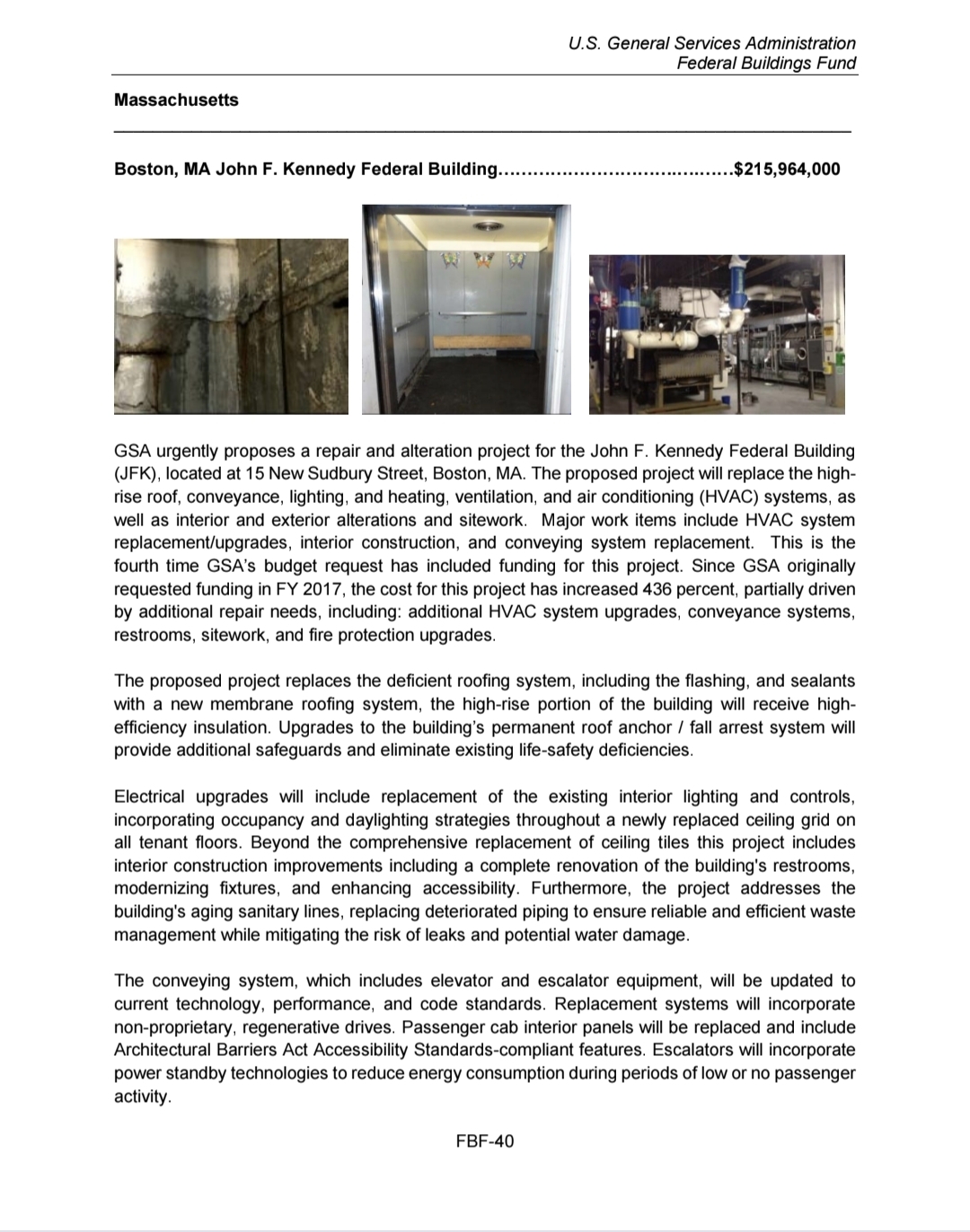
I think we may be forgetting at least one very important piece... It's not as if those federal buildings are wholly vacant, and even if they're redeveloping I'd expect at least one of the major federal buildings to remain in Boston. Personally, I think the most likely candidate to be divested is the JFK Building, with functions consolidating into the Tip O'Niell. It's needed major rehabilitation for years now due to deferred maintenance, to the point where it's currently the single biggest project line item in the GSA's CIP - at nearly $216M, it's fully 1.9% of the entire agency's FY27 requested budget, or put another way, ~29% of the "major repairs and alterations" request.
Last edited:
bigpicture7
Senior Member
- Joined
- May 5, 2016
- Messages
- 4,108
- Reaction score
- 10,806
I don't see why, though, that the future home of consolidated office functions needs to be in one of those existing buildings. None were designed in the last ~40 years. If consolidating, why not do so in a modern, purpose-built facility? See what the DoT did with divesting the old Volpe facility, while making development of a new facility part of the same package. Would love to see that done in this case. If drawing analogies to Volpe, I could see a new build on the low-rise parcel of JFK whilst turning over the high-rise side of the site to a developer.I think we may be forgetting at least one very important piece... It's not as if those federal buildings are wholly vacant, and even if they're redeveloping I'd expect at least one of the major federal buildings to remain in Boston. Personally, I think the most likely candidate to be divested is the JFK Building, with functions consolidating into the Tip O'Niell. It's needed major rehabilitation for years now due to deferred maintenance, to the point where it's currently the single biggest project line item in the GSA's CIP - at nearly $216M, it's fully 1.9% of the entire agency's FY27 requested budget, or put another way, ~29% of the "major repairs and alterations" request.
That's mostly a personal judgement call; unlike Volpe which houses labs, simulators etc and thus has specific requirements, JFKs principal tenants are DHS, HHS and Treasury, plus offices for Markey & Warren, none of which require anything beyond standard office spaces. Meanwhile, Mccormack got a $132M deep renovation in 2009 that netted it LEED gold, and Tip O'Neill is also in relatively good material condition - the only thing the GSA reports it needing is a relatively cheap roof replacement. I don't see the government, or this admin in particular, being willing to develop additional space when 2/3 of their other major buildings are both in decent condition and have sufficient vacant area to accommodate the displaced agencies.I don't see why, though, that the future home of consolidated office functions needs to be in one of those existing buildings. None were designed in the last ~40 years. If consolidating, why not do so in a modern, purpose-built facility? See what the DoT did with divesting the old Volpe facility, while making development of a new facility part of the same package. Would love to see that done in this case. If drawing analogies to Volpe, I could see a new build on the low-rise parcel of JFK whilst turning over the high-rise side of the site to a developer.
My understanding is one of the reasons Mccormack is so high up the list is it's a 700k square foot building, but only about 300k is currently used by tenant agencies. That said, JFK is a far better location for Federal offices - the entire Gov't Center thing - Not to say Redevelopment and accommodating the federal offices in new construction digs on site isn't an option, I just don't think that's realistic right now when there's multiple buildings they could move into without doing so, nor would I, personally, divest the recently ish renovated one in favor of keeping the one that needs 200M in system repairs.
Last edited:
stick n move
Superstar
- Joined
- Oct 14, 2009
- Messages
- 13,823
- Reaction score
- 25,995
I don't see why, though, that the future home of consolidated office functions needs to be in one of those existing buildings. None were designed in the last ~40 years. If consolidating, why not do so in a modern, purpose-built facility? See what the DoT did with divesting the old Volpe facility, while making development of a new facility part of the same package. Would love to see that done in this case. If drawing analogies to Volpe, I could see a new build on the low-rise parcel of JFK whilst turning over the high-rise side of the site to a developer.
Thats the tone I got from it. It seemed (to me) like they want to sell the real estate and get as much money from the sites as they can and then just rent office space in a modern building or buildings.
This would be in the same vein as how the federal govt does public housing now since around the faircloth act, sell as much of the real estate holdings as possible and then just give people vouchers they can use in any normal apartment building to pay a percentage of the rent. Much less permanent as vouchers are just money that can be given/taken away vs physical public housing developments, but both versions have positives and negatives.
Its nice to own your own buildings and not have to pay rent, but just like owning a home there are still many costs associated and especially as buildings get older maintenance and renovations get more and more expensive. Like with the public housing approach theyve taken theres positives and negatives to this also. I’m definitely interested in where this goes as we find out more information.
I was involved with trying to move a VA clinic up to the 16th floor of the McCormack (replacing the 250 Causeway clinic - gov't leasing rules require the GSA to offer space first), and it was ultimately scrapped later on after the renovation costs for healthcare were found to be too high, especially with dealing with the SHPO on the historic elements of the building. The elevator lobbies in that building are gorgeous, and the way it's built and the floorplates are really best suited for offices unless you're fully gutting it. It really should just be *the* federal building in Boston, with any other services leased in other spaces, then the JFK or O'Neill can be sold or converted.
(As an aside, initially the O'Neill was offered for the clinic, which would have been perfect, only a block from the old clinic and with much more flexible spaces that would be easier to convert. However, other gov't tenants objected to the fact one of the VA services was going to be a day treatment program for rehab, so that was sadly scrapped.)
(As an aside, initially the O'Neill was offered for the clinic, which would have been perfect, only a block from the old clinic and with much more flexible spaces that would be easier to convert. However, other gov't tenants objected to the fact one of the VA services was going to be a day treatment program for rehab, so that was sadly scrapped.)
Charlie_mta
Senior Member
- Joined
- Jul 15, 2006
- Messages
- 5,261
- Reaction score
- 8,027
Thank you for trying to help the vets. As a veteran myself, I find it shameful that VA services was blocked by the gov't tenants.(As an aside, initially the O'Neill was offered for the clinic, which would have been perfect, only a block from the old clinic and with much more flexible spaces that would be easier to convert. However, other gov't tenants objected to the fact one of the VA services was going to be a day treatment program for rehab, so that was sadly scrapped.)
stick n move
Superstar
- Joined
- Oct 14, 2009
- Messages
- 13,823
- Reaction score
- 25,995
15 State Street
“Under the Downtown Office to Residential Conversion Program, this project will convert an existing 11-story office building, with retail, to 45 residential apartment units, including 8 IZ units, with ground-floor and second-floor retail space.”
15 State Street | Bostonplans.org
Development Projects and Planned Development Areas (PDAs) that the Development Review division is coordinating.
 www.bostonplans.org
Smuttynose
Active Member
- Joined
- May 26, 2006
- Messages
- 749
- Reaction score
- 4,235
It’s notable that while Boston gives developers a huge tax break for office-to-res conversions, it doesn’t give any relief from the inclusionary/affordable housing mandates requiring between 17-20% of units to be rented at below market rates. I’d rather see the City reduce the tax break - to improve its increasingly challenged finance situation - in return for waiving the IZ requirements. Seattle and Minneapolis, for example, waive their affordability requirements for projects in their conversion programs.

JumboBuc
Senior Member
- Joined
- Jun 26, 2013
- Messages
- 2,847
- Reaction score
- 2,102
I personally adore the McCormack and my opinion of the JFK basically boils down to "tall part is a decent example of 1960s Modernism (like the Pru) and the short part is meh." The Coast Guard building is a slam-dunk no-brainer candidate for a hotel conversion (a la what's going on with its direct next door neighbor) and it's already approved for sale.Not a height fetishist, and don't think all of these sites need to go tall, but the Thomas P. O'Neill Federal Building is an obvious candidate site for Boston's next tallest.
The Tip O'Neill building, meanwhile, has ZERO architectural merit. It's 1980s office-park architecture of which there are probably thousands of examples in suburbs across America. That's not a candidate for conversion, it's a candidate for complete replacement.
I don't really see a world in which all of of the four -- or even three of the four -- get sold (and there's really nothing to indicate that's under consideration). GSA still values federal buildings and doesn't want to be just another commercial office tenant; for plenty of reasons (security and tax purposes among them), they shouldn't be. And if each building is still occupied 27% "on average" and 1/3 "on a good day," you can't really make due with with just one of them.
A plan I would love to see would be to:
- Sell the Coast Guard building ASAP for hotel (or possibly residential) conversion. Move its occupants to the to the O'Neill / JFK.
- Sell the McCormack for residential conversion. Move its occupants to the O'Neill / JFK.
- Use the money from those sales to renovate and restore the JFK tower, and convert some portion of the low-rise JFK section into a modern bankruptcy courthouse.
- Sit on that arrangement for like a decade or so, potentially over-capacity or potentially not depending on the future of federal office employment.
- If it turns out that you only need one of the two remaining complexes, consolidate into the JFK and sell the O'Neill to be the future site of Boston's newest tallest.
RandomWalk
Senior Member
- Joined
- Feb 2, 2014
- Messages
- 3,950
- Reaction score
- 7,451
I would love to see the O’Neill nuked and Nashua St straightened and connected to Causeway. Split the lot and get some height with small footprints.
Justbuildit
Senior Member
- Joined
- Nov 27, 2022
- Messages
- 1,130
- Reaction score
- 3,964
Looks like one of the bigger conversions now has a leasing and overview website. This is the Boston Wharf Company building in Fort Point on Melcher and Summer, using 263 Summer Street as its address.

Only a few listings, but looks like:
Studio - $2,900
1br - $3,500
2br - $5,600
Leases available starting 9/1 and has a roof deck and fitness center. Looks good!

Only a few listings, but looks like:
Studio - $2,900
1br - $3,500
2br - $5,600
Leases available starting 9/1 and has a roof deck and fitness center. Looks good!
The Barnes Building (and it's associated parking lots) is federally owned, but it's not part of the GSA portfolio because it's technically owned by the Army & thus DoD. Similarly, the USCG base in the North End - I know, USCG is technically part of DHS but I suspect it works more like the DoD administratively than not - I suspect the Capt. Williams building fell under GSA mostly because its originally space that was built for the customs service. Basically, Barnes is the last vestiges of the South Boston Navy Yard Annex/Army Base, so it's used by the .mil agencies that don't quite work at Devens/ Hanscom/ Natick - like the ONR, DTRA, recruiting commands, etc. In fact, this is where I'd expect the CG to move out of the Capt Williams building to.Also - what's the deal with the Barnes Building in the Seaport? That's a federal building too, right?
JumboBuc
Senior Member
- Joined
- Jun 26, 2013
- Messages
- 2,847
- Reaction score
- 2,102
My understanding was that the Capt. Williams building had USCG occupants, but also that other Fed agencies (including NOAA) had offices there. I'd imagine the non-USCG occupants (like NOAA) would go to the O'Neill or JFK?The Barnes Building (and it's associated parking lots) is federally owned, but it's not part of the GSA portfolio because it's technically owned by the Army & thus DoD. Similarly, the USCG base in the North End - I know, USCG is technically part of DHS but I suspect it works more like the DoD administratively than not - I suspect the Capt. Williams building fell under GSA mostly because its originally space that was built for the customs service. Basically, Barnes is the last vestiges of the South Boston Navy Yard Annex/Army Base, so it's used by the .mil agencies that don't quite work at Devens/ Hanscom/ Natick - like the ONR, DTRA, recruiting commands, etc. In fact, this is where I'd expect the CG to move out of the Capt Williams building to.
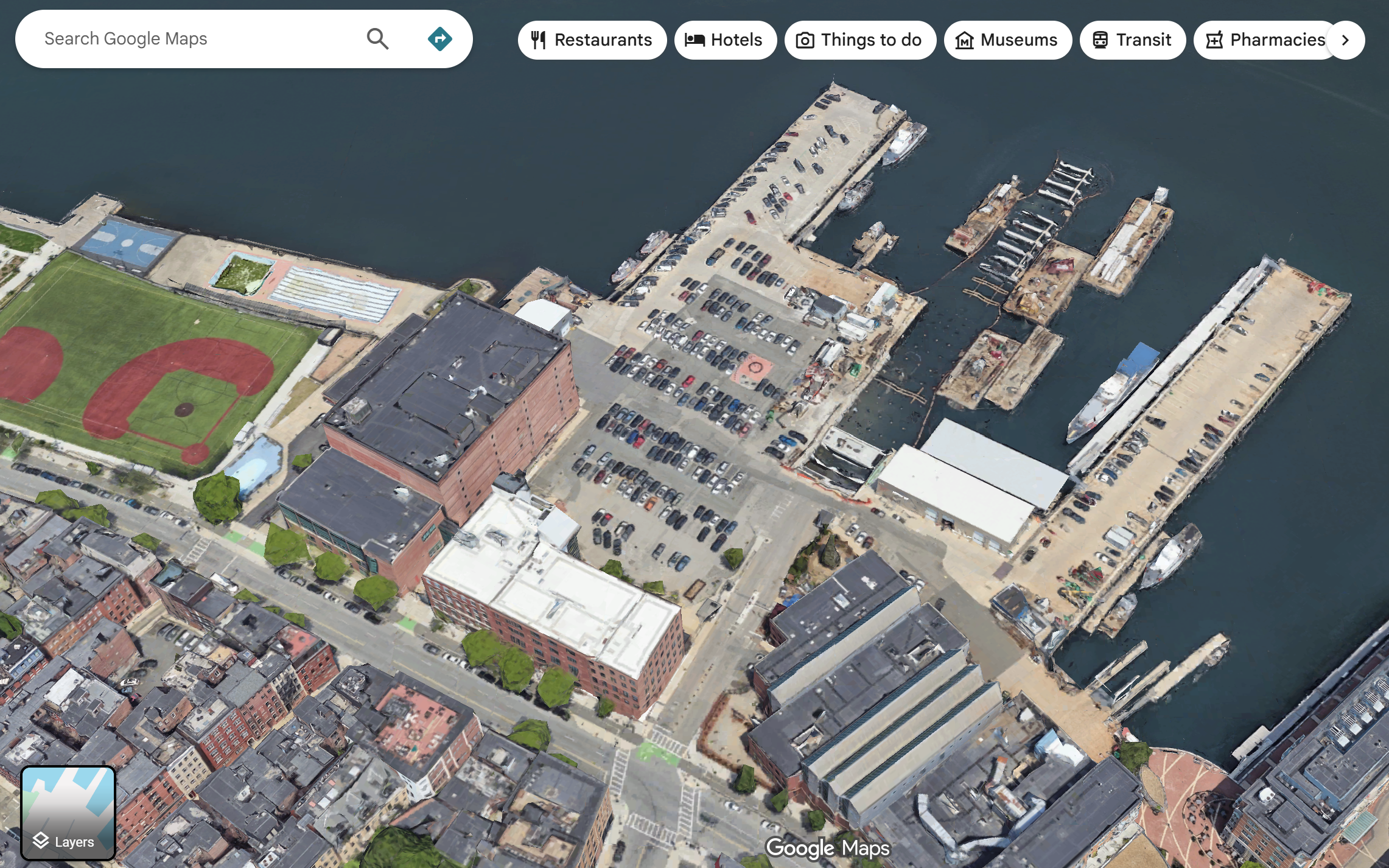
Is there space for the Atlantic Ave USCG tenants at the USCG base in the North End?
Justbuildit
Senior Member
- Joined
- Nov 27, 2022
- Messages
- 1,130
- Reaction score
- 3,964
Tons of room, but don't mess with that parking.
JeffDowntown
Senior Member
- Joined
- May 28, 2007
- Messages
- 5,094
- Reaction score
- 4,344
Storage of empty 2 ton metal transportation containers is prime use for a waterfront location, so I hear from Americans.