General MBTA Topics (Multi Modal, Budget, MassDOT)

The Orange Line is now back. Hopefully we can see some good results in the very few days we have before the federal election that's looking more increasingly grim.

Typically the first few days always have signal problems for some unknown reason. No early morning data from TransitMatters at the moment.

1730560914221.png
 
So like, if the tracks are in much better shape on the orange line, what are the odds of increasing the operating speed sometime in the next say 5 years?
 
So like, if the tracks are in much better shape on the orange line, what are the odds of increasing the operating speed sometime in the next say 5 years?
Not impossible, (According to one railroad.net poster the max speed used to be 50, no source provided) but it's probably not a priority either. The only place you'd really see significant time savings is between Malden Center and Wellington as that's the only place with stops over 1 mile apart. For reference, NQ and JFK are 3.6 miles apart. Just to model the time savings we'll use R160s from NYC since I can immediately find numbers for them. They have an average acceleration of 2.5 MPH/s, which means that they take .14 miles to accelerate to 50 MPH, compared to around .09 miles to accelerate to 40 MPH. I'll assume a similar distance for deceleration because I'm lazy, it's actually a bit shorter. Add a few seconds onto the time savings if you'd like. So with a maximum speed of 40 MPH, JFK-NQ takes ~5:40, but with a max speed of 50 MPH it goes down to ~4:40. Malden Center and Wellington are 1.7 miles apart, so running the numbers again gets you 2:50 at 40 MPH, or 2:20 at 50 MPH. For stops spaced .5 miles apart like on the SW corridor, it's 1:01 at 40 MPH vs 0:56 at 50 MPH.

Assuming an average 10 second penalty between stops, excluding the downtown stops which are closer than 1500ft between them and with the 30 seconds for Malden Center-Wellington, that gives a very rough estimate for the total end-to-end time penalty for the Orange Line of about 2 minutes. Not really a big deal, and less than the ~2:30 just on the Braintree branch of the Red Line.

 
Last edited:
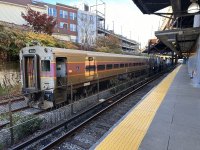
Standing at Sullivan on the inbound platform and there’s two CR coaches parked on track 21 (IIRC). I’ve never seen MBTA equipment parked there ever since I’ve been coming to this station.

Anyone know what gives?
 

Attachments

  • IMG_5922.jpeg
    IMG_5922.jpeg
    4.9 MB · Views: 186
  • image.jpg
    image.jpg
    1.5 MB · Views: 161
Standing at Sullivan on the inbound platform and there’s two CR coaches parked on track 21 (IIRC). I’ve never seen MBTA equipment parked there ever since I’ve been coming to this station.

Anyone know what gives?
They might be going for scrap at Schnitzer Steel in Everett via CSX. 4 others in the retired 1600-series Bombardier cab cars were scrapped there earlier this year.
 
Not impossible, (According to one railroad.net poster the max speed used to be 50, no source provided) but it's probably not a priority either. The only place you'd really see significant time savings is between Malden Center and Wellington as that's the only place with stops over 1 mile apart. For reference, NQ and JFK are 3.6 miles apart. Just to model the time savings we'll use R160s from NYC since I can immediately find numbers for them. They have an average acceleration of 2.5 MPH/s, which means that they take .14 miles to accelerate to 50 MPH, compared to around .09 miles to accelerate to 40 MPH. I'll assume a similar distance for deceleration because I'm lazy, it's actually a bit shorter. Add a few seconds onto the time savings if you'd like. So with a maximum speed of 40 MPH, JFK-NQ takes ~5:40, but with a max speed of 50 MPH it goes down to ~4:40. Malden Center and Wellington are 1.7 miles apart, so running the numbers again gets you 2:50 at 40 MPH, or 2:20 at 50 MPH. For stops spaced .5 miles apart like on the SW corridor, it's 1:01 at 40 MPH vs 0:56 at 50 MPH.

Assuming an average 10 second penalty between stops, excluding the downtown stops which are closer than 1500ft between them and with the 30 seconds for Malden Center-Wellington, that gives a very rough estimate for the total end-to-end time penalty for the Orange Line of about 2 minutes. Not really a big deal, and less than the ~2:30 just on the Braintree branch of the Red Line.
My ca ~2001 copy of the OL track profile says that the entire Northern OL, from Community College to Oak Grove, was actually rated for 55, outside the stations themselves, and the same is true on the southern end from Green St to Forest Hills. That's actually higher than the Red, but likely due to the original plan of running express service to Reading. While I agree it may not result in meaningful service improvements to actually operate at those speeds, especially compared to slow zone free speeds, I don't think we should accept degraded service "because it's good enough." If the T is meant to eliminate its technical / sogr debt, running at design speed everywhere should be part of the deal, but at least here it probably shouldn't be a priority over other sogr needs.
1000038117.jpg
1000038119.jpg
 
Not impossible, (According to one railroad.net poster the max speed used to be 50, no source provided) but it's probably not a priority either. The only place you'd really see significant time savings is between Malden Center and Wellington as that's the only place with stops over 1 mile apart. For reference, NQ and JFK are 3.6 miles apart. Just to model the time savings we'll use R160s from NYC since I can immediately find numbers for them. They have an average acceleration of 2.5 MPH/s, which means that they take .14 miles to accelerate to 50 MPH, compared to around .09 miles to accelerate to 40 MPH. I'll assume a similar distance for deceleration because I'm lazy, it's actually a bit shorter. Add a few seconds onto the time savings if you'd like. So with a maximum speed of 40 MPH, JFK-NQ takes ~5:40, but with a max speed of 50 MPH it goes down to ~4:40. Malden Center and Wellington are 1.7 miles apart, so running the numbers again gets you 2:50 at 40 MPH, or 2:20 at 50 MPH. For stops spaced .5 miles apart like on the SW corridor, it's 1:01 at 40 MPH vs 0:56 at 50 MPH.

Assuming an average 10 second penalty between stops, excluding the downtown stops which are closer than 1500ft between them and with the 30 seconds for Malden Center-Wellington, that gives a very rough estimate for the total end-to-end time penalty for the Orange Line of about 2 minutes. Not really a big deal, and less than the ~2:30 just on the Braintree branch of the Red Line.
My ca ~2001 copy of the OL track profile says that the entire Northern OL, from Community College to Oak Grove, was actually rated for 55, outside the stations themselves, and the same is true on the southern end from Green St to Forest Hills. That's actually higher than the Red, but likely due to the original plan of running express service to Reading. While I agree it may not result in meaningful service improvements to actually operate at those speeds, especially compared to slow zone free speeds, I don't think we should accept degraded service "because it's good enough." If the T is meant to eliminate its technical / sogr debt, running at design speed everywhere should be part of the deal, but at least here it probably shouldn't be a priority over other sogr needs.
View attachment 57533View attachment 57535

2 minutes is still pretty signficant in amount the off-peak headways can decrease.

8 trainsets on Sunday means you shorten Sunday headways by 15 seconds.

Fall 2024 schedules use runtimes as of mid-2024, which was 42 minutes for a one way trip. Early data from TransitMatters suggests OL is currently able to run a one way trip in 36 minutes. For sake of simplicity, let's say a roundtrip of the OL includes 9 minute buffers on either terminal.

# TrainsetsFall 2024 schedules (mid-2024 runtimes = 42 mins one way)

Headway:
36 minute runtime (estimate of one way trip for full speed OL today)

Headway:
35 minute one way trip runtime (raise speed from 40 -> 55 MPH)

Headway:
8 (Sunday)12.8 min11.3 min11 min
911.3 min10 min9.8 min
10 (Saturday)10.2 min9 min8.8 min
119.2 min8.2 min8 min
12 (Weekday evening)8.5 min7.5 min7.3 min
13 (Weekday interpeak)7.8 min6.9 min6.8 min
147.2 min6.4 min6.3 min
156.8 min6 min5.9 min
166.4 min5.6 min5.5 min
17 (AM/PM weekday peak)6 min5.3 min5.2 min

IMO I still think making the Orange faster at 55 MPH is a worthwile endeavor. Saturday and Sunday headways each shave 15 seconds off the wait time from the scheduled headway.

10.2 minute headways on Saturday is unacceptably long and requires printed timetables with scheduled departures. 9 minutes is still meh, but 8.8 minute headways allows for 7 trains per hour service, which is SUAG, and means timetables are only needed for Sunday service. Weekday interpeak and evening service also improve decently. Today's it's every 7.5 - 9 minutes, but frequency increases to every 7 - 7.5 minutes. Raise operating speeds from 40 to 55 and headways further decrease to every 6.8 - 7.3 minutes.
 
Sorry if this is against the rules or the wrong thread, but it is worth having a discussion on what self-funding the MBTA would look like, and if we could do pull it off politically.
 
Nailed it. Didn't celebrate the OL being slow zone free for the past 4 days? Too late to celebrate it now.


A neccessity. Discussions are going to have to get going. 700 million hole that must be solved with ZERO federal funds. No federal funds that can be used until like 2030 at least.

Boston's gridlock is gonna get worse once federal monies for transit dries up. Need the bus to get to the subway? The end of all bus service except for Warren St. in Roxbury.
The answer is congestion pricing and it can't be a 35-year slog like in New York.
 
Wouldn't we need federal approval to do it like in NYC? We'd only have 5 or 6 weeks to set up a system now before the Trump presidential transition gets through. Too late. We'd have to start this at least some years ago.
So then put the tolls on Storrow Drive, the Sumner/Callaghan tunnels, the Longfellow/Harvard/Charles River Dam/N. Washington St bridges, any streets Crossing Mass Ave until Melnea Cass, and finally A St, The S. Boston Bypass, and any streets that connect to Summer St in Seaport. Give all residents EZ-Passes and obviously exempt any vehicles owned by the federal government. Leave the Interstates untouched and untolled, they'll be free but slow as molasses. People who want to get anywhere have to pay the toll. There, you have now essentially implemented a congestion charge without touching any federally controlled roads.

If you really want to toe the line you could just toll all the Interstate exists in Downtown as well but that could get a little iffy.
 
Wouldn't we need federal approval to do it like in NYC? We'd only have 5 or 6 weeks to set up a system now before the Trump presidential transition gets through. Too late. We'd have to start this at least some years ago.

Basically, what are our options now with only 5 - 6 weeks of time we can do? Is there any solution without cutting any MBTA service at all?
I'm also really curious what we can do to save transit. With the funding shortfall it seems like we would have to live with no weekend CR, all buses cut to 30-min or worse frequency, and all heavy/light rail at a 15-min frequency.

Raising fares is not an option. Congestion tolling seems politically impossible. Is quadrupling the gas tax feasible? What about increasing car registration/inspection by $200?
 
So then put the tolls on Storrow Drive, the Sumner/Callaghan tunnels, the Longfellow/Harvard/Charles River Dam/N. Washington St bridges, any streets Crossing Mass Ave until Melnea Cass, and finally A St, The S. Boston Bypass, and any streets that connect to Summer St in Seaport. Give all residents EZ-Passes and obviously exempt any vehicles owned by the federal government. Leave the Interstates untouched and untolled, they'll be free but slow as molasses. People who want to get anywhere have to pay the toll. There, you have now essentially implemented a congestion charge without touching any federally controlled roads.

If you really want to toe the line you could just toll all the Interstate exists in Downtown as well but that could get a little iffy.
I am pretty sure you could strategically toll "around the exits" in a way that does not force Fed scrutiny.
 
Potentially obnoxiously optimistic, but it's possible that the threat of federal funding disappearing is exactly what states like MA need in order to implement serious, long-term sustainable, state-level transit funding measures like congestion tolling, such that when federal funds eventually do come back, they can be used for expansion and improvement rather than life support. As advocates, maybe this is our moment.
 
The city of Boston is already paying for some bus routes to be free of charge. Start charging money for residential parking permits and stop having parking meters be free on Sundays. Start charging in the free city owned lots. Why does a neighborhood like JP have ZERO parking meters? That’s tens of millions in handouts being given to drivers every year that could instead be used to keep bus routes open if need be.
 
No question that the result of the federal election is bad for the MBTA. The GOP control will result in less federal funding. With less federal funding, repairs and expansions may slow down or be skipped altogether, making service worse and decreasing ridership. Fewer riders could mean Massachusetts needs more state money or higher fares, putting pressure on the MBTA’s budget and making it harder to keep the system safe, reliable, and affordable for everyone. Massachusetts will either bridge the gap with state funds or make difficult decisions on fares and service levels to sustain the transit system.

I’m not looking forward to it.

Looks like we’ve got a few more months of good service. Let’s enjoy it while it lasts and advocate for the best possible solutions in a Trump presidency and GOP controlled Senate. It happened before, last time Trump was president, and this time we have Healey and Eng instead of Baker and Poftak. I’ll take that as a reason to be hopeful.
GOP house too. Federal transit funding is going to nil.
 
Best case is MBTA is deferred as we have to wait through a hostile administration. Not much different than before except Eng manage to roll the bolder back enough that we don't have slow zones.

But worse case is the loss of Fed fund with the fiscal cliff means the gap is so big that we get what Delvin already describe as service - or honestly even worse.

We just seem to sleep walking right into it and it feels like the only line that's going to be uttered in mainstream circles is government/MBTA bashing. Tracks all fixed up just to suddenly not use them. If Eng gets scapegoated, I'm going to be so pissed
 
I feel obligated to point out that historically, the T nor other transit agencies didn't have access to any amount of federal operations money - it was all COVID relief funds, and there were no signs that a prospective Harris admin would have made billions available for transit operations nationally. Capital programs would have been a different beast, but unfortunately, this one is on the local agencies to swing. I would expect to see NYC bring back its congestion program, and we in Boston would need to be comfortable with the idea that we'll have to pay more.

I do disagree that fare increases are off the table - the last rise was prepandemic. Given how many fare policy and revenue presentations the board has been taking, I'd expect a fare increase to be imminent. It might not have been politically viable during the slow zone crisis, it absolutely is now. Especially since fare increases are limited by law to 7% every 2 years, it has no chance of catching up to inflation and increase in costs. With the recent expansion of the reduced fare program, the difference from $2.40 to $2.57 (2.55 or 2.50 being more likely) or $1.70 to $1.80 is minor enough that most ridership should be able to swallow it - while it won't come close to bridging the fiscal cliff, across all ridership it'd bring in ~30m in additional revenue - and at this point, every penny helps. If it is a inflation catch-up, at 23% it'd be a full 95m @ a 2.96 subway fare.

1000038146.jpg
1000038148.jpg
1000038150.jpg

As for capital... MA has the capacity to build a lot of it without federal dollars. GLX was funded by 1.3B in State funds in addition to 996M in federal dollars. For SCR phase 1, the full cost of 1.1B was funded by the Commonwealth. Red-Blue is in the same ballpark. NSRL not so much, but it could be worse.
 
Last edited:

Back
Top