oh shit, is this "150 second cycle" something you can look up via massdot or something? I would love to add it to my arsenal of "things in my mind that are almost totally useless but pretty cool if i can use it in a scenario that helps save time". or are you basing it off empirical evidence (or extrapolating from 5 phases + 30 seconds per interval)this is a 150 second cycle intersection with 5 phases (SB advance, SB/NB, WB Commercial, Endicott St, EB Causeway). none of the approaches are getting 40%.

You are using an out of date browser. It may not display this or other websites correctly.
You should upgrade or use an alternative browser.
You should upgrade or use an alternative browser.
MBTA Buses & Infrastructure
- Thread starter Arlington
- Start date

Highwayguy
Active Member
- Joined
- Apr 1, 2020
- Messages
- 206
- Reaction score
- 548
Absolutely. Should have clarified my point:this is a 150 second cycle intersection with 5 phases (SB advance, SB/NB, WB Commercial, Endicott St, EB Causeway). none of the approaches are getting 40%.
Even with wildly overly generous auto throughput assumptions, if we prioritize moving the maximum number of people, it is mathematically impossible this change is an improvement.
Frankly, the NB parking lane along this entire stretch should have been on the chopping block way before the bus lane, or the second vehicular lane for that matter. IMO the cars vs bus/peds/bikes fight often misses the forest for the trees; the removal of the bus lane and the prior removal of the vehicular lane are great examples of mobility consistently losing the war against on street self-storage units(?).

Delvin4519
Active Member
- Joined
- Oct 8, 2022
- Messages
- 962
- Reaction score
- 1,657
So I would really like some input from some neutral parties here. How bad was the traffic because of this bus lane (and obviously I’m asking about rushhour)? I’m not looking to hear from anyone who’s going to show me traffic counter numbers or who just doesn’t think that any of the bus lane and bike lane stuff has caused traffic to get worse.
Using the MBTA bus timepoints data gives this graph in the northbound direction.
Weekday travel times signficantly worsened in the wake of the COVID pandemic ending in mid-2021 to late 2022. At one point in early 2022, 5-10% of weekday trips were taking longer than 18 minutes to travel outbound between Haymarket and City Square.
There doesn't seem to be any effect on Saturday or Sunday travel times (the middle and bottom rows)
The median time to cross the bridge northbound during rush hour pre-COVID and currently, is about 7 - 8 minutes. In Fall 2021 and early 2022, it climed to around 14 minutes.
Southbound/Inbound data doesn't seem to be impacted that much (though there are some data quality control problems in Fall 2020 and early 2021)
Southbound/inbound travel times seem to decrease on weekdays compared to pre-COVID, but increase on Saturdays
Historically, traffic outbound wasnt typically terrible, but there has only been 1 lane open outbound on the bridge since 2018 (when emergency repairs to the old bridge started). will be interesting to see how it all operates again. its been a long time
The bad news is the MBTA slashed bus service across the bridge by almost 50%, with a new additional service cut and reduction earlier this spring, despite the bridge opening in full. Only half as many buses cross the new bridge nowadays compared to pre-COVID. Instead of 120 buses crossing the bridge in each direction per weekday, it is now just over 60 buses each day,

themissinglink
Senior Member
- Joined
- Jan 13, 2018
- Messages
- 2,199
- Reaction score
- 6,280

Are the bus lanes near Brookline Village working? Town, MBTA say they need six more months to find out - Brookline.News
A key town board on Wednesday recommended extending a controversial bus-only lane pilot near Brookline Village for at least another six months to allow the town and MBTA to keep testing out the concept. The “Gateway East” project laid down a bus-only lane last July that runs in both directions...
 brookline.news
Data presented on Wednesday shows that, as expected given the lane’s design, buses have sped up and overall car traffic has slowed down. Congestion in the area, present before the pilot, has persisted and at some intersections delays have been longer.
Botti’s nine-month update shows that during morning and evening peak traffic times, bus travel times within the stretch improved, compared to the same time last year. Outside of the study area and along their routes in Brookline, bus travel times remained steady or slightly worsened, compared to previous months.
The data indicates that more cars are skipping Route 9 traffic and moving to nearby side streets, confirming worries residents had previously voiced.

cubbe8
Active Member
- Joined
- Mar 18, 2022
- Messages
- 429
- Reaction score
- 763
The select board will probably kill it considering their views related to bike and bus infrastructure. Getting it approved the first time was a massive headache.Are the bus lanes near Brookline Village working? Town, MBTA say they need six more months to find out - Brookline.News
A key town board on Wednesday recommended extending a controversial bus-only lane pilot near Brookline Village for at least another six months to allow the town and MBTA to keep testing out the concept. The “Gateway East” project laid down a bus-only lane last July that runs in both directions...

HenryAlan
Senior Member
- Joined
- Dec 15, 2009
- Messages
- 4,534
- Reaction score
- 5,452
I'm not sure this is the right question to ask. I'd suggest asking which configuration improves throughput for the greatest number of people. I don't have the data, so I can't particularly answer the question, but it seems clear that there is a trade-off. Do we favor single occupancy vehicle throughput, or do we favor bus rider throughput? The answer to that question should inform how we determine best street design.So I would really like some input from some neutral parties here. How bad was the traffic because of this bus lane (and obviously I’m asking about rushhour)?
I asked that question specifically because I wanted to know what Wu’s angle was, if any, with the change. If the traffic was clearly worse due to the bus lane, it would suggest she is trying to placate a specific neighborhood, Charlestown, which historically has not been known for enlightened or progressive political leanings. If traffic wasn’t obviously much worse, the move would be more a political signal to the broader electorate but without any real impact—to say “hey, I’m Wu and I’m listening to all you Kraft people”.I'm not sure this is the right question to ask. I'd suggest asking which configuration improves throughput for the greatest number of people. I don't have the data, so I can't particularly answer the question, but it seems clear that there is a trade-off. Do we favor single occupancy vehicle throughput, or do we favor bus rider throughput? The answer to that question should inform how we determine best street design.
However, I think from a transportation perspective your question is the only the very first question to ask. If you can move large numbers of people in buses from the Navy Yard but strangle everyone else coming in from the North Shore, vs the opposite of that, also matters—it’s not just how many bodies cross the bridge per minute but what is the distribution geographically. It also does matter significantly if flow is improved on average but during rush hour traffic is hopelessly snarled. Boston does not have much capacity for vehicles and one design fuck up can cause gridlock in many directions, which has direct impacts on emergency vehicle access, among other things.
Bus lanes are even better for emergency vehicles than an extra travel lane.Boston does not have much capacity for vehicles and one design fuck up can cause gridlock in many directions, which has direct impacts on emergency vehicle access, among other things.
But, that premise - Boston doesn't have much capacity for vehicles - is going to tilt things even more toward bus lanes, congestion pricing, or other forms of non-SOV investment.

HBH
Senior Member
- Joined
- Apr 17, 2018
- Messages
- 1,566
- Reaction score
- 4,761
Somewhere along the way the MBTA published this list of evaluations of all of their bus lanes, presumably made in response to increasing criticism from certain municipalities... https://www.mbta.com/performance-metrics/bus-lane-performance-reports
Of particular interest to me is some of the 2025 ones which reference the currently unannounced BNRD Phase 2.
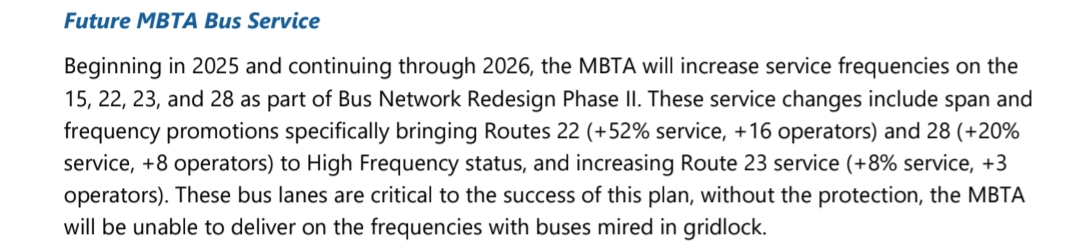
Of particular interest to me is some of the 2025 ones which reference the currently unannounced BNRD Phase 2.
Re your first sentence— that may be so, but Boston never has continuous bus lanes. The issue I was raising was if some random 3 block segment of bus lane causes massive traffic backup everywhere around it. That does not help emergency vehicle times, it hurts them.Bus lanes are even better for emergency vehicles than an extra travel lane.
But, that premise - Boston doesn't have much capacity for vehicles - is going to tilt things even more toward bus lanes, congestion pricing, or other forms of non-SOV investment.
But both your sentences obliquely refer to the reality that the only real solutions are systemic and that piecemeal solutions to systemic problems dont work. Random bits and pieces of bus lanes work dont really solve the problem. Yes to congestion charge since that's the only local yet systemwide intervention available to local governments (if that). But really we should have much more centralized planning at the regional and national level. Alas, it seems we probably will never live to see that happen.
bigeman312
Senior Member
- Joined
- Jul 19, 2012
- Messages
- 2,439
- Reaction score
- 2,551
This is yet another reason why larger scale center-running bus lane projects, like Blue Hill Ave, or the multi-phase Columbus Ave project, are such a value-add. They are corridor, rather than short segments.Re your first sentence— that may be so, but Boston never has continuous bus lanes. The issue I was raising was if some random 3 block segment of bus lane causes massive traffic backup everywhere around it. That does not help emergency vehicle times, it hurts them.
But both your sentences obliquely refer to the reality that the only real solutions are systemic and that piecemeal solutions to systemic problems dont work. Random bits and pieces of bus lanes work dont really solve the problem. Yes to congestion charge since that's the only local yet systemwide intervention available to local governments (if that). But really we should have much more centralized planning at the regional and national level. Alas, it seems we probably will never live to see that happen.
Emergency vehicles can travel for miles over them unimpeded.

TheRatmeister
Senior Member
- Joined
- Sep 23, 2023
- Messages
- 1,630
- Reaction score
- 3,340
And to keep adding to this, it's why I think that having such corridors downtown is especially valuable.This is yet another reason why larger scale center-running bus lane projects, like Blue Hill Ave, or the multi-phase Columbus Ave project, are such a value-add. They are corridor, rather than short segments.
Emergency vehicles can travel for miles over them unimpeded.

Koopzilla24
Active Member
- Joined
- Dec 20, 2022
- Messages
- 465
- Reaction score
- 1,393
Im here nearly every day to commute via the 65, 66, or by bike, and the biggest issue with any traffic congestion is the pretty terrible light cycle timing. Doing my best to annotate on an iPhone on an old image but the problem is that there are a lot of backups trying to take the left onto Brookline from Rt9 in the AM, so everyone ignores the "Right Only" at High St. and continues straigh through the bus lane (Green) to get around the left turn traffic (Red). This turning traffic builds up a lot because Washington St from Brookline Village releases onto Rt9 at the end of the green cycles for Brookline Ave and the Pearl/Walnut intersection leading to the Rt9 traffic at Washington Int. getting realeased into already full lanes on a red. What would go a long way to relieving this is if drivers coming from Rt9 realized they could take the legal right onto High to then go left on Walnut and straight through to Pearl and then Brookline (Blue). As it stands these side streets only have a few cars each cycle on them and are basically empty, and with the current signal timing, doing this maneuver would get those going to Brookline Ave through the area quicker since its on green or about to go green when they get that Washington green (convoluted sounding I know).Are the bus lanes near Brookline Village working? Town, MBTA say they need six more months to find out - Brookline.News
A key town board on Wednesday recommended extending a controversial bus-only lane pilot near Brookline Village for at least another six months to allow the town and MBTA to keep testing out the concept. The “Gateway East” project laid down a bus-only lane last July that runs in both directions...
Hopefully what Im getting at makes sense and I described it properly. Kinda rushed the explaination
If you have this experience, I highly recommend reaching out to the project team so that they can include that in their review.Im here nearly every day to commute via the 65, 66, or by bike, and the biggest issue with any traffic congestion is the pretty terrible light cycle timing. Doing my best to annotate on an iPhone on an old image but the problem is that there are a lot of backups trying to take the left onto Brookline from Rt9 in the AM, so everyone ignores the "Right Only" at High St. and continues straigh through the bus lane (Green) to get around the left turn traffic (Red). This turning traffic builds up a lot because Washington St from Brookline Village releases onto Rt9 at the end of the green cycles for Brookline Ave and the Pearl/Walnut intersection leading to the Rt9 traffic at Washington Int. getting realeased into already full lanes on a red. What would go a long way to relieving this is if drivers coming from Rt9 realized they could take the legal right onto High to then go left on Walnut and straight through to Pearl and then Brookline (Blue). As it stands these side streets only have a few cars each cycle on them and are basically empty, and with the current signal timing, doing this maneuver would get those going to Brookline Ave through the area quicker since its on green or about to go green when they get that Washington green (convoluted sounding I know).
View attachment 65250That being said, reconfiguring the timings and cycles to better suit the traffic patterns of the given time of day as originally stated would be the best remedy of the situation. Rt9 at High St should go red before Pearl/Walnut and Brookline, leaving them green to empty out traffic before letting Washington out onto Rt9 with Peal/Walnut green (westbound can simultaneously head up Washington) to let Wahsington traffic fill the Queue then turning red briefly for cross traffic (whilst Westbound is released up the Rt9 hill) then start from the top with green at Brookline for Rt9 eastbound cascading to Peal/Walnut and High St. This would keep queues from overflowing and blocking the next cycle and is much better in line with where the AM traffic volumes are than the existing timings. PM is way simpler and not too bad. The backups happen more with the Cypruss intersection than back here and the bus has a clear path because few people are heading right up Washington.
Hopefully what Im getting at makes sense and I described it properly. Kinda rushed the explaination
soundguise
New member
- Joined
- Jun 11, 2021
- Messages
- 25
- Reaction score
- 78
Related to center running bus lanes…This is yet another reason why larger scale center-running bus lane projects, like Blue Hill Ave, or the multi-phase Columbus Ave project, are such a value-add. They are corridor, rather than short segments.
Emergency vehicles can travel for miles over them unimpeded.
Do we ever hear anyone talking about upgrading the silver line Washington st to center running? There (mostly based on a quick google maps measurement of Washington st and comparison to Columbus ave) seems to be plenty of room for most of the run. There might even be room in a few spots to add some loading zones and bike lanes.
The lack of knowledge of using that Walnut Street extension (or whatever it is, it’s probably the original beginning of the street) around the fire station has been a longstanding issue.Im here nearly every day to commute via the 65, 66, or by bike, and the biggest issue with any traffic congestion is the pretty terrible light cycle timing. Doing my best to annotate on an iPhone on an old image but the problem is that there are a lot of backups trying to take the left onto Brookline from Rt9 in the AM, so everyone ignores the "Right Only" at High St. and continues straigh through the bus lane (Green) to get around the left turn traffic (Red). This turning traffic builds up a lot because Washington St from Brookline Village releases onto Rt9 at the end of the green cycles for Brookline Ave and the Pearl/Walnut intersection leading to the Rt9 traffic at Washington Int. getting realeased into already full lanes on a red. What would go a long way to relieving this is if drivers coming from Rt9 realized they could take the legal right onto High to then go left on Walnut and straight through to Pearl and then Brookline (Blue). As it stands these side streets only have a few cars each cycle on them and are basically empty, and with the current signal timing, doing this maneuver would get those going to Brookline Ave through the area quicker since its on green or about to go green when they get that Washington green (convoluted sounding I know).
View attachment 65250That being said, reconfiguring the timings and cycles to better suit the traffic patterns of the given time of day as originally stated would be the best remedy of the situation. Rt9 at High St should go red before Pearl/Walnut and Brookline, leaving them green to empty out traffic before letting Washington out onto Rt9 with Peal/Walnut green (westbound can simultaneously head up Washington) to let Wahsington traffic fill the Queue then turning red briefly for cross traffic (whilst Westbound is released up the Rt9 hill) then start from the top with green at Brookline for Rt9 eastbound cascading to Peal/Walnut and High St. This would keep queues from overflowing and blocking the next cycle and is much better in line with where the AM traffic volumes are than the existing timings. PM is way simpler and not too bad. The backups happen more with the Cypruss intersection than back here and the bus has a clear path because few people are heading right up Washington.
Hopefully what Im getting at makes sense and I described it properly. Kinda rushed the explaination
This is a little tangential for this thread, but I’m thinking about the fact that at least in my experience, driving in cities in Europe there are a lot more signs and painted lane markings then we tend to see in the states. And they are actually followed. I’m wondering if part of this is the fact that urban driving tends to be lower speed, and also the fact that vehicles are much smaller. When you’re close to the ground in your little sedan, it’s easier to feel like you’re in the street and easier to observe lane markings. I think the physical distance American drivers have from people bikes pavement because of driving enormous vehicles probably contributes more than we realize to the harsh driving culture. I doubt this will change anytime soon but I do wish we could shrink the size of vehicles.
Koopzilla24
Active Member
- Joined
- Dec 20, 2022
- Messages
- 465
- Reaction score
- 1,393
I responded to the survey with feedback and emailed the project team a slightly more polished version of the above. I hope it is viewed by someone and helps them get a better idea of daily conditions.If you have this experience, I highly recommend reaching out to the project team so that they can include that in their review.
Speaking of the fire station, another observation/thought is when fire trucks leave or return, the lights obviously halt all traffic in the intersection for their maneuver, but after its complete they always revert to greens on Rt9 and hold them for an extended period of time regardless of whether or not the previous cycle before the halt was a green for Rt9 already. It seemingly makes sense for it to get the go-ahead cause it has more traffic on it, but the other streets, Washington and High, have very short queue areas between this intersection and their respective prior ones. This means that every firetruck movement is essentially a lost signal cycle for them and the effects cascade down the line. It's especially problematic on the Washington end because the buses lose 5min if they're caught up at a bad time, which is bad when the rush hour headways are only 8-12min (bunching). It happens so often that I have such a detailed recounting of it.The lack of knowledge of using that Walnut Street extension (or whatever it is, it’s probably the original beginning of the street) around the fire station has been a longstanding issue.
Talking with emergency services folks - the presence of any bus lanes is generally better than no bus lanes on the streets of today. This being because with bigger SUVs, more sound proofing, and anti-social attitudes, drivers don't make space when cars are stacked. Emergency services want space for people to pull over into and bus lanes provide that extra space, so they prefer a street with bus lanes when responding to a call. Continuous would be ideal but they understand and appreciate when the ideal can't be made real.Boston never has continuous bus lanes
This is going round in circles but if the two block bus lane (eg, in Chinatown) causes massive traffic backups (eg, such that Essex and Boylston and other nearby roads are completely gridlocked), the ambulance is going nowhere, period, because the ambulance isn’t even gonna reach that little bus lane if it can’t get there in the first place.Talking with emergency services folks - the presence of any bus lanes is generally better than no bus lanes on the streets of today. This being because with bigger SUVs, more sound proofing, and anti-social attitudes, drivers don't make space when cars are stacked. Emergency services want space for people to pull over into and bus lanes provide that extra space, so they prefer a street with bus lanes when responding to a call. Continuous would be ideal but they understand and appreciate when the ideal can't be made real.
The only real fix is to increase flow: move more people per minute, however it’s done.
However, in a city like Boston, with very little room for error, even a small tweak can lead to significant backup elsewhere, and this has to be factored into any calculation. No segment exists in isolation.
No, it's not going in circles - you're just not getting the point. Emergency services folks like bus lanes because they generally keep some part of the street clear even if it's for a few blocks. Where before bus lanes, they would be stuck in traffic and no one - masshole or ambulance/truck driver - had any space on the street to move into to get out of the way when lights/sirens are running. This is especially true of the places with "massive traffic backups" in the places you name.This is going round in circles but if the two block bus lane (eg, in Chinatown) causes massive traffic backups (eg, such that Essex and Boylston and other nearby roads are completely gridlocked), the ambulance is going nowhere, period, because the ambulance isn’t even gonna reach that little bus lane if it can’t get there in the first place.
The only real fix is to increase flow: move more people per minute, however it’s done.
However, in a city like Boston, with very little room for error, even a small tweak can lead to significant backup elsewhere, and this has to be factored into any calculation. No segment exists in isolation.