MBTA Fare System (Charlie, AFC 2.0, Zone, Discounts)

Looking over this, the T does not seem convinced that boarding will become significantly faster if routes are made fare-free. Based on the data from the current pilot and the move to all door boarding systemwide, that seems reasonable at face value. The only cost savings come from less Fare Enforcement Personnel, as described below:
A curtailment of future hiring of this manner could save the MBTA approximately $2.9 million per year for each 16-person cohort of Fare Engagement Representatives not hired in the future.
This notably does not provide any estimation of how many fewer cohorts would be needed (and what the total annual savings might be). While it's not much, it does seem to suggest that costs savings and operational improvements were not given the thorough analysis that cost increases were.

Also, the MBTA appears to think that they cannot legally halt the current Fare Free "Pilot" due to FTA rules stemming from the Civil Rights Act:
All public transit fare changes, whether fare increases or decreases, are subject to federal regulation under Title VI of the Civil Rights Act of 1964, as detailed in FTA Circular 4702.1B Title VI Requirements and Guidelines for Federal Transit Administration Recipients.6,7 At a high level, Circular 4702.1B specifies that all fare changes require public engagement, equity analysis, and board approval.
The ending of a fare-free bus program, meaning the resumption of fare collection for riders, after more than 6 months of operations also requires public comment, equity approval, and board approval. Given that MBTA bus routes generally have a higher percentage of riders of color and riders with low-income than the system as a whole, the creation of a fare-free bus program is likely to “pass” an equity analysis.11 However, if and when fare- free service is to end on those routes, the required equity analysis will likely return a failing result absent significant mitigation. In short, the requirement for equity analysis of any fare change lasting longer than six months makes fare-free bus programs relatively easy to begin but hard for the MBTA to end.
FTA Circular 4702.1B appears to still be in effect (at least for now). Even if it was repealed, the optics would not be pretty in needing it for a fare increase.

Lastly, it is worth noting that costs associated with the RIDE could be the most expensive part of implementing fare-free busses. ADA rules mean that if the busses are free, the RIDE largely has to be as well. This is projected to cost between $27 and $63 million (Table 3). While it is understandable to not charge paratransit users exorbitant fares, I don't think this scenario was envisioned when the ADA language was written limiting fares to no more than double fixed route fares.
 
Last edited:

Note: While I have no doubt that people evade fares on the surface branches, IMO the title is clickbait-y.

As written, the headline would make you think that there are more fare evaders than before. But the main quantitative statements in the article doesn't exactly paint that picture: (emphasis mine)
Before the contactless system launched, about 42 to 46% of riders used non-gated stations. After August of 2024, that figure rose sharply — reaching 56.5% in September — suggesting that more people are boarding at stops where fare payment is unenforced.
This is about (# people who board at Green Line surface stations) divided by (# people who use the Green Line). Technically, total ridership at these stations isn't equivalent to the number of fare evaders.

More importantly, the time frame of August 2024 seems suspect. Of course, as the fall semester begins, the BU stops will see more total ridership and take up a higher proportion among all Green Line riders -- because students are back to campus! Same for the E branch with NEU and other schools.

So when exactly was the "42 to 46%" measured? If it was August 2023, that's totally reasonable. But August 2023 to August 2024 probably wouldn't be described as "rose sharply". If the rise was from July 2024 to September 2024... Then this whole paragraph is meaningless as it should be common sense.

When I first read the headline, my interpretation was "riders used to be forced to board at the front door and pay fares more often, but because all doors open now, they no longer pay fares". That's not the impression I got from this article, and definitely not from the numbers -- even if it's true.
 
Last edited:
20250405_142229.jpg

Man these things are pretty ugly
 
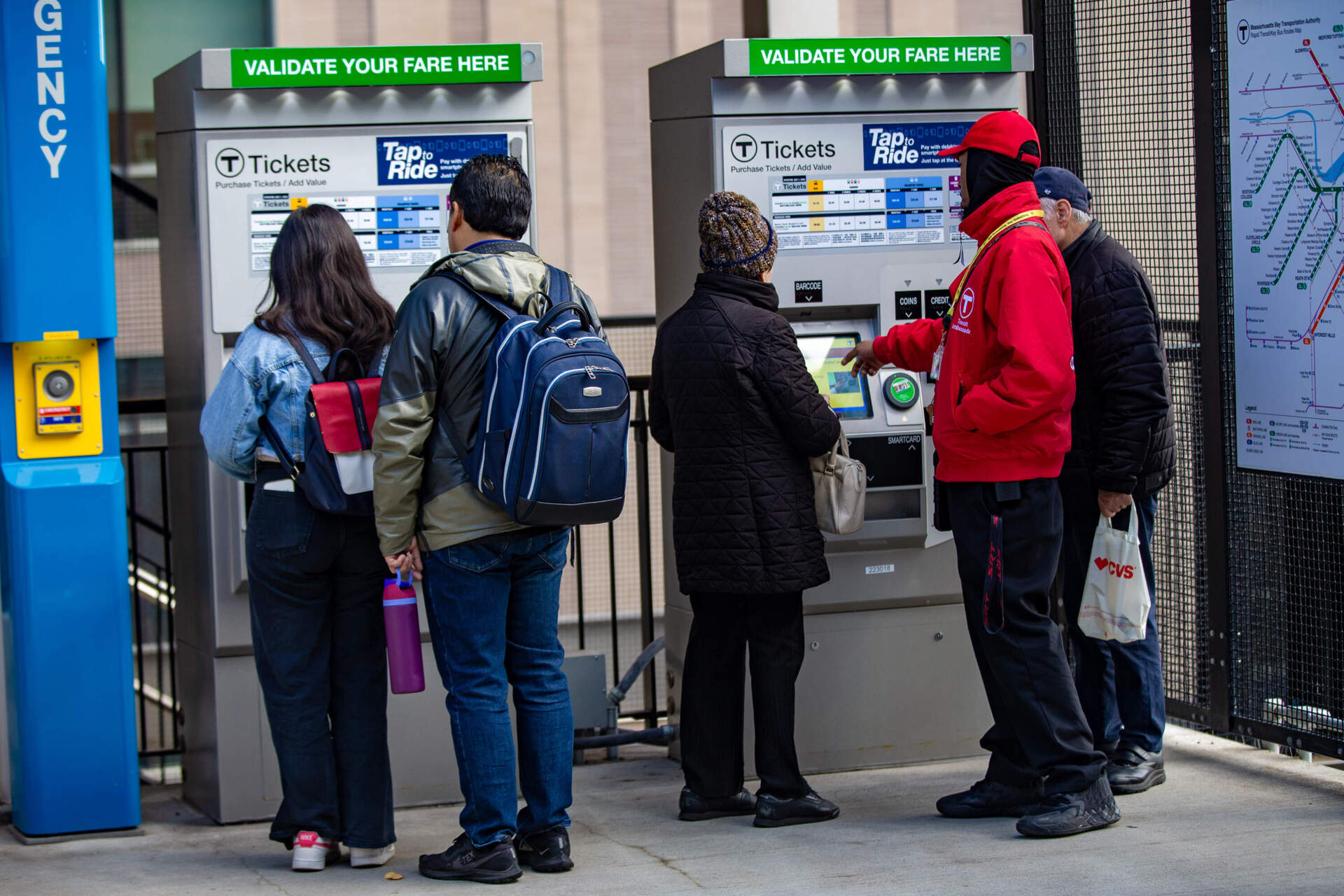
Those are original Oyster machines installed circa 2010 (15 years ago). Their new machines look like this, screen centric which is what a modern machine should be.
View attachment 63802View attachment 63803View attachment 63804
View attachment 63805
Notice that all your pictures are indoor locations.

Pure touchscreen interaction with fare machines are problematic and prone to breakdown in New England conditions outdoors.

There are the ultra-resistive touch screens that can work outdoors in almost all weather, but they are pricey. I suspect side buttons are much cheaper (and can be used with gloves on).
 
It’s Cubic remixing their kit of parts from the MTA. I’m not surprised given the requirements or the contractor.
 
So is the Charlie Card staying the same appearance-wise, but upgraded for AFC 2.0? The MBTA website for it made it seem like they were doing a funky new design, did that get canned? The card on the new machine looks the same (unless the machines are backwards-compatible, which would make sense why it’s showing the old card).
 
Notice that all your pictures are indoor locations.

Pure touchscreen interaction with fare machines are problematic and prone to breakdown in New England conditions outdoors.

There are the ultra-resistive touch screens that can work outdoors in almost all weather, but they are pricey. I suspect side buttons are much cheaper (and can be used with gloves on).
Famously there are no outdoor touch screens on any of the existing fare machines the MBTA has though right.

Also the new ones are still touch screen. Buttons are just an accessibility option. So it's not for cost savings.
 
More than 13,000 of the approved applicants live in Boston, representing nearly 45% of the total pool and far more than any other municipality, according to MBTA data. Quincy (1,413 enrollees), Malden (1,316), Cambridge (1,115) and Revere (951) were the next most common communities.

Within Boston itself, the most common neighborhoods from which applicants hailed were Dorchester, East Boston and Beacon Hill.

Before the program launched, the T projected that 25,000 to 29,000 fixed-route riders would enroll in the first year. Officials forecast the annual membership would grow to 62,000 by the fifth year, generating millions of additional trips in the process as well as increasing usage — and costs — of the RIDE paratransit service.
 
I wonder how this compares with corporate pass program, college pass, and school pass participant numbers.
 
The sixty-fith thousand five hundred thirty-fifth reason that frustrates me with discourse here.

In Canada, Australia, Japan, or Europe*, free fares simply aren't used at all anywhere on massive scale. They focus on expanding service frequency and therefore have high ridership.

Meanwhile domestic discourse here wastes time and energy on free fares, while Chicago, Portland, Providence, and Philadelphia get ready to massacre mass transit completely with 25-45% service cuts.

Nobody is going to want a free bus that runs once an hour. But'd they'd be happy to pay a fare for a bus that runs every 10 minutes. Why not just do unlimited transfers for 2 hours?

Toronto and Sydney don't have free fares. Why is the discourse here "we need to do free fares", if there is a massive 300-500 million fiscal cliff looming? We're literally less than a year away from something that could kill 70% of all of service that exists. Eng should really stress the fiscal cliff and warn of dangerous "service cuts", and "service cuts" with a stern voice pointed directly at the free fare advocates.

The fact that domestic discourse is this bad and frustrating is demoralizing. Toronto, Calgary, and Edmonton inspire hope. Boston and everything else, does not.

1753838757982.png
 
Last edited:
At least they won’t be cordoning off the South Station interior.
But those purple labels are saying the fare gates will be in front of the new bus terminal entrance, which makes exactly zero sense. Either they're placed incorrectly, or the right hand and left hand are truly not speaking to each other.
 
But those purple labels are saying the fare gates will be in front of the new bus terminal entrance, which makes exactly zero sense. Either they're placed incorrectly, or the right hand and left hand are truly not speaking to each other.

Weirdly, in the second picture the purple label looks like it dead-ends at the base of the arch near the escalators to the bus station (in the second picture, in front of the construction fencing), while the label is clearly denoting fare gates in front of the elevator access to the bus station (in the third picture of the set).

Either they just couldn't put the purple label across the escalator access because of the construction fencing, or they screwed up somewhere, because it'd be insane to have the escalator entrance to the bus station outside the gates but the elevator entrance inside them.
 

Back
Top