Roads and Highways General Development Thread

I know a lot of highway departments have started to narrow roads in subdivisions and eliminate unnecessary sidewalks for environmental reasons as well as safety, so seeing this is mind-boggling. I'd be curious to see the amount of pavement used in the intersection before construction versus after. Just having an at-grade intersection would make so much more sense!
 
I know a lot of highway departments have started to narrow roads in subdivisions and eliminate unnecessary sidewalks for environmental reasons as well as safety, so seeing this is mind-boggling. I'd be curious to see the amount of pavement used in the intersection before construction versus after. Just having an at-grade intersection would make so much more sense!
At-grade is my preferred option. Plus make bus lanes down the center of Route 9.
 
At-grade is my preferred option. Plus make bus lanes down the center of Route 9.
I'm serious about the bus lanes. Sure, they would wipe out one of the two general traffic lanes on Rte 9, but the bus lanes would help mitigate that traffic capacity loss with expanded and faster bus service. This interchange is located in a typical "car is king" suburbia replete with sprawling commercial and retail complexes with huge parking lots. Break it up with bus lanes and TOD at the BRT stops.
 
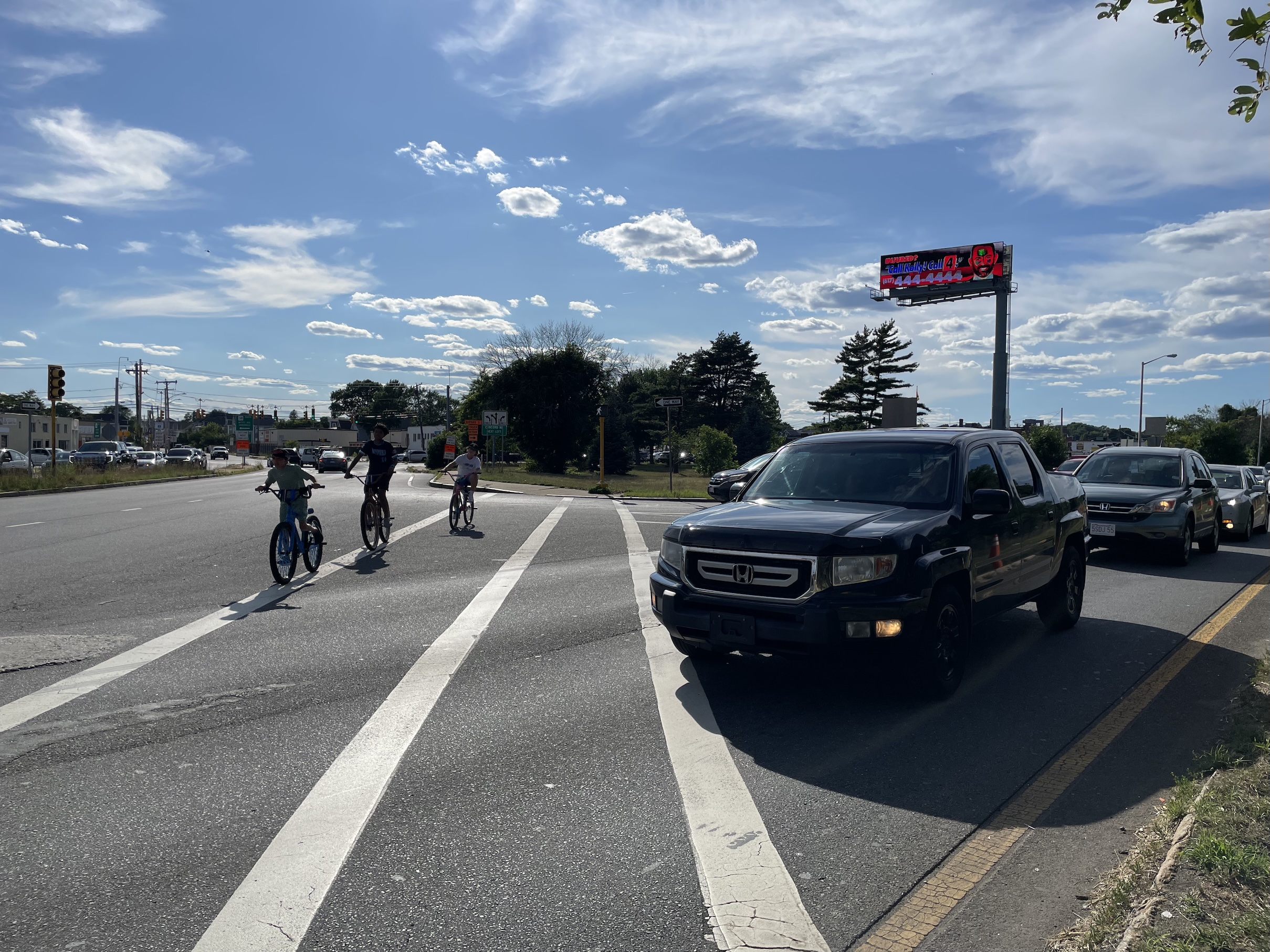
Route 6 has been a “crash problem for a long time,” said Jacqueline Jones, assistant director of transportation planning at the Southeastern Regional Planning & Economic Development District. Route 6 is home to 23 of 100 of southeastern Massachusetts’ most dangerous intersections, according to the agency.
Jones attributed “the crash problem” to the highway’s “outdated design.”
Route 6 was originally constructed in 1926 to bring travelers from Provincetown to Brewster, New York. But in 1974, a new highway, Interstate-195, that ran parallel to Route 6 and performed much of similar functions was completed. Now, Route 6 no longer serves as a highway. But those who live and work along the road say it still feels like one instead of a main boulevard.
“(Route 6) was designed long before pedestrian and bicycle needs were taken into any consideration,” Jones said. “It doesn’t meet any standards or what people need from it.”
While some stretches of Route 6 wind through forested areas with few pedestrians or businesses, the section cutting through Fairhaven receives a lot of activity. Peter Furth, a professor at Northeastern University who studies traffic issues, called Fairhaven’s part of the highway the “deadliest kind of highway.”
 
This route definitely needs a "Complete Streets' transformation with one travel lane in each direction, protected bike lanes, improved sidewalks and crosswalks, a median or median barrier to prevent random left turns, and left turn lanes at intersections. Seems like a no-brainer to do this, especially since I-195 is the main thoroughfare and Rte 6 is basically a local distributor road.
 
I'm serious about the bus lanes. Sure, they would wipe out one of the two general traffic lanes on Rte 9, but the bus lanes would help mitigate that traffic capacity loss with expanded and faster bus service. This interchange is located in a typical "car is king" suburbia replete with sprawling commercial and retail complexes with huge parking lots. Break it up with bus lanes and TOD at the BRT stops.
No one is taking busses in this area. There are no places for TOD as the towns don’t want traffic funneled on to side streets. They want the traffic ON route 9!
 
No one is taking busses in this area. There are no places for TOD as the towns don’t want traffic funneled on to side streets. They want the traffic ON route 9!
Yet the MassDOT render for this interchange project shows bus pull-offs and shelters on Rte 9. With the commuter rail line and its stations not far to the south, a bus system feeding into those CR stations would benefit from dedicated bus lanes on Rte 9.
 
People are absolutely taking buses in this area:
mwrta.JPG
 
I drove on this a few weeks ago going to a friends daughters birthday party out towards worcester. I couldnt help but think it felt like something youd see in Texas not Massachusetts. Idk why, but the huge flyovers and large retaining walls and stuff just feels foreign up here. I also couldnt help but think about how much future maintenance costs it will take with steel/concrete flyovers vs earthen fill on/off ramps like we have at most interchanges. I’m sure this is much more modern for traffic flow and all that, but in 50 years youre gonna have to rip it all down vs an earthen cloverleaf you just repave every once in a while and redo the bridge over.

On another note… how nice would it be to go away from reinforced concrete or steel? Its needed for long spans, but we could build unreinforced concrete arch bridges that would last 500 years. All of these very short span steel or reinforced concrete bridge decks are just unnecessary future maintenance. A bridge over a 2 lane road, 3 lanes of highway, or a small brook could easily be spanned with an unreinforced concrete arch and you wouldnt have to redo it until multiple generations later. Something to think about if were thinking about really being sustainable.
 
I drove on this a few weeks ago going to a friends daughters birthday party out towards worcester. I couldnt help but think it felt like something youd see in Texas not Massachusetts. Idk why, but the huge flyovers and large retaining walls and stuff just feels foreign up here. I also couldnt help but think about how much future maintenance costs it will take with steel/concrete flyovers vs earthen fill on/off ramps like we have at most interchanges. I’m sure this is much more modern for traffic flow and all that, but in 50 years youre gonna have to rip it all down vs an earthen cloverleaf you just repave every once in a while and redo the bridge over.

On another note… how nice would it be to go away from reinforced concrete or steel? Its needed for long spans, but we could build unreinforced concrete arch bridges that would last 500 years. All of these very short span steel or reinforced concrete bridge decks are just unnecessary future maintenance. A bridge over a 2 lane road, 3 lanes of highway, or a small brook could easily be spanned with an unreinforced concrete arch and you wouldnt have to redo it until multiple generations later. Something to think about if were thinking about really being sustainable.
That's a good point about the effect that climate has on the design of highway interchanges. Its no accident that interchanges in New England have historically included more earthen embankments and fills which ramp up to short overpasses, in contrast to the long sweeping concrete and steel flyovers common in places like California and Texas. The harsh New England climate's wear and tear on structures generally demands fewer and shorter overpasses.
 
People are absolutely taking buses in this area:
View attachment 65562
Only Route 1 bus travels on Route 9 though this area and it had 23,177 total riders in 2024 ANNUALLY vs 80,000 cars DAILY. So I’ll stick to my comment that no one rides the bus here and it would be crazy to take out a lane on Rt 9 to make it a bus lane.


Only Route 1 bus travels on Route 9 though this area
Only one bus travels through this area as of right now. We can and should expand bus service in Natick, such as new feeder buses for the Commuter Rail, like @Charlie_mta suggested. Extending MWRTA Routes 3 and/or 9 eastward to the 9/27 plaza or Babson College would also improve frequencies and open up new travel options in the area.

it had 23,177 total riders in 2024 ANNUALLY vs 80,000 cars DAILY. So I’ll stick to my comment that no one rides the bus here
It's disingenuous to suggest that 23,177 riders is "no one". Drivers aren't the only road users that matter. Besides, 23,177 riders is just the starting point, as ridership will obviously rise significantly if speed and reliability improve (by building bus lanes).

it would be crazy to take out a lane on Rt 9 to make it a bus lane.
It wouldn't be crazy to switch some of the lane capacity over to buses in an area like this. North Natick is relatively dense (for a suburb), with lots of businesses and jobs along Route 9 in both Natick and Framingham. Route 9 is a high-speed stroad cutting through the area, and its existence/purpose needs to be reimagined to better mesh with its surroundings. Things like adding bus lanes, improving bike infrastructure (the planned Lake Cochituate path alongside Route 9), and creating new pedestrian crossings (maybe footbridges?) would go a long way towards reshaping the Route 9 corridor into a safe corridor for all road users and nearby residents. The Pike should be the main throughfare through this area, not Route 9. The Pike runs along the Route 9 corridor from Boston all the way to the Worcester area, and it's a 6-lane controlled-access Interstate highway. The Pike is superior to Route 9 for moving large volumes of traffic; the only downside is the inferior access to the local road network. The solution to that problem is the addition of several new exits on the Pike in MetroWest to help shift some of the traffic off of Route 9 and onto the Pike.

Potential new Pike exits:
Exits at some (or all) of these locations would help shift large amounts of traffic from Route 9 onto the Pike. The gaps between exits on the Pike are abnormally large, so I don't think adding new exits would be that controversial, aside from the large expense.

 
Last edited:
Last edited:
Only one bus travels through this area as of right now. We can and should expand bus service in Natick, such as new feeder buses for the Commuter Rail, like @Charlie_mta suggested. Extending MWRTA Routes 3 and/or 9 eastward to the 9/27 plaza or Babson College would also improve frequencies and open up new travel options in the area.


It's disingenuous to suggest that 23,177 riders is "no one". Drivers aren't the only road users that matter. Besides, 23,177 riders is just the starting point, as ridership will obviously rise significantly if speed and reliability improve (by building bus lanes).


It wouldn't be crazy to switch some of the lane capacity over to buses in an area like this. North Natick is relatively dense (for a suburb), with lots of businesses and jobs along Route 9 in both Natick and Framingham. Route 9 is a high-speed stroad cutting through the area, and its existence/purpose needs to be reimagined to better mesh with its surroundings. Things like adding bus lanes, improving bike infrastructure (the planned Lake Cochituate path alongside Route 9), and creating new pedestrian crossings (maybe footbridges?) would go a long way towards reshaping the Route 9 corridor into a safe corridor for all road users and nearby residents. The Pike should be the main throughfare through this area, not Route 9. The Pike runs along the Route 9 corridor from Boston all the way to the Worcester area, and it's a 6-lane controlled-access Interstate highway. The Pike is superior to Route 9 for moving large volumes of traffic; the only downside is the inferior access to the local road network. The solution to that problem is the addition of several new exits on the Pike in MetroWest to help shift some of the traffic off of Route 9 and onto the Pike.

Potential new Pike exits:
Exits at some (or all) of these locations would help shift large amounts of traffic from Route 9 onto the Pike. The gaps between exits on the Pike are abnormally large, so I don't think adding new exits would be that controversial, aside from the large expense.
23000 annually is no one to over 80,000 cars daily. Route 9 is mostly for folks in the area not to get from Boston to Worcester. I live in the area so do understand it.
 
23000 annually is no one to over 80,000 cars daily.
Bus ridership in this area will grow significantly if speed and reliability improve with the addition of bus lanes. Doubly so if frequencies are increased and/or new bus routes are introduced to the area.

23,000 riders is not "no one", no matter how many times you claim it is.
Route 9 is mostly for folks in the area not to get from Boston to Worcester. I live in the area so do understand it.
Route 9 is overbuilt for a road that is "mostly for folks in the area". Also, I never claimed or implied that Route 9 is for getting from Boston to Worcester.

I live in MetroWest, have multiple family members who live in Natick, and a close relative of mine worked at an office on Route 9 near the 27 interchange for decades. I'm very familiar with this area.
 
Last edited:
It wouldn't be crazy to switch some of the lane capacity over to buses in an area like this. North Natick is relatively dense (for a suburb), with lots of businesses and jobs along Route 9 in both Natick and Framingham. Route 9 is a high-speed stroad cutting through the area, and its existence/purpose needs to be reimagined to better mesh with its surroundings. Things like adding bus lanes, improving bike infrastructure (the planned Lake Cochituate path alongside Route 9), and creating new pedestrian crossings (maybe footbridges?) would go a long way towards reshaping the Route 9 corridor into a safe corridor for all road users and nearby residents. The Pike should be the main throughfare through this area, not Route 9. The Pike runs along the Route 9 corridor from Boston all the way to the Worcester area, and it's a 6-lane controlled-access Interstate highway. The Pike is superior to Route 9 for moving large volumes of traffic; the only downside is the inferior access to the local road network. The solution to that problem is the addition of several new exits on the Pike in MetroWest to help shift some of the traffic off of Route 9 and onto the Pike.

Potential new Pike exits:
Exits at some (or all) of these locations would help shift large amounts of traffic from Route 9 onto the Pike. The gaps between exits on the Pike are abnormally large, so I don't think adding new exits would be that controversial, aside from the large expense.
I don't think adding exits to the Pike is going to change the fundamental reality of Route 9 as a secondary east-west artery. It would just add additional choke points to 90, which is going to drive more people to bail on it and take 9 instead. The focus should be on relieving some of the existing choke points on the Pike to keep people on it and off the local roads. Things are particularly bad right now because of the work at the 128 and 495 interchanges, but even when that clears up there will still be issues with the lane drops westbound after 128 and 495 (both also hampered by the awful locations of the State Police barracks and rest area, respectively), and the lack of slow acceleration lanes for trucks, among other things.
 
I don't think adding exits to the Pike is going to change the fundamental reality of Route 9 as a secondary east-west artery. It would just add additional choke points to 90, which is going to drive more people to bail on it and take 9 instead.
Adding a few exits to the Pike in addition to a road diet on Route 9 (with bus lanes) would result in a good amount of traffic shifting from Route 9 to the Pike. Pike access is currently way too limited for it to serve as a viable alternative for local travel in MetroWest. There are only 2 exits on the Pike between 128 and 495 (both in Framingham), and there's only one exit between 495 and 146 (in Millbury). We need to add 2 or 3 new exits on the Pike if we want to shift a meaningful amount of traffic from 9 to I-90.

The focus should be on relieving some of the existing choke points on the Pike to keep people on it and off the local roads. Things are particularly bad right now because of the work at the 128 and 495 interchanges, but even when that clears up there will still be issues with the lane drops westbound after 128 and 495 (both also hampered by the awful locations of the State Police barracks and rest area, respectively)
The 495 interchange project will help a lot once it's finally finished. That interchange was always such a nightmare. Also, 30-minute frequencies on the Framingham/Worcester line (planned for late 2026) and eventually East-West rail will help ease traffic on the Pike.

the lack of slow acceleration lanes for trucks, among other things.
I agree that this is problematic. More acceleration/deceleration lanes should be added to the Pike regardless of what happens with new exits or Route 9.
 
Bus ridership in this area will grow significantly if speed and reliability improve with the addition of bus lanes. Doubly so if frequencies are increased and/or new bus routes are introduced to the area.

23,000 riders is not "no one", no matter how many times you claim it is.

Route 9 is overbuilt for a road that is "mostly for folks in the area". Also, I never claimed or implied that Route 9 is for getting from Boston to Worcester.

I live in MetroWest, have multiple family members who live in Natick, and a close relative of mine worked at an office on Route 9 near the 27 interchange for decades. I'm very familiar with this area.
23000 people annually is 88 a DAY riding the bus. There are 88,000 cars a day and certainly more people than that. Removing 50% of car lanes for a bus lane is crazy.
 

Back
Top