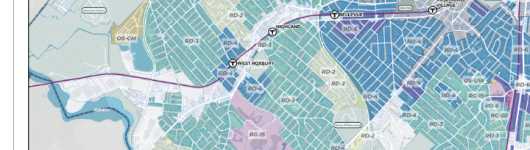
Boston to update its zoning code

Was anyone at the October Zoning Commission about PLAN: Downtown? Did it get approved?
 
“Residential uses are now legal throughout the new zoning districts, whereas large hotel, lab, and office uses will require further zoning approval. Also in support of housing growth, the zoning requires that any new buildings of significant height in the Washington Street corridor (more than 200’) must be predominantly residential.”
What is the Washington Street corridor defined as here?
It’s interesting that Seaport is the new central job hub w/o much residential while Dowtown is going to transition into more of a mixed neighborhood, I’d be interesting to how the commuter flows in the city change.
The Seaport could really use a light rail line…
 
It would definitely be good to protect a substantial portion of the older downtown building stock. Between the idea of it becoming an historic district and continued efforts toward residential conversion, we can hopefully retain a lot of what makes downtown interesting and visually compelling.
 
Love historic preservation, but it seems like this also really runs to the cost of maintenance, conversion, and rehabilitation. Didn't know there were explicit tax incentives to support these historically zoned areas:


Why is the City interested in having buildings and historic districts within its borders? National Register designation automatically creates eligibility for the Massachusetts Rehabilitation Tax Credit, and the Federal Historic Rehabilitation Tax Credits in instances where the buildings are undergoing substantial redevelopment. The two layers of credits can cover as much as 40% of capital costs in a preservation-oriented rehabilitation, helping to reduce the costs for retrofits, conversions and restoration.
 

Councilors propose eliminating parking requirements for new housing​


“The City Council will consider a proposal by three city councilors to end all zoning requirements for parking to go with new apartments and condos built in Boston - as a way to help spur development and reduce housing costs.

Councilor Sharon Durkan (West End, Beacon Hill, Back Bay, Fenway, Mission Hill) said current parking requirements - even if now generally reduced through Boston Planning Department and zoning-board determinations - are a sad relic of the 1950s that have failed in their goal of reducing congestion - and have left the city with up to one-third of its private parking spaces built for specific projects going unused each night.

Eliminating the requirement completely would spur new housing development - and reduce apartment and condo prices, she said. She added the proposal does not mean developers could not continue to propose new parking, just that they would no longer have to do so…..”

 
Is this true?

I've seen talk about this, but I'm not buying it.

The real explanation btw is Trump scaring off Foreign Students but haven't seen any evidence that is actually happening enough to impact rents.
 
census bureau released city population estimates this past week. The City Boston did not fare well, and in the most recent year 2024 to 2025 Boston continued to experience population loss. Although population loss is not desirable overall, I would think it is decreasing demand for apartments.
 
As a Boston renter, I sure as hell haven't noticed.
6% increase in my rent last year, 33% increase since 2020, and this year I'm moving out. The rent my landlord just posted it for is a 19% increase from my current payment. And it's not even that nice..
 
6% increase in my rent last year, 33% increase since 2020, and this year I'm moving out. The rent my landlord just posted it for is a 19% increase from my current payment. And it's not even that nice..
I'm not defending landlords' pricing policies (some squeeze all they can for sure), but...
Your complaint needs context: 2020 to 2026 has seen a large jump in real estate tax rate in Boston. I think the estimate is around +17% over that span. Boston is in an historic tax revenue crunch. But the tax burden on many property owners has increased by a lot more than 17%, since the assessed property values have also increased considerably during that span. If my napkin math is right, it is not unreasonable for a typical (non-owner-occupied) residential property to have experienced a +40% tax burden growth over the timeframe you're referring to.

Most landlords are going to at least attempt to recover some of that with rent increases.
 
I'm not defending landlords' pricing policies (some squeeze all they can for sure), but...
Your complaint needs context: 2020 to 2026 has seen a large jump in real estate tax rate in Boston. I think the estimate is around +17% over that span. Boston is in an historic tax revenue crunch. But the tax burden on many property owners has increased by a lot more than 17%, since the assessed property values have also increased considerably during that span. If my napkin math is right, it is not unreasonable for a typical (non-owner-occupied) residential property to have experienced a +40% tax burden growth over the timeframe you're referring to.

Most landlords are going to at least attempt to recover some of that with rent increases.
I'm with you here. I rented a Back Bay condo in 2017, and my landlord did not raise my rent until 2023 (to try and somewhat align with p/sf rents in the BB), and slightly increased again in 2024, due to their Boston residential taxes, post-Covid. All in, over six years, it was a minuscule 5% monthly increase for me.

I did the math. Had I been subject to a typical 3% annual increase, I'm still paying something like 12% less than I could have (per lease/SOP) and don't object to my savings. I do feel for non-occupied LL's who have a tax burden with tenants who may (or may not) be as stable and sane as I am.

As I near 50, this all just makes me want to move to the woods of Maine and forget life in the town.
 

Back
Top