I guess that either Medford or Tufts stalled this?It only took three years (lol) but the T finally placed inbound/outbound bus stops for the 80/94/96 directly adjacent/across from the Medford/Tufts station.

You are using an out of date browser. It may not display this or other websites correctly.
You should upgrade or use an alternative browser.
You should upgrade or use an alternative browser.
WestMedford
Active Member
- Joined
- Nov 9, 2021
- Messages
- 164
- Reaction score
- 434
I don’t know which party stalled it, but the Tufts Residence Hall construction on Boston Ave probably prompted the move much closer finally to the station entrance.I guess that either Medford or Tufts stalled this?

ball_square
Active Member
- Joined
- Nov 14, 2023
- Messages
- 277
- Reaction score
- 824
Seems like the snow mountain at Gilman Sq has busted through fence towards the CR tracks. One of the collapsed fenceposts is within a foot or two of the tracks.
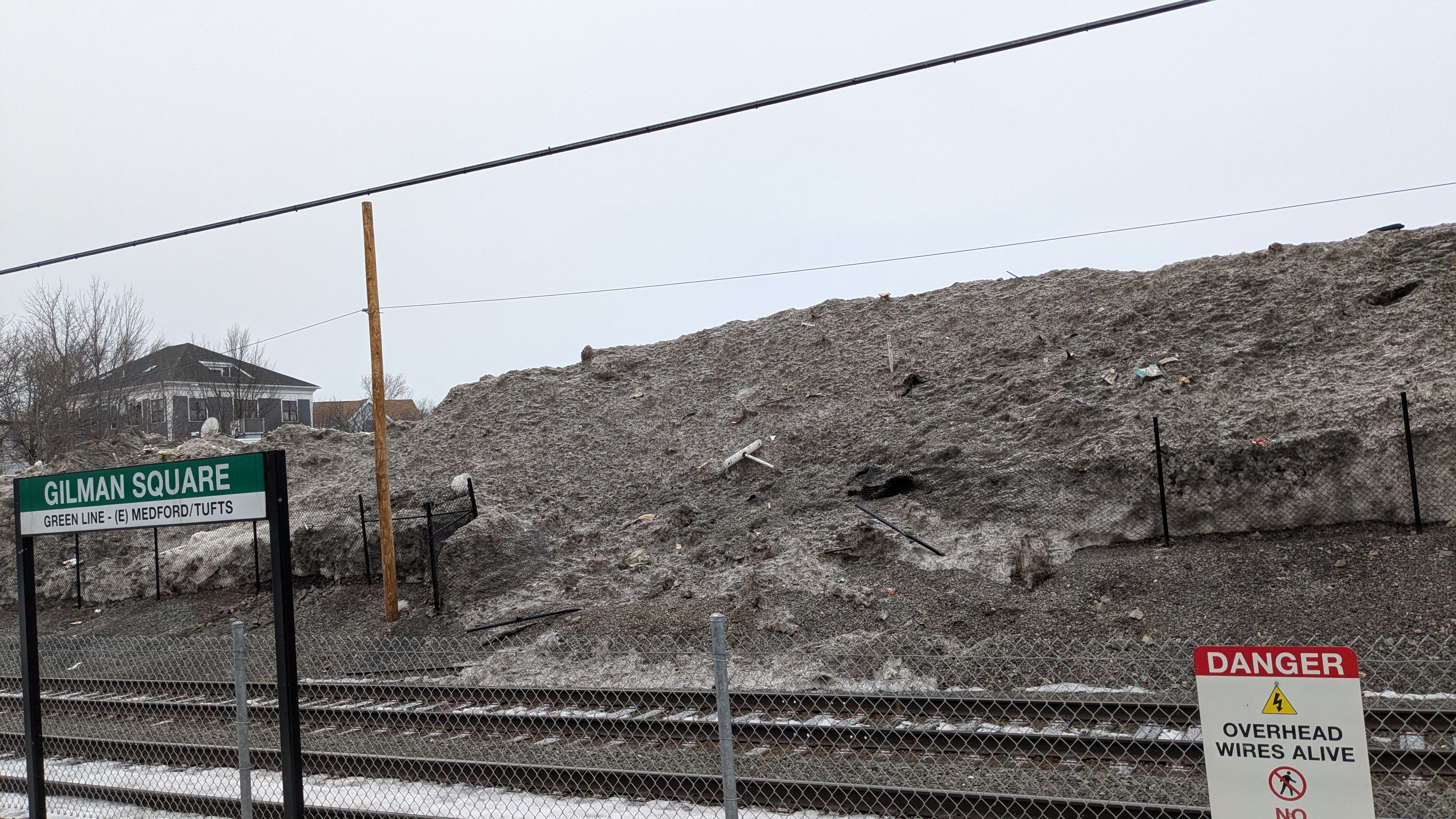
Badusername
Active Member
- Joined
- Dec 2, 2021
- Messages
- 258
- Reaction score
- 741
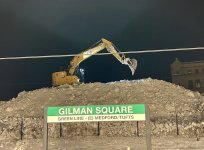
Yeah I’ve been wondering if there are any restrictions around heavy machinery in the vicinity of active RR tracks. The excavator (pre-fence collapse) was driving around the top of the pile mere feet away from the 90mph commuter rail track. Reddit thread with more photos.Seems like the snow mountain at Gilman Sq has busted through fence towards the CR tracks. One of the collapsed fenceposts is within a foot or two of the tracks.
View attachment 70660
Attachments
millerm277
Active Member
- Joined
- Jun 25, 2013
- Messages
- 577
- Reaction score
- 787
I mean, that looks like it's probably 50ft from the tracks. The fence itself looks to be ~15ft from them.Yeah I’ve been wondering if there are any restrictions around heavy machinery in the vicinity of active RR tracks. The excavator (pre-fence collapse) was driving around the top of the pile mere feet away from the 90mph commuter rail track. Reddit thread with more photos.
Operating within the MBTA property/track envelope there obviously are restrictions, but it seems unlikely that you can really have more restrictions than that on what you can do with property that the MBTA doesn't own or have any kind of easement on.
Badusername
Active Member
- Joined
- Dec 2, 2021
- Messages
- 258
- Reaction score
- 741
From the platform it felt much closer than that, but a fair point. It’s not unprecedented for excavator rollovers to occur on unstable ground, the tracks are lower than the empty lot. It was just noteworthy seeing the excavator up there and thinking it was getting a bit too close to the tracks, and then that same night the fence collapsed.I mean, that looks like it's probably 50ft from the tracks. The fence itself looks to be ~15ft from them.
Operating within the MBTA property/track envelope there obviously are restrictions, but it seems unlikely that you can really have more restrictions than that on what you can do with property that the MBTA doesn't own or have any kind of easement on.
millerm277
Active Member
- Joined
- Jun 25, 2013
- Messages
- 577
- Reaction score
- 787
From the platform it felt much closer than that, but a fair point. It’s not unprecedented for excavator rollovers to occur on unstable ground, the tracks are lower than the empty lot. It was just noteworthy seeing the excavator up there and thinking it was getting a bit too close to the tracks, and then that same night the fence collapsed.
Oh, I'm not disagreeing with your opinion about the risk of an accident that spills into the tracks existing - the fence collapse from the snow pile makes that pretty obviously real.
I just doubt that there's some regulation that says you can't use heavy equipment fully on your own property because tracks are nearby and I'm not sure it'd be legally defensible without compensation/easements to create that zone.
I'm sure there are other/better examples, but Boston Sand & Gravel is certainly working with plenty of heavy equipment a similar distance from the commuter rail tracks.
FormFollowsBudget
Senior Member
- Joined
- Jan 15, 2015
- Messages
- 2,309
- Reaction score
- 4,100
https://mbtarealty.com/licenses/
There is a process and guidelines but for this type of work, I think it slides.
There is a process and guidelines but for this type of work, I think it slides.
-anarresti-
New member
- Joined
- Jul 26, 2022
- Messages
- 42
- Reaction score
- 167
Does anyone who is familiar with the history of this project recall how the community path "skybridge" solution was decided upon? Were any alternatives weighed up and deemed sub-optimal in comparison? If so I am curious to understand the reasoning behind discarding the alternatives. I really wish they had gone with a tunnel.
Was it the water table? Utilities? Fitchburg line disruption (though I am not sure how bad, if at all, this was during actual construction)? Just the cost? Other variables? It's not as if the current bridge could have been cheap solution, so I'm hoping it was something technical?
I feel sorry for less able-bodied folks who have to surmount that thing.
Was it the water table? Utilities? Fitchburg line disruption (though I am not sure how bad, if at all, this was during actual construction)? Just the cost? Other variables? It's not as if the current bridge could have been cheap solution, so I'm hoping it was something technical?
I feel sorry for less able-bodied folks who have to surmount that thing.

The EGE
Senior Member
- Joined
- Jun 29, 2013
- Messages
- 1,888
- Reaction score
- 5,177
I don't believe a tunnel was ever seriously proposed. Because of the number of tracks, it would be a 200+ foot tunnel with lengthy approaches. There's definitely an element of a bridge feeling safer than a tunnel. The Community Path is on an embankment to the north (the tracks originally crossed over the Fitchburg Line on a bridge), so the vertical change to get down to a tunnel might be almost as significant as the bridge. The area is low-lying with a high water table because it used to be Millers River.

Charlie_mta
Senior Member
- Joined
- Jul 15, 2006
- Messages
- 5,088
- Reaction score
- 7,615
What the EGE said ^ , plus tunnels for pedestrians & bikes can tend to be more prone to crime compared to a bridge.Does anyone who is familiar with the history of this project recall how the community path "skybridge" solution was decided upon? Were any alternatives weighed up and deemed sub-optimal in comparison? If so I am curious to understand the reasoning behind discarding the alternatives. I really wish they had gone with a tunnel.
Was it the water table? Utilities? Fitchburg line disruption (though I am not sure how bad, if at all, this was during actual construction)? Just the cost? Other variables? It's not as if the current bridge could have been cheap solution, so I'm hoping it was something technical?
I feel sorry for less able-bodied folks who have to surmount that thing.
The only thing that I remember is that in the first version of the GLX the path was going to be on a longer viaduct - but - also shorter.Does anyone who is familiar with the history of this project recall how the community path "skybridge" solution was decided upon? Were any alternatives weighed up and deemed sub-optimal in comparison? If so I am curious to understand the reasoning behind discarding the alternatives. I really wish they had gone with a tunnel.
Was it the water table? Utilities? Fitchburg line disruption (though I am not sure how bad, if at all, this was during actual construction)? Just the cost? Other variables? It's not as if the current bridge could have been cheap solution, so I'm hoping it was something technical?
I feel sorry for less able-bodied folks who have to surmount that thing.
Do you have data to back up your claim?What the EGE said ^ , plus tunnels for pedestrians & bikes can tend to be more prone to crime compared to a bridge.
I assume they studied this claim one time based on Police Officer vibes and found a weak correlation and thus it was made into fact.Do you have data to back up your claim?
I don't think there's much research and actual data on actual safety in pedestrian tunnels, but there's definitely an issue with perceived safety in pedestrian underpasses. It's really more about the psychology - There's something about the enclosed nature of a tunnel or underpass that leads to an increased perception of danger, vs the "openness" of a bridge or surface crossing. Most of the pedestrian tunnel specific research is European - they have much more of those facilities than we do.Do you have data to back up your claim?
Also Look up something called "Crime Prevention Through Environmental Design" - underpasses and other confined spaces are generally the target of such efforts.
So, my PhD dissertation was on Risk Perception and it's effects on Public Policy. Many people grossly overestimate the frequency of crime.I don't think there's much research and actual data on actual safety in pedestrian tunnels, but there's definitely an issue with perceived safety in pedestrian underpasses. It's really more about the psychology - There's something about the enclosed nature of a tunnel or underpass that leads to an increased perception of danger, vs the "openness" of a bridge or surface crossing. Most of the pedestrian tunnel specific research is European - they have much more of those facilities than we do.
Also Look up something called "Crime Prevention Through Environmental Design" - underpasses and other confined spaces are generally the target of such efforts.
I am reluctant to spend and extra 25M per station because of peoples feelings.