MBTA "Transformation" (Green Line, Red Line, & Orange Line Transformation Projects)

Nearly seven years after a derailment caused extensive damage along the MBTA Red Line south of Boston, the transportation agency is working on a project that "should have been accomplished" years ago.
Starting Saturday, Red Line riders will face a series of service adjustments over two months, including speed reductions, frequency limits and platform transfers.
The project aims to modernize signals in an area just north of JFK/UMass, known as Columbia Junction. It's the place where the Ashmont and Braintree branches of the Red Line merge and where they connect to the Cabot Yard Maintenance Facility.
A 2019 derailment damaged tracks and sent sparks flying as the impact tore apart several signal bungalows in the area. It was one of the pivotal and embarrassing incidents that led to federal officials demanding safety improvements from the MBTA. Operations in that area have never fully recovered.
Ever since that derailment, the signal and switches in the area have been limited, according to MBTA Deputy Chief Operating Officer Deirdre Habershaw, who described the project to members of the MBTA board during a meeting on Thursday.
According to Habershaw, the limited functionality in that area currently limits the options available when the MBTA responds to issues like a disabled train. Instead of being able to route other trains around the trouble, a problem vehicle may need to take a circuitous route to the yard, with impacts on other operations.
 
The Orange Line is reopening early because the signal system upgrades were completed ahead of schedule.
Regular Orange Line service will resume tomorrow, March 7.
As a result of unencumbered access to the track area, crews will successfully complete the cutover and commissioning of the Orange Line’s new, digital signal system, including iVPI and AFTC 5.
The new Orange Line signal system is now complete:
The MBTA today announced the successful early completion of critical signal work on the Orange Line while service was suspended between Back Bay and Forest Hills. Originally planned to take place during nine consecutive days of shuttle bus service replacement, the project will complete work two days early, and Orange Line service will resume tomorrow, March 7. As a result of unencumbered access to track areas through this most recent service suspension, crews have successfully completed the commissioning of the new, modernized signaling system on the Orange Line, significantly increasing the operational efficiency of the Line and improving scheduling reliability for riders.
 
Last edited:
The Orange Line is reopening early because the signal system upgrades were completed ahead of schedule.

The new Orange Line signal system is now complete:
Even if almost as many years late as the new rolling stock, that's actually pretty awesome. Hopefully it leads to much better service.
 
Last edited:
Speed reductions?!! Speed reductions?!! I thought that the whole idea behind eliminating those slow zones was to fix or replace old track work. Now here we go again with this crap!!!! :mad::mad::mad:
 
Speed reductions?!! Speed reductions?!! I thought that the whole idea behind eliminating those slow zones was to fix or replace old track work. Now here we go again with this crap!!!! :mad::mad::mad:
Did you read the damn article before popping off yet again??? They're rebuilding the most complex set of interlockings on the entire rapid transit system. There will be temporary speed restrictions while they do so, because critical signal infrastructure needs to be taken offline while they do the replacements. The speed restrictions will be completely lifted once they're done. This should've been done 7 years ago after the big derailment, but wasn't because the previous T administration just deferred all maintenance beyond the barest of band-aids. Therefore they have no choice but to fix it right and all at once, because the frequency increases from the new fleet can't happen without it.

It's temporary. Like the article plainly @#$%ing says: temporary, temporary, temporary. Jesus, this sky-is-falling act is getting old.
 
This should've been done 7 years ago after the big derailment, but wasn't because the previous T administration just deferred all maintenance beyond the barest of band-aids.
I don't think it's that crazy it's taken this long. The derailment was June 2019, it took 3 months for regular service to be restored so stopping there and giving everyone a break from shuttle trains and slow zones was probably warranted. Of course soon enough it was March 2020 and COVID happened and then the slow zones happened...
 
Did you read the damn article before popping off yet again??? They're rebuilding the most complex set of interlockings on the entire rapid transit system. There will be temporary speed restrictions while they do so, because critical signal infrastructure needs to be taken offline while they do the replacements. The speed restrictions will be completely lifted once they're done. This should've been done 7 years ago after the big derailment, but wasn't because the previous T administration just deferred all maintenance beyond the barest of band-aids. Therefore they have no choice but to fix it right and all at once, because the frequency increases from the new fleet can't happen without it.

It's temporary. Like the article plainly @#$%ing says: temporary, temporary, temporary. Jesus, this sky-is-falling act is getting old.
Who are you to say that I'm popping off? You're always getting yourself in trouble with me by popping off yourself. I say what I want. You don't like it? Tough!!!! :mad:
 
1773101687188.png


:)
 
Wasn't that Rodney King who said that?!!! Some people around here need to take his advice. :)
 
1324.jpg

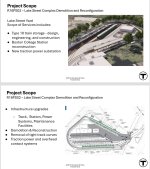
Screenshot_20260314_213408_PowerPoint.jpg

Apologies for the blurry, but that's the quality as it appears in the powerpoint. I knew they had taken out BC station itself from the B-Branch Accessibility Program, but I was unaware that they'd reverted to putting it on the Lake St Yard footprint, and retaining the separate inbound/outbound platforms. And more to the point that they're apparently planning on retaining a loop? This is apparently 30% design.

Below is the concept from 2024, and the 2009 report, even that which seems to imply a single island platform. This is also going to take a while - this is a professional services procurement for 2x 5 year terms, with 2 years worth of options to extends built in.
Screenshot_20260314_221029_Chrome.jpg
Screenshot_20260314_222352_Chrome.jpg
 

Attachments

  • Screenshot_20260314_220847_PowerPoint.jpg
    Screenshot_20260314_220847_PowerPoint.jpg
    428.5 KB · Views: 38
Last edited:
I guess they felt Boston needed to retain a classic Lechmere layout. Is the curve on the loop a new candidate for the governing curve in the system?
 
I guess they felt Boston needed to retain a classic Lechmere layout. Is the curve on the loop a new candidate for the governing curve in the system?
They would only have to come up with 2 more feet's worth of curve radius in the reconfig to equal Park St. loop, which isn't going to be modified. So it's not that big an ask.

Looping is definitely appropriate for a terminus like the B's where they have to triage a lot of between-headway deadheads to/from Reservoir carhouse to keep the car supply in-balance throughout the service day and shift changes. There's more mop-up activity of that sort at Lake St. than at any other terminal on the GL. Plus the much longer Type 10 cars mean the yard won't be able to store as many total sets as it does today, meaning the triages to/from Reservoir are going to increase. It looks like from the latest render they've only got space to idle 4 future two-car Type 10 supertrains, and the backup moves to get onto the loop and into the station look like they're going to be real awkward and spill onto Comm Ave. which means they're going to be extra-stingy for how often they do it.
 
IMG_0747.jpeg

The E branch accessibility project is going to cost a whopping 282 million dollars…
 

Back
Top