Roads and Highways General Development Thread

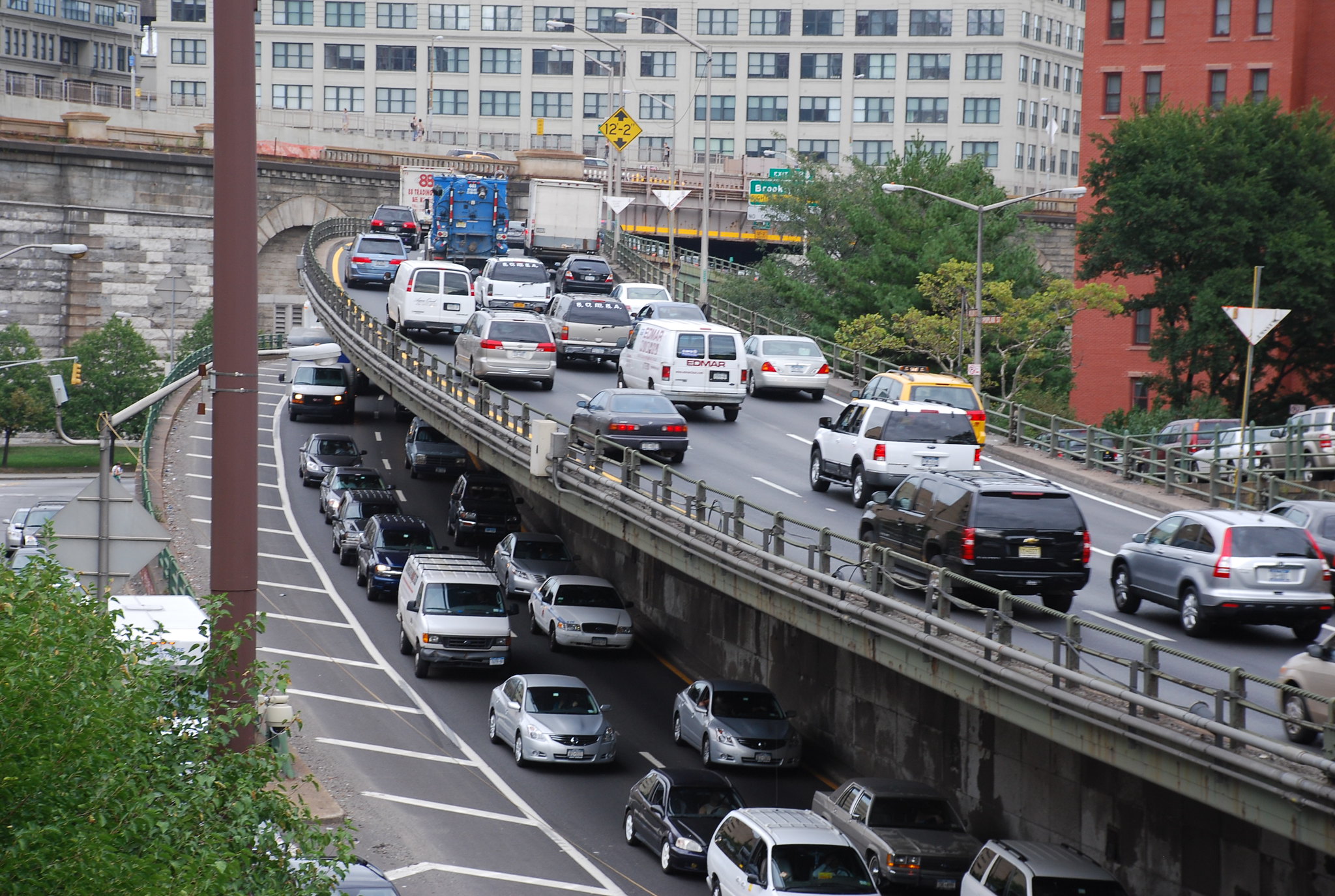
I think the main issue with this overpass project is that they are trying to redesign it in isolation. If you're holding steady all the other constraints around it, then I can see why MassDOT wants to preserve all the current number of lanes. But in reality, the backups are originating from the Boston side of the river. They just stretch all the way across the bridge. I do think the current configuration of the bridge and the intersection on the Boston side is not working well. MassDOT missed a huge opportunity to eliminate the zig-zag for people trying to go from Brookline to the BU Bridge when they redid the Comm Ave bridge over I-90.

If the team started thinking comprehensively about what all the streets connecting to it SHOULD look like if we actually followed through with the planned projects for them and created a functional network that doesn't have as many bottlenecks, then you can be much more bold and creative with how many lanes you need to accommodate all the different movements people are trying to make. For example, the Memorial Drive master plans shows a lane reduction west of the Reid Overpass, but they have not factored that in.

Also, the idea that slip lanes are better because pedestrians don't have to cross as many at once is laughable. It goes against all the best practices of roadway design of the last 20 years, which has said that slip lanes are terrible for pedestrians because they encourage dangerous behaviors by drivers. I really wish MassDOT would read their own design guidelines.

Finally, "design by neighborhood association" is a terrible way to do a design. It's fine to hear people's concerns and solicit ideas, but at the end of the day you must use professional judgement. They shouldn't just add back capacity because "neighbors are concerned about backups." That's just taking a poor decision and then saying "well this is what the public wanted!" Not cool.
 
I think the main issue with this overpass project is that they are trying to redesign it in isolation. If you're holding steady all the other constraints around it, then I can see why MassDOT wants to preserve all the current number of lanes. But in reality, the backups are originating from the Boston side of the river. They just stretch all the way across the bridge. I do think the current configuration of the bridge and the intersection on the Boston side is not working well. MassDOT missed a huge opportunity to eliminate the zig-zag for people trying to go from Brookline to the BU Bridge when they redid the Comm Ave bridge over I-90.

If the team started thinking comprehensively about what all the streets connecting to it SHOULD look like if we actually followed through with the planned projects for them and created a functional network that doesn't have as many bottlenecks, then you can be much more bold and creative with how many lanes you need to accommodate all the different movements people are trying to make. For example, the Memorial Drive master plans shows a lane reduction west of the Reid Overpass, but they have not factored that in.

Also, the idea that slip lanes are better because pedestrians don't have to cross as many at once is laughable. It goes against all the best practices of roadway design of the last 20 years, which has said that slip lanes are terrible for pedestrians because they encourage dangerous behaviors by drivers. I really wish MassDOT would read their own design guidelines.

Finally, "design by neighborhood association" is a terrible way to do a design. It's fine to hear people's concerns and solicit ideas, but at the end of the day you must use professional judgement. They shouldn't just add back capacity because "neighbors are concerned about backups." That's just taking a poor decision and then saying "well this is what the public wanted!" Not cool.
I agree. This project seems like it ignored the other work happening on Memorial Drive further west.
 
It's mainly because they don't have enough funding to complete the project and are just hoping to get it, so they make plans but then can't complete the plans or build the project. Then years go by and administrations change and they then have to redo the plans.

In the case of Rutherford Ave, I'm actually glad the previous plans were not built, as they were pretty bad. The latest ones are much better.
 
It's mainly because they don't have enough funding to complete the project and are just hoping to get it, so they make plans but then can't complete the plans or build the project. Then years go by and administrations change and they then have to redo the plans.

In the case of Rutherford Ave, I'm actually glad the previous plans were not built, as they were pretty bad. The latest ones are much better.
Money has never been the issue with this one since the federal dollars were committed from what I have been told. The issue has always been getting alignment of the interested parties of which they are many in addition to the community itself which has been highly polarized by the underpasses. You are correct that the agenda of the mayor at the time of each reset had a lot to do with it.

The change in leadership responsible for this project is refreshing. Hopefully, it finally gets done as what is there now is surely much worse than any improvement.
 
It is so incredibly hard to get rid of urban expressways and freeways in the US. The state DOTs of course have a built-in bias towards highways, due to a century of their complete focus on roads (with transit and other modes only coming into focus the last few decades), and the deep seated public and lobbyists' opposition to eliminating major highways. The urban expressways that have been outright eliminated are extremely rare. The Central Freeway and Embarcadero Freeway in San Francisco, and the Park East Freeway in Milwaukee, were all just stub freeways serving as feeders to surface streets, not major tie-through freeways. So, they were relatively expendable and politically easy to get rid of. The old elevated Central Artery in Boston was not totally eliminated, just put underground. There has been talk of eliminating I-45 through downtown Houston, but then again, there is the parallel I-69 freeway on the other side of downtown that can take its place. I've yet to see an expressway or freeway totally eliminated that is a stand-alone central piece of an urban highway system. Even just eliminating the Bowker overpass in Boston proved to be politically impossible. Getting rid of major sections of urban expressways will take a special type of political courage and vision, which I don't see happening for a while yet.
 
Another Federal Funding Fumble: Boston Loses $8.15 Million for Safety Project At Deadly Fenway Intersection

In 2022, a Boston Transportation Department spokesperson told StreetsblogMASS that the city was planning "a two-way cycle track on the south side of the Muddy River crossing (the segment of Brookline Avenue between Park Drive and Fenway), as well as a two-way cycle track connecting north along Park Drive to the Fenway Path through the Landmark Center site," plus the reconstruction of the Boylston Street separated bike lanes with permanent curbing.

The project had been budgeted to receive $8.15 million in federal funds for fiscal year 2026, which ends on June 30th.

But at meeting last week of the Boston Metropolitan Planning Organization (MPO), the regional council that allocates federal transportation funds for eastern Massachusetts, members voted to remove the project from the region's five-year transportation improvement plan, noting that it "it is not likely to advertise (for construction)" anytime soon.
 
The end of the article suggests the funding wasn't actually lost but instead reshuffled to other projects?

At its regular monthly meeting on March 19, the full board of the Boston MPO voted to recommend an amendment to its five-year plan that formally removes the Boylston Street project from the workplan.

That change freed up $8.15 million in federal funds to help finance other shovel-ready regional projects, including a project to build new elevators for improved accessibility at the Downtown Crossing MBTA subway station.
 
The end of the article suggests the funding wasn't actually lost but instead reshuffled to other projects?
The issue here is that this money has been obligated to this project for years, meaning that there are other projects that never advanced due to the anticipated lack of available funding in the TIP. What it's being shifted to is stuff that could be cobbled together at the last minute, so cost increase absorption on other projects, more bluebikes, operations funding, and the elevator project that the MBTA is saying they can design and construct within the fiscal year. Not that these things don't have merit, but this money could have funded hard infrastructure that is a lot harder to get executed.
 
The end of the article suggests the funding wasn't actually lost but instead reshuffled to other projects?
I don't think the problem is that the dollars weren't used - we live in a neoliberal society where austerity means there's always a project that's starving for money - the problem is that the project just occupied space on the ledger that other cities and towns have a right to access. Boston was occupying a seat at the buffet that kept someone else out from eating a meal.
 
Since the Northern Strand Community Trail runs closely parallel to it and the street is narrow, probably no bike lanes are warranted given the constrained width available. I'd say just go with 1 lane of traffic each way, with no center turn lane, and no on-street parking. This would allow room to widen the sidewalks and add landscaped buffers between the roadway and sidewalks. This is what it looks like now with the narrow sidewalks. It could look lot better.
 
Since the Northern Strand Community Trail runs closely parallel to it and the street is narrow, probably no bike lanes are warranted given the constrained width available.
I'm not sure I agree. Just as a general principle, I think bike lanes should go where people need to go, and a bunch of places people need to go are on Eastern Ave. We generally don't tell drivers they can't use a street because there's a nearby, parallel street. Specifically for this stretch, I think skipping bike lanes would be a problem. I'm trying to imagine how someone on a bike would get from the Northern Strand to anything on the south side of Eastern Ave. (businesses or side streets). If there aren't bike lanes on Eastern, it would mean a lot of really circuitous routes/biking in traffic/biking on sidewalks, etc. That's especially true because Eastern has such long blocks.

But there are space constraints, and I'm always in favor of better sidewalks, like you say. I don't really know what will fit.
 
Any thoughts on this Bill?

"Massachusetts Senate Bill S.2246, sponsored by Sen. Cynthia Creem, aims to reduce total statewide vehicle miles traveled (VMT) to meet climate goals, rather than imposing direct limits on individual driving. The bill proposes an interagency council to develop transportation alternatives, such as improved public transit, and is currently with the Senate Committee"

Same planners, same data, same funding — the only thing new here is the mandate to reduce how far workingclass people will be allowed to go.

Like I said before- "Another bill proposed with very limited choices, higher costs, and fewer freedoms for everyone besides the political elite."

---We are saving the planet but let's fly around in our private jets. -----Right.
 
Last edited:
Any thoughts on this Bill?

"Massachusetts Senate Bill S.2246, sponsored by Sen. Cynthia Creem, aims to reduce total statewide vehicle miles traveled (VMT) to meet climate goals, rather than imposing direct limits on individual driving. The bill proposes an interagency council to develop transportation alternatives, such as improved public transit, and is currently with the Senate Committee"

Same planners, same data, same funding — the only thing new here is the mandate to reduce how far workingclass people will be allowed to go.

Like I said before- "Another bill proposed with very limited choices, higher costs, and fewer freedoms for everyone besides the political elite."

---We are saving the planet. Right.
"Traffic is free-dumb; transit is tyranny."

-- Libertarians
🤡
 
"Traffic is free-dumb; transit is tyranny."

-- Libertarians
🤡

MBTA at this point should be free and there should be heavy federal & state tax dollars to help expand major projects throughout the state making them self-sufficient throughout the Baystate. Need to get a better understanding of the overall Federal & state income and where has all our tax dollars have been capitalized?

Like I said modernize the system into 3 pillars for human necessities for life-- #1 Transit #2 Food & water #3 Energy (All should be free) everything else would be consider luxury living.

The issue I'm having is Why another agency full of useless hacks when Massachusetts already has 10 regional MPOS and MassDot?
 
Last edited:
Any thoughts on this Bill?

"Massachusetts Senate Bill S.2246, sponsored by Sen. Cynthia Creem, aims to reduce total statewide vehicle miles traveled (VMT) to meet climate goals, rather than imposing direct limits on individual driving. The bill proposes an interagency council to develop transportation alternatives, such as improved public transit, and is currently with the Senate Committee"

This legislature needs to get its head out of its ass. We don't need a council to figure out what to do. The studies have already been done!

https://www.mapc.org/resource-library/vehicle-miles-traveled-emissions/

  • Land use patterns have a substantial impact on the rate of VMT increase: VMT growth in a “sprawl” scenario is 5.2 percentage points higher than a “smart growth” scenario with more development in urban areas and denser suburbs. These conservative estimates don’t yet account for the benefits of transit improvements or transit-oriented development, factors that will be addressed in the next phase of research.
  • Of the pricing policies tested, a straight 25-cent per mile fee had the largest impact, curbing VMT growth by about 15 percentage points. Congestion pricing, broadly applied, would have a slightly smaller effect. Our results also suggest that even a tripling of the gas tax would slow VMT growth by only one or two percentage points—a much smaller effect than the smart growth land use patterns we examined.

The answer is 1) TOD and 2) internalizing the cost of driving on drivers. Pretty much everything else is just performative politics.
 
This legislature needs to get its head out of its ass. We don't need a council to figure out what to do. The studies have already been done!

https://www.mapc.org/resource-library/vehicle-miles-traveled-emissions/


The answer is 1) TOD and 2) internalizing the cost of driving on drivers. Pretty much everything else is just performative politics.
This bill isn't really to do studies. It's to force DOT and MPOs to actually implement policies based on what we already know. This is using those past studies to actually do something. This looks broadly good (but maybe other people know state gov better could chime in). This is the meat of the bill:

No metropolitan planning organization shall approve a Regional Transportation Plan or Transportation Improvement Program developed pursuant to 23 CFR Part 450, and the department shall not approve a Statewide Transportation Improvement Program, unless the plan or program, including any mitigation measures interlinked to individual projects within the plan or program, provides a reasonable pathway to compliance with the greenhouse gas emissions sublimits for the transportation set pursuant to section 3A of chapter 21N and to the statewide vehicles miles traveled reduction goals established by the secretary pursuant to section 81 of this chapter.

The new council is a minor part, and would be there there to help set VMT reduction targets, evaluate new policies, and basically keep DOT on track.

The bill can be read here:
 

Back
Top