
Everett Transportation (SL3 extension, potential OLX/GLX, Sweetser Circle infill station)

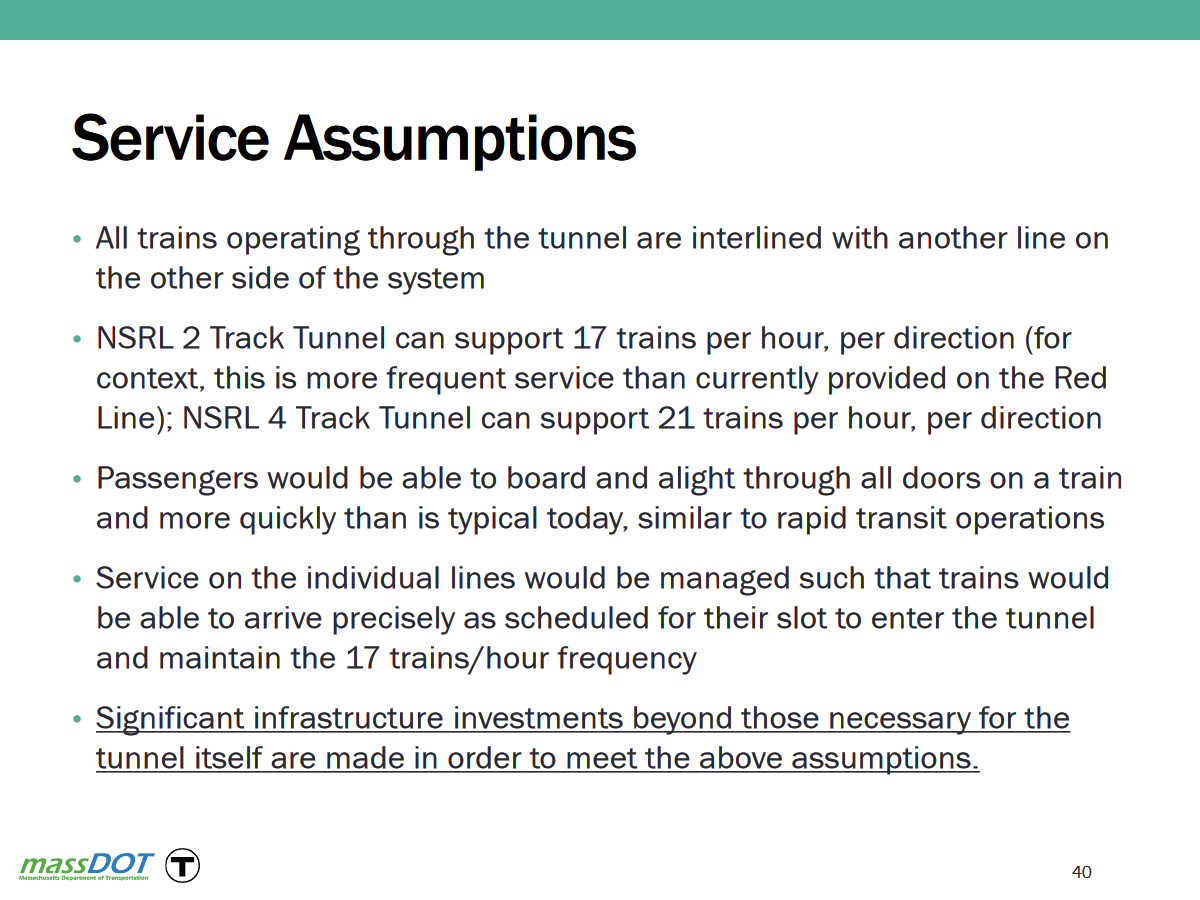
This is what the NSRL 2019 reassessment says in terms of tunnel throughput for the 2-track and 4-track builds:
1772735133070.png


We're going to have to revolutionize our on-time practices to even get a 3.5 minute per direction frequency, because that target is well shorter than the T's schedule padding for technical "on-time" status and it would be conflict-city (even going one-way) if American slop ops--even much less than we currently put up with--were the rule. Not only do you need 100% systemwide level boarding, but a lot of grade crossings are probably going to have to go in order to achieve that level of schedule certainty all the way from 495-land for orderly procession through the tunnel. It's considerably more difficult with an open system like the Purple Line compared to dispatching a closed rapid transit line, and while other countries do it don't sleep on the complexity of a wholesale systemic retrofit while we're still trying to substantially expand that system with more and further-flung lines.

I agree...this is a bad all-around application for mainline rail. LRT/HRT, and don't pussyfoot around it. NSRL does great things, but its focus gets diluted by carrying more intra-128 lines in a completist's universe than the ones (like Fairmount) that absolutely have to be on the FRA network for good reason. That's why Needham will be long gone by the time it comes to fruition, and converting Reading to its originally intended OL extension becomes a potentially significant decision afterward.


EDIT: And also what EGE said...the walking/escalator distance for line transfers from the claustrophobic and off-center underground stations is going to suck by necessity of the tunnel trajectories we have to work with, so if trying to link neighborhoods with the intent of facilitating easy transfers that's going to weight your mode choice heavily in favor of rapid transit over Regional Rail.
 
This is what the NSRL 2019 reassessment says in terms of tunnel throughput for the 2-track and 4-track builds:
Those numbers need some context, though. Here's how they came to those numbers (page 52):

1772739033620.png

So they are assuming the tunnels could handle 22tph per track, which is roughly what other real-world systems get. But, they say, bottlenecks in our system drastically reduce that. Apparently, part of their assumptions is they think Fairmount can only handle a maximum of 4tph, which is obviously suspect. We know that with some minor work (relative to NSRL) the Fairmount can handle double that. We don't know what other assumptions they made, but the T has been working on fixing some bottlenecks even since that report came out. Plus some of the numbers don't even seem to match at various points in the study. Plus that study did basically everything possible to inflate the costs and downplay the benefits.

So the claim of 21tph for quad-tracked NSRL just isn't credible. It's almost as meaningless as that study's price estimates. The true number of tph is almost certainly higher. Also, it isn't a fixed number. It can increase, to a point, with other infrastructure improvements.
 
We do have international examples to compare against too. The RER is probably the best example, last I heard RER A is the busiest double-track rail line in Europe and is probably the world leader in trying to cram as much capacity as possible out of Bi-Level intercity rolling stock used as metro trains (for some reason). From what I can find RER A currently runs 27 TPH peak, down from 30 after that caused reliability problems. To do this it still needs 4 tracks at La Défense though, and this is with CBTC and every bit of frequency-maximizing technology available. Meanwhile on their shared section, RER B and D run a combined ~30 TPH peak betwen Châtelet and Gare du Nord, with 4 tracks at each station although the tunnel itself is only 2 tracks. I think this is probably the best example. These lines do not (currently) have CBTC, which seems like an expense the NSRL is unlikely to spring for. Both stations have 4 tracks, and the service is a mix of bi-levels on RER D and singles on RER B. So based on that I think 30 TPH is a good lower bound for maximum NSRL throughput. Having a full quad-tracked line would likely let you squeeze out some more TPH but I'm not sure how much.
 
At 35 TPH that assumes ~3.5 minute headways. 120 minutes (2x60) ÷ 3.5 = ~34.2, rounding up to 35. Looking back I agree that 3x is probably too much for Amtrak, 2x is probably better. But I don't think it actually changes the conclusion, to be honest.
Munich S-Bahn pulls something like 30 tph on two tracks through its center, and while that's definitely straining capacity, I don't see how you couldn't get at least 40 tph from a quad-track tunnel with good ops.


Interesting idea, 3decker! Ratmeister's concerns are valid; I'll note that mainline rail also:
  • Has heavier rolling stock that's not ideal for stopping as frequently as light rail or metro
  • Requires more crew per train
  • Has longer trains (because train are designed for primarily sitting passengers), which increases station costs
  • Has a larger loading gauge, requiring larger and more expensive tunnels
  • Has larger curve radii, which will be tricky when trying to weave a tunnel under 93 and to connect to NSRL
  • Won't have great transfers to other subway lines downtown, because NSRL is rather deep
Agree with you on all of these, my calculus was pretty much just that, as much as some of these factors could increase expense, maximizing use of downtown tunnel capacity would be optimal, and this is one of the better branches to do. Lynnfield, Wayland, or Lexington branches are possible, but all pretty bad in one way or another.
 
Munich S-Bahn pulls something like 30 tph on two tracks through its center, and while that's definitely straining capacity, I don't see how you couldn't get at least 40 tph from a quad-track tunnel with good ops.
Which it does by using trains that have as many doors as the Orange or Red Lines, and Spanish solution platforms at all the interchange stations. Unless we plan on replicating that with the NSRL you're not getting those numbers with regular island platforms and a mixed fleet of mainly commuter trains. I deliberately used the RER as a reference for this exact reason.
 
Which it does by using trains that have as many doors as the Orange or Red Lines, and Spanish solution platforms at all the interchange stations. Unless we plan on replicating that with the NSRL you're not getting those numbers with regular island platforms and a mixed fleet of mainly commuter trains. I deliberately used the RER as a reference for this exact reason.
I'm confused. @3decker is citing 30tph on the Munich S-Bahn. You're citing 27tph, down from a max of 30tph, on the Paris RER A. Practically, for this conversation, you're coming to the same numbers. What are you nitpicking here?

Munich S-Bahn pulls something like 30 tph on two tracks through its center,
Perfect! I'm glad you had that number on hand. Munich is the system I was thinking would be most topologically similar to NSRL, in that it's a central, through-running tunnel with a ton of branching either end. Maybe people know of some others. No comparison to other systems will be perfect, but that's a useful data point.

FWIW, Transit Matters seems to have had a look around and found a max of 30tph for commuter rail in Paris, Berlin, Munich, and Tokyo. They assume our NSRL will max out at 24tph per track, in that link and also here.

I don't see how you couldn't get at least 40 tph from a quad-track tunnel with good ops.
And yeah, this is my assumption, too. We're not getting 30tph per track, but we can get at least 20. So, 40tph for quad-tracked, at least.

Tying this back to your original post, 40tph ought to give enough slots to allow an Everett line with subway-like frequencies. But I did remember one other maybe-problem. An Everett Line would connect to the eastern of the two NSLR tunnels. But from the north, that will already be the more cramped tunnel because it directly connects to three of the four north side lines. (Only the Fitchburg will connect directly to the west tunnel.) There would be a short bottleneck in there somewhere. That's solvable; I don't know the best way how, but it probably has to be more tunneling around the Boston Engine Terminal. That's just a kind of subtle problem if you're thinking about other possible north side lines to connect to the NSRL.

From the 2003 NSRL Design and Schematic Report
1772808146249.png
 
Which it does by using trains that have as many doors as the Orange or Red Lines, and Spanish solution platforms at all the interchange stations. Unless we plan on replicating that with the NSRL you're not getting those numbers with regular island platforms and a mixed fleet of mainly commuter trains. I deliberately used the RER as a reference for this exact reason.
NSRL isn't replicating that. There's no room in the station caverns for Spanish-solution platforms. It'll just be a single island for the 2-track versions and 2 islands--one per bore with separated bores--in the 4-track version. Boarding/alighting, especially with people already waiting on the platform for the next train and train after next or single-filing it to excruciatingly long escalators that are not all that conveniently placed because of the limited three-dimensional trajectories for shafts, is going to be noticeably constipated. And there's nothing they can physically do about it; the alignments are very width-constricted and don't have any unexplored alternatives. It's also not likely we're ever going to order Purple Line cars with extra center doors or quarter-point doors in lieu of vestibules, because the T's design standards dating back 40 years didn't ban curved full-highs like ConnDOT, the MTA, and NJT did. Like...you're not opening center-door cars at Lansdowne Station ever even if we do order cars with them to open at most stations, and that's a stop in the :15-or-better zone. Sweetser Circle, where this Everett Branch is supposed to split off, also likely can't be anything other than a curved platform...so right then and there this mythical line already has a station dwell problem to deal with on its quest for breakneck rapid transit frequencies.

So it's RER as a best-case for the system retrofit, with compromised dwells in the underground stations being a somewhat annoying throughput limiter. Like I said...if there's an overriding goal here of facilitating fast transfers from a new neighborhood line, you choose HRT/LRT interlining or new-lining full-stop over NSRL's bundle of design compromises. It'll be great for current and future Purple Line and intercity systems, but it's not perfection and won't outclass the world examples that do it so close to perfect they're functionally rapid transit. Seems like we're slipping into a Civil Engineering Strongman rabbit hole here trying to pigeonhole an Everett subway into an NSRL appendage because reasons. It's not a seamless fit. NSRL isn't a design-perfect run-thru tunnel. It's steep, it's deep, it's relatively slow and has complicated junctioning, and it'll have platform dwell issues that its world peers don't. And that's all it can be to exist at all. We'll use it to the hilt if it's built, but it's not a universal solvent for every transit problem in Greater Boston.
 
Looks great. The only (picky) thing I see needing a tweak is to straighten the wow in the alignment of the 104 bus route next to the Box District station on the SL3.
Doing that would make it match the straight alignments on the other similar locations on the 104 route nearby.
I know and I hate it but it's a deliberate choice, the 104 stays reasonably close to the SL3 all the way from Everett Sq to Airport, only about 5 mins max of walking except for Box District which is like 10 minutes away. Then again, this map lies about the 116 at Bellingham Sq, it's actually a few minutes closer to Box District. Or alternatively I could make the kink bigger so it looks less incidental.
 
I know and I hate it but it's a deliberate choice, the 104 stays reasonably close to the SL3 all the way from Everett Sq to Airport, only about 5 mins max of walking except for Box District which is like 10 minutes away. Then again, this map lies about the 116 at Bellingham Sq, it's actually a few minutes closer to Box District. Or alternatively I could make the kink bigger so it looks less incidental.
I see these bus route depictions as representational, not geographically exact, and I would expect the average viewer to see it that way as well, since that is the style of the entire map. So, I would eliminate the kink in the 104 route, because there are really no other geographically correct spacings like it elsewhere on the map, and leaving it in could be confusing. But in any case, it's a great map.
 
@TheRatmeister, is there a (non-Everett-related) thread where you are posting/discussing these maps? I am wondering whether you could apply the "Frequent Regional Rail" indicator to South Station <> Back Bay or even South Station <> Ruggles. (Apologies if I have raised this idea before.) We are close to 30-min or better to Back Bay (I think) today.
I've done the whole map with the thick CR lines but later reverted it (except for Fairmount) given the abysmal service many stations on the map. If/when frequent(ish) service comes to other parts of the network, I can fairly easily adapt the map.

But Back Bay-South Station just doesn't meet that criteria on weekends, not even close. There are so many 1-2 hour gaps in service right now, and even on weekdays it's not actually reliable for those trips with trains being scheduled to leave Back Bay early if they can.
 
This map makes my questioning of the current HFBR 104 route even more prescient post Silver Line extension to Sullivan. At that point it seems like the T should just run the 104 as the SL104 to Airport from Malden and use the Gateway Transitway, no?
That would prevent it serving downtown Chelsea, and would leave Central Avenue without frequent service.
 

Back
Top