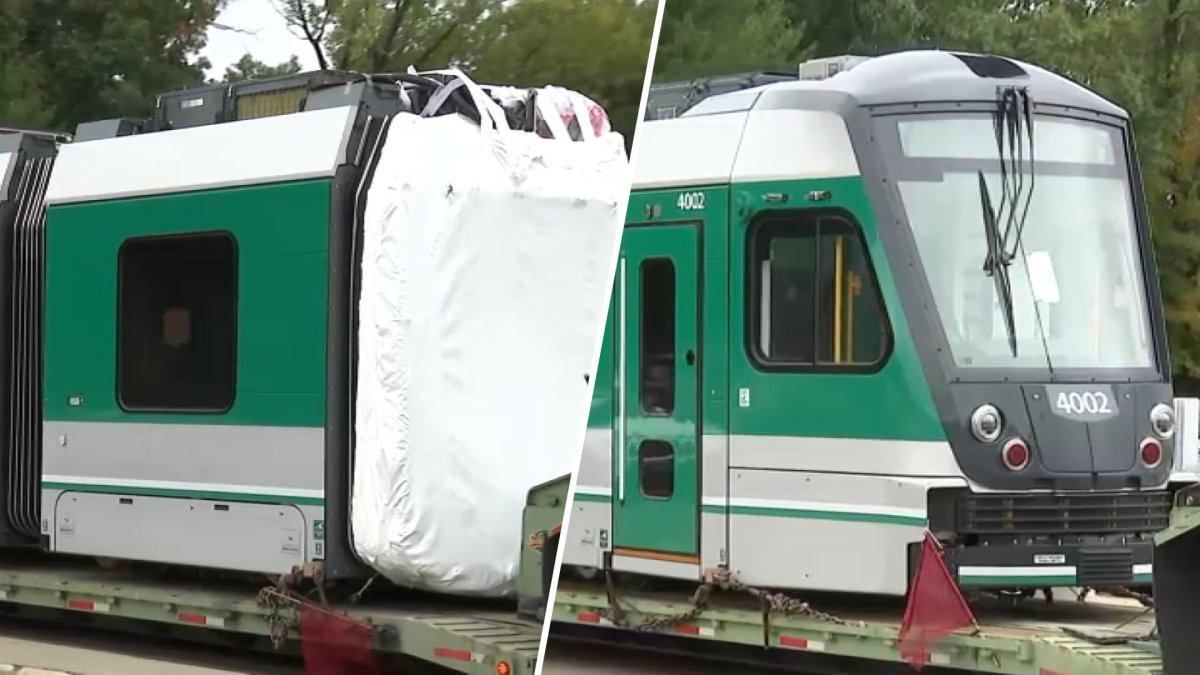
Via MBTA: New Type 10 Green Line vehicle being tested on tracks at the manufacturing facility in Elmira, New York
Source | Reddit post


Hopefully they show some more angles.View attachment 75983
Via MBTA: New Type 10 Green Line vehicle being tested on tracks at the manufacturing facility in Elmira, New York
Source | Reddit post
 www.nbcboston.com
Grabbed some screenshots to try to compare if they were in fact able to make the path between the seats a bit wider.PHOTOS: MBTA's new Green Line trains have officially arrived in Mass.
The first of the MBTA's new Green Line train cars have arrived in Massachusetts, and we got a first look at their arrival.
That was a surprise.


 www.bostonglobe.com
I like em but they definitely did manage to make new cars look older than they are. Those circular lights on the front could have definitely looked a bit more modern.
Something something historic preservation and neighborhood characterI like em but they definitely did manage to make new cars look older than they are. Those circular lights on the front could have definitely looked a bit more modern.
I presume those are standard sizes that are relatively cheap to replace, similar to the old sealed beam lights.I like em but they definitely did manage to make new cars look older than they are. Those circular lights on the front could have definitely looked a bit more modern.
I'll agree, but at the same time looking at these images I have to wonder why "100% low-floor" was something we actually need in a car anyway.Its hard to tell but it does honestly look a little wider.
Anecdotally, I've seen at least 5 people fall on the interior stairs of the Green Line Type 8/9, including my pregnant wife. Some operators are heavy on the brake/accelerator, which can create dangerous conditions for people on/near the stairs of a crowded train.I'll agree, but at the same time looking at these images I have to wonder why "100% low-floor" was something we actually need in a car anyway.
It's rather obvious that even if it is technically, theoretically, possible for a person in a wheelchair or with a stroller to get it down that aisle if zero other people were on the car, in practice they will never be leaving the car section they enter in.
In which case we probably could have had a cheaper train that held more people and had the same effective level of accessibility.
The interior stairs are absolutely dangerous, particularly in bad weather when the steps are wet or slick with slush brought in on passenger's feet.Anecdotally, I've seen at least 5 people fall on the interior stairs of the Green Line Type 8/9, including my pregnant wife. Some operators are heavy on the brake/accelerator, which can create dangerous conditions for people on/near the stairs of a crowded train.

No, a level deck can hold more people than one with stairs. There are many good reasons to go with this design -- eliminating the stairs enhances safety and capacity.In which case we probably could have had a cheaper train that held more people and had the same effective level of accessibility.
There also aren't as many near- off-shelf shopping options for combo high-and-low floor vehicles. Most modern makes of tram these days either all low-floor or all high-floor. The half-and-half era was pretty short-lived because it was just too hard to design modular mass-market product families around. So if the T had stuck with that design, they'd be buying completely bespoke vehicles again at a steep markup, dubious long-term parts support, and all the teething risks that come with that...instead of getting something that's 80%+ made up of a battle-tested CAF Urbos 3. The agency's Type 8 trauma casts a very long shadow. They absolutely had no choice but to evolve away from bespoke designs as much as they could physically muster, and that pretty much eliminated half-and-half designs from consideration because the only mass-market adaptable buying options were all-low-floor.No, a level deck can hold more people than one with stairs. There are many good reasons to go with this design -- eliminating the stairs enhances safety and capacity.
If that's true, then never mind.No, a level deck can hold more people than one with stairs. There are many good reasons to go with this design -- eliminating the stairs enhances safety and capacity.
If they were going to do a stretched supercar with half-and-half configuration, some of the low-level sections would have to have powered bogies instead of being unpowered like the Type 8/9 center trucks. That would end up constraining the space exactly as much as the all-low cars on the low-level sections, while still having to deal with the huge capacity/flow/safety downsides of the stairs. It would be a worse overall passenger experience than even what they have now, while also being bespoke-as-hell on the design. It's way better to just do 100% low-floor. While the seating arrangement may not be the platonic ideal, these cars will be bona fide crowd-swallowers for standees and way less a hazard for moving around despite the narrow aisles.I was going off of the claims I've seen by some that the narrow-ness here is due to having to fit all the equipment into a 100% low-floor design, which implies that you could have gotten more interior square footage by not going with one.