RandomWalk
Senior Member
- Joined
- Feb 2, 2014
- Messages
- 3,991
- Reaction score
- 7,616
There needs to be a sunsetting of the transferable liquor licenses. They create perverse incentives where a restaurant is more valuable dead than alive.

This might work. But I wonder, really specifically, who is it lobbying against allowing new liquor licenses in Boston? Do we know? I thought a part of the problem is that people are essentially using liquor licenses as collateral with banks and landlords. It's those groups who are most resistant to any change. In that case, giving tax breaks to the restaurateurs (who technically hold the license) doesn't appease the bank.I've posted this elsewhere, but there's a pretty straightforward business-friendly approach that both makes licenses more available and also prevents the real issue, which is fear of asset forfeiture/devaluation experience by current license holders. Make it revenue neutral to reset the system and then go forward under the new regime:
1. Commonwealth estimates demand for new licenses in Boston under an unlimited scenario
2. Price licenses statewide such that the vast majority would be willing and able to pay (say $10,000, one-time)
3. Estimate the total market value of Boston liquor licenses bought and sold in the last 5 years
4. Provide incumbent license holders with a tax deduction equal to aggregate license "value", divided by number of current holders, that applies over 5 years
5. Increase price of (2) as needed to cover shortfalls and approach budget neutrality
6. Print cash based on new sales tax revenue from a million new successful businesses
Basically provide a huge one-time tax write off to current holders while writing down the value of their liquor license to zero and then remove all restrictions. Have to get incentives aligned somehow, and even if lifting the cap were "good" for Boston, doing so without relief to incumbents will have them fighting like hell to prevent any changes.
I'm almost certain that this area was not part of the new neighborhood license program. Most of central Boston is not. In fact, there was some legislature rep from Brighton that got 3 random extra licenses just for the oak square section of Brighton because the Allston/Brighton was not part of the recent license expansion. The city and mayor Wu were focused on outlying neighborhoods in the last expansion. While I agree that demand in those neighborhood needed to be addressed, the problem is that supply is so artificially restricted, that the Seaport and maybe Back bay seem to be siphoning available licenses. For example bars have closed in downtown crossing in order to sell their license. I suspect the same situation happened here with the Dugout. Apparently, there are neighborhood restricted licenses still available in all of the outlying neighborhoods due to slow uptake aside from East Boston and the 3 licenses in Oak Square which have all been snapped up (https://www.wbur.org/news/2025/09/18/boston-liquor-licenses-neighborhood-disparity). My problem with the recent expansion, although it was a step in the right direction, is that it did nothing to address where demand is highest, which is in the core, so neighborhoods like the Fenway, Beacon HIll, Southie, Downtown Crossing were omitted.I can't recall whether 02215 is one of the zip codes in the neighborhood license program, but even if it is, the original set of neighborhood licenses came with a restriction on such replacement of existing licenses.
Do the banks actually have that much influence over that? Like a house pledged to a bank as collateral, it doesn’t matter if the collateral isn't worth as much as it was the loan was taken out - even if you're underwater on the loan, you (or the resturanteur) still owe the bank 500k.This might work. But I wonder, really specifically, who is it lobbying against allowing new liquor licenses in Boston? Do we know? I thought a part of the problem is that people are essentially using liquor licenses as collateral with banks and landlords. It's those groups who are most resistant to any change. In that case, giving tax breaks to the restaurateurs (who technically hold the license) doesn't appease the bank.
I'm almost certain that this area was not part of the new neighborhood license program. Most of central Boston is not. In fact, there was some legislature rep from Brighton that got 3 random extra licenses just for the oak square section of Brighton because the Allston/Brighton was not part of the recent license expansion. The city and mayor Wu were focused on outlying neighborhoods in the last expansion. While I agree that demand in those neighborhood needed to be addressed, the problem is that supply is so artificially restricted, that the Seaport and maybe Back bay seem to be siphoning available licenses. For example bars have closed in downtown crossing in order to sell their license. I suspect the same situation happened here with the Dugout. Apparently, there are neighborhood restricted licenses still available in all of the outlying neighborhoods due to slow uptake aside from East Boston and the 3 licenses in Oak Square which have all been snapped up (https://www.wbur.org/news/2025/09/18/boston-liquor-licenses-neighborhood-disparity). My problem with the recent expansion, although it was a step in the right direction, is that it did nothing to address where demand is highest, which is in the core, so neighborhoods like the Fenway, Beacon HIll, Southie, Downtown Crossing were omitted.
This might work. But I wonder, really specifically, who is it lobbying against allowing new liquor licenses in Boston? Do we know? I thought a part of the problem is that people are essentially using liquor licenses as collateral with banks and landlords. It's those groups who are most resistant to any change. In that case, giving tax breaks to the restaurateurs (who technically hold the license) doesn't appease the bank.

 commonwealthbeacon.org
The Brighton rep is the current Majority Leader, Michael Moran.I'm almost certain that this area was not part of the new neighborhood license program. Most of central Boston is not. In fact, there was some legislature rep from Brighton that got 3 random extra licenses just for the oak square section of Brighton because the Allston/Brighton was not part of the recent license expansion. T
Oh, it matters a lot if the value of a collateralized asset goes down. The loanee might still owe the 500k, but that could be effectively uncollectable. The loanee might not be able to pay, file for bankruptcy, skip town, whatever. That's kind of the whole point of the collateral, is to make sure there is something of value the bank or investors can collect if need be. Banks/investors/landlords who are holding those licenses as collateral could be reasonably worried if their value were about to drop to zero. I could see them secretly lobbying to make sure there are no new liquor licenses, and I also don't think tax breaks to restauranteurs makes the banks/investors/landlords change their mind.Like a house pledged to a bank as collateral, it doesn’t matter if the collateral isn't worth as much as it was the loan was taken out - even if you're underwater on the loan, you (or the resturanteur) still owe the bank 500k.
That's a fair analogy. But it makes me think we're talking about two slightly different things here. One issue is how to be fair to the restauranteurs who got screwed by the government and were forced to pay through the nose for liquor license. We don't want them getting screwed again, and maybe go bankrupt like the taxi drivers. Tax breaks like @Justbuildit suggested make sense. And some policy like that is probably the right thing to do however this plays out.Here the analogy I'm going to reach for is taxi medallions, which until the birth of Uber used to be worth hundreds of thousands - Boston's used to trade for $700k as recently as 2014, and Cambridge and NYC medallions were similar. They're worth a fraction now - and at least in NYC some drivers who had taken out loans to buy them were forced into bankruptcy.

A major issue with this is that the decision of who gets free licenses and who doesn't becomes purely political. If two businesses from the same neighborhood are going for the same free license, it will end up in the hands of the one that the politicians and bureaucrats favor. This is one more handout that politicians can dangle over businesses for their support, and one more lever that can be pulled to enforce conformity and incumbent advantage. You're never going to see a yard sign for a non-incumbent politician in the window of a business going for a free license, but you will absolutely will see yard signs for the incumbents who gave them their license in their windows.What is needed, is a system through which neighborhood/independent establishments can sell their license to a seaport chain, and then obtain a free license. I can't recall whether 02215 is one of the zip codes in the neighborhood license program, but even if it is, the original set of neighborhood licenses came with a restriction on such replacement of existing licenses. There was a restaurant in Roslindale (Reds-n-Rozzie) that closed because the owner wanted to make such an exchange, and ultimately took his ball and went home. Now he operates a restaurant in Somerville instead, after selling the license. That spot is now a Chilicates, with no liquor license.
If the city is concerned about abetting an unfair windfall for a place like the Dugout, they could tax the sale, while replacing the license, then use the proceeds to establish some kind of lending fund for assisting new restaurants to open.
I've posted this elsewhere, but there's a pretty straightforward business-friendly approach that both makes licenses more available and also prevents the real issue, which is fear of asset forfeiture/devaluation experience by current license holders. Make it revenue neutral to reset the system and then go forward under the new regime:
1. Commonwealth estimates demand for new licenses in Boston under an unlimited scenario
2. Price licenses statewide such that the vast majority would be willing and able to pay (say $10,000, one-time)
3. Estimate the total market value of Boston liquor licenses bought and sold in the last 5 years
4. Provide incumbent license holders with a tax deduction equal to aggregate license "value", divided by number of current holders, that applies over 5 years
5. Increase price of (2) as needed to cover shortfalls and approach budget neutrality
6. Print cash based on new sales tax revenue from a million new successful businesses
Basically provide a huge one-time tax write off to current holders while writing down the value of their liquor license to zero and then remove all restrictions. Have to get incentives aligned somehow, and even if lifting the cap were "good" for Boston, doing so without relief to incumbents will have them fighting like hell to prevent any changes.

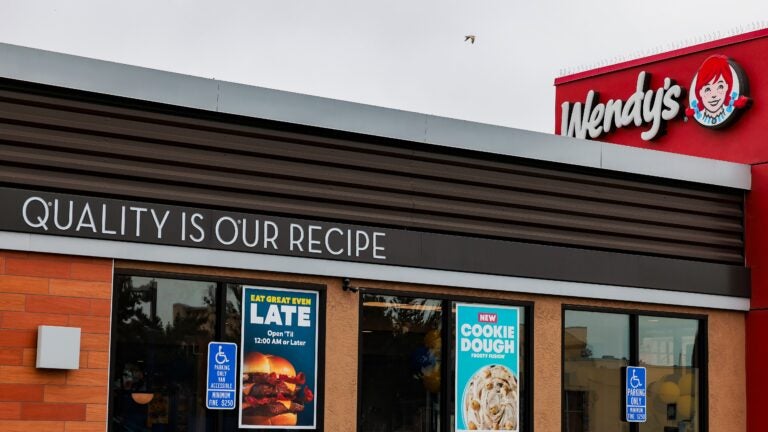
A Roslindale Wendy’s was warned twice this week after Boston police found the restaurant open four hours past its licensed closing time on two occasions, raising concerns about late-night activity at the location.
The Wendy’s at 520 American Legion Highway is licensed to operate from 10:30 a.m. to 11 p.m., and police told the Boston Licensing Board that they found the restaurant open after midnight on July 14 and again on July 20.
The restaurant’s website listed its closing time as 3 a.m., four hours later than its licensed closing time. Police also found that required inspectional and fire licenses were not posted at the restaurant.
[...]
Goble said the restaurant is now closing at 11 p.m. and is working through the process of applying for permission to operate later. The licenses are now posted as well, she said. But board members said extending the restaurant hours is not a simple fix.
“What made you think you could open until 3 a.m.?” Chairwoman Kathleen Joyce asked Goble at the hearing. Goble said she could not answer because the practice began before she took over the location. The district manager told the board that the restaurant had been operating those hours since at least the COVID-19 pandemic.
Interesting parallels to Boston, residential areas close to nightlife resulting in NIMBY noise complaints as well as over regulation etc.Not specific to Boston, but I thought this was an interesting video on the decline (perceived or actual) of nightlife in North American cities:
