Congestion toll in Boston?

I don't see a zipper working on I-90. I-90 does seem to get more reverse traffic and less peak direction traffic than I-93.

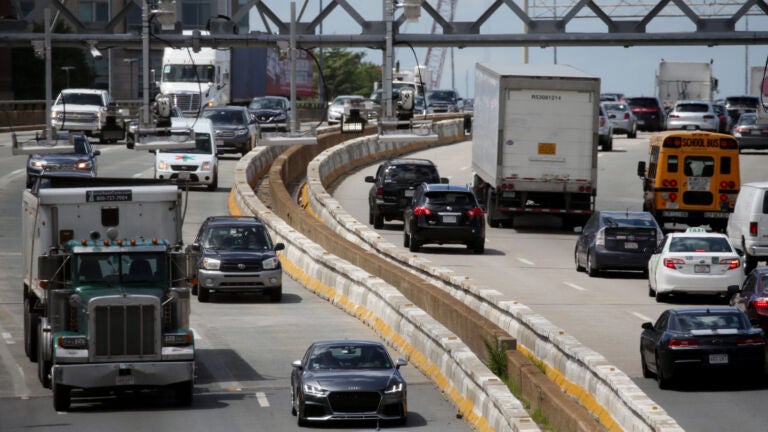
The 93 zipper NEVER worked. By cannibalizing what little shoulder space was left on a grandfathered interstate, stuffing the zipper barrier on the existing footprint wrecked what extremely small resiliency the highway had to withstand a disablement. It locks like it does every hour of every goddamn day because there is absolutely nowhere to weave around when traffic flow sustains a flesh wound. The highway would literally be improved by just getting rid of the zipper and re-claiming what little continuous shoulder space they can grab, but the only way it's going to be fixed at tangible improvement to traffic flow is by a billion-dollar Braintree Split-Southampton St. widening project that adds no lane capacity whatsoever but merely buffs out full Interstate-spec left and right shoulders through every bridge and overpass like vastly more resilient 128 now has. With the Pike, it already gets banged up daily by its lack of continuous breakdown lane inside of 128, though the road itself is much straighter than 93 so disablements don't yet bite traffic flow as hard as they do on the SE Expressway. But I can only imagine how awful it would be if you took what little shoulder remained and made a zippah out of it.

In Boston the only way a managed lane add is going to work completely trouble-free is if the pavement space allowances are akin to the sprawling I-84/I-91 carriageways east and north of Hartford: everything having full-width shoulders, including the HOV reservation. That's not construction we have any space to do in this region, certainly not for the dubious overall benefits of HOV's.
 
Last edited:
The 93 zipper NEVER worked. By cannibalizing what little shoulder space was left on a grandfathered interstate, stuffing the zipper barrier on the existing footprint wrecked what extremely small resiliency the highway had to withstand a disablement. It locks like it does every hour of every goddamn day because there is absolutely nowhere to weave around when traffic flow sustains a flesh wound. The highway would literally be improved by just getting rid of the zipper and re-claiming what little continuous shoulder space they can grab, but the only way it's going to be fixed at tangible improvement to traffic flow is by a billion-dollar Braintree Split-Southampton St. widening project that adds no lane capacity whatsoever but merely buffs out full Interstate-spec left and right shoulders through every bridge and overpass like vastly more resilient 128 now has. With the Pike, it already gets banged up daily by its lack of continuous breakdown lane inside of 128, though the road itself is much straighter than 93 so disablements don't yet bite traffic flow as hard as they do on the SE Expressway. But I can only imagine how awful it would be if you took what little shoulder remained and made a zippah out of it.

In Boston the only way a managed lane add is going to work completely trouble-free is if the pavement space allowances are akin to the sprawling I-84/I-91 carriageways east and north of Hartford: everything having full-width shoulders, including the HOV reservation. That's not construction we have any space to do in this region, certainly not for the dubious overall benefits of HOV's.

Double liked. The commute time in from even as close as Quincy is absurd, and the zipper punishes you for moving your commute out of rush hour.
 
Money is fungible, right?

Union pensions are a totally separate budget, like operating costs. Most don't understand this.

The problem with capital projects at the MTA is that there is often graft between the public workers and private contractors. The contractor (or straight up mob member) will ask that a certain truck with certain material be "lost" and the union worker will look the other way when it's driven off the lot. The IG has been cracking down on this so it usually isn't as bad as, say, Goodfellas. So with the congestion pricing money there does need to be more accountability. This is certainly tough with any bureaucracy but with Cuomo's MTA it more likely means it will allow him to build what he wants with the contractors he chooses. Supposedly there is a restructuring going to happen so that capital projects are more transparent. We will have to wait and see on this.
 
The point of the lockbox is to directly answer the reflex assertion that "they" will not spend it to improve work commutes for people who work in the zone but live outside it. Whether any metro area can effectively spend $ to improve transit is a separate question.

If there's no lockbox, the odds of improving transit are negative (it gets more crowded), and opponents can charge that the money will be "wasted" and "not help the people"

With a lockbox, you've done everything from a revenue side to ensure that the money is spent where "fairness" demands. Then it is a separate question of will the unions/contractors rip it off.

For NYC the answer is that they get about 1/4th the amount of mobility per capital dollar versus other high cost cities around the world (Paris, London), ripped off by the union-contractor-political syndicate.

For Boston the answer is more hopeful: We'd hope that Baker's intervention on the GLX--which stopped what was essentially $1b worth of contractor ripoff--says that Boston will spend its $ about as well as London has.
 
NYC's success will be a model for Boston.

Of a total 51.5b plan (including LIRR) essentially a third of it is made possible by a projected $15b from congestion tolling

Or you could say that the plan for the NYC subway is 37% bigger than it would have been without a congestion toll.

The promise in Boston will be: "Just as in NYC, the congestion toll will both speed downtown traffic *and* fund alternatives that make it easier to not drive"

 
Haven’t talked about congestion tolling (rebranded as mobility pricing)
Since the pandemic, but it is back as an idea for a commission to study


Is there any chance the gas tax could potentially be increased? I know it was a proposal pre-pandemic, but it didn't end up passing as the pandemic took full scope and attention.
 
Is there any chance the gas tax could potentially be increased? I know it was a proposal pre-pandemic, but it didn't end up passing as the pandemic took full scope and attention.
There's the Federal gas tax and the State gas tax. I'd say the Federal gas tax has very little chance of an increase because Congress will likely be of a conservative bent for the next few years. The state gas tax stands a higher chance of being increased.
 
There's the Federal gas tax and the State gas tax. I'd say the Federal gas tax has very little chance of an increase because Congress will likely be of a conservative bent for the next few years. The state gas tax stands a higher chance of being increased.

Yea. I was mainly referring the state gas tax, not the federal one. The pre-pandemic proposal was from Massachusetts. It was passed on March 4, 2020, and would had raised the gas tax across the Commonwealth of Massachusetts. The gas tax would increase from 24 cents/gallon to 29 cents, and increase state revenues by hundreds of millions.
 
An increase in the gas tax would be useful, but on its own it's not likely to solve much. With new ICE vehicles being increasingly unlikely by 2035, what with CAs and others ban on new sales we're going to need to rethink how we fund roadways generally.

Even modern ICE vehicles pay less in on a absolute-per-vehicle-mile basis compared to 20 years ago thanks to significantly better fuel economy across almost all segments - I think the projection was that gas-tax revenue declined about 1 percent each year as a result.

OR, UT, VA are piloting per-mile (VMT -Vehicle Miles Travelled) charges, supported by IRA funding. CA and other states are also probably launching something soon, and the Feds are looking at doing this as well. The IIJA included funding for a voluntary pilot for participants to replace the Federal Gas Tax (note that Treasury hasn't promulgated anything yet about how it's going to work.) For now, all of these are opt-in, but I think they'll probably go mandatory at some point in the near future. They also entirely replace the gas tax, rather than be an "on top of" - I believe that Treasury is establishing different rates for different categories of vehicles, but it would probably have the effect where they don't quite capture the full impact of gas-guzzlers.
 
It will take a while to move through the State House and then to be implemented, but I really think they need to get the T in much better shape before implementing.

It's really not a viable alternative right now and think this could choke the city's economic growth if alternative transportation options are not improved/ phased in ahead of the implementation.

I know there will be arguments about needing this revenue to support that future state of improved transit infrastructure, but I think we'd wind up in a "chick vs egg" scenario. The state should consider frontloading further investment be it through issuing bonds that could then in part be repaid through added revenue later.
 
Does anybody know if there's been any movement on the potential HOV to High Occupancy + Tolling (HOT) lanes conversion? Or any movement toward HOT lanes, sometimes referred to as 'managed lanes.' I know MassDOT looked at it back in 2020. I made the mistake of getting stuck in the tunnel yesterday afternoon for nearly an hour, and it seems like express/HOT lanes might help reduce peak hour congestion.

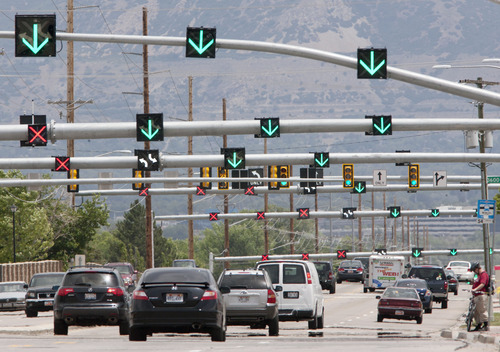
It seems like there are a fair amount of innovative things we could do or at least consider, short of expanding highway capacity, to help address congestion during the peak hours. You see some of the Western states embracing things like reversible/flexible lanes (where certain lanes can change directions based on traffic flows) and ramp metering/other technologies to better regulate flows from highway on-ramps, but they are slower to catch on in these parts. I realize these things are easier to do when you have a lot more space to work within, but our approach still seems a bit conservative.

'Flex lanes' aid traffic flow - and are proving safe

Ramp metering, a proven, effective strategy
 

“As I said earlier, everything needs to be on the table,” said Crighton, noting that lawmakers also need to take “regional equity” into consideration when supporting the T. “We shouldn’t be shy about talking about this stuff.”

Crighton briefly mentioned congestion pricing — a broad category that involves electronic tolling to charge drivers more, often for using a highway at a peak time of day, or going into a particularly dense part of the city (such as the program that recently started in Manhattan).

“I know people sometimes get assailed for saying the phrase ‘congestion pricing,’” Crighton said. “We shouldn’t be scared to have these conversations. Even getting a pilot done for congestion pricing has been near impossible. We’re not saying we’re pursuing that just by looking at it, right?”
 
The only place I can possibly think of where you could do a pilot would be the North End, bounded by N Washington/Cross St and Atlantic Ave/Commercial St, excluding the North End Garage, Resident Parking Permit holders, commercial vehicles, and disability plates/placards. Nothing else seems self-contained enough for such a pilot to work.

Even that seems questionable, how much non-commercial, non-resident traffic is the North End getting exactly?
 
Everything should be on the table and the notion of talking about all possible options should not be shied away from. If we are going to go this route though, we need to swing big from the beginning because enlarging down the road would prove to be VERY difficult. I think an initial congestion zone could be bounded by I-90 to the south, Arlington & Storrow to the west, North Station & Harbor to the north and then Harbor & Fort Point Channel to the east. This zone is served by mass transit train line and includes the two regional rail hubs for the city on top of countless bus lines.
1764084098041.png

Growth of the zone could go west, but those neighborhoods (ie Back Bay and South End) would fiercely pushback. My guess is Beacon Hill would even push for a carve out because they have the money to do so. There also may need to be collateral considerations such as impacts on Chinatown, which is a neighborhood we all know has been impacted by many policy decisions in the city.

One would also consider a carveout for MGH so that folks who need that kind of medical attention should not be hampered by congestion pricing. We don't need to make medical MORE expensive and less convenient in this country. MGH carveout would be more paletteable than a Beacon Hill carveout to me.

If this is the path that the city/state would want to take, I think the city/state should prioritize building out multi-modal roads throughout this zone including dedicated bus lanes with camera enforcement, grade separated bike lanes and the whole kit and caboodle. On-street parking could be minimized and repurposed for these efforts because the amount of on street cars would drop (look at the congestion drop in Manhattan) and we could design specific loading & ride share locations that are clear and relatively convenient. Maybe even some of these roads lose car access altogether!
 
I would extend the western boundary all the way to Mass Ave, but otherwise, agree with @CBCArch61 on trying to do the full zone up front. It's quite possible that people in the South End would then petition for inclusion, once a lot of traffic diverts from Boylston to Tremont and Washington Streets.
 
I would extend the western boundary all the way to Mass Ave, but otherwise, agree with @CBCArch61 on trying to do the full zone up front. It's quite possible that people in the South End would then petition for inclusion, once a lot of traffic diverts from Boylston to Tremont and Washington Streets.
A cleaner western boundary would be Bowker. It’s a lot less porous than Mass Ave. Bowker, Mass Pike, Fort Point Channel, Boston Harbor, Charles River forms a very clean boundary.
 
A cleaner western boundary would be Bowker. It’s a lot less porous than Mass Ave. Bowker, Mass Pike, Fort Point Channel, Boston Harbor, Charles River forms a very clean boundary.
I was thinking Bowker too initially because it would catch a ton of flow off of Storrow. Getting that "far" west should also look at including the Fenway area and Prudential areas. The aim is obviously to capture folks who are commuting into the city rather than residents. Presumably there would be an exemption for residents? How does Manhattan handle residents?
The map starts to look like a gerrymander political map haha.
1764164764900.png
 

Back
Top