Crazy Transit Pitches

I'm so glad you finished this! Or, at least round one. It'll be fun to look through, but some initial thoughts and questions:

For reviving abandoned routes, how much were you paying attention to what's been built over them already? Reviving rail-trails, fine. But a bunch of this requires demolishing sprawling housing developments, right?

And at a quick glance, it seems odd to miss a Worcester -> Lowell -> Lawrence line. Those are much bigger centers to connect than, say, Worchester -> Pepperell. And it would create a kind of circle line if it extended south through Woonsocket and Providence.

Much of New England was built as railroad towns,
This is pedantic, but I'm not sure I'd call anything in Massachusetts a "railroad town." I tend to think of a railroad town as one that wouldn't be there but-for the railroad, or not nearly so important. But basically everything on your map existed as a town before railroads even existed. The railroads just connected them all.

The practical difference is that for a "railroad town," the train station almost de facto defined the center of town, and everything grew around that, which is great for public transit. Get off the train, and you're on Main Street, Wherever. By contrast, when railroads were trying to connect to existing towns, they'd sometimes just try to get reasonably close to downtown. Off the top of my head, an Amherst station might be a mile from the real downtown. I can't think of any that would be too bad, but maybe you've considered which are most egregious. (I've heard people complain about this more in the UK, where old railroad companies named a station after a town, but really it'll be a couple mile hike.)

But again, this is just nitpicking.

The network design broadly takes inspiration from the rail networks of the Netherlands and Germany.
I'm not sure how to quantify this, but how "dense" is your New England network compared to the rail networks of the Netherlands or Germany? This seems denser even than those, and for much fewer people. I'm not sure what you would reasonably compare this too.

There is definitely a strong argument for the god-mode threat but hot take: It doesn't really matter,
Yeah, whatever. I certainly don't care. Even some of the cheapest and humblest of Reasonable Transit Pitches get treated like they should be in god-mode. Post wherever.
 
It's a cool map, the one question I have, regards the elimination of the Needham Line. I realize most crayon maps do that, on the assumption that it gets a rapid transit replacement. But in a world where you are basically restoring passenger rail to most places it has ever been in the past, it seems odd to eliminate an actual operating passenger line.
 
This is pedantic, but I'm not sure I'd call anything in Massachusetts a "railroad town." I tend to think of a railroad town as one that wouldn't be there but-for the railroad, or not nearly so important. But basically everything on your map existed as a town before railroads even existed. The railroads just connected them all.

The practical difference is that for a "railroad town," the train station almost de facto defined the center of town, and everything grew around that, which is great for public transit. Get off the train, and you're on Main Street, Wherever.
Buzzards Bay isn't a town (it's a village in the town of Bourne), but its development was largely due to the railroad. The Cape Cod Branch Railroad between Middleboro and Sandwich crossed Cohasset Narrows here in 1848. At the time, there only a handful of buildings here, and the Sandwich glass works landed shipments along the shores of the narrows. These shipments were then transported over land in the valley between the narrows and Sandwich. At the time, the nearest substantial village was Monument to the east (today's Bourne village).

Cohasset Narrows' fortunes changed with the opening of the Woods Hole branch in 1872. A new, busy station was built at the junction, and the village soon grew around the station. The Old Colony Railroad changed the name of the station to "Buzzards Bay" in the summer of 1879, to, and the July 29, 1879 Barnstable Patriot stated, "This is done because there is a Cohasset station of the Old Colony Railroad in the town of Cohassett, and freight sometimes gets forwarded to the wrong place, and passengers who are strangers are sometimes misled. We noted one instance only a week or two since. Mail matter too is often miscarried, and we presume that the name of the post office will also be changed to Buzzard’s Bay."

So while not a railroad town, Buzzards Bay is definitely a railroad village, down to its name.
 
For reviving abandoned routes, how much were you paying attention to what's been built over them already? Reviving rail-trails, fine. But a bunch of this requires demolishing sprawling housing developments, right?
I went over everything on google earth, plotting routes and station locations. Unless I made a mistake (which is entirely possible), there should be no major developments that would need demolishing. I think in a few places you need to get rid of one or two buildings or deviate behind a new development, but that should be it. You can check my work here. That was one of the big motivations for the interurban lines, they feature street-running to avoid tight sections or encroachment.

And yes, a lot of rail trails are converted on this map.

This is pedantic, but I'm not sure I'd call anything in Massachusetts a "railroad town." I tend to think of a railroad town as one that wouldn't be there but-for the railroad, or not nearly so important. But basically everything on your map existed as a town before railroads even existed. The railroads just connected them all.

The practical difference is that for a "railroad town," the train station almost de facto defined the center of town, and everything grew around that, which is great for public transit. Get off the train, and you're on Main Street, Wherever. By contrast, when railroads were trying to connect to existing towns, they'd sometimes just try to get reasonably close to downtown. Off the top of my head, an Amherst station might be a mile from the real downtown. I can't think of any that would be too bad, but maybe you've considered which are most egregious. (I've heard people complain about this more in the UK, where old railroad companies named a station after a town, but really it'll be a couple mile hike.)

But again, this is just nitpicking.
I'd nominate Ayer, Shirley, and North Easton in MA or Griswold in CT as just a couple examples. When putting the station markers down I tried to get as close to downtown as possible, that is a key point for getting good bike-up ridership, it has to be close(ish) to everyone. Sometimes this wasn't possible, Rutland is an example I can immediately find where the station is a half-mile outside of downtown. There are also some stations on this map in much more rural areas that would operate more like park-and-rides, probably on a flag-stop system like Florida or South Barre. While the focus was on building a network to support these ' new railroad towns' I also wasn't going to just totally ignore everything in-between if there was a big distance covered.
I'm not sure how to quantify this, but how "dense" is your New England network compared to the rail networks of the Netherlands or Germany? This seems denser even than those, and for much fewer people. I'm not sure what you would reasonably compare this too.
It really depends. Broadly the answer is probably going to be more dense but it's also not without comparison, the reactivation of old lines gets discussed in NL/DE plenty and around smaller cities in Germany many lines have been converted to tram-train lines. There are also some pretty rail-but-not-people dense areas in both countries. Limburg, Groningen, the Harz, and southern Bavaria are a few cases.
It's a cool map, the one question I have, regards the elimination of the Needham Line. I realize most crayon maps do that, on the assumption that it gets a rapid transit replacement. But in a world where you are basically restoring passenger rail to most places it has ever been in the past, it seems odd to eliminate an actual operating passenger line.
To keep it on this map would suggest that everywhere else gets better service except for Needham and West Roxbury. In a world where there are something like 13-15 TPH going through Forest Hills, it's hard to imagine Needham ever getting more than half-hourly service over that flat junction and even that is a reach. Yes you could rebuild Forest Hills with a flying junction but there is literally 0 reason to do that when you could build a rapid transit extension instead without going through any of that trouble.
The map looks great, and the comprehensive passenger rail system you show is needed to sustain future population and transportation growth. The existing highway system is already overloaded and could never be expanded enough to serve current and future passenger and freight needs. I'm wondering about freight traffic on an expanded rail system. Would some or all of the expanded lines you show also handle freight traffic? The old rail system that once extended into every nook and cranny of New England used to support freight movement for the small factories, mills and warehouses that populated almost all of the towns and cities. Those don't exist anymore, but the rise of on-line shopping and other factors would justify an expanded freight rail system.
No doubt there would be extensive freight service, but that's partially because many of these lines already see freight service. With a wider network you could think about experimenting with a freight shipping/distribution network but that's probably not a basis for building out a system like this. As I work further north freight comes in as a bigger and bigger factor, many lines in VT+NH+ME are still used for freight for quarry and forestry products, so passenger use is more feasible despite density and total population being much lower.
 
Last edited:
@TheRatmeister , you designed this vast network, but didn't extend the Cape Cod rail all the way to Provincetown? C'mon.

It's got a small year-round population, but in the summer it grows to ~50,000. That's bigger than Everett. Truro, along the way, has a similar summer swell from 2,400 to 20,000 people. If you're really trying to connect people across the state, it makes sense to extend the line all the way to PTown.
I wanted to add that but there is functionally no existing ROW. The Cape Cod Main Line north of Wellfleet is so extremely, thoroughly encroached upon to the point of being unusable. If you want rail service to Provincetown you'd probably need to build a new line next to Rt 6, either adjacent to it or by widening it and putting the rail line in the middle. Both options seem quite rough but maybe I'm overestimating the difficulty here. There's also the ferry service from Plymouth and Boston that would reduce the demand for such a line by quite a bit, and you could add another service from Sandwich if you wanted to.

(Chatham is the same, FYI)
 
@TheRatmeister First of all, I just have to say: bravo! The diagram alone is a behemoth, and very impressive; the network desgin, all the more so.

There are so many interesting and thought-provoking things here, I don't know if I'll have time to call them all out (at least not today). But some things that jump out at me, I've noted below.

(A comment for other folks: I think it's important to acknowledge the Crazy Transit Pitches are inherently creative expressions. Yes, they can and should be backed up by data, but data doesn't make decisions; people do. So I think it's important for us to bear in mind that sometimes the answer to "Why did you do it this way?" is going to be "Because I liked it the most", and that's something we should be fine with.)

I'm keeping this in Crazy Transit Pitches because I'd argue over the timescale you'd be seeing anywhere near a full-build at, it's could possibly maybe not be that expensive. SMART is building rail in California at $30m per mile today. But yes, it does involve a total (if gradual) total re-imagining of urban development and transportation in New England, which is obviously quite a large undertaking. There is definitely a strong argument for the god-mode threat but hot take: It doesn't really matter, it's probably not happening either way. Anyways, the map. It's so large that the most effective way I can find to share it is a PDF. It's an attachment below.

And here's the vision/utopian pitch: Much of New England was built as railroad towns, and we could, if we choose, rebuild it as railroad towns.
This is pedantic, but I'm not sure I'd call anything in Massachusetts a "railroad town." I tend to think of a railroad town as one that wouldn't be there but-for the railroad, or not nearly so important. But basically everything on your map existed as a town before railroads even existed. The railroads just connected them all.

The practical difference is that for a "railroad town," the train station almost de facto defined the center of town, and everything grew around that, which is great for public transit. Get off the train, and you're on Main Street, Wherever. By contrast, when railroads were trying to connect to existing towns, they'd sometimes just try to get reasonably close to downtown. Off the top of my head, an Amherst station might be a mile from the real downtown. I can't think of any that would be too bad, but maybe you've considered which are most egregious. (I've heard people complain about this more in the UK, where old railroad companies named a station after a town, but really it'll be a couple mile hike.)

But again, this is just nitpicking.
Buzzards Bay isn't a town (it's a village in the town of Bourne), but its development was largely due to the railroad. The Cape Cod Branch Railroad between Middleboro and Sandwich crossed Cohasset Narrows here in 1848. At the time, there only a handful of buildings here, and the Sandwich glass works landed shipments along the shores of the narrows. These shipments were then transported over land in the valley between the narrows and Sandwich. At the time, the nearest substantial village was Monument to the east (today's Bourne village).

Cohasset Narrows' fortunes changed with the opening of the Woods Hole branch in 1872. A new, busy station was built at the junction, and the village soon grew around the station. The Old Colony Railroad changed the name of the station to "Buzzards Bay" in the summer of 1879, to, and the July 29, 1879 Barnstable Patriot stated, "This is done because there is a Cohasset station of the Old Colony Railroad in the town of Cohassett, and freight sometimes gets forwarded to the wrong place, and passengers who are strangers are sometimes misled. We noted one instance only a week or two since. Mail matter too is often miscarried, and we presume that the name of the post office will also be changed to Buzzard’s Bay."

So while not a railroad town, Buzzards Bay is definitely a railroad village, down to its name.
I'd nominate Ayer, Shirley, and North Easton in MA or Griswold in CT as just a couple examples. When putting the station markers down I tried to get as close to downtown as possible, that is a key point for getting good bike-up ridership, it has to be close(ish) to everyone. Sometimes this wasn't possible, Rutland is an example I can immediately find where the station is a half-mile outside of downtown. There are also some stations on this map in much more rural areas that would operate more like park-and-rides, probably on a flag-stop system like Florida or South Barre. While the focus was on building a network to support these ' new railroad towns' I also wasn't going to just totally ignore everything in-between if there was a big distance covered.
This is an interesting discussion in and of itself. My understanding has always been that there were communities that primarily sprung up around railroad stations, through the process that @OldColony described above. (Really cool write-up, by the way!) IIRC, Waban on the Green Line has a similar story, where the station really preceded the village.

A "railroad village" is actually a distinction worth highlighting; yes, some (many) MA towns long precede the railroad, but my recollection is that many had "satellite villages" that emerged within their municipal borders when stations were built there. In any case, I think that "railroad village" might be a good encapsulation of your vision, @TheRatmeister, since it evokes the cohesiveness and contiguousness of a suburban/rural village, rather than municipal entities that may contain large tracts of unsettled/lightly settled land.

This process, of the station preceding the village, also is one that could be repeated in new areas as well. Transit-oriented development, but on a larger scale.
 

Attachments

  • 1763264613485.png
    1763264613485.png
    16.3 KB · Views: 106
  • 1763325770080.png
    1763325770080.png
    1.9 MB · Views: 101
Interspersed between these larger and medium-sized cities are the railroad towns, the new centers of rural New England. ... These communities blend a (relatively) dense, compact core with mostly agricultural and rural surroundings. These towns are where you find your single-family homes with large amounts of private green space. To an extent spralwing, but nonetheless still within biking distance from all the local amenities and the railway station. And yes, biking. Any city or railroad town will have a robust network of cycling infrastructure, really enabling car-free living for the masses. The catchment area for a railway station is not a 10-15 minute walking distance, but a 10-15 minute cycling distance on quiet streets and safe bicycle paths.
This is really interesting. It really is true -- the expansiveness of a bikeshed compared to a walkshed offers the most compelling vision for "having our cake and eating it too" in terms of today's modern suburb. SFH and lawns have been given too much primacy over the last 50 years, but they definitely need to have their place in some vision for a sustainable future. This might just be the ticket.

(I've still got mixed feelings about bikes, but I appreciate the way you've deployed them into this larger system.)

Last but not least, in pink are the interurbans. Making some use of city streets and boulevards, these are mostly concentrated into three networks around Lexington, Salem, and the South Coast where they provide a mix of high-frequency urban-transit and local intercity transit. These routes are among the most frequent, with 15-30 minute headways on each line all day.
I like your use of interurbans here. Light rail's ability to go off-ROW for short stretches really enables some stitching together that just isn't possible otherwise. The Fall River <> New Bedford Line is a good example of this, including its connection to UMass Dartmouth. I also really like the creativity of extending Newport's (and New Bedford's) line(s) the extra mile (along remarkably convenient boulevards!) to provide more direct service within those communities. That actually makes one of the more compelling arguments I've seen for light rail along the 195 Corridor. (You could also do something similar in Providence, though I can understand why you chose not to.)

There were a couple of lines I was surprised you didn't deploy the Interurban option for. In particular, I was curious why the Central Mass Line got the light rail treatment, but the Millis Branch didn't? The ability to use the same "off-ROW linkage" and "extra mile extension" techniques that you deployed along the South Coast could also work for connecting this line to Milford, which strikes me as a bigger prize than Franklin. Was there anything in particular that pointed you toward Franklin over Milford? (Obligatory link to my own concept for a Milford interurban.)

It also strikes me that your Lowell <> Framingham Line could work well as an Interurban, and could (for example) join your Minuteman <> Lowell Line for its direct service through Downtown Lowell. At the other end, you could divert east after Framingham Common - FSU, steal some space along Route 9 (and potentially Cochituate Road), serve the Natick Mall etc, and then pick up the Saxonville Branch to terminate at Natick Center. (The Saxonville <> Natick Mall <> Framingham Center path is something I've crayoned for a while, without much success.) This would also produce the minor benefit of unifying your Minuteman and Central Mass networks.

It's also still very much unfinished. Of course there are still things like a legend that need to get done, and I'm not really happy with the current color scheme to be honest, there's too much green. I'd also like to add some ferries to the map, plus make it more clear where the railroad cities and towns are so that the map alone is better at representing the idea.
I actually don't personally feel like there's too much green. I suppose you could break the green category up, perhaps distinguishing between services that do reach "major" cities (however you wish to define those) and those which don't?

I really like the idea of adding ferries. As discussed below, I think access by ferry to Provincetown will remain important, so worth showing. It would also be great to show the ferries to Block Island, Martha's Vineyard, and Nantucket, which could have very strong rail connections at Hyannis, New Bedford, Fall River, Newport, New London, and, to a lesser extent, Providence. Ferry connections from Connecticut to Long Island could also be cool. (Block Island already has a little bit of the "15-minute bikeshed" culture, in that visitors who don't want to pay to bring their car will rent a bike for the day.)

For marking the railroad cities/towns/villages, I wonder if you could use a really light backdrop around those stations. Maybe something like this?:

View attachment 68587
[see screenshot in previous post]
@TheRatmeister , you designed this vast network, but didn't extend the Cape Cod rail all the way to Provincetown? C'mon.

It's got a small year-round population, but in the summer it grows to ~50,000. That's bigger than Everett. Truro, along the way, has a similar summer swell from 2,400 to 20,000 people. ...
I wanted to add that but there is functionally no existing ROW. The Cape Cod Main Line north of Wellfleet is so extremely, thoroughly encroached upon to the point of being unusable. If you want rail service to Provincetown you'd probably need to build a new line next to Rt 6, either adjacent to it or by widening it and putting the rail line in the middle. Both options seem quite rough but maybe I'm overestimating the difficulty here. There's also the ferry service from Plymouth and Boston that would reduce the demand for such a line by quite a bit, and you could add another service from Sandwich if you wanted to.

(Chatham is the same, FYI)
Ferries with good rail transfers at Sandwich, Plymouth, and Boston seem like the best solution, IMO. Keep in mind also that going via rail is the long way around. The Boston ferry takes 1h40m; the Plymouth ferry seems to be slower, at 1h30m for half the distance; Sandwich is a similar distance as Plymouth (~24 miles). The overland route from Sandwich is something like 54 miles long, and would have ~11 stops, which is actually pretty similar to South Station <> Wickford Junction, which takes 1h45m (under better conditions than the Cape Cod Main alignment, also). Those are some challenging obstacles to overcome.
 
"High Speed Line" Transfers: I think what you've done at Millennium Park, Arlington Heights, Wakefield, and potentially Braintree is to create something similar to the Mattapan High Speed Line, in that an interurban service (or local suburban service) provides a transfer to a rapid transit service. The downside of the discontinuity is the forced transfer, but the upside is that it liberates the urban-suburban-exurban corridor from requiring a single mode to serve all purposes, opening the door to "rightsized" infrastructure and frequencies (including not needing to compete with other services within 128). I like this concept, and crayoned it in forms similar to you over the years. (MMMMM Line, for one; I've crayoned a Central Mass LRT Line that connects to a Green Line extension to Weston/128 as well; and a "Lexington High Speed Line" has been tossed around for years as a response to the change in density past Arlington -- though it's definitely much less common to crayon it all the way to Lowell!) In any case, am I reading your intention correctly there?

Marblehead: I really like what you've done here. This corner of the network has always been interesting: two major branches (Newburyport and Rockport) forming a trunk, with a litany of minor branches that mostly converge at Salem. In principle, it makes for a good S-Bahn topology, where low-frequency branches converge at the edge of the built-up density, to provide high frequencies along the trunk; in practice, the particular details here make that hard to implement. Your solution is to turn those would-be diverging branches into a set of circumferential services -- similar to the Aldgate Junction concept, but in your case there is no junction (topologically) but rather a crossing. (An "Aldgate Crossing"?) This is clever, and in fact is something you've deployed in quite a few places across the map.

You've doubled this "Aldgate Crossing" concept with a "mini-S-Bahn" structure, where your interlined routes between Danvers and Marblehead create maximum frequencies within the densely settled area before splitting out into low-density suburbs with lower-frequency service. It's a very parsimonious solution.

South Coast Interurbans: You've used something of an "inverse Aldgate Crossing" (these terms are getting out of control, ha), in that you've taken what is often seen as a + or T shaped corridor (Boston <> Fall River/Newport, and Providence <> New Bedford), and converted it into into a Y shape, in a way that both results in good S-Bahn-style trunks in New Bedford, Fall River, and the East Bay, and a good range of connectivity across the region. Obviously you have sacrificed the PVD <> NB 1SR via Fall River, but on the other hand you have a mainline service that connects Providence and New Bedford via Taunton. Personally, I think I probably would still keep the East-West 1SR, but I think what you've shown is still compelling.

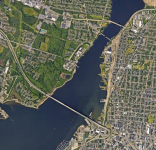
FWIW, you might consider using the old crossing a bit further north:

View attachment 68604
[see screenshot in previous post]

It's (a lot) shorter of a water crossing, and I think wouldn't need to be as high (or could just use the drawbridge, perhaps). It would also let you capture whatever TOD goes in around Fall River Depot, and maybe provide a little bit more service to the neighborhoods along there (e.g. an interurban infill at Maple St or something).

"Mini-networks": I like how many "mini-networks" you have built in across the system, reflecting your vision for decentralization. For example, a small "Taunton network" exists with local trains terminating at Middleborough, North Taunton, TF Green Airport via Providence, Battleship Cove, and New Bedford Depot. A "Cape Cod" network has local trains terminating at Middleborough, Woods Hole, Hyannis, and Wellfleet, connecting to your Intercity services as the spine. Framingham, Lowell, Lawrence, Providence, Worcester, Springfield, Hartford, New Haven -- the usual suspects, but then also places like Woonsocket, Willimantic, New London, and Greenfield.

Inland Route: Another thing I was surprised by was your exclusion of any sort of Worcester <> Springfield <> Hartford 1SR. Was there anything in particular you had in mind there? For example, your Brewster Intercity line could continue through Springfield to Worcester.
 
@TheRatmeister First of all, I just have to say: bravo! The diagram alone is a behemoth, and very impressive; the network desgin, all the more so.
Thank you! I believe I've been working on this for a month and a half now?
You could also do something similar in Providence, though I can understand why you chose not to.)
I looked at a few other interurban routes for Providence but nothing really made sense to me. Obviously you could also design a light rail or maybe even metro system for Providence, but that felt very out of scope and a project for another time.
There were a couple of lines I was surprised you didn't deploy the Interurban option for. In particular, I was curious why the Central Mass Line got the light rail treatment, but the Millis Branch didn't? The ability to use the same "off-ROW linkage" and "extra mile extension" techniques that you deployed along the South Coast could also work for connecting this line to Milford, which strikes me as a bigger prize than Franklin. Was there anything in particular that pointed you toward Franklin over Milford? (Obligatory link to my own concept for a Milford interurban.)
I believe this was an area where I couldn't find anything I really liked so I just picked something. I should give it more thought and come back for all the reasons you mentioned.
It also strikes me that your Lowell <> Framingham Line could work well as an Interurban, and could (for example) join your Minuteman <> Lowell Line for its direct service through Downtown Lowell. At the other end, you could divert east after Framingham Common - FSU, steal some space along Route 9 (and potentially Cochituate Road), serve the Natick Mall etc, and then pick up the Saxonville Branch to terminate at Natick Center. (The Saxonville <> Natick Mall <> Framingham Center path is something I've crayoned for a while, without much success.) This would also produce the minor benefit of unifying your Minuteman and Central Mass networks.
I'll give it some thought, its definitely worth investigating.
In any case, am I reading your intention correctly there?
Pretty much.
Personally, I think I probably would still keep the East-West 1SR, but I think what you've shown is still compelling.
I forget the exact numbers but NB-Providence via Taunton is really not that far off in terms of distance, and given the slightly snakey mess through Fall River it would probably come out faster too. For the demand from New Bedford or Dartmouth to Warren or Barrington I think the transfer is acceptable.
FWIW, you might consider using the old crossing a bit further north:
Maybe, it would definitely save on the costs of a new bridge or tunnel. I just don't really see how you'd get there.
"Mini-networks": I like how many "mini-networks" you have built in across the system, reflecting your vision for decentralization. For example, a small "Taunton network" exists with local trains terminating at Middleborough, North Taunton, TF Green Airport via Providence, Battleship Cove, and New Bedford Depot. A "Cape Cod" network has local trains terminating at Middleborough, Woods Hole, Hyannis, and Wellfleet, connecting to your Intercity services as the spine. Framingham, Lowell, Lawrence, Providence, Worcester, Springfield, Hartford, New Haven -- the usual suspects, but then also places like Woonsocket, Willimantic, New London, and Greenfield.
Definitely a design goal! Have the local lines converge at a few hubs for easy transfers, plus build out smaller S-Bahn style networks in Providence, Springfield, and Worcester.
Inland Route: Another thing I was surprised by was your exclusion of any sort of Worcester <> Springfield <> Hartford 1SR. Was there anything in particular you had in mind there? For example, your Brewster Intercity line could continue through Springfield to Worcester.
There are definitely some intercity connections that are lacking on this map, and I do need to go back and update them. I was not as thorough as I should have been when making those routes.

I will say it's not necessarily a problem though if a good transfer exists. In the Netherlands for example there are no direct trains from Nijmegen or Arnhem to Den Haag or Rotterdam, there's just a high quality transfer with very good frequencies in Utrecht. If your transfers are good and frequencies high, a 2SR can be nearly as good.
 
Maybe, it would definitely save on the costs of a new bridge or tunnel. I just don't really see how you'd get there.
Well, so this uncovered an interesting mistake on my part. The abandoned drawbridge I was looking at is actually an old automobile bridge, which explains why there isn’t a clear ROW leading into it. The rail bridge was a bit further south; I haven’t looked super carefully, but my suspicion is that Wilbur Ave is built on or along the old ROW. (Indeed, the width of the parking lots, and the general character of the buildings, points to it being alongside.) I’m pretty sure the ROW continued through the woods along the Walker St Path, cut through the residential neighborhood south of the highway and across the power plant lot, to a crossing at Long Point.

So, there is perhaps a path from 195 to the old rail bridge, but south of the highway, it doesn’t look nearly as feasible.
I will say it's not necessarily a problem though if a good transfer exists. In the Netherlands for example there are no direct trains from Nijmegen or Arnhem to Den Haag or Rotterdam, there's just a high quality transfer with very good frequencies in Utrecht. If your transfers are good and frequencies high, a 2SR can be nearly as good.
Agreed! As I said above, some of this is just straight-up a creative/artistic/political statement, and (implicitly) arguing in favor of reliable transfers in lieu of 1SRs is perfectly valid to that end.
 
I wanted to add that but there is functionally no existing ROW. The Cape Cod Main Line north of Wellfleet is so extremely, thoroughly encroached upon to the point of being unusable. If you want rail service to Provincetown you'd probably need to build a new line next to Rt 6, either adjacent to it or by widening it and putting the rail line in the middle. Both options seem quite rough but maybe I'm overestimating the difficulty here.
I see, you're absolutely right. There's way more encroachment than I was thinking. Going along Route 6 looks tough in places. There are also some power line ROWs to look at, but I don't have any good suggestion for how to string them all together.

This whole network you've drawn out is easily a half a trillion dollars in capital investment. I'd say that in a world where we're actually building this, you'd find a way to get to Ptown with tunnels, eminent domain, or a whole new ROW. But also, this is you're exercise. If you want to avoid that, makes sense to me.

There's also the ferry service from Plymouth and Boston that would reduce the demand for such a line by quite a bit, and you could add another service from Sandwich if you wanted to.
I'm not sure that's true. First, I think there'd be a lot of demand for people who are staying elsewhere on the Cape, but want to visit Ptown for the day. But also, a train connection to the ferry could be useful for people taking the ferry from Boston, but are actually going to, say, Brewster. That could be faster, or more fun, or more convenient than taking the train the whole way.
 
This whole network you've drawn out is easily a half a trillion dollars in capital investment. I'd say that in a world where we're actually building this, you'd find a way to get to Ptown with tunnels, eminent domain, or a whole new ROW. But also, this is you're exercise. If you want to avoid that, makes sense to me.
If you can actually do cost controls it shouldn't, at least in theory. I haven't counted everything up but it's around 2,000 miles of new or significantly improved line, plus something like 550 new stations and some amount of rolling stock. At $50m per mile that's $100bn in rails, at $20m per station which I think is a reasonable average, some will be tiny and others quite large, that's another $11bn, and rolling stock+facilities would be some additional amount of money but not $390bn. That $50m per mile is also on the higher side, like I said SMART is building at $30m per mile in the bay area today. So expensive yes, annual defense budget sized no.
 
Well, so this uncovered an interesting mistake on my part. The abandoned drawbridge I was looking at is actually an old automobile bridge, which explains why there isn’t a clear ROW leading into it. The rail bridge was a bit further south; I haven’t looked super carefully, but my suspicion is that Wilbur Ave is built on or along the old ROW. (Indeed, the width of the parking lots, and the general character of the buildings, points to it being alongside.) I’m pretty sure the ROW continued through the woods along the Walker St Path, cut through the residential neighborhood south of the highway and across the power plant lot, to a crossing at Long Point.

The rail bridge was the Slade's Ferry Bridge, which had rail on top and road below. Abutments are still there on both sides.

The ROW paralleled Wilbur Avenue to the east. A bit west of Riverside Avenue, there's an abandoned battery house (used to supplement the power station at peak hours) in the woods. There's also a bridge abutment at Walker Street, and remains of the pre-Slade's Ferry Bridge ferry wharf.
1763404347210.png
 
The rail bridge was the Slade's Ferry Bridge, which had rail on top and road below. Abutments are still there on both sides.

The ROW paralleled Wilbur Avenue to the east. A bit west of Riverside Avenue, there's an abandoned battery house (used to supplement the power station at peak hours) in the woods. There's also a bridge abutment at Walker Street, and remains of the pre-Slade's Ferry Bridge ferry wharf.
View attachment 68620
Definitely the best corridor for getting a rail line across the Taunton River at Fall River. It ties beautifully into the existing Fall River station, and there is plenty of wooded area west of the river to route a rail line. The question is how to continue eastward across Fall River from the existing commuter rail station. I would go for a deep bore tunnel under downtown.
 
The rail bridge was the Slade's Ferry Bridge, which had rail on top and road below. Abutments are still there on both sides.

The ROW paralleled Wilbur Avenue to the east. A bit west of Riverside Avenue, there's an abandoned battery house (used to supplement the power station at peak hours) in the woods. There's also a bridge abutment at Walker Street, and remains of the pre-Slade's Ferry Bridge ferry wharf.
View attachment 68620
That Old Slade's Ferry Bridge corridor would make the best location, IMO, for a Providence/Fall River/New Bedford interurban line crossing of the Taunton River. The river is relatively narrow there, and the crossing is near the existing Fall River commuter rail station. Here's the route I would use, utilizing the wide I-195 median to the west. Stations are shown by the blue markers.

1763530085925.png
 
I went over everything on google earth, plotting routes and station locations. Unless I made a mistake (which is entirely possible), there should be no major developments that would need demolishing. I think in a few places you need to get rid of one or two buildings or deviate behind a new development, but that should be it. You can check my work here. That was one of the big motivations for the interurban lines, they feature street-running to avoid tight sections or encroachment.

And yes, a lot of rail trails are converted on this map.
Not that it matters for the concept, but the Waterbury-Hartford line on the highland branch makes a couple unnecessary detours as you mapped it. You have it skipping the Terryville Tunnel on the old alignment, and you have it riding along the top of the dike protecting the line from Hancock Brook Lake, reintroducing a grade crossing with Greystone Road. Another nit is that the Danbury-Waterbury line cant join the Waterbury branch line in Platts Mills; there's a 50+ elevation difference there. Shouldn't make a difference following the original row paralleling Leonard Street to where they meet at Washington Ave as the old row is still more or less undeveloped and used for storage or the occasional driveway.

As for comments on the extent of line reactivation, I was wondering why you didn't add a line for the Canal line from New Haven to Hamden, maybe as part of an interurban network centered on New Haven.
 
Always wondered how a branch of the orange line to Medford Square would pencil out cost + ridership-wise...

1763894382792.png


Using old ROW w/ cap cut tunneling and the existing flying junction could bring costs down substantially. Only like 5-6 houses would need demo (plus a BUNCH of backyard construction).

I think a station at Spring St would have a pretty good walkshed in a relatively underserved area in eastern Medford, but unsure on what the best alignment/station placement would be for Medford Square.

This feels pretty crazy due to the invasive construction and impact on orange line scheduling, but maybe in another world it would be a realistic proposal.
 
Always wondered how a branch of the orange line to Medford Square would pencil out cost + ridership-wise...

View attachment 68752

Using old ROW w/ cap cut tunneling and the existing flying junction could bring costs down substantially. Only like 5-6 houses would need demo (plus a BUNCH of backyard construction).

I think a station at Spring St would have a pretty good walkshed in a relatively underserved area in eastern Medford, but unsure on what the best alignment/station placement would be for Medford Square.

This feels pretty crazy due to the invasive construction and impact on orange line scheduling, but maybe in another world it would be a realistic proposal.
This extension has been proposed as far back as 1945 and detailed in this 1947 report which included a description and cost estimate: https://archive.org/details/reportofmetropol00mass

If you go to page 39-41 you’ll find the description. The intent was for it to remain as a freight route at night only with gauntlet tracks at stations and electric rapid transit (orange line) during the day. Of course, this was an active freight line at the time so the costs today would be substantially greater than initially estimated ($1.45M if 1945, ~$26M today adjusted for inflation)
 
Always wondered how a branch of the orange line to Medford Square would pencil out cost + ridership-wise...

View attachment 68752

Using old ROW w/ cap cut tunneling and the existing flying junction could bring costs down substantially. Only like 5-6 houses would need demo (plus a BUNCH of backyard construction).

I think a station at Spring St would have a pretty good walkshed in a relatively underserved area in eastern Medford, but unsure on what the best alignment/station placement would be for Medford Square.

This feels pretty crazy due to the invasive construction and impact on orange line scheduling, but maybe in another world it would be a realistic proposal.
The original rail ROW has been so encroached and built upon, that major land takings and residential demolition would be required to build a transit line, either surface or tunnel.
 

Back
Top