The biggest difference here historically is really that the construction of logan didn't resultnin mass evictions or urban destruction in quite the same way, largely because it never was fully built out. As a result, displacements were much more limited. I've posted about it before in a now defunct thread, but up until ww2, Olmsteads grid just never materialized or filled in.
View attachment 68281
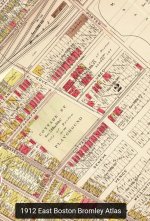
The above may have been the 1860 vision, but it just never fully built out. In the 1922 Bromley Atlas, when Logan was mostly a dream, most of those parcels are shown as white, unfilled, unbought, and the same applies to Eastie proper. Its worth remembering that everything north of Maverick and East of Bremen (including the old B&A yard that is now the Bremen St buffer park) used to be salt marsh that was only filled in the 1920s - much of it was never developed as anything other than Logan. While the segment around Neptune is terra firma, it too remained largely vacant / unsold through 1940 and the outbreak of WW2.
View attachment 68285
View attachment 68286
View attachment 68287
View attachment 68289
The inital 1920s construction of Logan required next to no land takings, as takings were of future fill parcels and new fill, so the street grid of Eastie today is basically as it stood in 1945 - by 1950, the modern shape of Logan is already evident, as are the modern contours of eastie. The Neptune blocks at this time still hadn't built out. The ~1947-1952 construction of the Revere Extension's RoW and Wood Island Station hollowed out the grid somewhat, and despite the new transit connection no more of the grid would ever be built out. The approximately 50 triple deckers then remaining would linger through 1978, when aerials show them being individually demolished, along with the pocket on Frankfort - which, incidentally, was meant to be contiguous to Maverick. I don't know if these were seizures or voluntary sales, but it occurred on a much smaller scale than the downtown urban renewals.
View attachment 68288
View attachment 68290View attachment 68291View attachment 68292
And on that note, I do think we need to accept that Eminent Domain as a power has the potential to do a lot of good, as long as its used surgically, deliberately - its inevitable for infrastructure projects. Without getting into the debate about what's good vs bad infrastructure, like highways, sometimes that means folks gets displaced, because its not viable to keep everything on existing properties. Even today, despite local opposition, we'd probably have supported the 1947 demolitions to create the Revere RoW, and see Baltimore and the controversial takings for the Frederick Douglass Tunnel which most transit and infrastructure folks agree is sorely needed. But there's a difference in building necessary public infrastructure as compared to urban renewal or to advance private development. Getting the Blue Line to Lynn is certain to need eminent domain, but redeveloping Everett doesn't - Theres a reason
Kelo v. City of New London is a landmark supreme court case. Notably, MA is one of 5 states that hasn't adopted post-Kelo reforms to eminent domain.