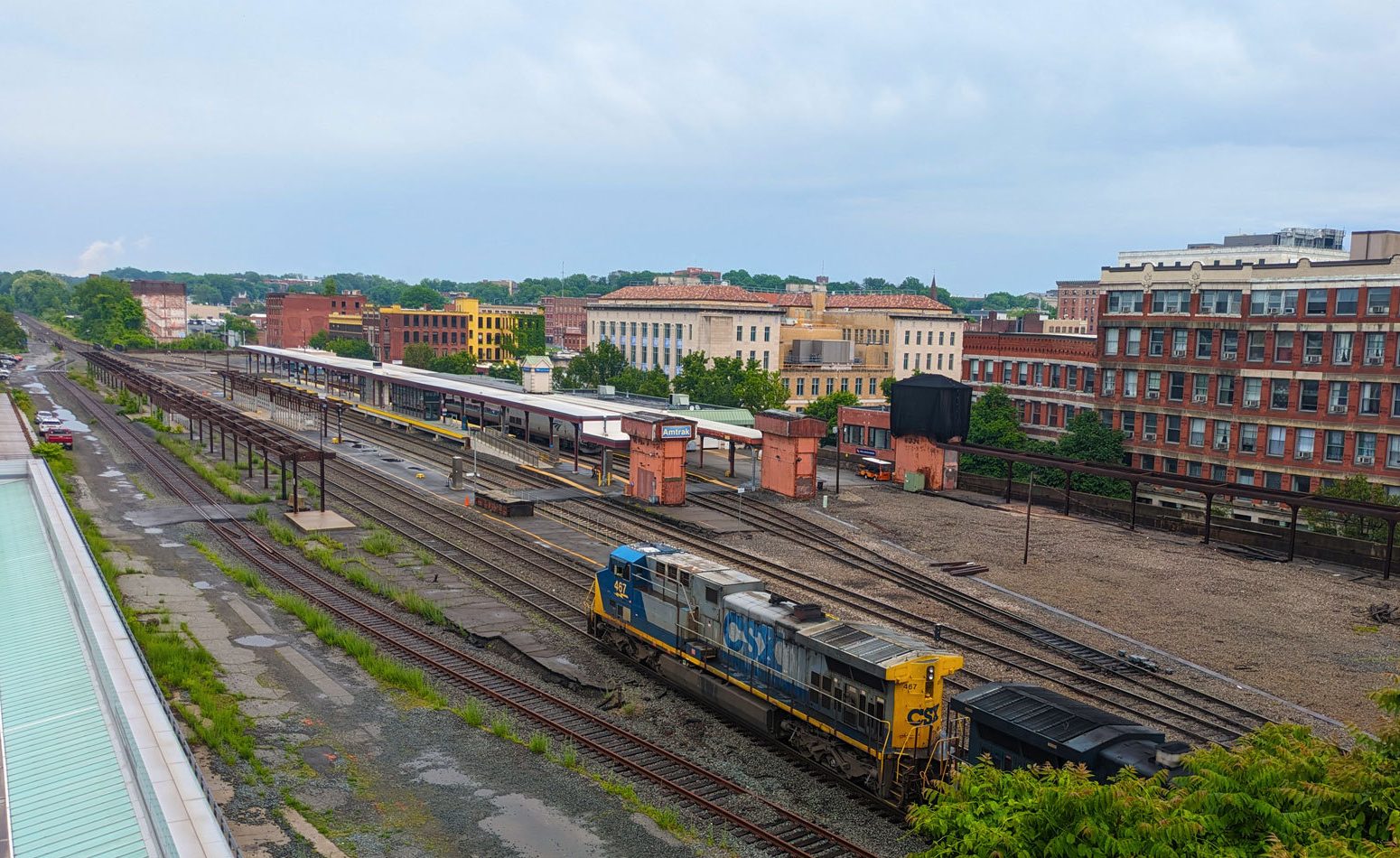
MassDOT Rail: Springfield Hub (East-West, NNERI, Berkshires, CT-Valley-VT-Quebec)

But when would you ever have a six-way timed transfer? There are only four directions trains can come/go. A four-way timed transfer would give everyone every possible transfer option.

If there were a six-way timed transfer, that would mean multiple trains are coming in from the same direction at essentially the same time, which is wasteful and redundant. Multiple trains would then leave in the same direction, one right after the other, which is wasteful and redundant. With such sparse schedules, it doesn't make sense to have multiple trains clumped together, only a couple minutes apart.
it's not the directions, it's the service patterns:

Vermonter
Harford Line
Valley Flyer
NE REgional (inland route)
Boston-Albany
Lake Shore Limited

That's six distinct service patterns, even though the specific station location only feeds into North-South and East-West, 4 directions as you note. I am not trying to predict what the future holds, but it's not hard to conceive of a situation in which somebody needs to transfer between any 2 pairings of the six. Maybe it's not that likely most of the time, but it could happen. Ideally, it would happen. And then there are the points that @F-Line to Dudley made about switching and freight clearances. Regardless, four tracks doesn't seem extreme, because it's not hard to imagine a scenario that might require them, even in a world involving a still limited number of passenger trains.
 
If you look at the proposed service patterns, some trains change from N-S to E-W at Springfield. It is not pure N-S, E-W service. Inland route New Haven to Boston, for example.

Not saying you get to six trains, but there are complications. Plus freight.
Yeah. Plus, remember, the N-S and E-W trains are going to have timed transfers to each other. You want people from Boston to be able to get more than one whack-per-day at the Valley+Vermont+Montreal, so that one-RT-a-day Boston-Montreal direct train is going to be complemented by stock Inland slots that have a timed transfer to the existing Vemonter/Montrealer from D.C. so two-seaters to/from Boston and the north are easily stageable. And vice versa with the people from Connecticut getting a second whack at the Valley+Vermont+Montreal by having their stock Inland slot timed with a transfer to the Boston-Montreal train. Ply the same timed-transfer strategy for getting from Connecticut to Albany (a drive that's nearly impossible without either back-tracking many dozens of miles on highways or taking the backroads). The Amtraks are going to clump multiples at a time many times per day at irregular intervals under a full service rollout, while the Hartford Line is going to run at a more predictable clockface that's probably going to interact a few times a day with these AMTK meets.

Like I said...I don't know if you get to all the way to 4 platforms' worth of usage, so there's maybe *some* fat in this design. But 3 platforms at a time? Yeah...that's definitely going to happen by-design here.
 
If you look at the proposed service patterns, some trains change from N-S to E-W at Springfield. It is not pure N-S, E-W service. Inland route New Haven to Boston, for example.

Not saying you get to six trains, but there are complications. Plus freight.
Yeah, that's right. I should have been clearer. I think four is the maximum number of trains you'd ever need to time together at this station. Because the routes are not straight N-S annd E-W, the true number is probably less, I think only three.

I think that's fine, BTW. What will probably be the more popular routes won't need a transfer at all, like New Haven <-> Boston. Less common routes hopefully get a timed transfer, like Boston <-> Greenfield. For uncommon routes, transfers will still be possible, but probably not timed, like Greenfield <-> Albany.

it's not the directions, it's the service patterns:

Vermonter
Harford Line
Valley Flyer
NE REgional (inland route)
Boston-Albany
Lake Shore Limited

That's six distinct service patterns, even though the specific station location only feeds into North-South and East-West, 4 directions as you note. I am not trying to predict what the future holds, but it's not hard to conceive of a situation in which somebody needs to transfer between any 2 pairings of the six. Maybe it's not that likely most of the time, but it could happen. Ideally, it would happen. And then there are the points that @F-Line to Dudley made about switching and freight clearances. Regardless, four tracks doesn't seem extreme, because it's not hard to imagine a scenario that might require them, even in a world involving a still limited number of passenger trains.
Yes, there are those services, but it wouldn't make sense to do timed transfers between a bunch of them. For example, why do a timed transfer between Boston-Albany and the Lake Shore Limited? They run the same route. There'd be no reason to transfer. And if they are pulling into Springfield at the same time, that means they are running long parts of their routes at essentially the same time. That would be bad because then that wouldn't actually be helping frequencies at, say, Pittsfield if they were to get more trains per day, but always in clumps of two just a couple minutes apart. The same logic goes for the Vermonter and the Valley Flyer.

Look, I'm not totally sure about this. Here's the full list of routes listed on the Compass Rail page. Anyone can prove me wrong by listing which five trains (route and direction) for which they think it would make sense to all be in Springfield station at the same time.

1772483120033.png
 
It also needs to be said...this is not like the cost of Worcester Union Station getting its new-construction island platform that hadn't previously existed in any way, shape, or form attached to the station in over 60 years. Springfield Union Station already has 4 serviceable island platforms. A couple of them are not in great physical shape, but they all have active pedestrian access to the station building, at least 2 of them if not more have active passenger elevators, and 2 of them have fairly recently disused baggage elevators that wouldn't cost much to refurb into general passenger elevators. Plus something's going to have to remain low-level or mini-high for freight passage within the crossover layout, meaning we're not talking full-cost renos for all 4 islands. With how incredibly complex the crossovers are going to have to be throughout the whole area to make the envisioned service layer cake work without conflict, it's not saving very much money to try to VE the platforms to the absolute bare-minimum layout that the Train Sim printout says will physically work for a very unruly set of non-clockfacing Amtrak service variety + clock-facing CTrail + crush-load freight. Just get it all done at once and move on to the individual service implementations.
 
For example, why do a timed transfer between Boston-Albany and the Lake Shore Limited?
I think we are close to having the same understanding of things, but I would point out that there is a reason for timed transfer between Boston-Albany service and LSL trains, due to the local vs limited aspect of their stops. You can't take the Lake Shore Limited from Cleveland to Palmer, but you could take the train from Cleveland to Palmer if you transfer in Springfield. There may not be a lot of customers for that ticket, but if we can design the system to enable it, especially when the design isn't a significant cost bloat, then why shouldn't we?
 
I think we are close to having the same understanding of things, but I would point out that there is a reason for timed transfer between Boston-Albany service and LSL trains, due to the local vs limited aspect of their stops. You can't take the Lake Shore Limited from Cleveland to Palmer, but you could take the train from Cleveland to Palmer if you transfer in Springfield. There may not be a lot of customers for that ticket, but if we can design the system to enable it, especially when the design isn't a significant cost bloat, then why shouldn't we?
Also, there are times where this helps capacity (or your own personal cost vs convenience calculus). Might not be too common outside of holiday periods, but trains sometimes do sell out for certain segments, and sometimes when they're highly sold but not sold out you get very different costs for your trip by boarding a few stops apart.

I've absolutely done things like board NJT to ride a couple stops to catch an Amtrak before even though that Amtrak *did* serve my initial boarding location, and saved $100 for it or been able to ride a train that showed as sold out from my station but wasn't sold out if I boarded a few stops further down the line.
 
I think we are close to having the same understanding of things, but I would point out that there is a reason for timed transfer between Boston-Albany service and LSL trains, due to the local vs limited aspect of their stops. You can't take the Lake Shore Limited from Cleveland to Palmer, but you could take the train from Cleveland to Palmer if you transfer in Springfield. There may not be a lot of customers for that ticket, but if we can design the system to enable it, especially when the design isn't a significant cost bloat, then why shouldn't we?
Do we know if the Lake Shore Limited is going to skip Palmer? I was under the impression that Palmer would be a stop on the LSL.
 
Do we know if the Lake Shore Limited is going to skip Palmer? I was under the impression that Palmer would be a stop on the LSL.
No idea, I just threw that out there as an example, but pick any town that the Boston-Albany service will visit, that is not part of the LSL route, and you get the same justification for timed transfers.
 
I think we are close to having the same understanding of things, but I would point out that there is a reason for timed transfer between Boston-Albany service and LSL trains, due to the local vs limited aspect of their stops. You can't take the Lake Shore Limited from Cleveland to Palmer, but you could take the train from Cleveland to Palmer if you transfer in Springfield. There may not be a lot of customers for that ticket, but if we can design the system to enable it, especially when the design isn't a significant cost bloat, then why shouldn't we?
Oh yeah, I'm guessing we have pretty similar understandings of this, but I'll try to answer your question.

The overwhelming primary purpose for the Boston-Springfield-Albany service is to improve frequencies throughout the day at those (and intermediate) stops. We need enough options through the day to actually make that service useful. Transfers, and especially timed transfers, are nice, but secondary. In your example of timing the Boston-Albany with the Lake Shore Limited, that would be failing in the primary purpose. One train would be following the other, just a couple minutes behind, the whole way from Albany to Boston. Riders would technically be able to pick from between the 1:00 from Albany to Boston or the 1:03 from Albany to Boston (for example), but that's not a meaningful difference for riders, and there would still be the same, huge gaps in the schedule through the rest of the day. The same would be true for every other stop along the line. To improve frequency and give more people more flexibility in travel, you need to run the new East-West trains when there isn't already a Lake Shore Limited train running. That is overwhelmingly more important than basically any possible transfer.

@millerm277 points out that that running those two services together could help with capacity, and that's true. You'd be running two trains at the same time, so that would carry more people. But I'm not aware of any capacity problems on the existing Lake Shore Limited. Someone else knows better than me, but a quick poke around Amtrak's website and I can't find any sold out trains, even day-of. Maybe those trains sell out around the holidays, but that's not a reason to run a redundant, mostly empty train every day the rest of the year.

Yes, if you ran these services together, you could get a timed transfer to Palmer (that'll be the only local stop, right?). But that's really inconsequential compared to the downsides. People taking the train from west of Albany to Palmer (population 12,000) might just have to wait a bit for transfer. That's vastly better than running redundant trains every day.

Don't get me wrong, obviously transfers are great. They improve options for people. Amtrak doesn't do a lot of timed transfers around the country, but we actually have the routes and the station to pull off a four-way timed transfer, which should be seen as minor miracle for North American railroading. A nickel for anyone who can name a three-way timed transfer in the US, because I can't. It's great we're planning for this. But I think it's basically impossible you will ever, ever see a six-way timed transfer at Springfield. Any dollar we spend towards making more than four-way transfer is a wasted dollar.

There may not be a lot of customers for that ticket, but if we can design the system to enable it, especially when the design isn't a significant cost bloat, then why shouldn't we?
Yeah, the marginal cost of fixing up the last (almost certainly unnecessary) platform, might not cost too much extra, which is why I'm not too upset about it. It will never be used for a six-way transfer (or even a five-way), but maybe it's useful for some flexibility.

However, it is still bloat. It's not free. Just fixing up that extra platform will adds millions of dollars, maybe tens of millions. We're assuming it's not too much more, which is plausible, but we don't have any numbers. It could be that they can easily build on the existing infrastructure at the station. Or it could be the existing infrastructure is a huge impediment to things like ADA upgrades. We don't know. And either way, this kind of bloat at every level of planning is a part of why infrastructure costs keep going up. It's maybe not egregious on it's own, but it adds up and can be a sign of a worrying lack of planning.

 
No idea, I just threw that out there as an example, but pick any town that the Boston-Albany service will visit, that is not part of the LSL route, and you get the same justification for timed transfers.
The only proposed infills in any of the studies are Palmer and Chester...and Chester is only mentioned as an afterthought in a universe where we have max-build BOS-ALB schedules. There's not a chance it goes it on the board for just the Lake Shore Ltd. or only a couple BOS-ALB slots; it's way too small. New York State could also opt for a Chatham infill since that hits a nice density pocket between Pittsfield and Albany and there's a gorgeous station building there, but they haven't run any of their own studies yet. Palmer's expected to feature on all schedules, LSL included. The track class Worcester-Springfield is being uprated from Class 3/59 MPH to Class 4/79 MPH swallowing any infill penalties and lopping a full half hour off the LSL schedules with it in there, so there's no hand-wringing about including Palmer on the Chicago run. It'll be a necessary step for any BOS-ALB service development to do a similar track class uprate from Springfield to Schodack, NY, which would swallow any penalties from adding Chester and/or Chatham in the future. There'll be no skip-stoppage in any envisioned service pattern running East-West, so transfers will not ever need to be coordinated between unlike E-W vs. E-W slots. Even the long-distance trains are slated to be fully load-bearing for East-West connectivity.

You do need to coordinate transfers between all manner of unlike E-W and N-S Amtrak trains at Springfield, though. And that's where things get messy. The Vermonter is timetabled to/from Washington D.C., and so are the thru Northeast Regionals (which will likely increase in number post-Gateway). They're all running on an NEC schedule cadence, which is going to differ from the train spacing of things operating exclusively on the Springfield Line (Inlands and Valley Flyers) that are built around the Hartford Line's schedule cadence (because the Amtrak slots are load-bearing for ConnDOT commuter cross-ticketing). It's very likely that B&A Amtrak schedules are thus going to be a bit 'clumpy' and not be--at full build--anything close to a perfect regular clockface. The multi-directional transfers (Boston-Greenfield/VT/Montreal, Hartford/New Haven-Albany) will be prioritized to tap the ridership sources from destinations that have no current linkage, and that's going to involve chaining a lot of unlike schedules together on the transfers. And you've also got to bob and weave around more than a dozen daily freight slots, which is going to cause the remaining regularity of frequencies to wobble a little. For example, they may choose to ride a 79 MPH BOS-SPG westbound Inland a few minutes in the 'wake' of a 60 MPH Worcester-West Springfield westbound CSX nonstop, with the Palmer stop acting as the timing mechanism that keeps them from ever catching up with the freight so long as everybody's running on-time...and they won't necessarily be able to be choosy about the particular clockface of those 'opportunistic' slots.

It's not going to be a perfect European takt...far from it. Its very imperfection--that linkage of unlike schedules at a common diverging station--ends up being where the whole Compass Rail investment draws its value.
 
I think we are close to having the same understanding of things, but I would point out that there is a reason for timed transfer between Boston-Albany service and LSL trains, due to the local vs limited aspect of their stops. You can't take the Lake Shore Limited from Cleveland to Palmer, but you could take the train from Cleveland to Palmer if you transfer in Springfield. There may not be a lot of customers for that ticket, but if we can design the system to enable it, especially when the design isn't a significant cost bloat, then why shouldn't we?
Sorry, not going to happen.
 
Timed transfers involving the Late For Sure Limited seems like kind of a dubious proposition.
Timing with a westbound Lake Shore Limited? Yeah, maybe.
Timing with an eastbound Lake Shore Limited? lol
 
Some info about East-West/Compass rail in this article:
  • Congress's February spending bill included a $1.2 million earmark for MassDOT to start planning new "positive train control" (PTC) systems on the state-owned tracks between Springfield and Greenfield, where Amtrak currently runs the Vermonter and the Valley Flyer routes. Federal safety rules require PTC as a condition for running more frequent passenger service.
  • MassDOT expects to begin construction next year on its $108 million project to upgrade tracks between Springfield and Worcester for higher-speed passenger trips. The project will benefit the new Inland Route and the proposed Boston-Albany route.
  • MassDOT is also in "step two" of a service development plan for the proposed Boston-Albany route. "This is to identify the service levels and required capital projects to deliver the entire west-east service," explained Slesinger. "Once complete, we anticipate a 'Step 3' award to conduct PE (preliminary engineering) and environmental review for the identified infrastructure improvements. Ultimately, completion of Step 3 enables project eligibility for FRA (Federal Railroad Administration) funds for implementation."
  • Slesinger reported that the Springfield track reconfiguration project, which we reported on last month, is nearly finished with its preliminary engineering and environmental permitting, and its final design phase will begin soon.
  • MassDOT and CSX are also building new track infrastructure in the Pittsfield area to ensure that Amtrak's Berkshire Flyer won't get stuck behind slower-moving freight trains (most of the railway between Pittsfield and New York currently consists of a single track, so trains can't pass each other). MassDOT is designing a three-mile passing track in Richmond, plus new siding tracks near the CSX yard in Pittsfield. These projects would also benefit the proposed new Boston-Albany route.
 
Some info about East-West/Compass rail in this article:
The hourly Springfield-NYC service would probably entail extension of the Keystones from terminating-NY trains to thru-NY trains, since those run on a mostly hourly cadence. That's been talked about extensively as a long-term consideration. Capacity for it will exist once the top-down rehab of the 4 East River Tunnel bores is complete and Springfield gets its layover yard built, so long as Metro-North don't throw a dispatching monkey wrench into it (I could see them trying to bait the feds into paying to finally grade-separating the flat junction at New Rochelle).

These will probably end up being the source slots for all Inland Route trains from New Haven-Springfield-Boston, since there'll be a lot of them to choose from and they run on such regularly-spaced frequencies. The studies to-date have only specified New Haven short-turns, but if the thru-to-Springfield trains already exist it makes all the sense in the world to just extend as many of them to Boston as they have available B&A slots.
 

Officials: With fresh cash infusion, WMass rail projects chug forward

“Union Station here in Springfield is going to be the center of activity,” said Neal, D-Mass., who spearheaded the $100 million renovation project that saved the 100-year-old station. “Every conversation that you have. This is a crossroads of New England.”
Neal also announced a $1.2 million earmark for advanced positive train controls for the Knowledge Corridor rail line from Springfield to Greenfield. And he touted a total of $150 million in federal funding that’s flowed into west-east rail over the past five years.
But the first two new trains from Springfield to Boston still aren’t scheduled to depart until 2030, according to a rundown delivered both by Koziol and MassDOT Rail Administrator Meredith Slesinger. The long-sought Palmer station is now scheduled for 2033.
[...]
But west-east service as far as Albany, New York, isn’t scheduled until the year 2045. State Rep. Tricia Farley-Bouvier, D-2nd Berkshire, said that’s too long for a region starving for economic development. She’s been telling constituents that frequent trains to Albany and Boston probably would not happen during her time in office, but certainly in her lifetime, she said.
“But I’m getting a little scared about that,” she said. And she promised to keep advocating to keep Boston-to-Springfield-to-Albany service on track, noting that she’s not alone in her efforts. “The entire Berkshire delegation is here,” she said.
State Rep. Kelly Pease, R-Westfield, asked about planned stops between Springfield and Pittsfield. Bob Daley, a representative of Chester’s rail advocacy group, pushed for a stop in his scenic hilltown, which has a rail museum.
 

Back
Top