New England Electrical Grid

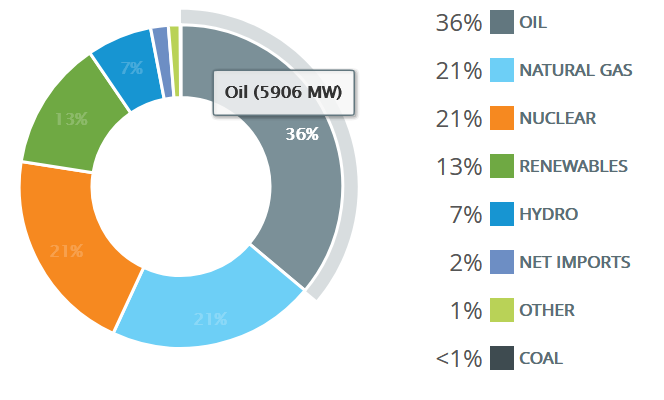
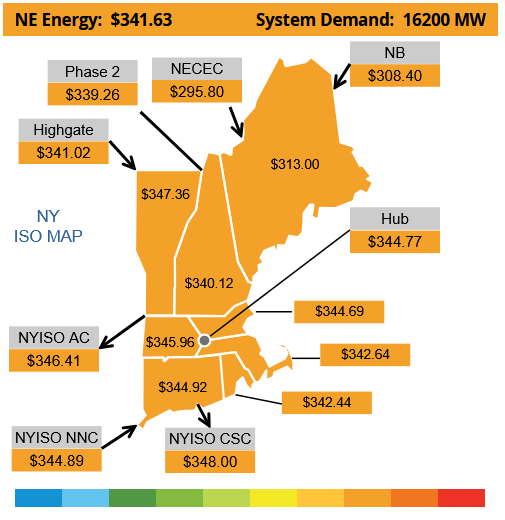
And the oil share of generation keeps going up (we're approaching 6GW now), with wholesale electricity prices getting very high:

And we're still 3 hours away from evening peak grid demand, when another 3.5GW of generation will need to come online.
1769285159392.png
1769285185864.png
 
Oil is up to 6.1GW; imports are also way down (we're now exporting to Quebec on the old Phase 2 line and exporting to New York State, though NECEC is still importing but down to 250MW). Let's see where that 3.5GW to meet evening peak will come from.
 
We're at peak. Oil is up to 7.1GW, and gas is up to 5.2GW (maybe generators were saving gas for peak?). Quebec turned off their spigot, and we're now exporting to Quebec. NYISO turned on their spigot though, contributing 1.1GW. The wind also picked up a little (sitting at about 1GW).
 
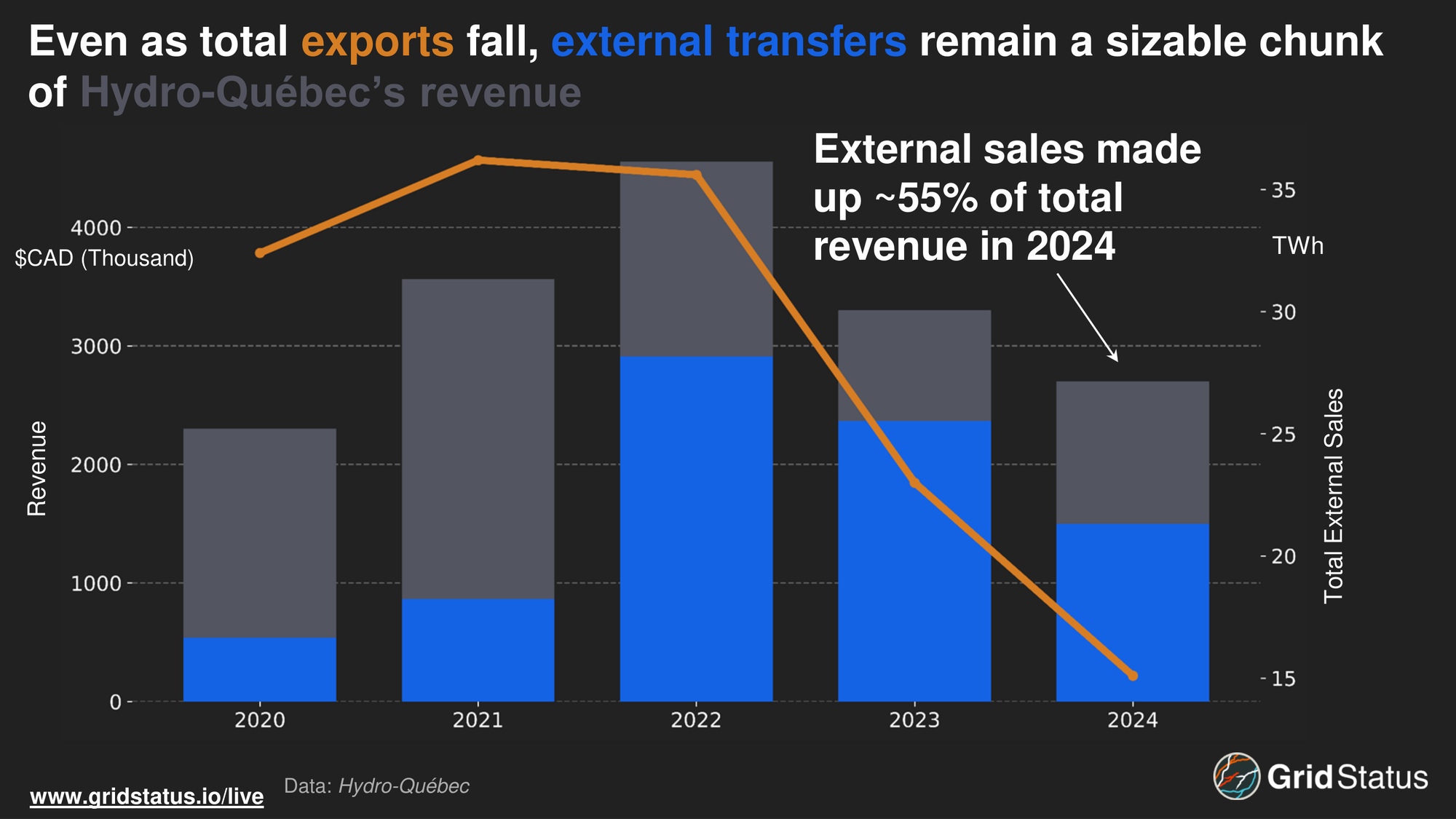
An interesting read on the history of Quebec's interconnections with New England and New York, and why exports from Quebec have rapidly fallen recently, with frequent bouts of New England and New York exporting power to Quebec:
 
Today looks like it will be worse - we're basically at yesterday's evening peak already in terms of demand and power prices by 11:50AM, but without much solar to help us out due to the storm. Wind generation is down significantly at 225 MW. Oil generation is at 7.6GW and gas generation is back up at 6GW. ISO-NE is issuing an "M/LCC 2, Abnormal Conditions" alert.
1769359986559.png
1769360018321.png
 
I'm not personally much of an expert on the grid, but at what point are we looking at rolling blackouts? We're going to run out of fuel oil reserves sooner or later (at 7GW of oil generation we're burning somewhere around 1500 tons of fuel oil per hour, assuming 40% power plant efficiency), and it's looking pretty cold for the next week.
 
Also not an expert, but we're still exporting out of ISONE back to Canada since they're winter-peaking demand, too. I'd expect to see those exports tick down if load continues increasing as prices also rise. It will absolutely be cold the rest of this week, but the BTM solar will come back online as it'll be sunny, and we might get some wind, too. If gas pipelines are at risk of reduced flow due to freezing, then I think we end up in some real trouble. You've already linked to it, but for anyone else the Gridstatus insight articles and blogs are super helpful getting up to speed.

So odds are we'll avoid blackouts but the grid will be super expensive and dirty. If pipelines freeze it could get ugly...
 
This honestly highlights the current weakness of dispatchable renewable energy - most current and planned BESS installations I've seen are only able to dispatch their rated nameplate capacities for 4-8hrs, which while sufficient for short term peaker duty, that is much less sufficient over the longer duration of a multi day event - An oil or gas peaker can dispatch so long as it has fuel. I believe ISO NE only has less than 1GW of BESS operational; we need much more long duration BESS storage assets and/or other dispatchable energy. Integration and live load shifting to behind the meter storage can help, but we need more dispatch able renewables to be able to replace all that oil generation. (As an aside, "synthetic natural gas" and SMRs are starting to get some attention to serve that market.)
 
Last edited:
On the topic of batteries - interestingly, according to Gridstatus, Texas battery operators are holding onto their charged batteries in hopes of wholesale power prices increasing even further before selling their power into the grid (essentially trying to time the market for maximum profit), with much reduced battery discharging into the grid compared to before the storm.
 
As for remaining oil capacity - according to page 8 of ISO-NE's 21-day energy assessment, we entered the cold spell with roughly 40 million gallons of residual fuel oil and about 50 million gallons of distillate fuel oil on-hand.

Running some numbers:

Number 6 fuel oil (residual fuel oil) has 44.6kwh of thermal energy per gallon. Assuming 40% power plant efficiency, that gets us about 17.84kwh of electrical energy per gallon of fuel oil.

With 40 million gallons, we have about 713,600MWh of electrical energy, which can sustain 7GW of operation for about 102 hours, or about 4 and a quarter days.

Diesel fuel (which is a distillate fuel) has about 40.8kwh thermal energy per gallon, which gets us 16.32kwh of electrical energy per gallon. 50 million gallons gets us about 816,000MWh of electrical energy, which can sustain 7GW of operation for 117 hours, or almost 5 days.

So we have roughly 9 days of fuel stock to burn at current rates, and we've used up 2 of those days, giving us about a week left if gas supplies don't recover, or other sources (solar, wind) don't pick up. Solar will probably pick back up as it will be sunnier, but wind speeds aren't that high next week.

 
Also, looking at ISO New England's cold weather update for this week, they asked for a 202(c) emergency order from the Secretary of Energy to override pollution and other environmental controls until the end of the month, which was granted. According to their letter to Secretary Wright, this is largely for Fore River Energy Center in Weymouth, an 818MW dual-fuel natural gas/distillate fuel oil generating plant which is subject to environmental restrictions around, NOx, CO, and NH3 pollution.
 
Does anyone know how much it hurt us to lose the coal-fired plant at Somerset?
 
Somerset (2020) and Pilgrim (2019) were both losses of about 680 MW capacity each.

If we are looking for more base load capacity, we should really be back investing in nuclear, like NY State, not coal.
The federal government is trying to slash some of the permitting requirements for nuclear. And the governor's energy bill will remove the statewide referendum requirement to operate a new plant in MA. Hopefully this leads to a nuclear resurgence.

 
The federal government is trying to slash some of the permitting requirements for nuclear. And the governor's energy bill will remove the statewide referendum requirement to operate a new plant in MA. Hopefully this leads to a nuclear resurgence.

A bit ambivalent on the relaxing of permitting standards. But if we could ever treat nuclear plants like products (SMR) rather than custom built albatrosses, it should be easier to replicate and scale capacity safely.
 
Somerset (2020) and Pilgrim (2019) were both losses of about 680 MW capacity each.

If we are looking for more base load capacity, we should really be back investing in nuclear, like NY State, not coal.
The biggest local generating loss was definitely the 2024 closure of Mystic 8&9 - but if we're looking at NY State as a point of reference... we don't have a NYPA / Santee Cooper analogue agency for the state to be able to directly make such power plant decisions. Especially over the timeframe for a nuclear plant to be worthwhile, I think a public entity not concerned about the 5 year sharholder return, more comfortable with the 50 year outlook we're looking at - theres a reason BPA/TVA/NYPA exist (large scale hydro having the same issue - the Northeast is notable for not having access to a federal Power Marketing Administration).

IMO, we'd want to look at a regional compact to fund and maintain new large nuclear power plants as a public good - power shortages are a NE wide problem not isolated to MA. Seabrook has the pad for a second unit, Millstone has the former Unit 1 site that can be rebuilt and reconnected. Create a separate corporate entity, with Allocated ownership of the unit to each state as a percentage of costs contributed with a bonus to whichever state hosts it. Pilgrim is probably too worn for a restart, but depending on the risk profiles the site may be good for SMRs - the former Vermont and Maine Yankee sites would also be good candidates for new SMR generating units.

Edit: ooc, I know CFS's Devens SPARC is going to be a tech demostator, but would it ever be viable to connect it to the grid?
 
Last edited:
A bit ambivalent on the relaxing of permitting standards. But if we could ever treat nuclear plants like products (SMR) rather than custom built albatrosses, it should be easier to replicate and scale capacity safely.
I'm not exactly an expert on this stuff, but I was under the impression commoditized solar + battery storage already exists at a per MWh cost lower than what any new nuclear can provide, while SMRs are theoretical and far from being proven to be more cost-effective than solar paired with battery storage for baseload power.
 

Back
Top