
You are using an out of date browser. It may not display this or other websites correctly.
You should upgrade or use an alternative browser.
You should upgrade or use an alternative browser.
P
Portlander
Guest
That is a gain of 9.2% over last year so far if my math is correct! 

NR2Portland
Active Member
- Joined
- May 18, 2022
- Messages
- 458
- Reaction score
- 1,368
Looking like they’ll be on pace for around an impressive 7% increase in enplanements year over year. Last year was a record of course, continuing to grow and honestly lots more room to grow from here. Excited to see what’s down the road for 2026.

Portland councilors to consider funding for controversial jetport parking expansion
The plans call for the paving of new surface lots to accommodate a growing number of travelers who park their cars at the Portland International Jetport for longer periods of time. It would add a net total of 265 parking spaces.
 www.mainepublic.org
NR2Portland
Active Member
- Joined
- May 18, 2022
- Messages
- 458
- Reaction score
- 1,368
it shouldn’t be labeled as “controversial”. Anyone who argues that this is not a necessary step towards a new garage isn’t educated on the situation. It’s too bad. Crossing my fingers for tonight
NR2Portland
Active Member
- Joined
- May 18, 2022
- Messages
- 458
- Reaction score
- 1,368
city council is a bunch of mindless politicians… mayor Dion, surrounded by all these councilors that only care about staying in office, is doing all he can for the city.
Council voted almost unanimously against this expansion. Dion; for the expansion backed by logic. All these councilors saying “there’s a better way!” But aren’t saying what it is.
The system is so broken and this is a huge loss for the Jetport
Council voted almost unanimously against this expansion. Dion; for the expansion backed by logic. All these councilors saying “there’s a better way!” But aren’t saying what it is.
The system is so broken and this is a huge loss for the Jetport
Let me guess....they will build new bike trails to the Jetport.city council is a bunch of mindless politicians… mayor Dion, surrounded by all these councilors that only care about staying in office, is doing all he can for the city.
Council voted almost unanimously against this expansion. Dion; for the expansion backed by logic. All these councilors saying “there’s a better way!” But aren’t saying what it is.
The system is so broken and this is a huge loss for the Jetport
P
Portlander
Guest
Disappointing but I'm guessing the staff already has a back up plan which will probably utilize the cell phone lot, a portion of the employee lot and maybe even the baggage claim lot to relocate the cars from where the garage will be expanded. They may even move all employee parking off site and use a shuttle service like many airports across the country. The good news is that the construction time for the garage will be relatively short once it gets underway.
NR2Portland
Active Member
- Joined
- May 18, 2022
- Messages
- 458
- Reaction score
- 1,368
I’m thinking of going to back Mayor Dion for the next meeting on this (probably next year at the earliest). It’s ridiculous. Multiple councilors against it referenced expanding metro… you aren’t going to expand metro to Oxford, New Hampshire, Canada, or Sugarloaf for the 100 people a week who use the Jetport from those areas respectively. The Jetports catchment area is huge. Metro isn’t the answer lol.
You know what isn’t huge?! The Jetports footprint in Portland/south Portland. This will be one of the points I bring up if there’s a next meeting. Please feel free to spread the word;
Heres a list of surface area acreage at competing north east airports designated for passenger parking…
PWM- 19.67 acres (including pink lot)
BGR- 24.87 acres
MHT- 25.29 acres
SYR- 32.15 acres
ALB- 32.58 acres
PVD- 42.02 acres…
PWM with this small surface parking expansion- 24.62… STILL the smallest on the list. Cmon people, open your eyes. This doesn’t change anyone’s life for the worst.
This is bigger than the city, this is a regional decision.
You know what isn’t huge?! The Jetports footprint in Portland/south Portland. This will be one of the points I bring up if there’s a next meeting. Please feel free to spread the word;
Heres a list of surface area acreage at competing north east airports designated for passenger parking…
PWM- 19.67 acres (including pink lot)
BGR- 24.87 acres
MHT- 25.29 acres
SYR- 32.15 acres
ALB- 32.58 acres
PVD- 42.02 acres…
PWM with this small surface parking expansion- 24.62… STILL the smallest on the list. Cmon people, open your eyes. This doesn’t change anyone’s life for the worst.
This is bigger than the city, this is a regional decision.
You will like this:
Issue Brief: The 2025 Jetport Parking Plan
Compiled by Joey Brunelle with contributions from:
The Portland Climate Action Team (PCAT)
the Portland Pedestrian & Bicycle Advisory Committee (PBPAC)
Residents of the Stroudwater Neighborhood
What is the Jetport's parking proposal?
The proposal is to pave acres of green space (including wetlands), destroying over 150 large trees and wetlands to create 265 surface parking places, which will only expand parking capacity by a small fraction.
According to the parameters and milestones set forth in the 2018 Jetport Master Plan, the existing parking structures should have already been expanded. Instead, this surface parking option has been floated. At a projected cost of $9 million ($33,963/space), it is an expensive short-term fix that does not improve walking/pedestrian access or public transit, and maximally and irreversibly damages the environment.
The Jetport plans state that environment and transit should be prioritized wherever possible, but this surface parking lot is the worst option from both perspectives. It is a short-sighted, short-term solution to a long-term problem.
What are the specific problems with the current proposal?
So what are the alternatives?
There is a wide variety of possible alternatives and options to be considered in parallel. Some of these were considered by the Planning Board (see email from former Planning Board Chair Sean Dundon at the end of this document) and Jetport staff, but all were ultimately rejected. We are asking that they be more seriously considered by the City Council, and that alternatives be priced out to determine the best long-term solution.
Issue Brief: The 2025 Jetport Parking Plan
Compiled by Joey Brunelle with contributions from:
The Portland Climate Action Team (PCAT)
the Portland Pedestrian & Bicycle Advisory Committee (PBPAC)
Residents of the Stroudwater Neighborhood
What is the Jetport's parking proposal?
The proposal is to pave acres of green space (including wetlands), destroying over 150 large trees and wetlands to create 265 surface parking places, which will only expand parking capacity by a small fraction.
According to the parameters and milestones set forth in the 2018 Jetport Master Plan, the existing parking structures should have already been expanded. Instead, this surface parking option has been floated. At a projected cost of $9 million ($33,963/space), it is an expensive short-term fix that does not improve walking/pedestrian access or public transit, and maximally and irreversibly damages the environment.
The Jetport plans state that environment and transit should be prioritized wherever possible, but this surface parking lot is the worst option from both perspectives. It is a short-sighted, short-term solution to a long-term problem.
What are the specific problems with the current proposal?
- It will jeopardize our transportation and climate goals.
- “Induced Demand” will mean this parking expansion will further increase the number of people using personal automobiles to access the jetport.
- Automobile emissions account for one-third of Portland’s total carbon emissions, according to the “One Climate Future” plan.
- We are currently on track to miss our “One Climate Future” goals.
- The Jetport does not currently have any plans to expand public transportation services, nor to create any new berthing areas for public transit buses or shuttles.
- The new parking areas are not planned to have walkable connections to the terminals or bikeable connections to the surrounding city. (An on-site shuttle will be required to circulate people to and from the new parking areas.)
- “Induced Demand” will mean this parking expansion will further increase the number of people using personal automobiles to access the jetport.
- It will irreversibly damage the environment.
- The destruction of over 150 trees would also increase exposure to air pollution and toxic particulates.
- Ultrafine particulate pollution in the vicinity of airports has been proven to increase the risk for cancer, dementia, respiratory diseases, and other ailments.
- The acres of additional impervious pavement surface, on top of wetland, will increase toxic runoff into the Fore River estuary.
- The destruction of the woodland would significantly reduce the natural noise barrier between the airport and the surrounding neighborhood.
- Every 100 feet of forested land cuts noise energy reaching the neighborhood by about half. The 300 feet of woodlands between the Stroudwater neighborhood and the airport reduces the sound energy at the nearby houses by 8 times.
- Once paved, this undeveloped land will never be restored to its natural condition. This development is effectively irreversible.
- The destruction of over 150 trees would also increase exposure to air pollution and toxic particulates.
- It is inconsistent with multiple city-approved plans such as the Jetport Master Plan and One Climate Future.
- Note that the Battery Storage project current being planned at the Jetport, a great project for sustainability, does not require this surface parking lot project. It can proceed on the planned site even if the full surface lot is not constructed. It also does not prevent the Jetport from pursuing any of the other alternatives, such as partnering with METRO to increase bus frequency and interconnectivity.
So what are the alternatives?
There is a wide variety of possible alternatives and options to be considered in parallel. Some of these were considered by the Planning Board (see email from former Planning Board Chair Sean Dundon at the end of this document) and Jetport staff, but all were ultimately rejected. We are asking that they be more seriously considered by the City Council, and that alternatives be priced out to determine the best long-term solution.
- Build the parking structure that was expected anyway in the 2018 Jetport Master Plan. Apply the same good urbanism principle to this as we do with housing: build UP not OUT.
- A parking structure is a substantially more effective noise and light buffer for the neighborhood, which would be extremely helpful with the planned destruction of the natural barrier.
- For example, we could further develop the Park-n-Fly lot that has just been sitting there and is paved already.
- The Jetport Director has said that building a parking structure will take some existing parking spots out of service, and in that scenario, any of the following options could also be used to handle demand during that time.
- Use off-site parking (e.g. the Maine Mall lots that South Portland has offered us) for staff, rental car customers, and/or passengers, and shuttle them to the Terminals.
- For example, we could reconfigure existing parking to convert the employee lot to passenger use, and then shuttle employees to an off-site lot.
- Or we could reconfigure existing parking to send rental cars to an off-site lot and shuttle customers there as needed.
- If shuttling is not the optimal solution for passengers, it could still be used for staff and reduce the need for on-site staff parking.
- There is additional interest from rental car companies in additional parking capacity and they’d be willing to use off-site parking at the Maine Mall.
- Strike deals with neighboring hotels and landowners which we know have excess parking capacity.
- More efficiently utilize existing with new technology and better management practices.
- The Jetport outsources parking management to SPPlus, and they have different tiers of sophistication of services that we are not currently utilizing.
- For example, we could implement Dynamic Pricing and/or Higher Pricing to better manage demand. Higher pricing would both generate more revenue for improvements and reduce overall demand for parking by encouraging alternative modes of transportation. (Jetport parking is priced below average/market rate for other comparable airports.)
- Or we could use sensors and electronic signage (rather than manually counting vacant spots) to better track and manage utilization.
- Do what USM did with the Husky Line: the Jetport could contribute additional funds to METRO and collaborate to create better airport service, reducing the overall demand for additional parking.
- Give Jetport employees free METRO passes, so they can commute to work with the bus instead of needing to drive.
- Or work with METRO to extend hours for lines to the Jetport.
- Charge a pollution-impact fee on jetport passengers.
- These funds could be used to offset Jetport airplane and automobile emissions by expanding public transit, paying for new shuttle services, leasing surface parking at the Maine Mall, or paying to improve parking technology.
- Build bike and pedestrian connections to the surrounding area.
- Formalize a bicycle path and connection from Westbrook Street through the Stroudwater neighborhood.
- Improve sidewalk access to the Jetport, particularly along Congress Street between Frost Street and Waldo Street, currently a dangerous high-speed corridor with sidewalks on just one side.
Dr. StrangeHat
Active Member
- Joined
- Sep 13, 2012
- Messages
- 951
- Reaction score
- 1,264
If the State ever decides to close the Long Creek youth center, that could be a feasible location for an overflow lot with a shuttle going directly over to the terminal. It'd be a much better option than the Pink Lot on the other side of the Turnpike, where the shuttle has to navigate through city traffic and four traffic lights. As the crow flies, it's also 1/3 of the distance from the terminal compared to the Pink Lot.
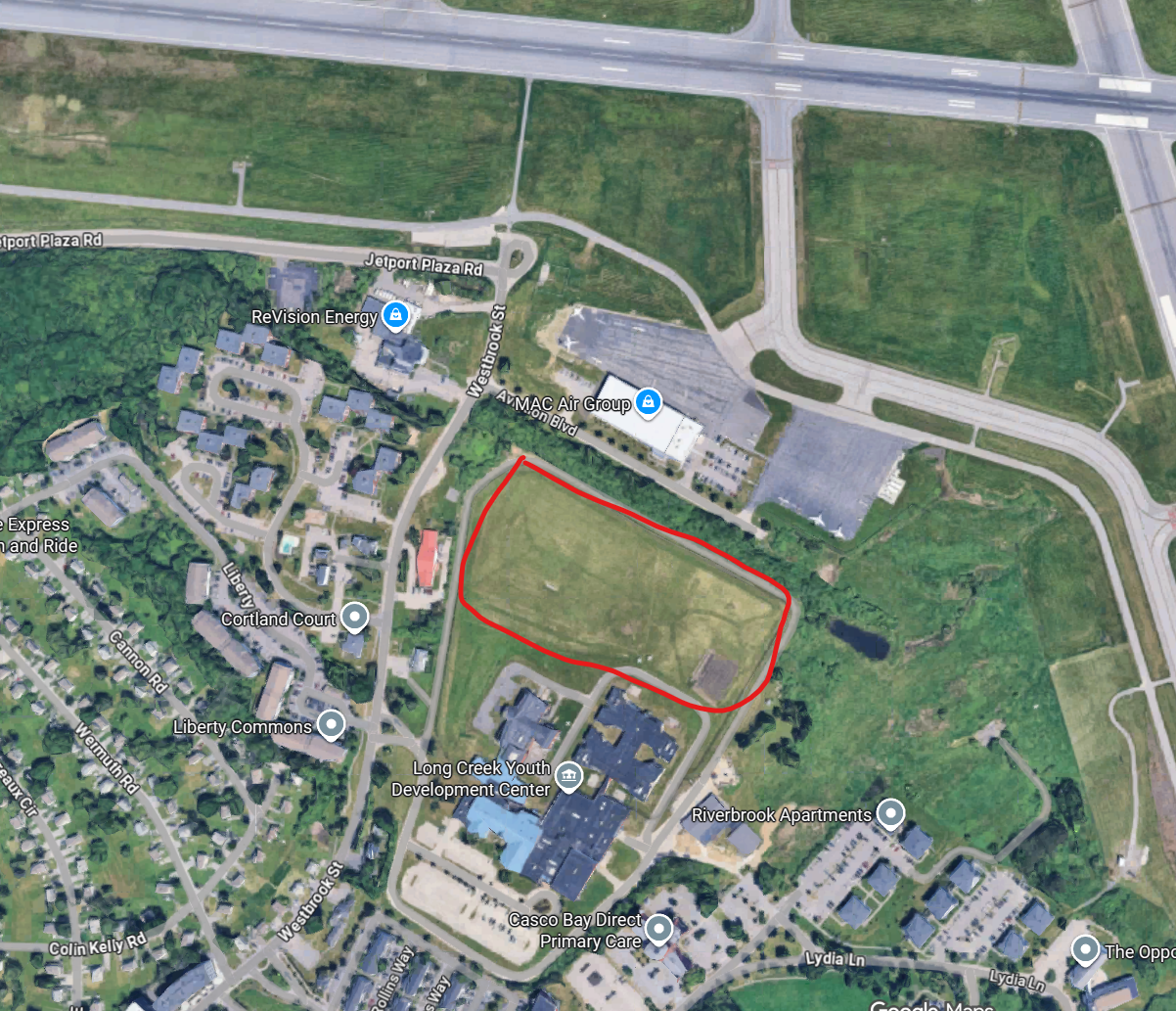
How would it get to the terminal? Via a tunnel? Tram via jetport access road?If the State ever decides to close the Long Creek youth center, that could be a feasible location for an overflow lot with a shuttle going directly over to the terminal. It'd be a much better option than the Pink Lot on the other side of the Turnpike, where the shuttle has to navigate through city traffic and four traffic lights. As the crow flies, it's also 1/3 of the distance from the terminal compared to the Pink Lot.
View attachment 67926
NR2Portland
Active Member
- Joined
- May 18, 2022
- Messages
- 458
- Reaction score
- 1,368
Two of those circles are paving over butterflies and ants!! How dare you!
T
Tom Nevers
Guest
I walk between the PTC and PWM. I’d prefer to bike it and would do so if PWM installed a bike share station.Does anyone ride a bike to the airport to catch a flight?
Dr. StrangeHat
Active Member
- Joined
- Sep 13, 2012
- Messages
- 951
- Reaction score
- 1,264
How would it get to the terminal? Via a tunnel? Tram via jetport access road?
Via monorail, of course! There's no other option to consider!
M
markhb
Guest
Is there such a thing as a hovercraft or air boat version of a duck boat? The river is too shallow for a full draught boat, but an access road from the old weather radar site to the water could make a ferry of sorts work between the PTC and the Jetport.
In case you haven't noticed, I'm a big proponent of water transit
In case you haven't noticed, I'm a big proponent of water transit
NR2Portland
Active Member
- Joined
- May 18, 2022
- Messages
- 458
- Reaction score
- 1,368
We are still seeing 16 overnight aircraft on a random Tuesday night in late October. The Jetport should advertise the convenient lawn parking in the Stroudwater neighborhood, lovely foliage will cover your car upon your return!