
czsz
Senior Member
- Joined
- Jan 12, 2007
- Messages
- 6,043
- Reaction score
- 9
Would it be fair to say all the Modernists you admire are probably well versed in the Classics and those who are responsible for the junk forgo the Classics entirely?
I wouldn't.


Would it be fair to say all the Modernists you admire are probably well versed in the Classics and those who are responsible for the junk forgo the Classics entirely?
Yeah, that didn't get much response. Don't even know where to find it anymore.I seem to remember you doing a rather lengthy post about Classicism. In in you showed a few examples of thoroughly Modern buildings that still (secretly?) followed Classic form.
Sure.Would it be fair to say all the Modernists you admire are probably well versed in the Classics...
No, the converse doesn't hold, as the Albany Mall illustrates....and those who are responsible for the junk forgo the Classics entirely?
That ... yes.Kind of a "you need to know the rules before you can break them" sort of thing?


Again, the problem is Modernism. You have to be super, super smart to make it yield paydirt. If you know how to do a classical building, you don't have to be a genius to come up with something satisfying. Ornament goes a long way towards pleasing people, and Modernism is the only style that forbids it. I bet Pete Sampras could beat you even if he were playing in handcuffs --but your local tennis pro couldn't.

Their building?s tectonic components are the structural and mechanical systems, and there?s precious little else to this building (except glass infill where the structure isn?t). The structural materials are brick and two kinds of concrete: poured-in-place and precast, which has a different nature.
And here?s a surprise: in their reductionist zeal, they made the upper levels? structure double as the mechanical system. Concrete ducts !! You can see them clamber up the building?s outside; that?s what those massive cement fins are that function ?decoratively? at the upper levels, like colossal dentil molding. Simultaneously they serve as the building?s structure and enclosure. To synthesize, to hang together, to do more with less.
Then you end up with what Venturi called a Duck:...but what happens when the architecture (the shapes, and lines, and forms) actually turn into the ornament?
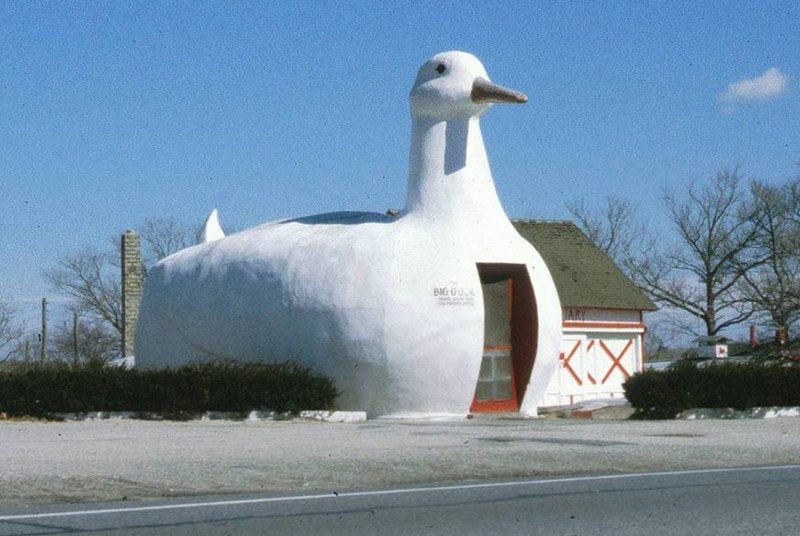
Well, actually it is. Being a Duck is Modernism's only access to ornament. The whole building becomes ornament. Boston has excellent examples in City Hall, the Carpenter Center and the ICA.It's not modernism, because modernism isn't ornamental.


ablarc said:...the Deco Style. It's still modern, it's due for a revival, and its vocabulary is rich enough to satisfy both journeyman and genius.
It also makes great cities.
Then you end up with what Venturi called a Duck:
By contrast, the duck is a building that has morphed into an ornament, where the decoration is the building. The "architectural systems of space, structure and program are submerged and distorted by an overall symbolic form...building-becoming-sculpture we call the duck in honor of the duck-shaped drive-in, 'The Long Island Duckling'". The duck no longer feels or looks like it is a building, because the key structural elements are concealed within its overall, ornamental form. The shape of the external appearance of the building has "submerged" and "distorted" its internal structures and function - the form has superseded the function.
http://www.usp.nus.edu.sg/writing/folio/vol2/duck1.html
http://en.wikipedia.org/wiki/Big_Duck
Well, actually it is. Being a Duck is Modernism's only access to ornament. The whole building becomes ornament. Boston has excellent examples in City Hall, the Carpenter Center and the ICA.

 . I'll check out The International Style next.
?The City in History? by Lewis Mumford: a splendidly-written and erudite history of urbanism and urbanity. The chapters on Rome (Chapter 8), the Middle Ages (Chapter 10), and the New Stone Age (Chapter 1) are particularly good.What reading would you suggest on urbanism and architecture?
Sho'nuff. A beauty that caused its architect a lifetime of pain and conflict. But definitely a work of genius.Moderism's greatest duck is a swan.
(But scratch the Oscar Mayer wienermobile.)
Another one: "Suburban Nation" by Andres Duany: true, entertaining and full of facts. Essential reading if you want to know what's going on in urban planning.What reading would you suggest on urbanism and architecture?
A beauty that caused its architect a lifetime of pain and conflict.
...the closer one gets, the worse it looks. The brown underwear in that shot reminds me of City Hall's unseemly bricks.
The Economist said:What he wanted for Sydney was the effect he had noticed when tacking round the promontory at Elsinore, of the castle?s piled-up turrets against the piled-up clouds and his own billowing white sails; the liberation he had felt on the great platforms of the Mayan temples in Mexico, of being lifted above the dark jungle into another world of light; the height and presence of Gothic cathedrals, whose ogival shape was to show in the cross-sections of the Sydney roof-shells; and the curved, three-dimensional rib-work of boat-building, as he had watched his own father doing it at Aalborg. The load-bearing beams of the Opera House shells he called spidsgattere, in homage to the sharp-sterned boats his father made.
