Roads and Highways General Development Thread

This bill isn't really to do studies. It's to force DOT and MPOs to actually implement policies based on what we already know. This is using those past studies to actually do something. This looks broadly good (but maybe other people know state gov better could chime in). This is the meat of the bill:


No metropolitan planning organization shall approve a Regional Transportation Plan or Transportation Improvement Program developed pursuant to 23 CFR Part 450, and the department shall not approve a Statewide Transportation Improvement Program, unless the plan or program, including any mitigation measures interlinked to individual projects within the plan or program, provides a reasonable pathway to compliance with the greenhouse gas emissions sublimits for the transportation set pursuant to section 3A of chapter 21N and to the statewide vehicles miles traveled reduction goals established by the secretary pursuant to section 81 of this chapter.

My reading of this was that it is focused on transportation policy/planning, not land use or tax policy, where a huge amount of the possible VMT reduction is hiding.
 
I'm not sure I agree. Just as a general principle, I think bike lanes should go where people need to go, and a bunch of places people need to go are on Eastern Ave. We generally don't tell drivers they can't use a street because there's a nearby, parallel street. Specifically for this stretch, I think skipping bike lanes would be a problem. I'm trying to imagine how someone on a bike would get from the Northern Strand to anything on the south side of Eastern Ave. (businesses or side streets). If there aren't bike lanes on Eastern, it would mean a lot of really circuitous routes/biking in traffic/biking on sidewalks, etc. That's especially true because Eastern has such long blocks.

But there are space constraints, and I'm always in favor of better sidewalks, like you say. I don't really know what will fit.
I agree that bike lanes should be on major streets. On Google Earth, in the western part of the project I measure a width of about 56 ft for the existing Eastern Ave right-of-way (ROW) width, including the existing sidewalks. So, with two 12 ft lanes for vehicular traffic, that leaves 16' each side of the road for an 8' wide sidewalk and an 8' wide protected bike lane, on each side of the road. However, on the eastern segment of the project, Eastern Ave's ROW is only 50' wide (including existing sidewalks), so with two 12' lanes for traffic, that leaves only room for a 6' wide sidewalk and a 6' wide bike lane on each side of the road. Also, looking at Google street view, there is some on-street parking going on along the north side of the street which would have to be eliminated.
 
My reading of this was that it is focused on transportation policy/planning, not land use or tax policy, where a huge amount of the possible VMT reduction is hiding.
I see. Yes, that's fair, this is mostly focused on transportation planning. But it does touch on land use a bit. This says one of the possible policies DOT should be considering for reducing VMT for new projects is "land use, including but not limited to residential and other density increases, mixed-use development, and transit-oriented development." But that's number 7 on a list of 8, and the rest are transportation oriented, for sure.

Transportation and land use really go hand in hand. We have a Department of Transportation, but we don't really have a state Department of Land Use. The state does regulate land use, but across probably dozens of departments. For reducing VMT, it makes sense to stick this in DOT, and it is good the law would have them consider land use. I don't know, this all seems basically positive.
 
I'm totally with you that it looks like a net positive! It just feels performative because there is SO much more that could be done for VMT reduction...

We're not even doing pilot studies on VMT-based taxes like a lot of other states.
 
I'm totally with you that it looks like a net positive! It just feels performative because there is SO much more that could be done for VMT reduction...

We're not even doing pilot studies on VMT-based taxes like a lot of other states.

That's what it sounds like they are talking about. Climate whatever is just their buzzword for how they are going to sell the idea.

I am seeing far too many Teslas out there so perhaps this is also about getting something out of EVs.
 
12 ft lanes
Curious about this. I know there's a push in some places to get away from 12 ft travel lanes. They're fine for highways, but on city streets they just encourage speeding. Any idea what the regulations would be for Eastern Ave? And besides regulations, is there some reason this street specifically couldn't use 10 or 11 ft travel lanes?
 
Curious about this. I know there's a push in some places to get away from 12 ft travel lanes. They're fine for highways, but on city streets they just encourage speeding. Any idea what the regulations would be for Eastern Ave? And besides regulations, is there some reason this street specifically couldn't use 10 or 11 ft travel lanes?
Great point. I looked up the AASHTO guidance on lane width, and I found this verbiage via AI: "AASHTO guidance, primarily from "A Policy on Geometric Design of Highways and Streets" (the "Green Book"), recommends 12-foot (3.6 m) lanes as the standard for high-speed, high-volume, and interstate highways. While 12-foot lanes are preferred, 10 to 11-foot (3.0 to 3.3 m) lanes are acceptable in urban, low-speed, or constrained areas, and 9-foot (2.7 m) lanes may be used on low-volume roads."
I was thinking 12' lanes on Eastern Ave because I had set up only one lane in each direction, with no center turn lane, so I was thinking 12' lanes might be appropriate in that tight of a situation. But I could see putting in two 11' lanes instead, based on the AASHTO guidance cited above. This would open up an extra foot for the bike lane or sidewalk on each side of the roadway.
 
Curious about this. I know there's a push in some places to get away from 12 ft travel lanes. They're fine for highways, but on city streets they just encourage speeding. Any idea what the regulations would be for Eastern Ave? And besides regulations, is there some reason this street specifically couldn't use 10 or 11 ft travel lanes?

Only major E/W route in that region of the metro area besides 16, and the commercial/industrial along some of this area seems to generate a decent volume of heavy truck trips. Not sure if narrower streets are ideal if you're expecting heavy truck trips to be on the corridor regardless.
 
Great point. I looked up the AASHTO guidance on lane width, and I found this verbiage via AI: "AASHTO guidance, primarily from "A Policy on Geometric Design of Highways and Streets" (the "Green Book"), recommends 12-foot (3.6 m) lanes as the standard for high-speed, high-volume, and interstate highways. While 12-foot lanes are preferred, 10 to 11-foot (3.0 to 3.3 m) lanes are acceptable in urban, low-speed, or constrained areas, and 9-foot (2.7 m) lanes may be used on low-volume roads."
I was thinking 12' lanes on Eastern Ave because I had set up only one lane in each direction, with no center turn lane, so I was thinking 12' lanes might be appropriate in that tight of a situation. But I could see putting in two 11' lanes instead, based on the AASHTO guidance cited above. This would open up an extra foot for the bike lane or sidewalk on each side of the roadway.
MassDOT's Project Development and Design Guide is what we use for the design of local roads, being based on AASHTO's Green Book. Roadway design width is based on a host of factors including design speed, setting (urban, suburban, rural), classification (arterial, collector, local), along with potential users such as bicycles.
 
MassDOT's Project Development and Design Guide is what we use for the design of local roads, being based on AASHTO's Green Book. Roadway design width is based on a host of factors including design speed, setting (urban, suburban, rural), classification (arterial, collector, local), along with potential users such as bicycles.
Here's the lane width table from MassDOT's Project Development and Design Guide. It's adapted from the AASHTO Green Book.
I'm leaning towards 12' lanes for Eastern Ave because of the heavy truck traffic, plus no center turn lane (under the scenario with protected bike lanes on both sides).

1776366962809.png
 
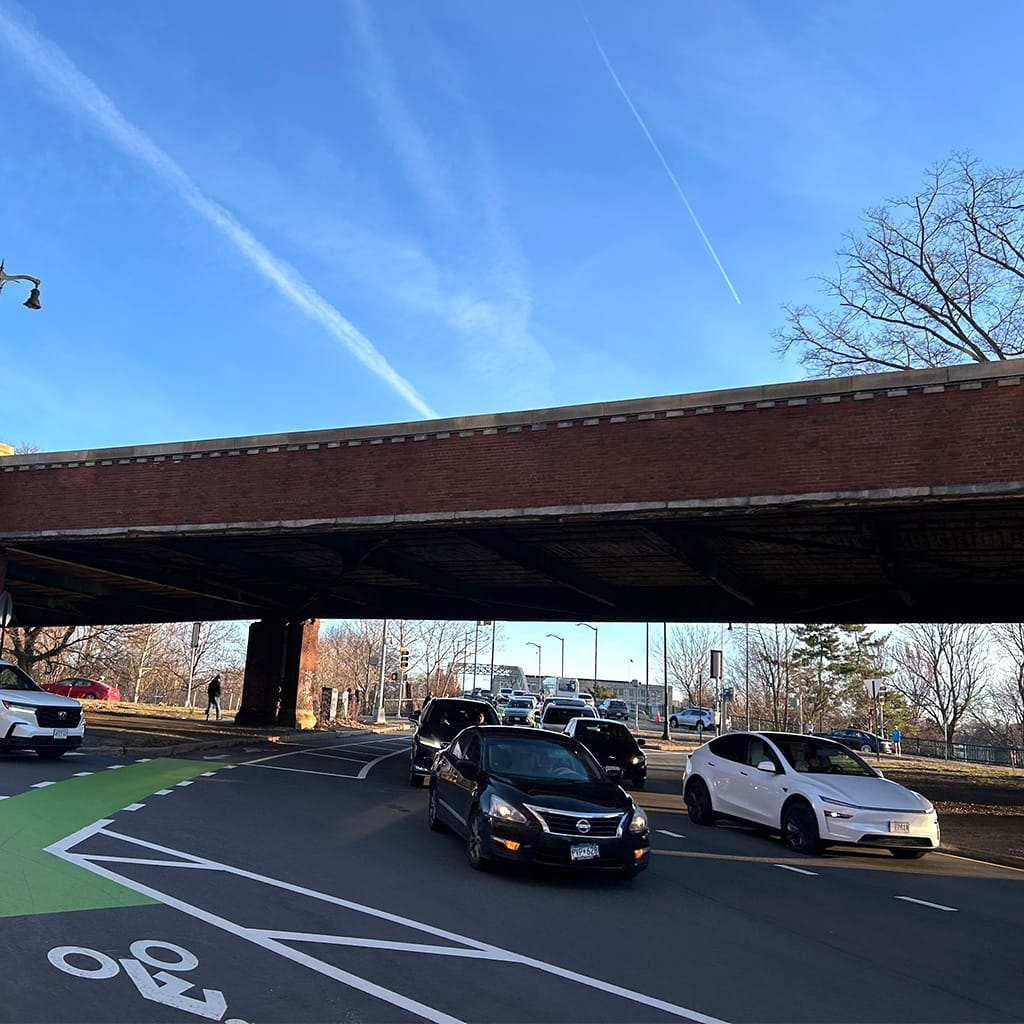
On the Reid Overpass:

 
I agree that bike lanes should be on major streets. On Google Earth, in the western part of the project I measure a width of about 56 ft for the existing Eastern Ave right-of-way (ROW) width, including the existing sidewalks. So, with two 12 ft lanes for vehicular traffic, that leaves 16' each side of the road for an 8' wide sidewalk and an 8' wide protected bike lane, on each side of the road. However, on the eastern segment of the project, Eastern Ave's ROW is only 50' wide (including existing sidewalks), so with two 12' lanes for traffic, that leaves only room for a 6' wide sidewalk and a 6' wide bike lane on each side of the road. Also, looking at Google street view, there is some on-street parking going on along the north side of the street which would have to be eliminated.
I also believe that bike lanes should be on main roads, but Eastern may provide a bit of opportunity for a compromise due to the proximity of US Bicycle Route 1/East Coast Greenway. Because the path is one block off Eastern, it may be possible to do a bike lane along the southern side of Eastern Ave, one-way heading east, and provide ample connection points back to the larger path for westbound travel. There would need to be an increased signage/wayfinding/striping budget to ensure direction and order is maintained, but this could provide a happy medium. We do tell drivers all the time which direction they can travel on a street, so I think it isn't out of the realm of possibility to propose such a compromise.
 
On the Reid Overpass:

From the article: "As with the Allston highway project, Bowker Overpass, McGrath Highway and countless other hack jobs, safety, climate change and community wishes are secondary to increasing vehicle throughput at any cost."
The traffic models will almost always show the need for multi-lane roads and overpasses on projects like this. We need to start considering traffic models as just one of several factors, and not the overruling factor. Unfortunately, MassDOT has failed to do this.
 

Back
Top