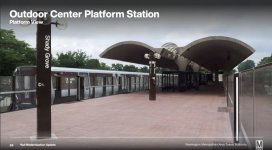
Platform screen doors.

I don't think we'll ever get full height platform doors. I believe, and I could be wrong, that the T's system relies at least in part on the piston effect of trains traveling to ventilate stations and tunnels. Plus, our stations are old and funky - enough that I suspect the most we should expect are partial height doors that don't seal & are open at the top - granted, that can be anything from half height to like, 8ft. In the US, I'd say the biggest current effort to retrofit PSDs is down at WMATA - their Red Line is slated to get them at 20/27 stations as a part of their effort to automate it to GOA4. (Their existing automatic train operation is GOA2.) I don't believe there's a breakdown of what amount of it is CBTC signal upgrades vs the station retrofits, but that effort is budgeted for $913M.
They're common in new builds because there is near zero reason not to build your new line automated, and if you're doing that then PSDs make it way easier. I would hestiate to say that retrofits are becoming common though. Retrofitting automation/PSDs is something that even cities like Paris have stumbled on, and those projects have tended to be expensive and prone to cost overruns. PSDs in particular often get omitted from automation retrofits because building them into stations that were never designed for them is really hard.

But there are alternatives.
View attachment 75645

New York's fixed barriers have been quite successful, especially for cost obviously.

View attachment 75646

And Sofia uses an (as far as I can tell) unique system with rolling screens protecting the length of the platform.

I agree the NYC style fence is a good cheap interim step.

That Sofia system is generally similar to quite a few I've seen in East Asia, where that lifting cable style is decently common at outdoor stations on Japanese commuter lines, and particularly the Chinese HSR system. I wouldn't be surprised if Sofia procured its system from an Asian supplier. That said, it looks a lot "denser" than the ones I've seen in Asia, which usually have significantly fewer strands where a determined individual could make their way through, but certainly a good option for retrofits to our system here, where without CBTC stopping positions aren't exact.
 

Attachments

  • Screenshot_20260914_105136_Chrome.jpg
    Screenshot_20260914_105136_Chrome.jpg
    347.6 KB · Views: 34
  • Screenshot_20260914_105127_Chrome.jpg
    Screenshot_20260914_105127_Chrome.jpg
    285.2 KB · Views: 35
Last edited:
where without CBTC stopping positions aren't exact.
That was clearly the motivation in Sofia, as I watched a few trains go by and none of them stopped quite at the same spot. I believe there's also some rolling stock heterogeneity which likely contributed to the decision.

The main reason I wouldn't necessarily expect to see it here is accessibility. Maybe there are better ways of doing it that I didn't see, but the implementation in Sofia generally had pillars placed across the platform, and sometimes a train door would end up (partially) behind them. Maybe there are ways to avoid that but stringing a long bit of (essentially) thin wire the whole length of a train car seems difficult.
PXL_20240813_131148450.jpg
 
It wouldn't cost a billion dollars if we could behave and not hire consultants to manage consultants.
 

Back
Top